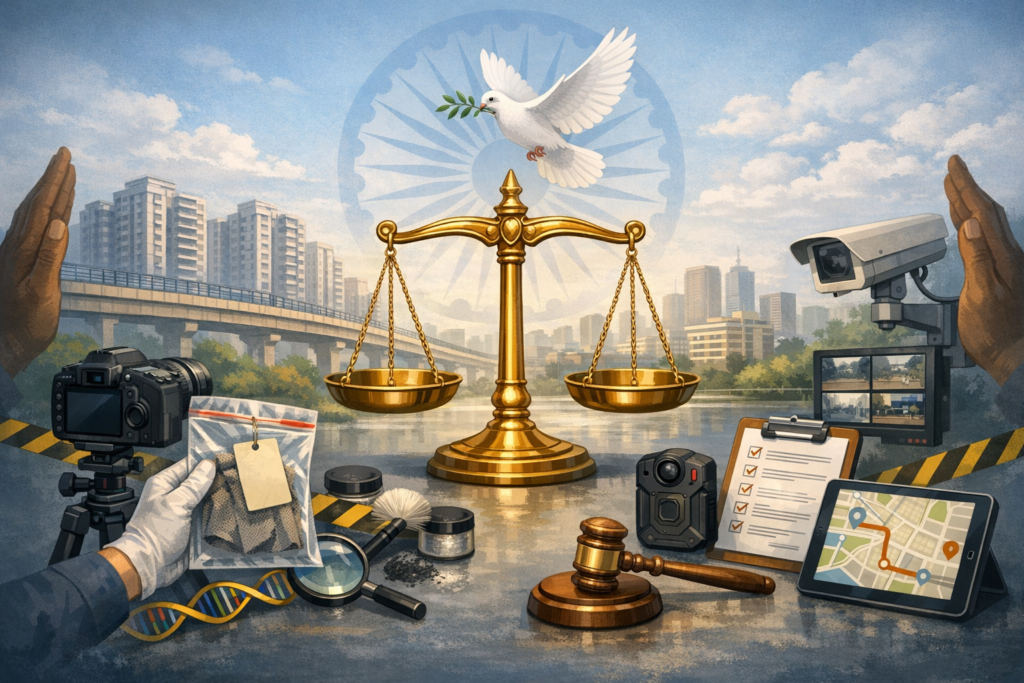
On April 6, 2026, a provincial-level Hindu Rashtra Sammelan in Shivamogga (Karnataka), convened by the Hindu Janajagruti Samiti (HJS), called for “Hindu Ideology-Based Governance” and reiterated aspirations often framed as “Hindu Rashtra” in Bharat. This development invites a rigorous, constitutional, and ecumenical analysis of what a values-driven public philosophy could mean for a plural society composed of Hindus, Buddhists, Jains, Sikhs, and communities of every other faith and conviction. Read in a scholarly and nation-building spirit, the Shivamogga deliberations can be interpreted not as theocratic intent, but as a call to embed governance with dharmic ethics—pluralism, compassion, duty, and accountability—aligned fully with India’s Constitution.
To evaluate such a call responsibly, the inquiry must first move from polemics to principles. The operative category for policy design is best understood as “dharmic governance,” an inclusive civilizational frame grounded in shared Indic ideals: Dharma (ethical order), Ahimsa/Karuna (non-violence/compassion), Anekantavada (intellectual humility and many-sidedness), and Miri-Piri (harmonizing temporal responsibility with spiritual discipline). These are not sectarian claims; they are civilizational values that can serve all citizens, irrespective of belief.
Constitutional fidelity is the non-negotiable anchor of any such program. India’s Preamble—Justice, Liberty, Equality, and Fraternity—together with Fundamental Rights (Articles 14–32) and the Directive Principles of State Policy (Part IV), define the normative boundaries within which ethical governance must operate. Article 25’s protection of freedom of conscience and the right freely to profess, practice, and propagate religion—subject to public order, morality, and health—codifies the plural ethos often articulated as Sarva Dharma Sambhava. Any dharmic public philosophy must therefore strengthen, not weaken, the secular, democratic, and republican character of the State.
Within this constitutional ambit, the phrase “Hindu Rashtra” has often carried diverse meanings in public discourse—from civilizational identity to political program. An academically robust and socially unifying reading treats it as a cultural-civilizational aspiration to reflect dharmic ethics in public life, rather than as a confessional State model. In this constructive interpretation, the State remains neutral among faiths even as it draws on the ethical vocabulary of Dharma to advance human dignity, social harmony, and good governance.
Dharmic governance can be articulated through interlocking pillars that translate Indic wisdom into actionable, constitutional policy. The first pillar is pluralism and freedom of conscience. Practically, this entails safeguarding individual and institutional religious freedoms (Articles 25–28), promoting interfaith dialogue, preventing hate crimes, and nurturing civic spaces where Hindus, Buddhists, Jains, Sikhs, and others can practice, critique, and collaborate without fear or favor. Pluralism here is active—requiring policy, pedagogy, and policing that defend diversity as a public good.
The second pillar is non-violence and compassion (Ahimsa, Karuna, Daya). Social policy so conceived reduces structural violence through targeted welfare for the most vulnerable, humane criminal justice reforms emphasizing rehabilitation, and public-health systems designed around dignity. Compassion operationalized also implies responsive disaster relief, care for the elderly and differently abled, and a civil society infrastructure capable of rapid, accountable service delivery.
The third pillar is Dharma as constitutional morality and rule of law. Historically, Rajadharma demanded that the ruler act as trustee for the realm; in a modern republic, that trusteeship is vested in public institutions bound by equality before law (Article 14), due process, and transparent administration. This pillar insists on merit-based appointments, judicial independence, time-bound services, and technology-enabled transparency to reduce discretion and corruption.
The fourth pillar is decentralization and community-led service, resonant with Panchayati Raj, the Sangha’s consensual ethic in Buddhism, Jain community self-regulation, and Sikh sangat and seva. Empowering urban local bodies and gram sabhas with fiscal autonomy, participatory planning, and social-audit mechanisms cultivates responsibility at the level where citizens experience the State most directly.
The fifth pillar is social equity and the dignity of labour. This builds on the Directive Principles to pursue nutrition security, universal learning outcomes, gender justice, and opportunities for economic mobility. Programmatically, it prioritizes last-mile delivery, skills aligned to local economies, elimination of caste-based discrimination, and equal protection against religious or cultural prejudice for every Indian.
The sixth pillar is ecological stewardship, recognizing Vasudhaiva Kutumbakam and the civilizational reverence for all life. Policy priorities include river-basin restoration, air-quality standards with clear compliance pathways, biodiversity corridors, urban heat mitigation, regenerative agriculture, and a just energy transition that safeguards livelihoods while meeting climate commitments.
The seventh pillar is cultural heritage and institution management with accountability. Transparent, professional stewardship of temples, gurdwaras, monasteries, and mathas—respecting autonomy while ensuring financial probity and public benefit—can support education, healthcare, and community kitchens (such as langar) without compromising religious freedoms. Heritage protection becomes a civic enterprise, not a sectarian contest.
The eighth pillar is education anchored in critical inquiry and values. Curricula that teach constitutionalism, comparative religion, Indic knowledge systems, and scientific temper together can nurture citizens who are both rooted and rational. Pedagogy emphasizing dialogue and Anekantavada equips youth to navigate disagreement constructively while resisting absolutism.
Ninth, digital public infrastructure for ethical governance can hard-wire dharmic ideals into daily administration. Open, secure platforms for benefits delivery, grievance redressal, and participatory budgeting allow citizens to see, shape, and scrutinize the State. Interoperable data standards—implemented with privacy-by-design—enable evidence-based policy while protecting rights.
These pillars have deep historical ancestry. The Arthasastra offers a realist theory of the State (danda-niti) tempered by welfare imperatives; fiscal prudence, public works, fair taxation, and protection of productive classes are presented as ethical and pragmatic necessities. Such canons—reinterpreted within constitutional democracy—lend rigor to contemporary public finance and regulatory design.
Ashokan edicts exemplify non-coercive public ethics: exhortations against religious denigration, commitments to medical infrastructure, and protection of fauna signal a multi-faith civility underwritten by compassion. The spirit of these edicts remains compatible with a modern secular State that enables, rather than engineers, virtue through institutions and incentives.
Across dharmic traditions, Anekantavada (Jainism) models intellectual humility, the Middle Path (Buddhism) argues for balance and moderation, and Miri-Piri (Sikhism) binds public power to ethical restraint. A unifying civic doctrine drawing from these streams can cultivate moral seriousness without conferring civil privilege on any one community.
Translating principles into policy warrants a pragmatic blueprint. First, establish inter-dharmic councils at national and state levels with constitutionally literate scholars, community leaders, jurists, and administrators. Their mandate: produce non-binding white papers on pluralism, ethics in administration, and conflict de-escalation consistent with Fundamental Rights and the Directive Principles.
Second, institutionalize social equity through time-bound, measurable guarantees: universal foundational literacy and numeracy, nutrition baselines for every child and expectant mother, and skilling aligned to regional economic clusters. A public dashboard culture—disaggregated by district—should make progress visible and correctable.
Third, reform education with three layers: constitutional studies across grades, comparative ethics (Hindu, Buddhist, Jain, Sikh, and other world traditions), and scientific temper. Teacher training must emphasize free inquiry, respectful debate, and the ability to present multiple viewpoints with fidelity and fairness.
Fourth, create a heritage governance code for religious and cultural institutions that balances autonomy, transparency, and community benefit. Standardized audits, voluntary public disclosures, and best-practice exchanges across temples, gurdwaras, viharas, and mathas can raise trust and impact without State micromanagement.
Fifth, adopt a whole-of-society environmental program: city-scale heat action plans, watershed cooperatives managed by local bodies, biodiversity registers maintained by schools and community groups, and green procurement in public spending. Such initiatives fuse dharmic care for life with enforceable standards.
Debates such as a Uniform Civil Code (UCC) should proceed through consensus-building and constitutional prudence. A dharmic approach would privilege fairness, gender justice, and freedom of conscience, advance gradual harmonization where broad agreement exists, and preserve legitimate diversity where uniformity would erode rights or social peace. Procedural integrity—wide consultation, transparent drafting, and judicial review—matters as much as substantive outcomes.
Guardrails are essential. Non-discrimination in public services, speech protections with narrowly tailored, rights-respecting limits, and independent oversight of policing protect minorities and majorities alike. The architecture of remedy—fast, fair, and accessible—is the democratic expression of Dharma as lived justice.
Measurement closes the loop. Alongside GDP and poverty reduction, adopt multidimensional indicators of social trust, interfaith harmony, learning outcomes, environmental quality, and institutional responsiveness. International exemplars such as Bhutan’s holistic well-being metrics can be adapted to India’s scale and diversity without importing ill-fitting models.
Implementation benefits from phasing: pilot in willing districts, codify successful templates into model rules, and scale through fiscal incentives tied to outcomes. Civil society and faith-based organizations—Hindu, Buddhist, Jain, Sikh, and others—should be treated as partners in service delivery with transparent compacts that respect autonomy and ensure accountability.
Accounts from gatherings like the Shivamogga Sammelan often describe a blend of hope and concern: hope that civilizational ethics can elevate governance, and concern that polarization can fracture communities. When channeled through constitutionalism and empathy, that emotional energy becomes a resource for institution-building rather than a catalyst for division. Citizens consistently respond to governance that is visible, fair, and compassionate—whatever their creed.
It is therefore both possible and necessary to read calls for “Hindutva Governance” as an invitation to a wider, dharmic conversation that includes, respects, and empowers Hindus, Buddhists, Jains, Sikhs, and all other communities. The path forward is not a State of any faith, but a State of ethical purpose—rooted in Dharma, bounded by the Constitution, and animated by the conviction that unity in diversity is Bharat’s greatest strength.
Shivamogga’s message, reframed through this lens, is clear: embed public life with compassion, courage, and constitutional clarity; protect freedom of conscience while nurturing shared responsibility; and build institutions that treat every Indian with dignity. This is a vision worthy of a vast, plural civilization—at once ancient in wisdom and modern in method.
Inspired by this post on Struggle for Hindu Existence.