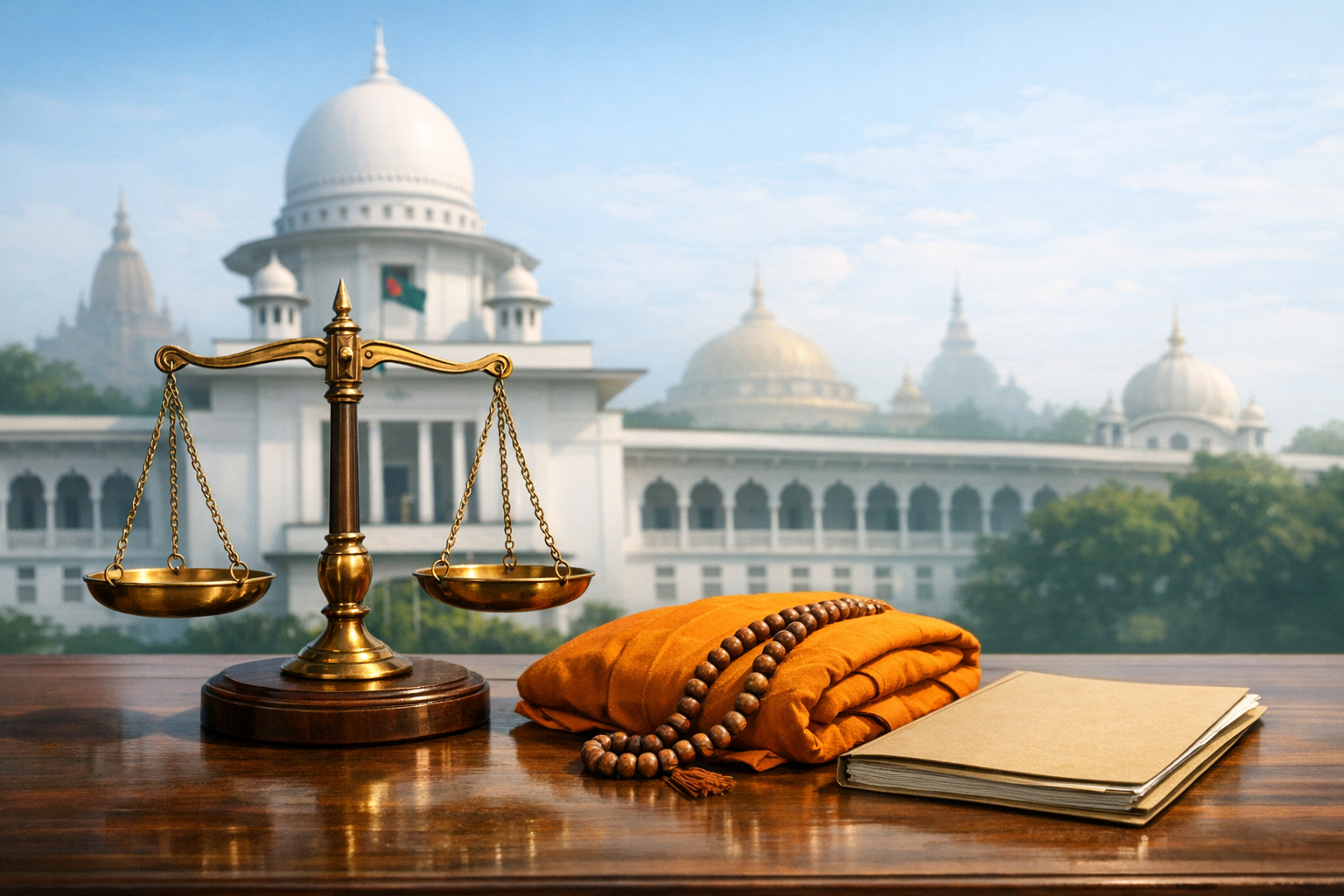
The High Court Division of the Supreme Court of Bangladesh has rejected a bail petition filed on behalf of Hindu monk Chinmoy Krishna Das, an order that has sharpened public debate over minority protection, due process, and the rule of law. Reportage dated May 10, 2026 by Upananda Brahmachari (HENB, New Delhi) signaled heightened concern across civil society, particularly within Hindu, Buddhist, Jain, and Sikh communities that share cultural and spiritual linkages in the region.
At the core of this case lies a legal question distinct from adjudication on guilt: bail is a procedural safeguard assessing necessity of pre-trial detention, not a final determination of culpability. Even so, the denial has assumed symbolic weight, intersecting with longer-running anxieties about the safety and dignity of religious minorities in Bangladesh and the perceived climate of impunity around episodic communal violence.
Bangladesh’s bail framework is principally anchored in the Code of Criminal Procedure, 1898 (CrPC), where Sections 496–498 empower courts, including the High Court Division, to exercise discretion. The judicial inquiry commonly considers the gravity of the alleged offense, the existence of a prima facie case, the risk of absconding, the possibility of tampering with witnesses or evidence, the likelihood of repetition, and the attendant public order implications. Reasoned orders are expected to balance individual liberty against legitimate state interests in investigation and prosecution.
Constitutional safeguards provide the normative canvas. Articles 27 (equality before law), 31 (protection of law), 32 (protection of life and personal liberty), and 35 (fair trial guarantees) together establish a robust expectation that pre-trial detention be justified by necessity rather than convenience. Article 41, securing freedom of religion, adds a further dimension whenever alleged facts and social reactions touch upon religious identity or practice.
Bangladesh’s international obligations reinforce these principles. As a State Party to the International Covenant on Civil and Political Rights (ICCPR), the country is bound by Article 9 (liberty and security of person; the presumption in favor of liberty pending trial) and Article 18 (freedom of thought, conscience, and religion). The spirit of the Universal Declaration of Human Rights likewise orients authorities toward necessity-and-proportionality tests whenever restricting liberty.
In practice, courts often face complex trade-offs when alleged facts or public narratives evoke communal sensitivities. Judicial discretion, while grounded in law, is frequently exercised amid pressures to contain tension, deter vigilantism, and preserve public order. This background helps explain how bail decisions in religion-adjacent cases can differ from routine outcomes, even while remaining tethered to legal standards.
For context, Hindus constitute a visible minority in Bangladesh, commonly estimated in recent censuses at under a tenth of the national population. Their presence, with historic centers such as Dhaka and the southwestern districts, contributes to a pluralistic mosaic that also includes Buddhist (notably Chakma and Barua communities in the Chittagong Hill Tracts), Jain, and Sikh micro-minorities. These dharmic traditions share cultural continuities across South Asia and have often mobilized in mutual support when security concerns arise.
Public concern about Hinduphobia and minority safety in Bangladesh is shaped by cumulative memory: post-election violence reported in 2001; attacks around 2013–2014 linked to political turbulence; the 2016 Nasirnagar incidents; and the October 2021 Durga Puja violence that spread from Cumilla to numerous districts, damaging temples and homes. Human rights monitors documented dozens of assaults during those waves, with digital rumor and incitement repeatedly acting as accelerants. Such history does not predetermine any single case, but it does inform how communities interpret new developments.
Legal risk has also evolved with information technology. Bangladesh’s Digital Security Act (now superseded by the Cyber Security Act, 2023) was frequently invoked in cases alleging hurt religious sentiments or digital incitement. While the statutory language aims to protect social harmony, rights advocates have urged tighter safeguards to prevent overbroad application and to keep bail accessible where custodial investigation is not strictly necessary.
Against this backdrop, the denial of bail to Chinmoy Krishna Das has been read by many as a signal of caution at a volatile intersection of faith and public order. Yet the legal posture remains inherently case-specific. Absent a publicly available charge sheet or a fully reasoned order, external inferences should be measured; both prosecution and defense arguments deserve precise, document-based scrutiny.
Procedurally, prosecutors in Bangladesh typically rely on the case diary and an articulation of custodial necessity, while defense counsel may emphasize strong community ties, a fixed address, lack of criminal antecedents, willingness to comply with conditions, and a low risk of interference with witnesses. Where courts perceive a credible prospect of witness intimidation or evidence tampering, bail conditions can be tightened; where the prosecution case is preliminary or largely documentary, conditional liberty is often considered a less-restrictive alternative.
Reliable national statistics on bail grant rates by offense category remain scarce, complicating efforts to benchmark decisions. A data-forward approachregular publication of anonymized bail metrics by jurisdiction and offensewould help legal practitioners, policymakers, and rights groups calibrate expectations and identify areas for procedural improvement without compromising ongoing investigations.
Comparative experience in the subcontinent underscores similar tensions. Jurisdictions influenced by the CrPC tradition wrestle with high pre-trial detention rates, crowded dockets, and uneven access to counsel. Bangladesh’s own trajectorymarked by judicial innovations and resource constraintssuggests that targeted reforms in case management, reasoned orders, and bail condition design can improve both fairness and public confidence.
Political narratives inevitably color public interpretation of sensitive cases. References to Tarique Rahman and shifting alignments within Bangladesh’s political landscape frame some commentary, but the legal obligations of the Stateconstitutional, statutory, and internationalremain consistent irrespective of the party or personality in ascendance. Centering analysis on standards rather than factions best serves those rights.
For religious minorities, the practical stakes extend beyond any single hearing. Households often recalibrate public celebrations, temple committees reassess festival risk protocols, and civil society builds quiet crisis-response networks. In Dhaka, the cultural gravitas of the Dhakeshwari Temple Dhaka symbolizes both resilience and the enduring public value of pluralism; its congregants, like many others, balance devotion with vigilant community care.
Dharmic solidarity is a crucial protective factor. Hindus, Buddhists, Jains, and Sikhssharing intertwined histories and valueshave repeatedly organized intercommunal support for legal aid, trauma care, property restoration, and youth education on nonviolent civic engagement. Such unity not only mitigates harm but also models the inclusive ethos that underpins South Asia’s civilizational heritage.
Specific legal-policy steps can narrow the gap between constitutional promise and lived security. Publishing timely, reasoned bail ordersideally with accessible summariesclarifies how courts weigh liberty and public order. Adopting prosecutorial guidelines for hate-crime elements, coupled with fast-tracked trials and witness protection, increases deterrence without sacrificing fairness. Training for investigators on evidence standards in incitement and communal-tension cases further reduces over-reliance on custodial detention.
Community-level architecture also matters. Early-warning hotlines, verified rumor-control channels, and festival safety protocols co-designed by police, temple or vihara committees, and local administrators can interrupt escalation cycles. Digital literacy campaigns that teach verification habits and de-emphasize outrage sharing are especially vital given the role of fast-moving social media content in past incidents.
At a systems level, structured cooperation among the National Human Rights Commission, bar associations, faith leaders, and district administrations can standardize best practices while remaining sensitive to local context. Periodic joint reviewspublicly reportedcreate reputational incentives for steady improvement and help reassure vulnerable communities that grievances will be heard and addressed.
International law offers both a compass and a vocabulary for reform. Alignment with ICCPR Article 9’s presumption in favor of liberty and Article 18’s protection of religion can be operationalized through bail conditions tailored to risk rather than categorical detention. Transparent engagement with United Nations special procedures and regional partners signals confidence in domestic institutions and invites constructive assistance where needed.
Ethically, reportage on cases like that of Chinmoy Krishna Das should avoid sensationalism, maintain precision on names and allegations, and respect the presumption of innocence. The narrative power of high-profile legal decisions is considerable; responsible framing helps contain secondary harms such as stigmatization, retaliatory vigilantism, or the entrenchment of communal stereotypes.
In legal terms, the present denial of bail is neither a conviction nor a prediction of eventual guilt. Bangladeshi law permits reconsideration when material circumstances change, investigations mature, or delays threaten the fairness of trial. Ensuring that such reassessment remains genuinely availablewithout undue procedural frictionprotects both individual rights and institutional legitimacy.
The wider public interest is served when courts, prosecutors, police, and community leaders collectively demonstrate that justice can be firm without being punitive, and protective without being prejudicial. Where minority security is a lived concern, visible adherence to lawful standards is itself a deterrent against those who might exploit communal identities for violence or gain.
Ultimately, the measure of progress will be fewer attacks, more successful prosecutions for targeted violence, and a legal culture that defaults to liberty under enforceable conditions. The case of Chinmoy Krishna Das, whatever its eventual merits, should catalyze improvements in transparency, evidence-driven investigation, and calibrated bail practiceoutcomes that strengthen Bangladesh’s justice system for all citizens.
For the interconnected dharmic traditionsHinduism, Buddhism, Jainism, and Sikhismthe path forward remains clear: unity in diversity, principled advocacy for minority rights, and unwavering commitment to nonviolence and lawful redress. This shared stance honors a civilizational idealVasudhaiva Kutumbakamwhile advancing practical safeguards that make pluralism real in daily life.
Inspired by this post on Struggle for Hindu Existence.