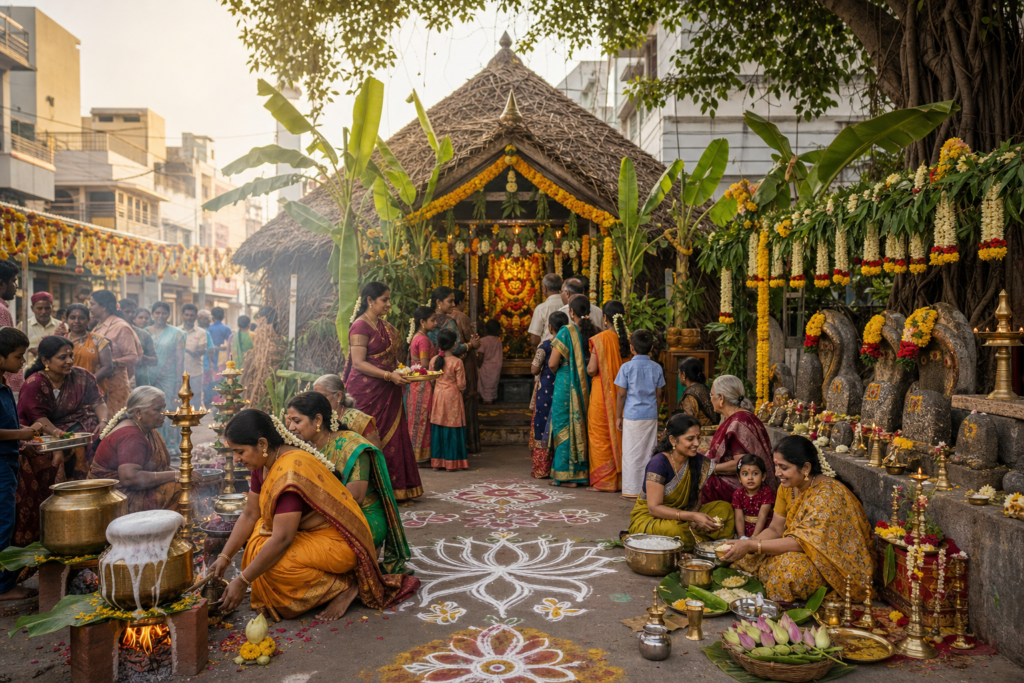
The Thousand Pillar Temple, widely identified with the historic Rudreswara (Rudreshwara) Swamy Temple in Hanamkonda, stands as one of the most important Kakatiya-period monuments in present-day Warangal, Telangana. Renowned in scholarship and among pilgrims alike, it exemplifies the region’s sophisticated temple culture and enduring spiritual life.
Situated within the Warangal urban area, the temple is a Trikutalayaan architectural plan with three sanctumsdedicated to Shiva (as Rudreshwara), Vishnu, and Surya. This triadic arrangement, central to its identity, reflects a harmonizing vision within Hindu traditions, where multiple deities and paths to the divine are held in reverent balance.
Architecturally, the temple is celebrated for its dense field of finely carved pillars, intricate stone reliefs, and balanced proportionsfeatures that collectively confer the epithet “Thousand Pillar Temple.” The workmanship characteristic of Kakatiya architecture reveals advanced stonecraft, with rhythmic pillars, delicately carved cornices, and ornate ceilings contributing to a refined interplay of light and shadow.
The historical context places the monument in the high medieval flowering of the Kakatiya dynasty (12th–13th centuries), when Hanamkonda and the wider Warangal region developed a distinctive architectural idiom. That idiom blended structural rigor with elaborate ornamentation, creating sacred spaces equally suited to ritual practice and aesthetic contemplation.
Visitors often describe a quiet immersion while moving between the three sanctumsan experience shaped by the choreography of pillars, the luminosity of the stone surfaces, and the steady cadence of temple life. One senses a living continuity: artisanship as devotion, and devotion as a shared cultural memory that bridges past and present.
In its Trikutalaya form, the Thousand Pillar Temple gently illustrates a broader dharmic ethos: unity through diversity. The simultaneous presence of Shiva, Vishnu, and Surya reinforces an inclusive vision that resonates with the wider civilizational fabric also honored in Buddhism, Jainism, and Sikhismtraditions that uphold ethical living, contemplation, and respect for many paths to truth.
As a heritage site of high cultural value, the temple underscores the importance of conservation and sensitive visitor engagement. Its setting in Hanamkonda, with ready connections across Warangal and Telangana, makes it a compelling destination for those seeking both architectural insight and the lived experience of sacred space in India.
Inspired by this post on Hindu Pad.