Goddess Lakshmi, revered as the embodiment of wealth, prosperity, and auspiciousness in Hindu traditions, has long been portrayed alongside a remarkable range of animals and birds. These living symbols—appearing in sculpture, painting, and ritual practice—illuminate evolving cultural values and devotional insights. Tracing this visual journey reveals not only the historical richness of Lakshmi’s iconography but also the shared dharmic ethos of wisdom, compassion, and responsible prosperity across Hinduism, Buddhism, Jainism, and Sikhism.
Early representations, especially from the Śuṅga, Kuṣāṇa, and Gupta eras, frequently emphasized Gaja-Lakshmi: Lakshmi with elephants pouring water from ritual vessels. This motif, prominent on temple lintels and coins, symbolizes rainfall, fertility, royal legitimacy, and orderly abundance. The elephants embody strength guided by restraint, suggesting that prosperity reaches its highest purpose when anchored in dharma and social well-being—an insight that resonates with broader South Asian cultural heritage.
Over time, regional traditions added further depth. In eastern India—particularly Bengal and Odisha—Lakshmi’s vahana is the owl (Ulooka). Far from being a mere companion, the owl functions as a didactic symbol: a vigilant seer that perceives through darkness. In devotional practice, it cautions against greed and impulsive spending while encouraging foresight and mindful wealth. During Manabasa Gurubara in Odisha, for instance, household art and ritual narratives use the owl to communicate that prosperity, to remain auspicious, must be ethical, shared, and rooted in community.
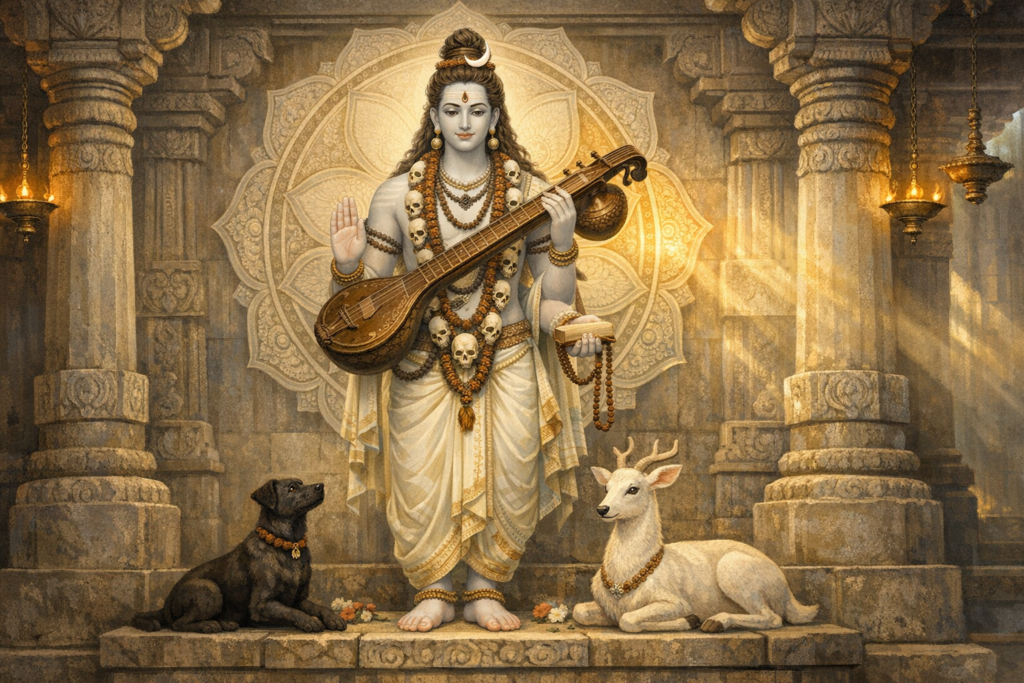
Regional art also places a gentle deer near Lakshmi in select murals and paintings. Though not a canonical vahana, the deer’s presence signals grace, serenity, and ecological harmony—qualities that refine the idea of prosperity beyond material accumulation. Across dharmic traditions, the deer evokes non-violence and contemplative calm (as remembered in the Buddhist Deer Park at Sarnath and in Jain emphasis on ahimsa). Read this way, Lakshmi’s proximity to the deer deepens an ethic of abundance guided by compassion and restraint.
Other animal associations appear as metaphors for plenitude. Cattle (go-māta) embody agrarian wealth, nourishment, and community resilience; related hymns and later liturgical traditions often praise Lakshmi as the bestower of cattle, grain, and household stability. Horses, when depicted in courtly or festive scenes, can suggest vigor and enterprise rightly directed. These images do not replace the owl or elephants but instead widen the semantic field of prosperity to include sustenance, mobility, and social responsibility.
Mythic memory further strengthens these associations. In narratives of samudra-manthana (the churning of the ocean), Lakshmi arises from the cosmic waters amid aquatic life, lotuses, and celestial beings. Coastal artistic vocabularies sometimes echo this maritime inheritance with fish and wave motifs, linking wealth to cyclical rhythms of nature, trade, and stewardship. The message is consistent: abundance flows from harmony—with seasons, society, and the sacred.
Across the subcontinent, these symbols enrich everyday devotion. During Diwali and Lakshmi Puja, families decorate entrances with motifs of elephants and the owl, narrating their meanings to younger generations. The practice fosters a living pedagogy in which prosperity is celebrated, questioned, and refined—inviting vigilance (owl), grace (deer), strength with restraint (elephants), and communal care (cattle). In this way, household ritual becomes a bridge between heritage and contemporary life.
Viewed through a dharmic lens inclusive of Hinduism, Buddhism, Jainism, and Sikhism, Lakshmi’s animal associations invite unity around shared virtues: wisdom, moderation, mutual aid, and ethical growth. Symbols are not fixed dogma; they are enduring educators. From deer to owl, from elephants to cattle, each presence amplifies a single insight—true prosperity thrives where inner clarity, social responsibility, and ecological balance meet.
Taken together, the evolution of animals and birds in Lakshmi’s iconography forms a coherent, compassionate vision of wealth. It encourages households and communities to cultivate abundance that is inclusive, sustainable, and spiritually aligned. The timeless appeal of these images lies in their power to make ethical prosperity both thinkable and practicable in daily life.
Inspired by this post on Hindu Blog.