
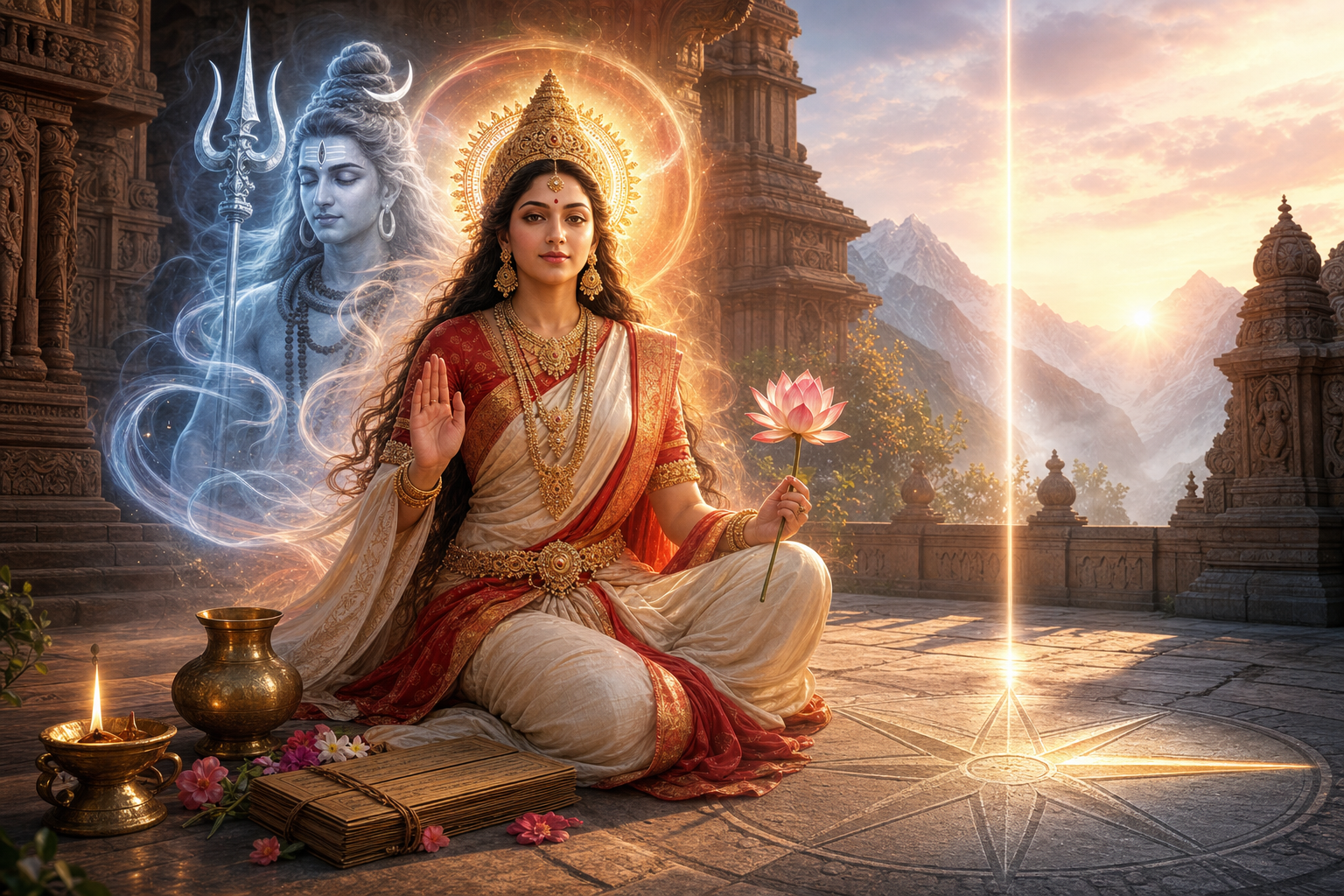
A visitor entering a Hindu temple may notice that the northeast is treated with unusual care. A niche may hold a serene form of Shiva, a directional guardian may appear among the exterior sculptures, or the corner may remain deliberately open and ritually pure. Behind these architectural choices stands the figure of Isana Shiva, and beside—or, in a deeper theological sense, within—his power stands Goddess Isani. Although Ishani Devi is not as widely discussed as Durga, Parvati, Kali, or Lalita, her name opens a remarkably rich field of Shaiva theology, Shakta philosophy, Sanskrit language, sacred geography, temple iconography, and devotional practice.
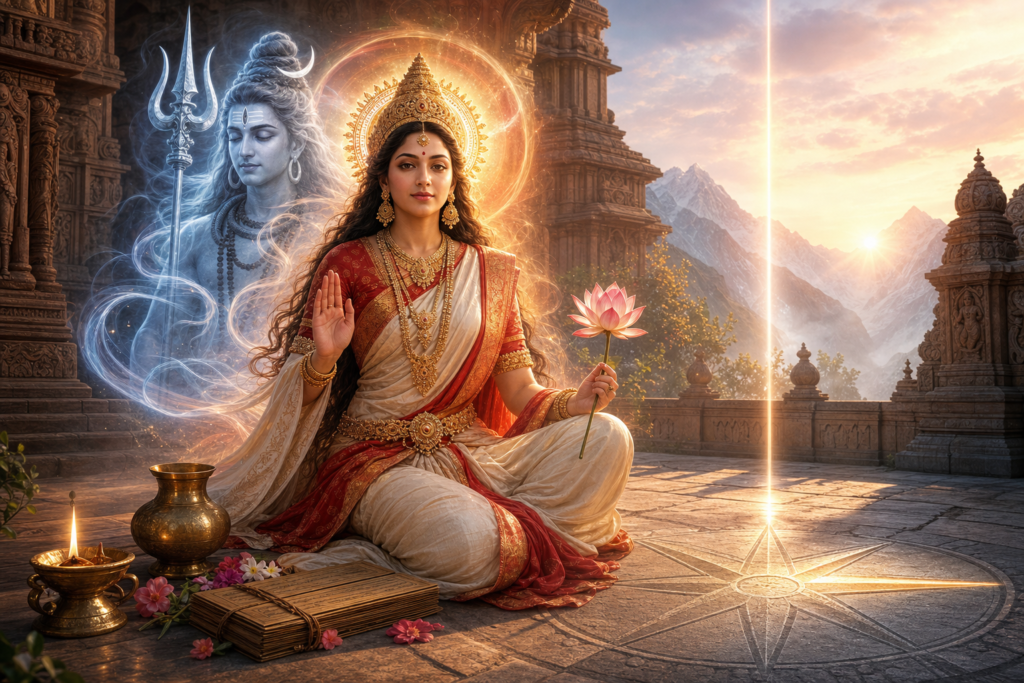
Goddess Isani, more precisely transliterated as Īśānī and commonly spelled Ishani, is understood as a name or manifestation of the Goddess, especially Parvati, Durga, Yogamaya, or the Shakti of Isana. Her identity is therefore relational without being secondary. In Shaiva language, she is the effective power of a form of Shiva associated with sovereignty, knowledge, transcendence, and the northeast. In Shakta interpretation, she can be approached as the sovereign Goddess whose power enables every divine function attributed to Isana. These two readings differ in emphasis, but both recognize that consciousness and power cannot be separated in living religious experience.
Goddess Isani at a glance
Isani is best understood as a sacred name with several overlapping meanings rather than as a deity restricted to one universally standardized image or mythology. She appears in Sanskrit sources as a designation of the Goddess, occurs among named forms of Durga, and belongs to the wider semantic world of Isana and Ishvara. Theologically, the name conveys ruling power, divine agency, and feminine sovereignty. Directionally, it evokes the northeast, called īśāna or īśānya in many ritual and architectural contexts. Devotionally, it brings the worshipper into the inseparable relationship between Shiva and Shakti.
The description “Goddess of the Northeast” is meaningful, but it requires precision. In the standard system of directional guardians, the formal northeast regent is the masculine Isana, a Shiva-related deity. Isani is his feminine counterpart or Shakti and is also an independent name of the greater Goddess in several texts. Consequently, she should not automatically be imagined as a separate female directional guardian with one fixed appearance in every region. Hindu textual, ritual, and artistic traditions preserve multiple classifications, and their categories must be distinguished before they are interpreted together.
The Sanskrit name Īśānī and its meaning
The name Īśānī is related to the Sanskrit verbal root īś, which conveys ruling, possessing, exercising power, or being capable. From the same linguistic family come terms such as Īśa, Īśāna, Īśvara, and Īśvarī. Īśāna can mean a lord, ruler, or sovereign and functions as a name of Shiva. The feminine formation Īśānī accordingly carries the sense of a female ruler, sovereign lady, or the feminine power associated with Īśāna. The name does more than identify a divine spouse: its grammar itself communicates authority.
The conventional English spelling Ishani represents the Sanskrit ईशानी, while Isani is a simplified spelling that omits the English digraph used for the sound ś. The academically precise form, Īśānī, marks both long vowels and the palatal sibilant. It is approximately pronounced “Ee-shaa-nee,” with three clear syllables. Ishani, Isani, Eeshani, and regional-script equivalents can refer to the same sacred name, although similar-looking words should not be treated as identical without examining their original spelling and context.
The title “sovereign” is therefore not merely decorative. It reflects the linguistic field of mastery and power surrounding the name. Yet sovereignty in this theological setting should not be reduced to political domination. It can signify mastery of knowledge, the capacity to manifest, protection of ordered space, and freedom from limitation. For a devotee, Ishani Devi may represent the quiet authority required to turn awareness toward wisdom. For a theologian, she represents the power through which divine consciousness becomes effective.
The textual record: where Isani appears
The sources associated with Isani belong to different historical and theological layers. Vedic passages illuminate the masculine Isana; Puranic texts explicitly name Īśānī as a form of the Goddess; Tantric and ritual literature places the name within more technical systems of Shakti. These materials should not be flattened into a single biography. Puranas are also layered compilations preserved in multiple recensions, so chapter numbering and wording may vary between editions. A careful account therefore identifies what each passage actually establishes.
The early foundation is the sacred status of Isana. The Taittiriya Aranyaka, associated with the Krishna Yajurveda, contains the celebrated expression “īśānaḥ sarvavidyānām īśvaraḥ sarvabhūtānām,” praising Isana as lord of all forms of knowledge and lord of beings. This is a masculine invocation and does not by itself describe a goddess named Isani. It is nevertheless important because it establishes the theological vocabulary of knowledge, lordship, and transcendence from which later Shaiva understandings of Isana—and relational readings of Isani—develop. The textual setting can be consulted through the Government of India’s Vedic Heritage Portal.
A direct and significant reference occurs in the Bhagavata Purana 10.2.11–12. In the narrative surrounding Krishna’s birth, Yogamaya is told that people will worship her under numerous names. The list includes Durga, Bhadrakali, Vijaya, Vaishnavi, Chandika, Maya, Narayani, Īśānī, Sharada, and Ambika, among others. In this passage, Isani is not confined to the role of a directional consort. She is one name within the many-named identity of Yogamaya, demonstrating that the epithet circulated across a broader Goddess theology. The passage is available in the Bhagavata Purana text and translation.
The Shiva Purana, in the Rudra-samhita’s Sati-khanda, provides another explicit witness. During the march associated with Virabhadra and the destruction of Daksha’s sacrifice, Mahakali is accompanied by nine Durgas: Kali, Katyayani, Īśānī, Chamunda, Mundamardini, Bhadrakali, Bhadra, Tvarita, and Vaishnavi. This list differs from the nine Navadurga forms most familiar in contemporary Navratri observance. The variation is not an error; it shows that Sanskrit traditions preserved more than one grouping of nine goddesses. In this narrative, Isani belongs to a forceful protective and corrective manifestation of Devi. The relevant verses appear in the Shiva Purana, Rudra-samhita 2.2.33.11–12.
The Lalitopakhyana, transmitted within the Brahmanda Purana, offers a more technical ritual context. In its discussion of alphabetic powers, Īśānī occurs in an ordered series of Shaktis corresponding to Sanskrit vowels. The name is associated there with the long vowel ī. This placement belongs to the Tantric understanding that speech is not an inert collection of sounds: each phoneme is a form of power, and the alphabet can be mapped onto the body, mantra, and cosmos. Isani consequently appears not only as a mythic goddess but also as a subtle linguistic potency. The sequence is preserved in the Lalitopakhyana’s account of the Varna Shaktis.
Taken together, these passages support three carefully framed conclusions. First, Īśānī is a genuine scriptural name of the Goddess rather than a purely modern invention. Second, the name is not limited to one narrative identity: it can designate Yogamaya, appear among forms of Durga, and function within a ritual alphabet of Shakti. Third, the surviving evidence does not establish one uniform, pan-Indian Isani cult with a single image, festival, vehicle, or independent mythology. Her importance lies precisely in the way one name connects several levels of Hindu thought.
Isana in the directional system of the Ashtadikpalas
The Ashtadikpalas are the eight guardians of horizontal space. A commonly encountered arrangement places Indra in the east, Agni in the southeast, Yama in the south, Nirrti in the southwest, Varuna in the west, Vayu in the northwest, Kubera in the north, and Isana in the northeast. These deities turn geography into sacred order. Their presence around a shrine establishes that the sanctum is not an isolated chamber but the center of an ordered cosmos extending in every direction.
Isana’s placement in the northeast is one of the most stable features of this system. The northeast may accordingly be called the Isana corner or īśāna-koṇa. In temple sculpture, the guardian can be marked by Shiva-related features such as matted hair, a third eye, a crescent, a trident, a serpent, an antelope, a water vessel, or the bull. Attributes vary with region, date, and the iconographic manual followed by the artisans. A documented sandstone image from the Khajuraho region, dated approximately 1100–1150, shows Isana with a trident, snake, water pot, and bull, as recorded by the Asian Art Museum.
The connection between Isani and this directional scheme is theological rather than mechanically uniform. If Isana is the conscious lord of the northeast, Isani can be understood as the Shakti by which his guardianship, illumination, and ordering capacity operate. Some ritual and artistic systems pair directional deities with their Shaktis, while others depict only the male guardians. Consequently, the absence of a separately labelled Isani image does not imply the absence of feminine power, and the presence of a goddess in the northeast should not be identified as Isani without supporting iconographic or local evidence.
Temple placement must also be read architecturally. Dikpala figures frequently occupy niches aligned with the direction they govern, especially on exterior walls or around a mandala-like plan. Their role is simultaneously protective, cosmographic, and liturgical. The temple body becomes a mapped universe whose center, boundaries, transitions, and corners all participate in worship. Isana’s northeast position is therefore not a decorative afterthought; it helps articulate the shrine’s relationship to total space.
Isana as one of the Panchabrahmas
A second classification places Isana among Shiva’s five Brahmas or five faces: Sadyojata, Vamadeva, Aghora, Tatpurusha, and Isana. In a widely used spatial mapping, the first four correspond to the west, north, south, and east, while Isana occupies the zenith or upward direction. This upward-facing Isana is not simply another way of saying northeast. The Panchabrahma system and the Ashtadikpala system are distinct symbolic grids, even though both employ the name Isana.
Later Shaiva interpretations connect the five faces with elements, mantras, divine activities, modes of consciousness, and stages of manifestation. Isana is often associated with the subtlest level, with space, knowledge, revelation, or grace. The exact correspondence varies among Agamic and regional traditions. Its central insight remains clear: Isana represents a dimension of Shiva that exceeds the four ordinary horizontal directions. When Isani is contemplated as his Shakti, she becomes the active capacity of disclosure—the power through which transcendent knowledge becomes accessible.
Isana and the Ashtamurti doctrine
A third classification is the Ashtamurti, Shiva’s eightfold manifestation. This term should not be treated as a synonym for Ashtadikpala. The Ashtadikpalas are eight different directional guardians; the Ashtamurti doctrine presents Shiva through eight names, bodies, or cosmic manifestations. One influential enumeration includes Bhava, Sharva, Rudra, Pashupati, Ugra, Mahadeva, Bhima, and Isana. Other texts correlate the eight forms with earth, water, fire, air, space, the sun, the moon, and the sacrificer or embodied self, although details vary.
It is therefore possible to say that Isana appears within certain Ashtamurti enumerations, but it is inaccurate to claim that Ashtamurtis and Ashtadikpalas are the same group. The first is an eightfold theology of Shiva; the second organizes the guardians of terrestrial direction. Panchabrahma adds a third framework in which Isana is the transcendent or upward face. The recurrence of the same name across these systems is meaningful, but the systems must remain analytically distinct.
This distinction also clarifies the status of Goddess Isani. As the feminine counterpart of Isana, she can be interpreted in relation to each framework: as the power of the northeast guardian, as the Shakti of the transcendent Panchabrahma face, or as the potency of an eightfold Shiva manifestation. No single one of these interpretations exhausts her identity. Their convergence creates a layered symbol of sovereignty, knowledge, sacred orientation, and divine effectiveness.
Shiva and Shakti: the theology behind Isani
The English word “energy” is often used to translate Shakti, but it can be too narrow if it suggests only an impersonal physical force. The Sanskrit term śakti can mean power, capacity, ability, potency, or effective agency. In theology, Shakti is that by which the divine knows, wills, manifests, sustains, conceals, transforms, and liberates. Describing Isani as the Shakti of Isana therefore means that she is his power of action and revelation, not merely a companion standing beside him.
Within many Shaiva systems, Shiva represents unbounded consciousness while Shakti is consciousness in its dynamic freedom. The distinction is conceptual rather than an absolute separation. Consciousness without its power would never appear as thought, world, body, mantra, compassion, or liberation; power without consciousness would lack an intelligible ground. Isana and Isani express this complementarity in a particularly elevated register because Isana is linked with knowledge and transcendence.
Shakta traditions can reverse the apparent hierarchy. Devi is not merely Shiva’s dependent power; she is supreme reality itself, while the gods and their functions are expressions of her sovereignty. From this standpoint, the name Isani may be read as the Goddess who possesses the lordly power signified by Isana. The Puranic identification of Isani with Yogamaya and Durga supports this broader reading. The same name can thus be interpreted through Shaiva relational theology or Shakta divine sovereignty without forcing either tradition to surrender its distinctive emphasis.
The image of Ardhanarishvara provides a useful comparison, even though it is not automatically an image of Isani. Ardhanarishvara joins Shiva and the Goddess in one body, showing visually that the masculine and feminine dimensions of divinity are differentiated yet inseparable. Isani communicates a related principle through a name: the lordship of Isana is never devoid of Shakti, and the power of Isani is never devoid of consciousness. Their union is not simply biological or marital; it is ontological.
Many Shaiva traditions describe five divine activities: manifestation, maintenance, withdrawal, concealment, and grace. Later mappings frequently associate Isana with revelation or grace, the movement by which limitation is overcome and knowledge of the divine becomes possible. In that interpretive setting, Isani is the potency of awakening. The symbolism does not require a spectacular miracle. It can be experienced as the disciplined clarity through which confusion gives way to understanding, fear to steadiness, and fragmentation to an awareness of sacred unity.
What does Goddess Isani look like?
No single, universally accepted independent iconography of Isani governs every temple and manuscript tradition. This is an important finding rather than a deficiency. Some Hindu deities possess highly standardized sets of weapons, vehicles, colors, and gestures; other divine names operate primarily as epithets, contextual manifestations, or powers embedded within larger ritual systems. Isani frequently belongs to the second category.
When Isani is identified with Parvati, her image may be gentle, maternal, regal, or ascetic. When identified with Durga, protective and martial features may become prominent. In the Shiva Purana’s nine-Durga context, the name belongs to a fierce collective accompanying Mahakali. In the Bhagavata Purana, it belongs to the many-named Yogamaya. In the Lalitopakhyana, the emphasis is not a visible body at all but the subtle power of a vowel. Each context highlights a different mode of the same sacred name.
Isana’s established directional iconography can provide relational clues. Matted hair, the crescent moon, a third eye, a trident, a serpent, a drum, an antelope, a water pot, and a bull can indicate his Shiva-related identity. These attributes should not all be transferred automatically to Isani. A local Isani image might instead follow regional conventions for Gauri, Parvati, Durga, or another Goddess form. Identification should proceed from inscriptions, temple records, oral tradition, position, accompanying figures, hand gestures, weapons, vehicle, crown, and sculptural context.
Color symbolism requires the same caution. White or crystal-like descriptions are often associated with Isana’s purity and transcendent aspect, while red commonly signifies active Shakti and may characterize forms of the Goddess. Yet neither color serves as a universal rule for Isani. A modern illustration that assigns her a particular complexion, number of arms, lion, bull, or weapon may be a legitimate devotional interpretation, but it should not be presented as an uncontested prescription from all scriptures.
For researchers visiting a temple, the safest method is contextual documentation. The precise location of the figure should be recorded, along with its orientation, adjacent deities, attributes, damage, restorations, inscriptions, and the name used by priests or local devotees. A figure in a northeastern niche carrying a trident and accompanied by a bull is more likely to be Isana than Isani unless local evidence indicates otherwise. A goddess called Ishani by the living community deserves to be understood through that community’s tradition as well as through comparative iconography.
Why the northeast matters
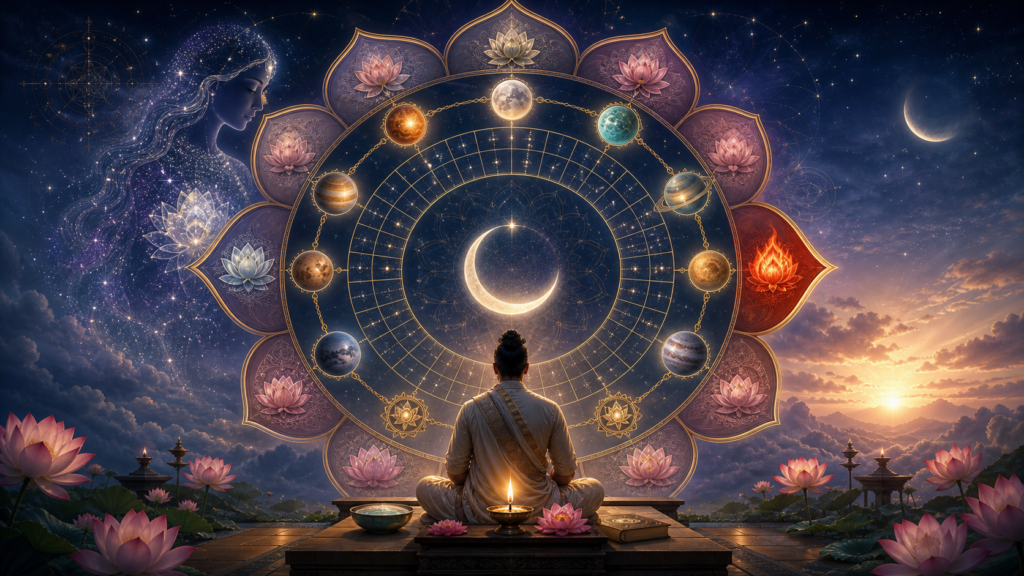
The northeast is a junction rather than a simple cardinal direction. It lies between east, associated in many symbolic systems with dawn and emergence, and north, often associated with elevation, stability, mountains, or divine realms. Later Vastu traditions consequently treat the northeast as especially receptive to light, water, contemplation, and sacred use. These associations help explain why Isana became so important in spatial theology, but they should be distinguished from the earliest textual meanings of his name.
Vastu teachings vary by text, region, building type, site, and lineage. Popular claims that every household will receive guaranteed prosperity from one northeast arrangement are not reliable substitutes for architectural analysis or traditional consultation. Nor should a sacred direction be turned into fear-based superstition. The deeper principle is order: built space can support attention when orientation, cleanliness, proportion, light, movement, and function are treated thoughtfully.
Read through Goddess Isani, the northeast becomes an interior metaphor as well as a physical direction. It represents the point at which awareness turns toward clarity. A devotee facing uncertainty may find this symbolism emotionally compelling: Isani does not remove the need for judgment, effort, or ethical responsibility, but she personifies the lucid power with which those capacities can be exercised. Sacred geography thereby becomes a discipline of attention rather than a mechanism for predicting outcomes.
Worship and contemplative practice
There is no universally observed, pan-Indian festival devoted exclusively to Isani, nor is there one ritual manual accepted by every Shaiva and Shakta community. Worship may occur through Parvati, Durga, Yogamaya, Shiva-Shakti, the Panchabrahma mantras, a local goddess tradition, or a temple’s directional ritual. The appropriate form depends on sampradaya, family custom, temple practice, and initiation. This diversity is characteristic of Hindu religious life and should not be mistaken for inconsistency.
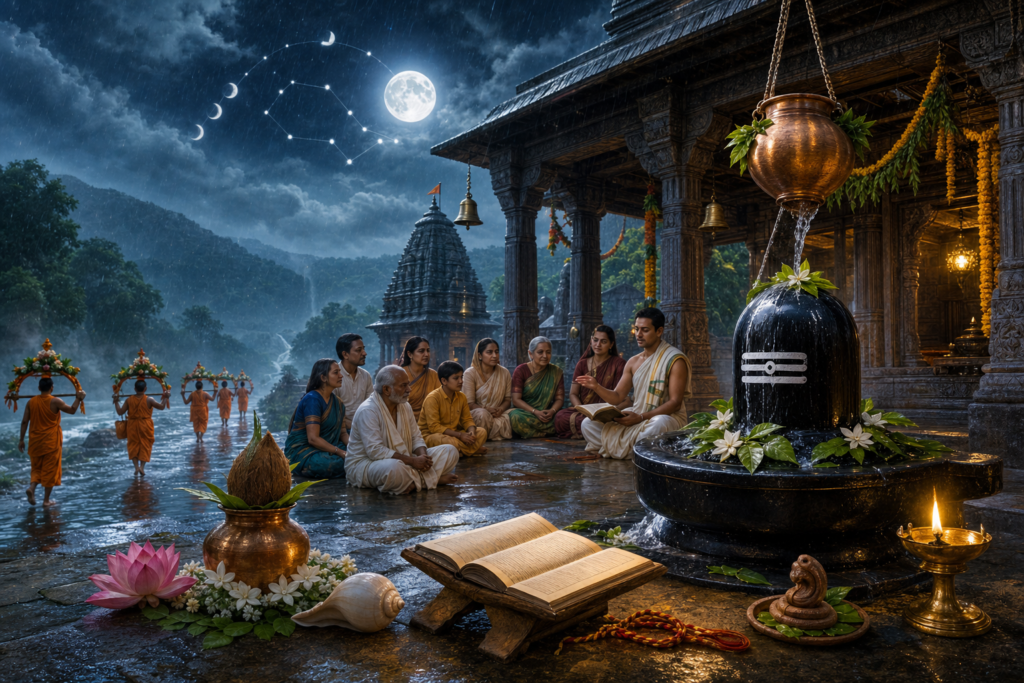
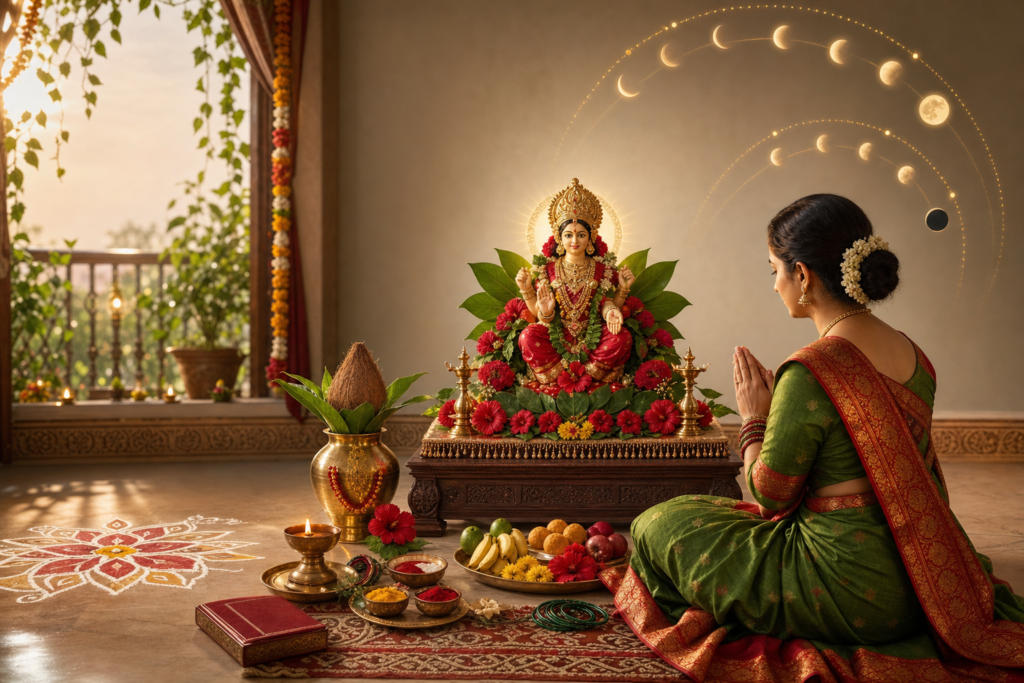
A simple non-initiatory devotional approach can honor Isani through a clean space, a lamp where safely permitted, water, flowers, silent reflection, and respectful remembrance of Shiva and Shakti. A devotee may contemplate the qualities carried by her name: clarity, responsible power, protection, knowledge, and inner sovereignty. Such an observance does not require inventing an elaborate visual form or claiming scriptural authority for a newly circulated ritual.
Mantras require particular care. The famous Panchabrahma formula concerning Isana addresses the masculine Shiva aspect and should not be relabelled casually as an ancient Isani mantra. Feminine name-mantras encountered online may follow valid Sanskrit grammar, a regional liturgy, or a specific Tantric lineage, but their origin should be verified before claims are made about antiquity or universal use. Initiatory mantras and complex nyasa practices are properly learned from a qualified lineage rather than reconstructed from isolated internet fragments.
The ethical dimension of worship is indispensable. If Isani signifies divine power, her remembrance should encourage power used with restraint, insight, and compassion. If she signifies knowledge, devotion should include study and intellectual honesty. If she protects sacred order, her worship should deepen care for people, animals, community, and the environment rather than produce hostility toward other traditions. Ritual becomes spiritually coherent when conduct reflects the deity’s qualities.
Isani and the wider Dharmic world
The directional form of Isana also illustrates the movement of Indic sacred imagery across religious boundaries. In Japanese Esoteric Buddhism, Ishanaten preserves Isana as a guardian of the northeast within the Twelve Devas. The Kyoto National Museum holds a celebrated set of twelve painted scrolls dated to 1127 in which Ishanaten appears among the protectors of Esoteric Buddhist monasteries. The Kyoto National Museum’s Twelve Devas demonstrate that a Sanskrit directional deity could be translated into a new artistic, linguistic, and ritual environment without remaining unchanged.
Jain ritual and temple traditions also incorporated directional guardians within their own cosmological and architectural programs. Jain texts frequently describe ten guardians by adding zenith and nadir to the eight horizontal directions, while many surviving temple programs depict eight. Isana retains the northeast position, but his presence serves a Jain sacred setting rather than turning that setting into a Shaiva temple. This evidence reveals cultural exchange and a shared visual vocabulary, not doctrinal identity.
This distinction supports constructive unity among Hindu, Buddhist, Jain, and Sikh communities. Unity does not require every tradition to interpret deity, Shakti, image, mantra, or revelation in the same way. It requires accurate representation, mutual respect, and recognition that Dharmic civilizations have long developed through dialogue, adaptation, debate, and shared cultural space. Isani’s symbolism can therefore inspire harmony without erasing the theological boundaries that give each path its integrity.
Common questions about Goddess Isani
Is Isani another name for Parvati or Durga? Yes, several lexicographic and devotional traditions identify Ishani with Parvati or Durga, and Puranic passages place the name within the many-formed Goddess. Context remains important. In one passage Isani is a name of Yogamaya; in another she is one of nine Durgas; in a technical ritual sequence she is a letter-Shakti. “Another name of Parvati” is therefore correct as a concise answer but incomplete as a comprehensive explanation.
Is Isani a completely independent goddess? She can be worshipped and addressed as a distinct divine form, particularly in local or lineage-specific practice, but the available pan-Indian textual record more often presents Īśānī as an epithet, manifestation, or Shakti within the greater identity of Devi. Hindu theology does not always force a choice between identity and distinction. A form can be fully sacred in worship while remaining non-separate from the supreme Goddess.
Is Isani the guardian of the northeast? Strictly speaking, Isana is the standard northeast Dikpala. Isani is associated with that direction as his Shakti, feminine counterpart, or a Goddess bearing the corresponding sovereign name. Calling her the “Goddess of the Northeast” is a meaningful theological summary, provided it does not conceal the formal role of Isana in the classical directional list.
Is Isani one of the Ashtamurtis? The term Ashtamurti normally concerns Shiva’s eightfold manifestations, and Isana appears in influential eight-name enumerations. Isani may be interpreted as the Shakti of that Isana form, but she is not ordinarily listed as one of eight male Shiva manifestations. Ashtamurti must also be distinguished from the eight directional guardians.
Does Isani have a fixed vehicle and weapon? No universally standardized independent combination can be asserted from the major references discussed here. Attributes depend on whether she is represented as Parvati, Durga, Yogamaya, a directional Shakti, or another regional form. Isana’s bull and trident should not automatically be assigned to every Isani image, just as Durga’s lion should not be assigned without contextual evidence.
Can Isani be worshipped at home? Respectful remembrance of the Goddess under this name can form part of ordinary devotion. Simple offerings and contemplation of Shiva-Shakti generally do not require elaborate claims. A practitioner seeking Tantric mantra, nyasa, yantra installation, fire ritual, or formal consecration should follow a competent teacher and an established lineage. Household worship should remain safe, sincere, and consistent with family or sampradaya practice.
Why does Goddess Isani remain relevant?
Isani offers a powerful corrective to the assumption that authority must be loud, coercive, or exclusively masculine. Her name presents sovereignty as intelligent capacity. Her relation to the northeast connects power with orientation and clarity. Her place in the alphabetic Shaktis connects divinity with language. Her Puranic identities connect protection with the many forms of the Goddess. Her relation to Isana presents masculine and feminine not as hostile opposites but as interdependent dimensions of sacred reality.
For a contemporary devotee, this symbolism can make ordinary choices feel spiritually significant. A difficult conversation demands clarity before force. Leadership requires responsibility rather than domination. Study requires humility as well as intelligence. Protection requires compassion as well as boundaries. These are not modern replacements for the traditional Goddess; they are ethical reflections drawn from the semantic and theological qualities preserved in her name.
For students of Hinduism, Isani also demonstrates why lesser-known divine names deserve careful attention. A single epithet can connect Vedic praise, Puranic narrative, Tantric phonology, temple architecture, iconographic classification, and living devotion. At the same time, disciplined study prevents attractive but unsupported claims from hardening into supposed history. Reverence and critical accuracy can strengthen one another.
Conclusion: the quiet sovereignty of Ishani Devi
Goddess Isani is the sacred feminine power of lordship, knowledge, orientation, and awakening. She is remembered as Parvati or Durga, named among the manifestations of Yogamaya, counted among nine Durgas in a Shaiva narrative, and located within the subtle alphabet of Shakti. Through Isana she is associated with the northeast, the Panchabrahma theology of Shiva, and certain Ashtamurti classifications, yet none of those systems should be confused with the others.
Her significance rests less in a single dramatic biography than in the coherence she brings to a network of ideas. Isani reveals that sacred power is not separate from consciousness, that space can become a vehicle of spiritual order, and that knowledge itself may be experienced as grace. To encounter her is to encounter the dynamic sovereignty within Shiva-Shakti—the power that does not merely rule the world but makes understanding, transformation, and compassionate action possible.
Research note
The principal textual points in this account derive from the Taittiriya Aranyaka 10.21.1 for the masculine Isana, the Bhagavata Purana 10.2.11–12 for Īśānī as a name of Yogamaya, the Shiva Purana, Rudra-samhita, Sati-khanda 33.11–12 for Īśānī among nine Durgas, and the Lalitopakhyana 44.84b–89 for her place among alphabetic Shaktis. Iconographic interpretation should be checked against inscriptions, regional Shilpa Shastras, temple records, and documented museum objects because attributes and spatial programs vary across periods and communities.
Inspired by this post on Hindu Blog.




Leave a Reply
You must be logged in to post a comment.