
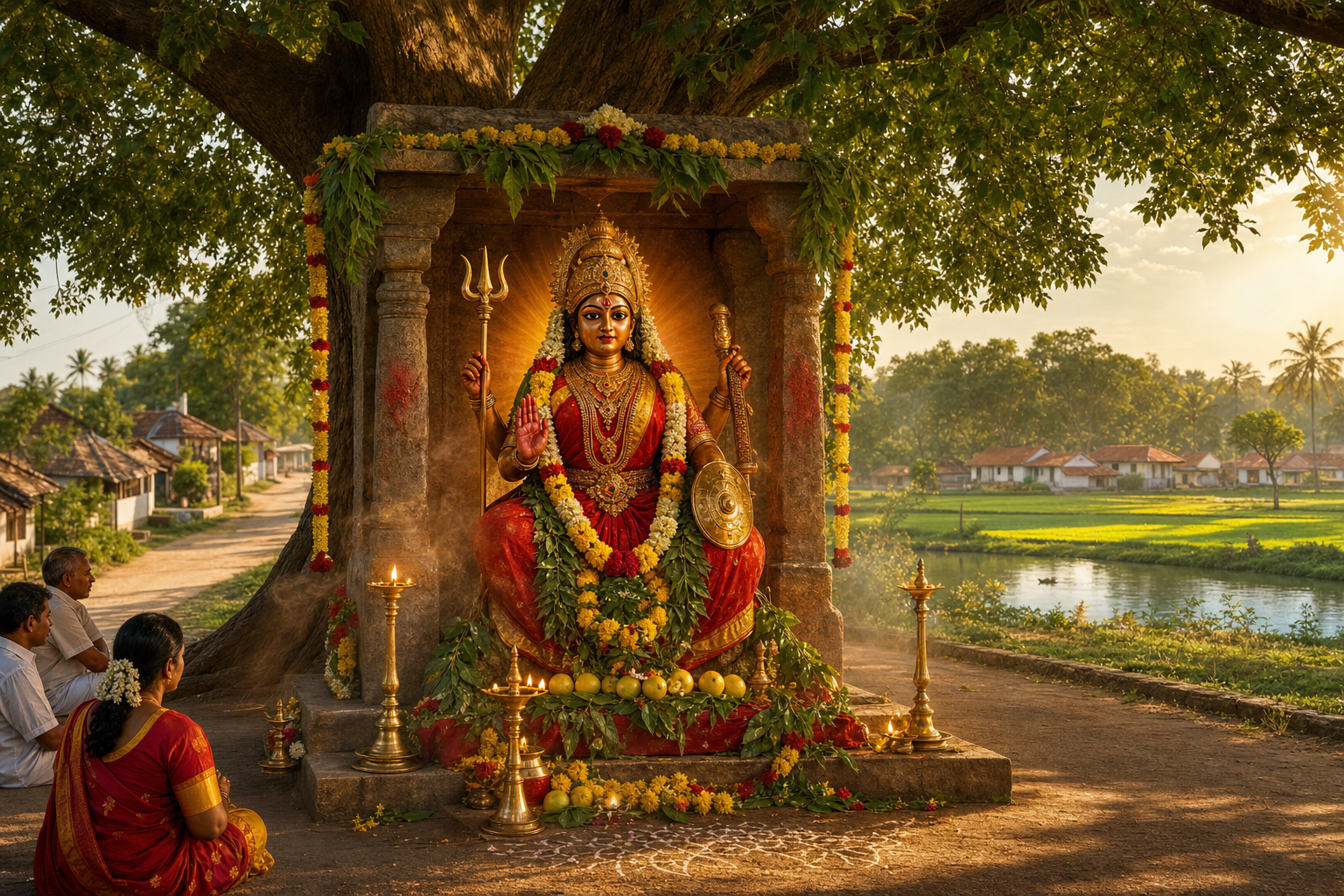
Pidari Amman and the Presence at the Village Boundary
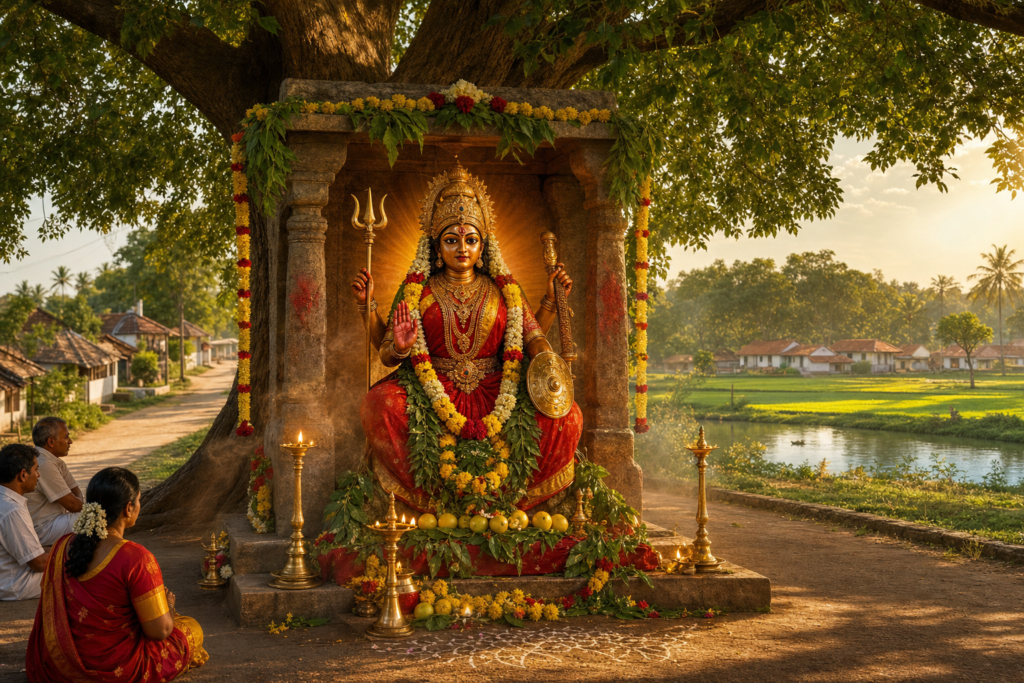
A first encounter with a Pidari Amman shrine can be emotionally arresting. The sanctuary may stand near a village boundary, beside an old tree, on the edge of cultivated land, or within a temple that has gradually acquired formal architecture. Its physical scale may be modest, yet devotees can experience the place as intensely alive. Pidari Amman iconography and philosophy begin with this contrast: the goddess is locally rooted but the power attributed to her is understood as an expression of Shakti, the universal divine energy that animates, protects, transforms, and renews existence.
Pidari Amman belongs to the diverse religious landscape of Tamil Nadu’s guardian and village goddesses. The expression “village goddess” describes a deity’s relationship to a community and territory; it does not imply that she is spiritually inferior, historically insignificant, or merely a rustic version of a supposedly higher deity. In many communities, she is the immediate mother of the settlement—the power approached for safety, justice, health, fertility, rain, social stability, and protection from forces perceived as disruptive.
A responsible account must nevertheless resist the temptation to construct one standardized Pidari Amman from many distinct traditions. Her name, myths, image, rituals, priesthood, festival calendar, and relationships with other deities can vary from one locality to another. Temple tradition, oral memory, inscriptional evidence, ritual practice, and later theological interpretation do not always tell the same story. That plurality is not an error to be corrected; it is one of the defining characteristics of Tamil sacred culture.
Who Is Pidari Amman?
Pidari Amman is generally revered as a fierce, maternal, and protective Hindu goddess. Within a Shakta framework, she may be understood as a localized manifestation of the supreme Shakti rather than as an isolated supernatural being. Shakti signifies active divine power: the capacity through which creation emerges, life is sustained, disorder is confronted, and exhausted forms are transformed. Pidari’s fierceness therefore belongs to a theology of protection and moral seriousness, not to a theology of evil.
The Tamil honorific Amman conveys the intimacy and authority of “Mother.” It places the goddess within a relationship of kinship while also acknowledging her sovereignty. A human mother can nourish, warn, discipline, defend, and refuse to permit conduct that endangers the family. Pidari Amman magnifies this maternal range into a sacred form. Her tenderness cannot be separated from her capacity to confront what threatens the community.
Her identity is best understood as relational rather than rigidly biographical. At one shrine, she may be explicitly identified with Kali, Durga, Bhadrakali, Parvati, Mariamman, or another form of Devi. Elsewhere, she may possess an independent local history and a distinct sphere of authority. Some traditions connect her with groups of sister goddesses or protective mothers. These associations are meaningful within their respective communities, but none should automatically be imposed on every Pidari shrine.
A familiar devotional explanation interprets Pidari as “she who seizes.” In this reading, the goddess seizes danger, restrains destructive forces, removes affliction, or takes hold of the devotee’s pride. The interpretation is spiritually expressive, especially when her power is related to the dissolution of ego. It should not, however, be presented as an uncontested philological conclusion. The history of the name is discussed differently across local traditions, and an English gloss cannot by itself establish a definitive Tamil etymology.
The description “terrific mother” uses terrific in its older sense of fearsome, overwhelming, and awe-inspiring. It does not mean that Pidari Amman is cruel or demonic. Her unsettling appearance communicates that sacred protection is not always gentle in form. A fire that cooks food can also burn contamination; a boundary that shelters a community must also resist violation. Her terrible beauty makes this double capacity visible.
Historical Presence in the Tamil Sacred Landscape
Pidari worship cannot be adequately described as a recent invention or as an accidental survival outside mainstream Hinduism. Medieval Tamil inscriptions include references to Pidari shrines, gifts, lands, ritual obligations, and local religious institutions. Such records show that deities bearing her name were integrated into organized village life and systems of patronage. They also caution against imagining a permanent division between monumental temple Hinduism and local goddess worship.
Epigraphy establishes that a shrine, endowment, or institutional relationship existed at a particular time, but it rarely preserves the full emotional and ritual world of worshippers. Oral histories explain why a goddess arrived, whom she protected, where she halted an epidemic, how she revealed a boundary, or why a festival follows a particular route. Temple images reveal another layer through posture, weapons, ornaments, and surrounding figures. A historically sound interpretation brings these sources together without forcing them into artificial agreement.
Over time, some Pidari shrines have adopted stone icons, Sanskritic names, Agamic procedures, larger temple complexes, or explicit identifications with widely worshipped forms of Devi. Scholars sometimes describe such processes as Sanskritization or institutionalization. Those terms can be useful, but they must not suggest that local traditions were empty until formalized. Change often occurred through negotiation: hereditary customs continued beside new liturgies, local myths were retained, and the goddess remained responsible for the territory even after her temple acquired broader recognition.
Continuity is therefore not the absence of change. A living Pidari tradition may preserve an old name while altering its offerings, architecture, festival management, or public theology. Migration, law, public-health knowledge, animal-welfare concerns, urban development, and changing caste relations can all reshape practice. The goddess’s enduring significance lies partly in a community’s capacity to reinterpret protection while maintaining a recognizable sacred relationship.
Why the Goddess Stands at Thresholds
Many guardian goddesses are associated with boundaries because a boundary is both vulnerable and generative. It separates settlement from wilderness, cultivated field from uncultivated ground, familiar kinship from the arrival of strangers, and regulated space from uncertain movement. The boundary is not merely a line on a map; it is where exchange, danger, hospitality, commerce, disease, weather, and conflict enter communal life. Pidari Amman’s presence at such a threshold makes territorial protection a visible religious principle.
This spatial function also explains why her shrine may face a road, field, water source, grove, or entrance. Location itself can be part of her iconography. A sculpture cannot be interpreted fully without asking where it is installed, which direction it faces, what procession reaches it, and which other deities share the ritual landscape. The sacred meaning belongs to the complete arrangement rather than to the statue alone.
Historically, village-goddess worship often addressed uncertainties that were simultaneously ecological, medical, agricultural, and social. Crop failure, fever, livestock disease, dangerous weather, and conflict could threaten the entire settlement. Ritual did not divide these experiences into the modern categories of medicine, environment, economy, and religion. Pidari’s protection gave the community a shared language for vulnerability and coordinated response.
Such historical meanings should not be converted into unsupported biomedical claims. Prayer, vows, and festivals may provide hope, belonging, emotional regulation, and communal care, but they are not substitutes for vaccination, sanitation, diagnosis, or professional treatment. A mature understanding allows religious devotion and evidence-based medicine to coexist without diminishing either the spiritual importance of the shrine or the practical duty to protect life.
Pidari Amman Iconography: Reading a Fierce Sacred Form
There is no single iconographic formula that identifies every image of Pidari Amman. She may appear seated or standing, with two arms or multiple arms, in a calm posture or an emphatically fierce one. One temple may house a carefully carved anthropomorphic image, while another may revere a stone, a head-like form, a trident, an earthen object, an anthill, or a presence associated with a tree. Aniconic worship is not an incomplete stage awaiting a statue; it is a different way of locating divine presence.
Large or intensely focused eyes are common features in fierce-goddess imagery. They signify wakefulness, vigilance, and the impossibility of hiding wrongdoing from sacred attention. Fangs, a projecting tongue, flame-like hair, or a severe facial expression may appear in some forms. These elements externalize the power to expose, consume, or neutralize disorder. Their meaning is protective when read within the devotional setting, even when their visual language is deliberately unsettling.
Weapons such as the trident, sword, spear, club, noose, or shield can occur, although the combination differs by shrine. The trident is often associated with concentrated divine power and the defeat of destabilizing forces. A sword can signify decisive discernment—the ability to cut through deception and attachment. A noose may represent restraint or the capture of what escapes ordinary control. A shield announces guardianship. These are theological interpretations, not a universal code in which every object has one fixed meaning.
Some fierce images carry a bowl, vessel, drum, bell, serpent, or severed symbolic object. A vessel can evoke nourishment, ritual offering, containment, or transformative power. Serpents may indicate danger mastered, fertility, the earth, guardianship, or concentrated energy, depending on local context. A drum or bell can mark the ordering power of sacred sound. Where skull imagery occurs, it generally evokes mortality, impermanence, and power over death rather than a celebration of violence.
The number of arms expands the visual field of divine capacity. Multiple arms do not imply anatomical realism; they indicate that the goddess performs many functions simultaneously and possesses powers beyond ordinary human limitation. Gesture also matters. A hand raised in reassurance can coexist with a weapon, communicating that the same power feared by destructive forces offers refuge to the devotee.
Red is frequently associated with Shakti, heat, fertility, blood, vitality, danger, and active power. Turmeric yellow can signify auspiciousness, protection, health, and embodied sacredness. Kumkum, flowers, neem leaves, cloth, lamps, and garlands may transform the image during worship. The decorated icon is not simply an artwork covered by ritual material; adornment makes the living relationship between deity and community visible.
A lion or another powerful animal may accompany formalized images in traditions that identify Pidari with Durga or a related goddess. Other shrines may have no fixed vahana at all. Attendant deities, guardian figures, hero stones, serpent forms, or neighboring shrines may be more important than a vehicle. Iconographic interpretation must therefore begin with observation rather than with a generic chart of Hindu symbols.
A technical study of Pidari Amman records the material, posture, number of arms, hand gestures, weapons, ornaments, facial expression, crown, surrounding figures, orientation, installation site, festival decorations, and evidence of repair or replacement. It then compares those observations with temple narratives, inscriptions, ritual testimony, and regional artistic conventions. This method prevents a popular internet image from being mistaken for the universal appearance of the goddess.
Pidari, Kali, Durga, Mariamman, and Other Forms of Devi
Pidari Amman is sometimes identified with Kali, Durga, Bhadrakali, Mariamman, Angalamman, Parvati, or another manifestation of the Sacred Feminine. Such identifications express theological unity: many forms can reveal one Shakti. They can also reflect historical interaction among temples, communities, ritual specialists, and devotional movements. Yet theological unity does not erase local distinction. Two goddesses may share weapons, colors, myths, or festival practices while retaining different names, territories, and obligations.
Some traditions place Pidari among seven mothers, seven sisters, or a wider circle of protective female powers. These groupings connect her to a recurring South Asian pattern in which collective feminine divinity guards settlements, children, fertility, and cosmic order. The number, names, and relationships vary. Consequently, an association with the Sapta Matrikas or another sisterhood should be reported only where local or textual evidence supports it.
Village religion also operates through networks of deities. Pidari may share ritual space with Shiva, Ganesha, Muruga, Ayyanar, Karuppar, ancestral powers, serpent deities, or other guardians. The network can express a sacred division of responsibility: one power guards the outer boundary, another receives the first offering, another protects roads, and another presides over rain or illness. Such relationships are often more informative than an attempt to construct a single family tree.
Local myths deserve attention even when they differ from printed Puranic narratives. A story about the goddess appearing in a dream, halting at a stone, protecting cattle, exposing injustice, or demanding recognition can function as a charter for the shrine. It explains why the deity belongs to that place and why particular families or communities carry ritual responsibilities. Oral tradition is historically situated evidence, though it should not automatically be treated as a literal record of datable events.
The Philosophy of Shakti and Fierce Protection
Within Hindu philosophy, Shakti is more than physical force and more than a poetic synonym for womanhood. It is the dynamic power through which consciousness becomes manifest as nature, body, thought, action, time, and transformation. Different Shakta, Shaiva, and Vedantic schools explain the relationship between Shakti and ultimate reality in different ways. Pidari worship does not require every devotee to adopt one philosophical system, but Shakti theology provides a rigorous framework for understanding how a village mother can embody universal power.
Fierceness is necessary within this framework because preservation occasionally requires the termination of harmful conditions. A physician may remove diseased tissue; a court may restrain an offender; a parent may intervene before a child reaches danger. These comparisons are limited, but they illustrate why destruction and compassion are not always opposites. Pidari’s weapons signify the capacity to end what prevents life from flourishing.
The claim that Pidari Amman dissolves ego requires careful definition. In ordinary English, ego often means arrogance. In Indian philosophical analysis, ahamkara is the principle that organizes experience around the sense of “I” and “mine.” It has a practical role in embodied life, yet it becomes spiritually binding when identity is treated as isolated, permanent, and entitled to control everything. The goddess does not need to be interpreted as destroying healthy individuality; her grace challenges possessiveness, vanity, and false self-sufficiency.
Fierce iconography dramatizes that challenge. The devotee stands before a power that cannot be managed through status, wealth, cleverness, or social performance. Fear may initially arise because the defended personality encounters something greater than itself. Through trust and surrender, that fear can become humility. The emotionally significant movement is not from weakness to terror, but from anxious control to responsible participation in a larger moral and sacred order.
Language about ego dissolution must never be used to justify humiliation, coercive authority, domestic abuse, or the silencing of legitimate needs. Spiritual surrender is not submission to human exploitation. Healthy devotion can strengthen discernment and boundaries because the devotee learns that dignity does not depend on pleasing every person. A fierce mother who confronts injustice cannot coherently be invoked to excuse it.
Moksha, or liberation, is another concept that requires nuance. Many village rituals are directed toward immediate well-being: protection, rain, fertility, recovery, family continuity, or resolution of conflict. It would be inaccurate to assume that every Pidari festival explicitly teaches a systematic doctrine of liberation. Nevertheless, Hindu theological interpretation can connect devotion to Pidari with moksha when surrender weakens attachment, clarifies moral responsibility, and reveals individual life as dependent upon a reality larger than the separate self.
In that sense, liberation is not a magical prize granted in exchange for an offering. It is a transformation of relationship. The worshipper ceases to approach the world solely as an owner and begins to recognize obligations to family, community, land, other beings, and the divine. Grace opens the possibility, while disciplined conduct gives it durable form.
The paradox of fierce grace is central to Pidari Amman’s appeal. Grace is often imagined as soothing, but protection sometimes arrives as interruption: an illusion collapses, harmful conduct meets a boundary, or a neglected responsibility can no longer be avoided. Devotees may interpret such moments as the Mother’s severe compassion. Academic analysis can describe this interpretation without claiming that every misfortune is divine punishment.
Pidari’s territorial role also gives philosophical depth to dharma. A boundary distinguishes freedom from intrusion and hospitality from exploitation. Her guardianship suggests that compassion requires structure. A community cannot preserve trust if it refuses to confront abuse, dishonesty, or disregard for shared resources. The goddess thus represents an ethics in which protection, justice, and care remain mutually dependent.
Pidari Amman should not automatically be classified as a Tantric deity merely because she is fierce, carries weapons, or receives worship outside a large institutional temple. Tantric traditions have complex textual lineages, initiations, ritual technologies, and philosophical systems. Some local practices may have interacted with Tantric currents, but visual resemblance alone cannot prove that relationship. Careful terminology protects both Pidari worship and Tantra from sensational misrepresentation.
Ritual Life: Offerings, Festivals, Vows, and Divine Presence
Pidari worship is sustained through repeated acts rather than through iconography alone. Lamps, flowers, turmeric, kumkum, neem, lemons, cooked food, cloth, and other locally prescribed offerings may be presented. The selection varies by shrine and occasion. An offering is not best understood as payment to a dangerous power; it establishes reciprocity, gratitude, remembrance, and shared responsibility between the community and its guardian.
Annual festivals may include purification of the sanctuary, processions, music, communal cooking, vows, fire-related observances, decorated pots, public storytelling, and the return of relatives who have migrated elsewhere. The Tamil month Aadi is important to many Amman traditions, although Pidari’s calendar is not uniform. Agricultural cycles, local history, temple custom, and regional climate can determine when a festival occurs.
A procession temporarily extends the goddess’s presence beyond the sanctum. As the image moves through streets or around fields, the territory is ritually inspected, blessed, and reassembled. The route can encode social history by stopping at particular households, water sources, boundaries, or neighboring shrines. Changes to that route may therefore become sensitive because ritual movement also represents belonging and recognition.
Vows commonly arise from moments of uncertainty. A devotee may promise an offering, fast, meal, procession, or act of service after seeking help. The fulfilled vow publicly acknowledges dependence and gratitude. Its spiritual value lies less in bargaining for guaranteed results than in converting private fear into disciplined action and communal memory.
In some communities, a ritual medium may enter an altered state understood by participants as the goddess’s presence and deliver arul vakku, a word of grace or guidance. Such events can settle questions, identify neglected obligations, or intensify collective emotion. Anthropology treats possession as a patterned religious and social practice rather than dismissing it as primitive superstition. At the same time, spiritual interpretation should not prevent compassionate medical assessment when a participant shows distress, injury, or continuing impairment.
Priesthood varies considerably. Some shrines are served by hereditary non-Brahmin priests or families with locally recognized ritual rights. Others incorporate Brahmin priests, Agamic worship, or mixed arrangements. This diversity reflects the layered history of Tamil Hinduism. No single priestly model can be assumed from the goddess’s name, and local custodians should be consulted before describing a temple’s practice.
Animal sacrifice has historically been documented at some South Asian guardian-goddess shrines, including particular local traditions associated with fierce deities. It is not universal to Pidari worship, and present practice differs according to community ethics, temple policy, and law. Many devotees and temples use vegetarian offerings or symbolic substitutions shaped by ahimsa. Academic honesty requires acknowledging historical diversity without sensationalizing it or attributing one practice to every shrine.
Healing narratives are another important part of the tradition. Devotees may report recovery, protection during an epidemic, relief from fear, or the resolution of family problems. Such testimony is meaningful evidence of religious experience, but it is not the same as a controlled medical finding. The most responsible practice joins prayer with appropriate clinical care, public-health measures, and practical support for vulnerable people.
Household devotion may be simple, but practices for fierce forms of Devi should not be invented from decontextualized online instructions. Families often follow inherited customs or guidance from a trusted temple. Respectful worship emphasizes cleanliness, sincerity, ethical conduct, and remembrance rather than dramatic occult claims. Pidari Amman is a guardian mother, not a technique for controlling another person or acquiring instant power.
A visitor can approach a Pidari temple by observing local expectations concerning footwear, clothing, photography, offerings, and access to the inner sanctuary. Asking before recording a ritual is especially important during possession, healing, or private vows. Respect begins with the recognition that the shrine is a living sacred home rather than an exhibition of exotic customs.
Community, Caste, Gender, and Sacred Ecology
A Pidari festival can create powerful social cohesion. Families cooperate, migrants return, food is shared, disputes may be suspended, and communal space is renewed. The goddess becomes a sacred representation of collective survival. This function helps explain why devotion can remain strong even when worshippers move to towns, adopt new occupations, or participate in large pan-Indian religious institutions.
Community should not, however, be romanticized as automatically harmonious. Temple honors, procession routes, priestly rights, access, and control of resources can reflect caste and status. A rigorous study asks who may enter, who performs labor, who speaks for the deity, and whose account is recorded. Traditions remain strongest when inherited dignity is preserved while exclusion and humiliation are addressed through dharma, fairness, and equal human worth.
The presence of a sovereign goddess also invites reflection on gender. Pidari Amman embodies authority, anger, protection, fertility, and independence rather than passive femininity. Her image can provide women with a sacred language for endurance and resistance. Yet the worship of a powerful female deity does not automatically prove that women enjoy equality in the surrounding society. Theological symbolism and social practice must be studied together without confusing one for the other.
Many village shrines are associated with trees, groves, tanks, fields, stones, or uncultivated margins. These locations can preserve ecological memory and sometimes protect small habitats from unrestricted use. Their value should be documented site by site rather than romanticized through the claim that every sacred grove is untouched wilderness. Even so, Pidari’s guardianship offers a compelling ethical principle: land is not merely an exploitable asset but a shared field of life carrying inherited obligations.
Modern infrastructure can place such sites under pressure. Roads, real-estate development, relocation, pollution, and administrative expansion may alter a shrine’s setting or sever a procession route. Heritage preservation should document not only the icon and building but also the tree, water source, boundary, oral history, festival path, ritual specialists, and communities of care. Removing a shrine from its landscape can erase part of its meaning even if the stone image survives.
Urban Pidari temples demonstrate that “village goddess” is not a synonym for a frozen rural past. Migrant communities can carry the Mother into new neighborhoods, where she protects families facing different forms of uncertainty. Amplified music, digital invitations, livestreamed worship, charitable service, and formal temple administration may join older vows and oral narratives. Tradition persists through selective adaptation.
Psychological and Ethical Relevance Without Reductionism
Contemporary readers often interpret fierce goddesses as symbols of psychological boundary-setting. Pidari can indeed provide a language for confronting fear, refusing abuse, and protecting what is valuable. Her sword may be contemplated as discernment and her vigilant eyes as awareness. These readings can be fruitful when presented as modern applications rather than as exhaustive explanations of the deity.
Reducing Pidari to an archetype inside the human mind would overlook the worshipper’s conviction that she is a real sacred presence with agency, history, and territory. Conversely, treating every emotion, illness, or coincidence as direct supernatural intervention can encourage fear and neglect practical causes. Intellectual humility allows theological, psychological, historical, and social interpretations to remain in conversation without forcing one to eliminate the others.
Her maternal ferocity also corrects the assumption that compassion must always appear agreeable. Ethical care may require a refusal, an intervention, or the defense of someone who cannot defend themselves. Pidari’s symbolism becomes especially relevant where politeness has been used to conceal injustice. The sacred feminine here is not ornamental; it is alert, accountable, and capable of decisive action.
At the same time, fierce symbolism cannot legitimize uncontrolled anger. The goddess’s force is ritually ordered and directed toward protection. Human anger becomes Dharmic only when governed by truth, proportion, responsibility, and concern for life. Rage that humiliates the innocent, targets another community, or excuses cruelty contradicts the protective meaning attributed to the Mother.
Pidari Amman and Unity Among Dharmic Traditions
Pidari Amman is specifically a Hindu goddess, and respectful dialogue should preserve that identity. Dharmic unity does not require Buddhism, Jainism, Sikhism, and Hinduism to be treated as interchangeable. Their doctrines, scriptures, ritual forms, and understandings of divinity differ. Solidarity becomes more credible when difference is acknowledged rather than concealed.
Meaningful resonances can nevertheless be recognized. Hindu fierce-goddess traditions portray protective Shakti; some Buddhist traditions employ wrathful imagery to represent compassion confronting delusion; Jain communities revere protective figures while placing ahimsa at the center of ethical discipline; Sikh tradition joins spiritual devotion with courage, justice, and seva. These comparisons do not turn Pidari into a figure of all four traditions. They show that spiritual life can unite compassion with moral strength.
Pidari’s worship also illustrates pluralism within Hinduism itself. Textual and oral traditions, village and urban institutions, anthropomorphic and aniconic forms, hereditary and Agamic rites, and philosophical and practical goals can coexist. Unity in this setting is not uniformity. It is the capacity to recognize related sacred paths without erasing their local histories.
The most constructive shared lesson is ethical: protection must serve life rather than identity-based hostility. A guardian deity should inspire care for the vulnerable, defense of sacred heritage, ecological responsibility, honest self-examination, and respectful relations with neighboring traditions. Pidari Amman’s fierceness loses its spiritual meaning when converted into contempt for other communities.
How Pidari Amman Should Be Studied
A comprehensive study begins with the shrine itself. It documents the name used by devotees, alternate names, location, orientation, icon, attributes, surrounding deities, priestly lineage, festival calendar, offerings, procession route, founding narrative, renovations, and community responsibilities. It then consults inscriptions, temple records, regional histories, photographs, interviews, and relevant scholarship. No single source can answer every question.
Evidence must also be classified carefully. An inscription may establish a historical reference but not current belief. A myth may explain ritual authority without functioning as chronological history. An icon may reveal artistic relationships but not the full meaning assigned by worshippers. An interview records a situated voice rather than the opinion of an entire community. Strong research makes these distinctions explicit.
Religious studies often distinguishes an emic account—the explanation given within a tradition—from an etic analysis developed by an external scholarly framework. Both can be valuable. Devotees may describe the goddess as having directly protected the village, while historians analyze how that narrative organizes memory and belonging. Respect does not require the historian to make an unverifiable claim, and critical analysis does not require the devotee’s experience to be mocked.
Common misinformation should be avoided. Pidari is not an evil deity because she appears fierce; she is not necessarily identical to Kali in every location; every shrine does not practice sacrifice; every ritual is not Tantric; and every illness attributed to divine displeasure should not be accepted as a medical explanation. Equally misleading is the claim that local goddess worship is merely superstition with no philosophical, historical, artistic, or social depth.
Preservation should give local communities a central role. Digitizing an inscription or photographing an icon is useful, but living heritage also includes songs, ritual vocabulary, women’s knowledge, craft practices, festival routes, food traditions, and memories of environmental change. Documentation must obtain consent and avoid exposing private rites to ridicule or commercial exploitation.
Frequently Asked Questions About Pidari Amman
Is Pidari Amman another name for Kali?
Some communities identify Pidari with Kali, Durga, Bhadrakali, or another form of Devi, but the equation is not universal. Local temple history, iconography, ritual language, and oral tradition should determine how the relationship is described.
Why does a protective mother look frightening?
Her fierce appearance communicates vigilance and the power to confront danger. Weapons, wide eyes, fangs, or flames are directed symbolically against disorder and delusion. To devotees who seek refuge, the same power can be reassuring rather than threatening.
Does Pidari Amman literally destroy the ego?
The phrase is primarily theological and contemplative. It describes the weakening of arrogance, possessiveness, and the illusion of complete self-sufficiency. It should not be interpreted as the destruction of personality, dignity, judgment, or healthy psychological boundaries.
Does Pidari worship guarantee moksha or miraculous healing?
Devotees may understand her grace as spiritually liberating and may testify to healing, but no ritual should be represented as an empirically guaranteed outcome. Moksha belongs to a broader transformation involving grace, insight, ethical conduct, and freedom from binding attachment. Medical concerns still require appropriate professional care.
Why are Pidari shrines often located near village edges?
The boundary is where a settlement encounters movement, uncertainty, and external danger. A shrine placed there expresses territorial guardianship. The location may also connect the goddess with fields, roads, groves, water, or a historically important event in the community’s sacred memory.
Can visitors respectfully enter a Pidari Amman temple?
Access depends on the customs of the individual shrine. Visitors should follow posted rules, consult temple custodians, dress respectfully, remove footwear where required, and request permission before taking photographs or recording rituals. Humility is more appropriate than arriving with assumptions drawn from another temple.
The Enduring Grace of the Fierce Mother
Pidari Amman reveals a dimension of the Sacred Feminine that modern descriptions of spirituality sometimes neglect. She does not offer comfort detached from responsibility. She guards boundaries, confronts disorder, exposes pride, and demands remembrance of the relationships that sustain life. Her grace is nurturing because it is strong enough to say no to what destroys.
Her iconography becomes intelligible when it is read through place, ritual, history, and living testimony. The trident is more than a weapon, red is more than a color, and the boundary is more than geography. Together they form a sacred grammar through which a community interprets vulnerability, justice, mortality, fertility, belonging, and hope.
The deepest meaning of “she who seizes” may therefore be approached devotionally rather than reduced to a linguistic slogan. Pidari seizes attention from complacency, courage from fear, responsibility from isolation, and humility from pride. Whether worshipped in a small boundary shrine or a formal temple, she remains the terrific Mother whose fierce presence protects life and points beyond the narrow sovereignty of the ego toward liberating grace.
Inspired by this post on Hindu Blog.







Leave a Reply
You must be logged in to post a comment.