
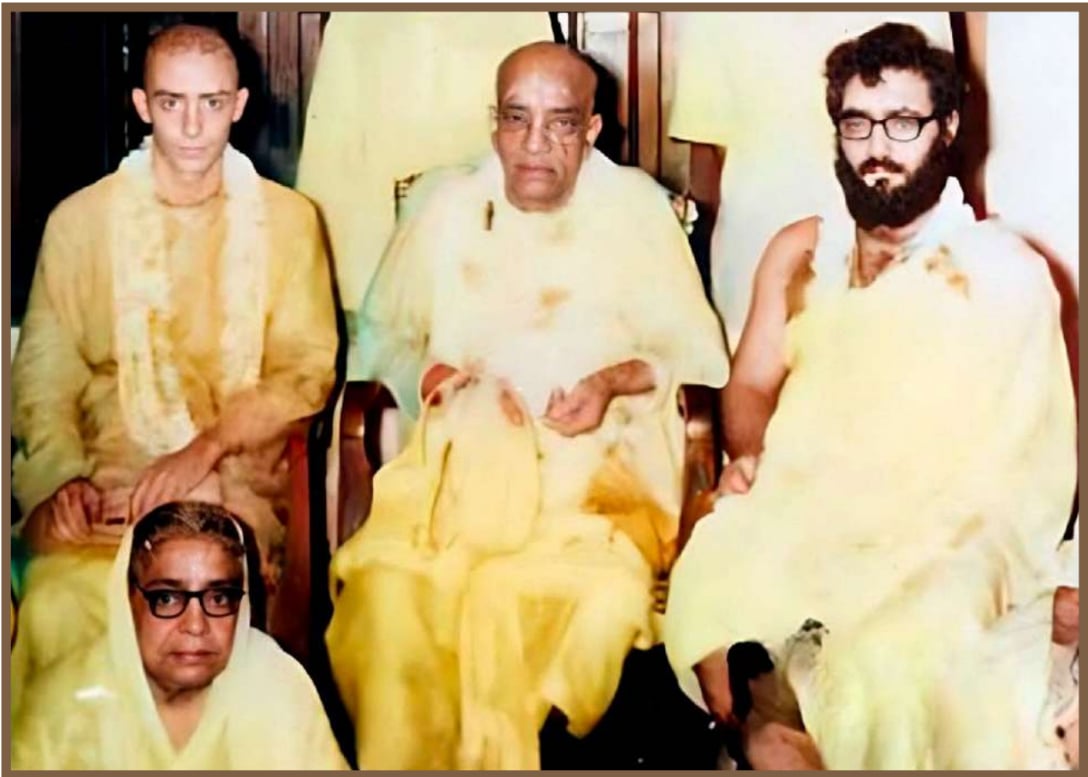

At a crowded public program in Bombay, Srila Prabhupada noticed a Muslim visitor holding a string of beads and asked that he be invited onto the stage. The ensuing exchange was brief, but its significance was substantial. It did not depend upon a formal interfaith declaration, a negotiated statement of doctrine, or an attempt to erase religious differences. Instead, one practitioner recognized in another a familiar discipline: the tactile counting of sacred remembrance. That simple recognition transformed a stranger at the edge of a crowd into an honored guest seated beside a major Vaishnava spiritual teacher.
The episode appears in Sri Krishna Kathamrita Bindu, issue 626, The Fire of Sectarianism. A substantially longer version survives in Bhakti Charu Swami’s recollections of his association with Srila Prabhupada. Read together, these sources present more than a sentimental story. They offer a compact case study in religious hospitality, oral history, the material culture of prayer, and the distinction between firm theological identity and hostile sectarianism.
The historical setting
The encounter belongs to Srila Prabhupada’s late-March 1977 visit to Bombay, now Mumbai. Bhakti Charu Swami described a three-evening program at Cross Maidan, a prominent public ground in the center of the city, with thousands attending each night. Independent chronological evidence confirms that Prabhupada delivered lectures at the Cross Maidan pandal on March 23 and 24. The March 1977 Vanipedia chronology records both engagements, while the surviving March 24 lecture transcript identifies the gathering as the Third International Bombay pandal.
This was therefore not an intimate conversation in a private residence. It occurred within a large and highly visible civic gathering where the physical arrangement carried social meaning. Prabhupada occupied the principal seat, disciples and invited participants surrounded him, and the general audience remained below. Bringing an unfamiliar visitor from the crowd onto that platform publicly altered the normal boundary between host and spectator.
Bhakti Charu Swami recalled that Prabhupada saw a man in traditional Arab dress among the audience and sent a sannyasi to invite him forward. The testimony identifies the visitor as a Muslim and as the chief of police of Kuwait. According to the same recollection, he had traveled to Bombay for medical treatment, and the evening walk that brought him to Cross Maidan was his first permitted outing from the hospital. He encountered the program by chance and approached it out of curiosity.
Once the guest was seated nearby, Prabhupada noticed the stone or crystal beads in his hand. He showed the visitor his own beads and explained that Vaishnavas used them to count repetitions of the holy names. He then suggested that the guest’s beads could similarly be used to remember and recite the name of Allah. The recollection also states that Prabhupada spoke about treating prayer beads as sacred objects and explained why his own beads were kept inside a cloth bag.
Prabhupada apparently invited the guest to address the assembly, but the man declined. Bhakti Charu Swami interpreted that reluctance as a wish to avoid public attention because of the visitor’s official position and circumstances. The refusal was accepted. This detail is important: hospitality created an opportunity to speak but did not turn the invitation into an obligation.
What the evidence establishes
An academic reading should distinguish corroborated context from details preserved only through personal memory. Dated recordings confirm Prabhupada’s presence at Cross Maidan in March 1977. Bhakti Charu Swami’s testimony supplies the encounter, the medical circumstances, the visitor’s reported office, the exchange about beads, and the declined invitation to speak. No name, contemporaneous newspaper account, official Kuwaiti record, or independently captioned photograph has been located that verifies the guest’s identity. The description of him as Kuwait’s police chief should therefore be attributed to the eyewitness recollection rather than presented as an independently proven institutional fact.
This qualification does not invalidate the account. Oral testimony is indispensable for reconstructing informal moments that official records rarely preserve. It does, however, establish appropriate levels of confidence. The date and public setting are historically anchored; the guest’s identity and private circumstances remain testimonial. Careful attribution protects both the event and the people involved from embellishment.
Why the beads mattered
Prayer beads are a deceptively simple devotional technology. They externalize counting, reduce the mental effort required to remember numerical totals, stabilize rhythm, and give the hand a repeated sequence through which attention can return to prayer. The physical object does not create devotion, but it can organize devotional practice. A distracted mind wanders; the next bead provides a quiet point of return.
Within Islamic cultures, prayer beads are known by such names as misbaḥa, tasbīḥ, and subḥa. Their forms and uses vary, and they are not employed uniformly by every Muslim community. A well-documented example in the British Museum’s Islamic collection contains ninety-nine beads corresponding to the Beautiful Names of God. The museum explains that such beads assist rhythmic repetitions of divine praise in the practice of dhikr, or remembrance. Some strings contain thirty-three counting beads and are cycled three times.
Dhikr has a broader meaning than the use of an object. It refers to remembrance of God through prescribed words, divine names, scriptural recitation, prayer, and attentive consciousness. The Qur’an itself instructs believers to remember Allah frequently in Qur’an 33:41. An overview in Encyclopaedia Iranica notes that divine names have historically been recited rhythmically with prayer beads as well as through litanies. The beads are therefore an aid to remembrance, not the theological substance of remembrance itself.
Gaudiya Vaishnava practice makes a related distinction. Japa is the repeated, usually individual recitation of a mantra counted on a mālā, whereas kīrtana or saṅkīrtana is audible, often musical and congregational chanting. ISKCON initiation records show Prabhupada checking that a mālā contained 108 counting beads and that practitioners possessed a bead bag. The 1971 Detroit initiation transcript, for example, records his practical instruction to obtain a bag in which the beads could be kept.
The public Cross Maidan program combined these devotional modes. Congregational chanting and lectures created the shared public environment, while the beads held by the two men pointed toward disciplined personal repetition. A modern academic study of American Gaudiya Vaishnava kīrtana explains that the tradition regards Krishna’s name as carrying sacred presence rather than functioning merely as a symbolic reference. That understanding helps explain why Prabhupada treated the act of chanting as spiritually consequential rather than as a neutral concentration exercise. See From Meditation to Bliss: Progressive Spiritual Energy through Kirtan.
The theology of sacred sound
In Prabhupada’s Gaudiya Vaishnava theology, the divine name and the divine person are not ultimately separate. Chanting is consequently understood as direct association with God through sound. During a 1975 press conference, he compared the relationship to sunlight connecting a person with the distant sun: sacred sound makes divine contact immediately available. The surviving San Francisco press-conference transcript presents this principle as the theological basis of chanting.
Prabhupada also extended the practical recommendation beyond the Hare Krishna mantra. In a 1974 public lecture in Rome, he was asked whether Muslim, Christian, Buddhist, and Japanese forms of chanting could serve the same spiritual purpose. He replied that adherents who possessed a genuine holy name of God could chant it. The statement did not eliminate his particular commitment to Krishna; it affirmed that sincere divine remembrance was not restricted by ethnicity or liturgical language.
The conversation at Cross Maidan embodied that principle through an object rather than an abstract proposition. Prabhupada did not begin by telling the visitor that his beads were meaningless or that his inherited practice had to be abandoned. He interpreted them as a latent instrument of remembrance. The guest already held something capable of supporting disciplined prayer; the proposed transformation concerned its intentional use.
This was a phenomenological comparison, not proof that Islamic dhikr and Gaudiya Vaishnava japa are doctrinally identical. Both may involve repeated sacred words, tactile counting, rhythmic attention, and remembrance of the Divine. They differ in their formulas, ritual histories, theological vocabularies, understandings of revelation, and conceptions of the relationship between God and the worshipper. Responsible interfaith analysis identifies genuine structural similarities without confiscating either tradition’s distinctive meaning.
The same caution applies to the bead bag. The recollection presents Prabhupada explaining a Vaishnava practice of protecting beads from casual or unclean contact. It should not be converted into a claim that Islamic law requires Muslim prayer beads to be enclosed in a Vaishnava-style bag. His advice expressed his own understanding of reverence toward an object dedicated to sacred recitation. The larger principle was careful handling, not ritual standardization across religions.
Hospitality without theological surrender
The encounter demonstrates a form of hospitality that begins with recognition rather than deficiency. Prabhupada saw neither an anonymous foreigner nor a representative of a rival community. He noticed a person carrying a devotional object. That observation supplied a concrete point of contact. The resulting conversation remained intelligible to both participants because it began with something visible, practical, and already present.
Inviting the visitor onto the stage also redistributed symbolic status. A platform distinguishes those authorized to be seen and heard from those expected only to watch. By seating the guest beside him, Prabhupada communicated to the wider audience that religious difference did not automatically require social distance. The act was public enough to challenge the visual grammar of separation, yet personal enough to avoid becoming an impersonal slogan.
The invitation to speak, followed by acceptance of the refusal, completed that hospitality. Genuine dialogue requires agency. A guest who is welcomed but then pressured to perform agreement has not been fully respected. The visitor could approach, sit, converse, and leave without being compelled to endorse a theological formula or become an exhibit of interfaith unity.
This posture was consistent with other recorded conversations. Speaking with Sister Mary in London in 1972, Prabhupada stated that God was neither Christian, Hindu, nor Muslim and argued that the central concern was whether a person developed love of God. He proposed cooperation around the chanting of divine names and explicitly said that Christians did not have to replace their own sacred vocabulary with Hare Krishna. The complete conversation with Sister Mary shows an interfaith approach that was invitational but not indifferent to spiritual discipline.
Such statements should not be misread as theological relativism. Prabhupada remained a committed Gaudiya Vaishnava and taught Krishna as the Supreme Personality of Godhead. Bhakti Charu Swami’s recollection itself emphasizes that this broad interfaith openness coexisted with strong doctrinal conviction. The relevant distinction is therefore not between conviction and tolerance. It is between conviction that seeks truthful, respectful encounter and sectarian identity that requires contempt for outsiders.
A Muslim theological account would naturally articulate divine unity, revelation, prayer, and the name Allah in Islamic terms rather than through Vaishnava categories. The Cross Maidan testimony does not record the visitor accepting a doctrinal identification of Allah with Krishna, and such assent should not be invented. The historical value of the encounter lies precisely in the fact that cordial recognition did not require a manufactured consensus.
The forest fire of sectarianism
The title of Sri Krishna Kathamrita Bindu issue 626 invokes a metaphor associated with Bhaktivinoda Thakura’s discussion of sectarianism. An English rendering of Śrī Kṛṣṇa-saṁhitā describes sectarianism as an obstacle resembling a forest fire because it prevents practitioners from recognizing spiritual worth outside their own group. A selection of the relevant passages is available in a documented compilation on Vaishnava sectarianism.
The metaphor is technically precise. A forest fire is difficult to confine once local conditions allow it to spread. In the same way, attachment to communal markers can move from healthy identity to comparison, from comparison to superiority, from superiority to suspicion, and from suspicion to dehumanization. Language, dress, food, ritual form, institutional affiliation, and philosophical terminology then cease to be meaningful expressions of a path and become fuel for hostility.
Extinguishing sectarianism does not require abolishing traditions. A forest is not protected by destroying every tree; it is protected by removing the conditions that turn living diversity into indiscriminate fire. Religious communities can preserve scriptures, disciplines, lineages, symbols, and doctrinal conclusions while refusing hatred, misrepresentation, and coercion. Unity without integrity becomes vagueness, but integrity without humility hardens into isolation.
The Cross Maidan exchange illustrates this balance. Prabhupada did not hide his beads, rename his practice, or pretend that all religious systems made identical claims. The Muslim guest was not asked to conceal his own identity. Their difference remained visible, yet the beads disclosed a shared human capacity for remembrance, discipline, and reverence.
A lesson for the dharmic traditions
The same principle has particular relevance for relations among Hindu, Buddhist, Jain, and Sikh traditions. These paths possess distinct scriptures, histories, metaphysical positions, ritual systems, and understandings of liberation. Treating them as interchangeable would diminish their intellectual depth. Treating every difference as a threat would be equally destructive. Their practitioners can meet through shared commitments to disciplined practice, ethical restraint, compassion, truthful inquiry, remembrance, meditation, and service while continuing to explain their differences accurately.
Dharmic unity is strongest when it protects plurality rather than demanding uniformity. A Vaishnava need not cease to be a Vaishnava to honor a Shaiva, Shakta, Buddhist, Jain, or Sikh practitioner. Nor does respectful association require any participant to surrender a lineage or adopt another community’s theology. The discipline is to recognize sincerity without pretending that disagreement has disappeared.
This principle also extends beyond the dharmic family. The encounter with the Muslim guest demonstrates that a secure tradition can approach another faith without fear of contamination and without the ambition to dominate. Such confidence makes curiosity possible. Insecurity tends to police boundaries obsessively; mature conviction can afford to listen.
Why the moment remains emotionally powerful
The most moving feature of the story is its smallness. There was no diplomatic delegation, formal panel, or carefully rehearsed declaration. There was a man standing in a crowd, a teacher who noticed him, and a string of beads passing silently through a hand. Many people recognize that ordinary physical gesture: fingers moving over beads, a rosary, a counter, or another object while the mind seeks steadiness. The encounter began at the level where religious life is often most real—within repeated, embodied practice.
Prabhupada’s response also conveyed dignity during a potentially vulnerable moment. According to the recollection, the visitor was away from home and receiving medical treatment. Instead of remaining an inconspicuous foreign observer, he was brought into a place of honor. Even if every biographical detail cannot now be independently verified, the remembered social gesture is clear: the stranger was seen.
A practical framework for interfaith dialogue
First, observe before classifying. Prabhupada noticed the beads before initiating a theological discussion. Effective dialogue begins with attention to the actual person and practice present, not with assumptions assembled from communal stereotypes.
Second, begin with a concrete point of contact. Abstract comparisons between religions can become defensive very quickly. A shared practice, ethical concern, act of service, or devotional object gives dialogue a specific center and allows each participant to explain lived meaning.
Third, translate without appropriating. Prabhupada interpreted the guest’s beads through the category of divine remembrance. Responsible translation identifies an analogy while allowing the other tradition to define its own terms. Similarity should open inquiry, not authorize one community to speak over another.
Fourth, state differences accurately. Harmony is not strengthened by vague claims that every religion teaches precisely the same doctrine. Durable respect can accommodate disagreement about revelation, divine form, authority, salvation, liberation, and ritual obligation without turning those disagreements into personal hostility.
Fifth, protect agency and privacy. The guest’s apparent decision not to address the crowd was respected. Interfaith programs should similarly avoid tokenizing participants, demanding public endorsements, or using a person’s presence as evidence of agreement that was never given.
Sixth, direct dialogue toward character and service. Repeated divine remembrance is meaningful when it cultivates humility, truthfulness, compassion, self-restraint, and responsibility. Interfaith engagement becomes socially credible when shared reverence produces cooperation in education, relief, environmental stewardship, community welfare, and the protection of human dignity.
Religious institutions can apply this framework by designing gatherings in which participants explain their own practices, share meals appropriate to their disciplines, cooperate in service, and retain the right to articulate disagreement respectfully. Visible inclusion matters, but inclusion should be more than symbolic seating. It should create relationships capable of surviving controversy.
Reading devotional history responsibly
The episode also teaches a methodological lesson. Devotional history often survives through several layers: a dated recording, a disciple’s memory, a later transcription, an edited newsletter, and a modern digital reposting. Each layer contributes something different. Recordings anchor time and language; recollections preserve atmosphere and informal action; editors supply thematic framing; later readers draw contemporary lessons. These layers should be connected without being confused.
The account cannot prove that the visitor represented an official Kuwaiti interfaith position, that he accepted Prabhupada’s theology, or that one cordial exchange resolved wider Hindu-Muslim tensions. It can show how Bhakti Charu Swami remembered Prabhupada responding to a Muslim guest and how that response coheres with recorded statements encouraging sincere remembrance of God across religious communities. That is a historically modest conclusion, but it is also a meaningful one.
The scene at Cross Maidan endures because it offers a disciplined alternative to sectarianism. Prabhupada remained visibly and explicitly Vaishnava. The visitor remained visibly Muslim. The beads did not erase that difference; they made conversation possible across it. A stranger was invited closer, a familiar spiritual practice was recognized, and participation remained voluntary. In an age when religious identity is frequently weaponized for suspicion, that small act of attention still provides a powerful model: conviction can be deep, hospitality can be public, and reverence for one path need not require contempt for another.
Inspired by this post on Dandavats.







Leave a Reply
You must be logged in to post a comment.