


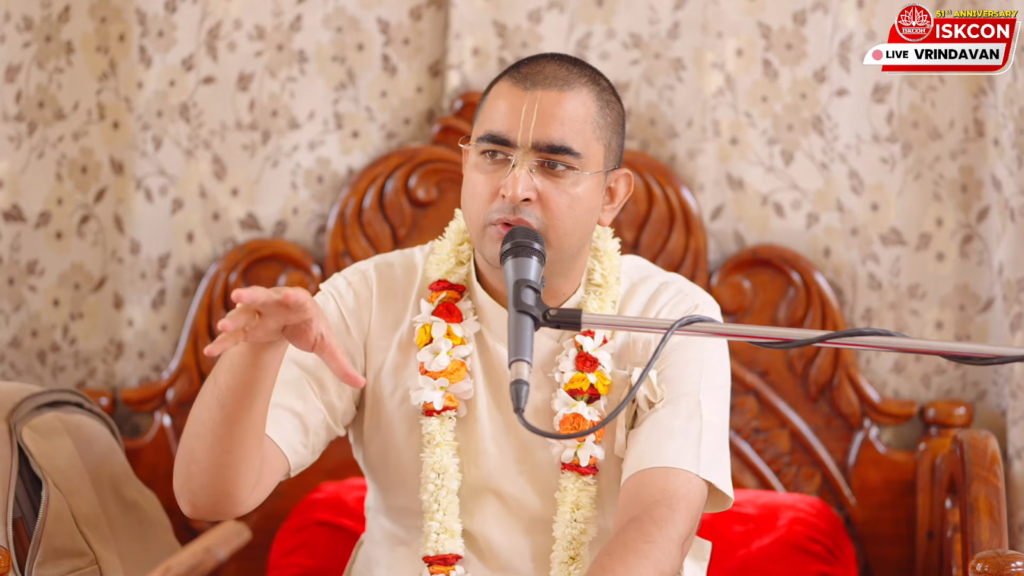
An archived entry from Hungary dated July 12, 2026 identifies a discussion of Bṛhad-Bhāgavatāmṛta 1.2.71–77, also searchable as Brihad Bhagavatamrita 1.2.71–77. The supplied WordPress body, however, contains only a video thumbnail; it provides no transcript, speaker attribution, or written exposition. To preserve academic accuracy, this study does not invent statements from the recording. It instead examines the named Sanskrit passage, its narrative setting, its principal terms, its connections with the Bhāgavata Purāṇa, and its practical implications.
Read as a unit, these seven verses form a tightly constructed confession spoken by Brahmā. Cosmic authority, delegated power, pride, accountability, devotional humility, and Kṛṣṇa’s Vṛndāvana pastimes all converge in a single argument: institutional rank does not automatically produce spiritual discernment. The passage becomes emotionally compelling because Brahmā does not criticize pride from a safe distance. He identifies its consequences in his own decisions and finally recalls the moment when his celebrated intelligence failed before the apparently ordinary play of a cowherd child.
Why this passage matters
Bṛhad-Bhāgavatāmṛta is a sixteenth-century Sanskrit theological narrative composed by Sanātana Gosvāmī, one of the formative thinkers of Caitanya or Gauḍīya Vaiṣṇavism. It should not be confused with the earlier Bhāgavata Purāṇa. Sanātana’s work is a later, highly structured exploration of bhakti that continually interprets Purāṇic narratives through questions of divine grace, devotional relationship, and spiritual intimacy. Its place within the wider Caitanya Vaiṣṇava tradition is outlined by the St Andrews Encyclopaedia of Theology.
Part One is framed as King Parīkṣit’s response to his mother Uttarā. Within that frame, Nārada travels from one revered figure to another while seeking the person who has received the fullest measure of Bhagavān’s mercy. The journey is not a ladder built to ridicule earlier devotees. Each encounter discloses a different form of devotion, and each honored figure redirects praise toward someone considered more deeply absorbed in loving service. Self-effacement therefore drives the narrative forward.
Chapter Two, called Divya, moves through the celestial plane. Indra directs Nārada toward Brahmā, and Nārada praises Brahmā’s creative office, scriptural knowledge, longevity, and apparent proximity to the Divine. Brahmā rejects the assumption that cosmic prominence proves exceptional grace. His response exposes a recurrent human error: visible power is easily mistaken for inner realization.
The verses immediately preceding 1.2.71 recall Brahmā’s boon to Hiraṇyakaśipu, the persecution of Prahlāda, the appearance of Nṛsiṃha, and the warning that such protection should not again be given to destructive beings. Verse 71 begins with tathāpi, meaning nevertheless or even so. That small connective word is essential. Brahmā is not describing an isolated mistake; he is admitting that clear correction did not prevent repetition.
The Sanskrit text below follows the linked online edition and its division of verses. The English explanations are fresh prose renderings rather than a reproduction of any one published translation. Traditional mappings supplied by the Dig-darśinī commentary are compared with parallel episodes in the Bhāgavata Purāṇa. Where the sources emphasize an event differently, that tension remains visible instead of being artificially harmonized.
Verse 71 — A warning ignored
तथापि रावणादिभ्यो दुष्टेभ्योऽहं वरानदाम् ।
रावणस्य तु यत् कर्म जिह्वा कस्य गृणाति तत् ॥ ७१ ॥
tathāpi rāvaṇādibhyo duṣṭebhyo’haṃ varānadām |
rāvaṇasya tu yat karma jihvā kasya gṛṇāti tat || 71 ||
Text and traditional commentary for verses 67–71
A close prose rendering is: Nevertheless, Brahmā gave boons to harmful figures such as Rāvaṇa. Who could adequately recount the deeds Rāvaṇa then performed? The verse is concise, but its first-person verb carries considerable weight. Brahmā does not hide behind procedure, destiny, or the recipient’s later choices. He names himself as the one who conferred the empowering boon.
The logical force of tathāpi makes the admission more serious. A first mistake may arise from incomplete information; a repeated mistake after explicit warning indicates a failure to integrate knowledge into conduct. The distinction resembles the difference between possessing information and cultivating viveka, discriminating judgment. Brahmā had received the lesson intellectually, yet it had not become a reliable restraint on the exercise of power.
Purāṇic boons often dramatize a rule-governed cosmos in which austerity, vows, office, and merit can generate real capacity. The recipient’s moral character does not automatically grow at the same rate as that capacity. Verse 71 therefore raises a durable problem in political theory and institutional ethics: systems may reward discipline or achievement while failing to ask whether the resulting authority will be used responsibly.
Rāvaṇa has complex profiles across Sanskrit and regional Rāmāyaṇa traditions, including learning, ascetic achievement, devotion, kingship, desire, violence, and catastrophic pride. This verse is not a complete biography and should not be used to erase that literary diversity. Within this particular argument, Rāvaṇa functions as evidence that power granted without adequate moral safeguards can magnify harm. The rhetorical question about whose tongue could recount his actions communicates moral excess, not a lack of narrative sources.
Verse 72 — Pride destroys discernment
मया दत्ताधिकाराणां शक्रादीनां महा-मदैः ।
सदा हत-विवेकानां तस्मिन्न् आगांसि संस्मर ॥ ७२ ॥
mayā dattādhikārāṇāṃ śakrādīnāṃ mahā-madaiḥ |
sadā hata-vivekānāṃ tasminn āgāṃsi saṃsmara || 72 ||
Text and traditional commentary for verses 72–75
The verse asks Nārada to remember the offenses against Bhagavān committed by Śakra, another name for Indra, and other officials to whom Brahmā had given authority. Their immense pride had repeatedly struck down their discernment. The passage consequently moves from a single dangerous boon to a wider administrative system.
Several Sanskrit expressions establish the argument with unusual precision. Mayā means by Brahmā or through Brahmā’s agency. Datta-adhikāra describes those to whom jurisdiction, office, or authorized competence had been given. Mahā-mada is not merely confidence; it is an intoxicating pride produced by greatness, possession, or rank. Hata-viveka depicts discernment as struck down or disabled. Āgāṃsi refers to offenses or transgressions, while the imperative saṃsmara asks Nārada to remember them carefully.
Pride is therefore presented as a cognitive failure as well as a moral one. It changes what an authority figure can notice, how criticism is interpreted, and which consequences remain visible. A leader intoxicated by office may still possess intelligence, technical skill, or ritual standing, yet lose the practical discrimination needed to use those capacities well.
Brahmā’s confession also introduces supervisory responsibility. He does not claim that every act of an appointee was directly performed by him, nor does the verse establish unlimited collective guilt. It does show that delegation cannot be used as a complete moral shield. The person who creates an office, selects its holder, supplies its authority, or ignores predictable misuse retains a duty of oversight and correction.
The text does not condemn hierarchy in itself. Brahmā’s cosmic administration requires differentiated functions. Its concern is the conversion of functional authority into self-exalting identity. Adhikāra becomes dangerous when its holder forgets that authority is received, bounded, and answerable to a purpose beyond personal prestige.
Verse 73 — Indra, Varuṇa, and the misuse of office
वृष्टि-युद्धादिनेन्द्रस्य गोवर्धन-मखादिषु ।
नन्दाहरण-बाणीय-धेन्व्-अदानादिनाप्-पतेः ॥ ७३ ॥
vṛṣṭi-yuddhādinendrasya govardhana-makhādiṣu |
nandāharaṇa-bāṇīya-dhenv-adānādināp-pateḥ || 73 ||
This densely compounded verse recalls Indra’s rain assault and conflict surrounding the Govardhana rite, the water-lord Varuṇa’s connection with the seizure of Nanda, and a Bāṇa-related failure to return cows. The grammar continues the command in verse 72: these incidents are examples Nārada is asked to remember. Repeated forms of ādi, meaning and so forth, show that the list is illustrative rather than exhaustive.
The Govardhana narrative is developed in Bhāgavata Purāṇa 10.24 and 10.25. Kṛṣṇa redirects the cowherd community’s ritual attention toward Govardhana and its immediate ecology. Indra interprets the change as an injury to his honor and deploys destructive rain against a dependent population. Kṛṣṇa protects the community by lifting Govardhana, and Indra eventually recognizes that pride distorted his judgment.
The compound vṛṣṭi-yuddha, a battle by means of rain, is ethically significant. Rain is ordinarily the life-sustaining gift associated with Indra’s office. Under wounded pride, the same capacity becomes a weapon. The problem is not power alone but the inversion of its purpose: a protective function is turned against those it should sustain.
The Nanda episode appears in Bhāgavata Purāṇa 10.28. That account says a servant of Varuṇa seized Nanda after he entered the water at a ritually irregular time, and Kṛṣṇa then recovered him. Bṛhad-Bhāgavatāmṛta compresses the event under the water-lord’s domain. The difference reinforces the passage’s administrative logic: a ruler may be implicated in what authorized agents do, even when the ruler did not personally execute the act.
The compact expression concerning Bāṇa and the cows is less transparent without commentary. The traditional gloss reads it as a refusal associated with Bāṇa to restore all the cows. Because the Sanskrit compresses several episodes and relationships into compounds, that identification should be presented as a received commentarial explanation rather than embellished with unsupported detail.
Indra’s later humility and Varuṇa’s reverence are as important as their errors. These figures are not permanently reduced to their failures. The narratives retain the possibility of recognition, surrender, and restored service. Accountability in bhakti literature can therefore be severe without becoming a doctrine of permanent exclusion.
Verse 74 — Responsibility across relationships
यमस्य च तद्-आचार्यात्मज-दुर्मारणादिना ।
कुबेरस्यापि दुश्चेष्ट-शङ्खचूड-कृतादिना ॥ ७४ ॥
yamasya ca tad-ācāryātmaja-durmāraṇādinā |
kuberasyāpi duśceṣṭa-śaṅkhacūḍa-kṛtādinā || 74 ||
The verse adds Yama’s connection with the improper death of Kṛṣṇa’s teacher’s son and Kuvera’s connection with the misconduct of Śaṅkhacūḍa. Its compressed logic continues to test office by the behavior occurring within its sphere. Authority is evaluated through relationships, not simply through formal titles.
The expression tad-ācārya-ātmaja means the son of His teacher, while dur-māraṇa suggests a bad, wrongful, or untimely death. The parallel narrative in Bhāgavata Purāṇa 10.45 is more nuanced: Sāndīpani Muni’s son dies near the ocean, Kṛṣṇa and Balarāma search for him, and Yamarāja obediently returns him when commanded. The Bṛhad-Bhāgavatāmṛta passage assigns stronger rhetorical responsibility to Yama’s domain than the parallel chapter assigns to Yama’s personal intention.
That difference should not be concealed. Sanātana’s immediate purpose is Brahmā’s confession about the failures of an administrative order; the Bhāgavata Purāṇa chapter emphasizes guru-dakṣiṇā, Kṛṣṇa and Balarāma’s devotion to their teacher, and their power to restore the son. A careful reading allows each narrative to retain its own rhetorical focus.
The Kuvera example is more directly supported by Bhāgavata Purāṇa 10.34, which identifies Śaṅkhacūḍa as Kuvera’s servant. Śaṅkhacūḍa attempts to abduct the women of Vraja while Kṛṣṇa and Balarāma are present. Verse 74 treats the subordinate’s misconduct as relevant to the superior’s moral record. Once again, the focus is not inherited guilt but neglected responsibility within a chain of service.
Modern institutions can recognize the same distinction. A supervisor is not automatically the direct perpetrator of every subordinate’s action, but remains responsible for selection, incentives, boundaries, reporting mechanisms, and meaningful remedies. The verse asks whether power has been organized so that abuse is restrained rather than quietly enabled.
Verse 75 — Hostility, ingrained anger, and interpretive caution
अधो-लोके तु दैतेया वैष्णव-द्रोह-कारिणः ।
सर्पाश् च सहज-क्रोध-दुष्टाः कालिय-बान्धवाः ॥ ७५ ॥
adho-loke tu daiteyā vaiṣṇava-droha-kāriṇaḥ |
sarpāś ca sahaja-krodha-duṣṭāḥ kāliya-bāndhavāḥ || 75 ||
The verse turns toward beings in the cosmological lower realms who act with hostility toward Vaiṣṇavas, together with serpents related to Kāliya and characterized within the narrative by deeply rooted anger. Adho-loka denotes a lower or subterranean cosmic region; it should not automatically be equated with an eternal hell, still less with any modern country, ethnicity, caste, or religious community.
Vaiṣṇava-droha-kāriṇaḥ identifies conduct directed against devotees. The ethical center is active hostility, not biological identity. Likewise, sahaja-krodha can suggest anger that has become naturalized or ingrained. When the verse is applied beyond its mythic setting, the relevant question concerns habits of anger and persecution. It must not become a pretext for labeling contemporary human groups as inherently demonic or serpentine.
The broader Kāliya narrative also resists a purely punitive reading. Kāliya poisons the Yamunā and threatens the ecology of Vraja, but after Kṛṣṇa subdues him and hears the prayers of his wives, Kāliya is spared and instructed to depart. Justice protects the community and restores balance while still allowing transformation. That restorative conclusion is indispensable for a blog committed to harmony among dharmic traditions.
Verse 75 consequently warns about the point at which anger becomes identity. When resentment is repeatedly rehearsed, cruelty can feel normal and discrimination can appear righteous. The text’s challenge is to interrupt that process through discernment, restraint, accountability, and the recognition that even a deeply disordered actor may be capable of change.
Verse 76 — Brahmā’s own test of Kṛṣṇa
सम्प्रत्य् अपि मया तस्य स्वयं वत्सास् तथार्भकाः ।
वृन्दावने पाल्यमाना भोजने मायया हृताः ॥ ७६ ॥
sampraty api mayā tasya svayaṃ vatsās tathārbhakāḥ |
vṛndāvane pālyamānā bhojane māyayā hṛtāḥ || 76 ||
Text and traditional commentary for verse 76
Brahmā now stops listing the failures of others. He admits that, even recently, he used his own mystic power to take away the calves and young cowherd boys under Kṛṣṇa’s care while Kṛṣṇa was eating in Vṛndāvana. The movement from their offenses to his own is structurally decisive. Genuine accountability eventually crosses the boundary between criticizing a system and confessing personal participation in it.
The verse contains an elegant verbal contrast: mayā, by Brahmā, and māyayā, by means of māyā or mystic power. The similarity of sound links agent and instrument. Brahmā acted, and he acted through a capacity he believed he controlled. The construction gives him no room to treat bewilderment as an impersonal accident.
The full Brahmā-vimohana-līlā unfolds in Bhāgavata Purāṇa 10.13. Kṛṣṇa and the boys share a joyful forest lunch. When Kṛṣṇa goes to search for wandering calves, Brahmā conceals both the calves and the boys in an attempt to test Kṛṣṇa’s power. Kṛṣṇa responds by expanding as every missing calf and child, reproducing their forms, voices, habits, possessions, and relationships.
The response is not merely a competitive display of greater magic. For an entire human year, the families of Vraja care for forms who are Kṛṣṇa Himself. The mothers’ affection for their sons and the cows’ affection for their calves deepen. A disruption caused by Brahmā’s experiment becomes an expansion of loving relationship. The theological answer to control is not only superior power but more abundant care.
The episode also plays with different scales of time. What appears brief from Brahmā’s celestial perspective encompasses a year in Vraja. His failure is therefore temporal as well as epistemic: he cannot adequately measure the world he has attempted to manipulate. Readers who have watched a seemingly minor decision reshape another person’s life may recognize the ethical force of that contrast.
Māyā requires contextual precision. Here it refers first to Brahmā’s limited power of concealment and then, in the wider narrative, to the divine potency that exceeds and redirects it. This usage should not be carelessly merged with every Advaita, Sāṅkhya, Buddhist, or popular definition of illusion. The verse operates within a specific Gauḍīya Vaiṣṇava theology in which Kṛṣṇa’s personal form and Vraja relationships are not dismissed as unreal.
Brahmā represents cosmic intelligence and aiśvarya, majestic power. Kṛṣṇa appears in gopa-bālaka-līlā, the intimate play of a cowherd boy. Gauḍīya theology often describes this intimacy as mādhurya, divine sweetness that can conceal majesty without lacking it. Verse 76 prepares the reversal in which the guardian of a universe cannot comprehend a child holding food among friends.
Verse 77 — Wonder, fear, prayer, and a humbled intellect
ततो वीक्ष्य महाश्चर्यं भीतः स्तुत्वा नमन्न् अपि ।
धृष्टोऽहं वञ्चितस् तेन गोप-बालक-लीलया ॥ ७७ ॥
tato vīkṣya mahāścaryaṃ bhītaḥ stutvā namann api |
dhṛṣṭo’haṃ vañcitas tena gopa-bālaka-līlayā || 77 ||
Text and traditional commentary for verse 77
After seeing the astonishing revelation, Brahmā becomes afraid, offers praise, and bows. Even so, he describes himself as audacious and says that Kṛṣṇa’s cowherd-boy pastime has foiled or outmaneuvered him. The confession reaches its climax not when Brahmā loses power, but when he finally understands the disproportion between his power and his knowledge.
The grammar traces a spiritual sequence. Vīkṣya means having seen; mahāścaryam is a great wonder; bhītaḥ means frightened; stutvā means having praised; and naman depicts bowing. Yet dhṛṣṭaḥ aham remains: Brahmā recognizes his own audacity. External reverence becomes meaningful because it is joined to an internal revision of self-understanding.
Vañcita can be translated as cheated or deceived, but those English words may imply unethical dishonesty if removed from devotional context. Here the force is better understood as baffled, defeated in presumption, or denied the recognition expected by status. Kṛṣṇa’s uninterrupted cowherd play refuses to treat Brahmā’s cosmic office as the center of the scene. The test is answered without allowing the tester to control the terms of the answer.
Bhāgavata Purāṇa 10.14 records Brahmā’s extended prayers and his recognition of the extraordinary fortune of Vraja’s residents. The next verse of Bṛhad-Bhāgavatāmṛta, just beyond the assigned range, likewise acknowledges the grace of entering Vraja and receiving Kṛṣṇa’s glance. Verse 77 should therefore not be read as a final claim that mercy was absent. Its language is the heightened self-assessment of a devotee whose pride has been exposed.
This distinction separates humility from shame. Shame declares the person irredeemably worthless; humility accurately locates finite ability within a larger reality. Brahmā does not cease to have a cosmic function. He learns that function is not sovereignty, intelligence is not omniscience, and prayer is not a technique for compelling divine acknowledgment.
Seven powerful lessons from Bṛhad-Bhāgavatāmṛta 1.2.71–77
1. Authority is a moral trust. Brahmā repeatedly describes power as something granted or delegated. A boon, jurisdiction, leadership role, scholarly credential, or spiritual office is therefore not private property. Its legitimacy depends on whether it serves the purpose for which it was received.
2. Pride damages perception before it damages reputation. The phrase hata-viveka reveals why pride is dangerous. Long before public collapse, intoxication with status narrows attention, suppresses corrective evidence, and turns disagreement into insult. The first casualty is discernment.
3. Spiritual prominence is not identical with devotion. Nārada praises Brahmā’s visible achievements, but Brahmā evaluates himself through responsiveness to Bhagavān and care for devotees. The narrative asks readers to distinguish sacred appearance, institutional office, intellectual mastery, and actual transformation.
4. The treatment of vulnerable relationships tests power. Cowherd families threatened by rain, Nanda seized by an official, women endangered by Śaṅkhacūḍa, a teacher grieving for his son, and calves and children taken during lunch all occupy the moral foreground. Grandeur is judged by its effect on those with less power.
5. Repentance becomes credible when it is specific. Brahmā names boons, appointments, agents, incidents, and his own intervention in Vraja. Vague regret can preserve the very self-image it appears to surrender. Specific recollection makes repair, safeguards, and changed conduct possible.
6. Wonder can correct an overconfident intellect. Mahāścarya, great astonishment, interrupts Brahmā’s attempt to master Kṛṣṇa through experiment. Wonder is not anti-intellectual. It is the recognition that evidence has exceeded a framework and that the framework must change.
7. Divine intimacy can exceed cosmic grandeur. The decisive revelation occurs during a child’s forest lunch, not in an imperial court. The image of Kṛṣṇa among friends shows why bhakti places such value on relationship, service, affection, and presence. The ordinary-looking scene contains a reality Brahmā’s cosmic categories cannot measure.
Practical applications for leadership, scholarship, and spiritual life
For institutional leaders, the passage suggests a rigorous accountability audit. Every significant authority can be examined through five questions: Who granted it? What purpose is it meant to serve? What incentives shape the conduct of subordinates? Which people bear the risks of failure? What remedy exists when the system causes harm? Delegation without oversight repeats the structure Brahmā regrets.
For scholars and teachers, the verses demonstrate why textual layers matter. The Sanskrit base text, Sanātana’s theological argument, the Dig-darśinī commentary, modern translations, and parallel Bhāgavata Purāṇa episodes should not be flattened into one undifferentiated account. The Yama episode especially shows that responsible interpretation sometimes preserves a difference rather than forcing every source to say exactly the same thing.
For practitioners, humility should lead toward repair rather than passivity. Brahmā’s example suggests a movement from remembering an ignored warning, to naming a harmful decision, to recognizing the role of pride, to bowing before a reality larger than the self. In contemporary life, that sequence may require apology, restitution, changed safeguards, renewed study, or willingness to receive criticism without retaliation.
For families and communities, the forest lunch offers a gentler but equally demanding insight. The most spiritually revealing moments may occur in caregiving, friendship, shared food, protection, and patient attention. Public prestige can distract from these relationships, while bhakti repeatedly returns value to the apparently small acts through which trust is sustained.
The passage can also support respectful unity across dharmic traditions without pretending that their doctrines are identical. Hindu bhakti vocabulary connects mada with the loss of viveka. Buddhist traditions analyze māna, conceit, and avidyā, ignorance. Jain traditions examine the kaṣāyas, passions such as anger and pride that bind and distort conduct, while anekāntavāda encourages disciplined awareness of partial viewpoints. Sikh teachings critique haumai, self-centered ego, and elevate sevā, service. These are meaningful ethical parallels, not interchangeable metaphysical systems.
Dharmic unity is strengthened when traditions meet through intellectual honesty, nonviolence, humility, and mutual service. It is weakened when mythic categories such as asura, serpent, or offender are mapped onto modern communities to justify hostility. Verse 75 identifies harmful conduct within a sacred narrative; it does not authorize collective hatred toward Hindus, Buddhists, Jains, Sikhs, or followers of any other path.
A disciplined seven-day reflection can make the textual sequence practical. On the first day, verse 71 can prompt examination of a warning that was understood but not followed. On the second, verse 72 can be used to map delegated authority and its consequences. Verse 73 can expose retaliatory uses of legitimate power, while verse 74 can illuminate indirect responsibility. Verse 75 can reveal anger that has become habitual. Verse 76 can recall an attempt to control what was not understood. Verse 77 can conclude the week with wonder, acknowledgment, and a concrete act of repair.
Several questions help keep that exercise grounded: Which role or achievement is most easily confused with personal worth? Whose feedback becomes difficult to hear when pride is activated? Who absorbs the consequences of decisions made from above? What would specific accountability require? Which ordinary relationship currently deserves more reverence than public status receives?
The enduring insight
Brahmā’s awakening is not a theatrical humiliation imposed for its own sake. It is a conversion of authority into service. The cosmic creator remains a servant within a reality he did not originate and cannot fully encompass. His dignity is ultimately preserved not by defending infallibility, but by becoming capable of confession, astonishment, prayer, and renewed discernment.
The passage leaves a memorable contrast: Brahmā arrives with cosmic intelligence and mystic power, while Kṛṣṇa stands as a cowherd child concerned with friends and calves. The apparent simplicity of the scene defeats the presumption that greatness must always look grand. For spiritual communities, scholars, and leaders alike, the resulting lesson is exacting and hopeful: power can be corrected, pride can yield to viveka, and accountability can become the beginning of deeper bhakti.
Research sources
The principal textual sources are the online edition and commentary for verses 67–71, verses 72–75, verse 76, and verse 77. The surrounding narrative can be reviewed in the complete Chapter Two presentation.
Parallel narrative context appears in Bhāgavata Purāṇa 10.13 and 10.14 for Brahmā’s bewilderment and prayers; 10.24 and 10.25 for Govardhana; 10.28 for Nanda and Varuṇa; 10.34 for Śaṅkhacūḍa; and 10.45 for Sāndīpani Muni’s son. These references establish the verifiable textual basis of the study while avoiding unsupported claims about the untranscribed Hungary recording.
Inspired by this post on Dandavats.







Leave a Reply
You must be logged in to post a comment.