
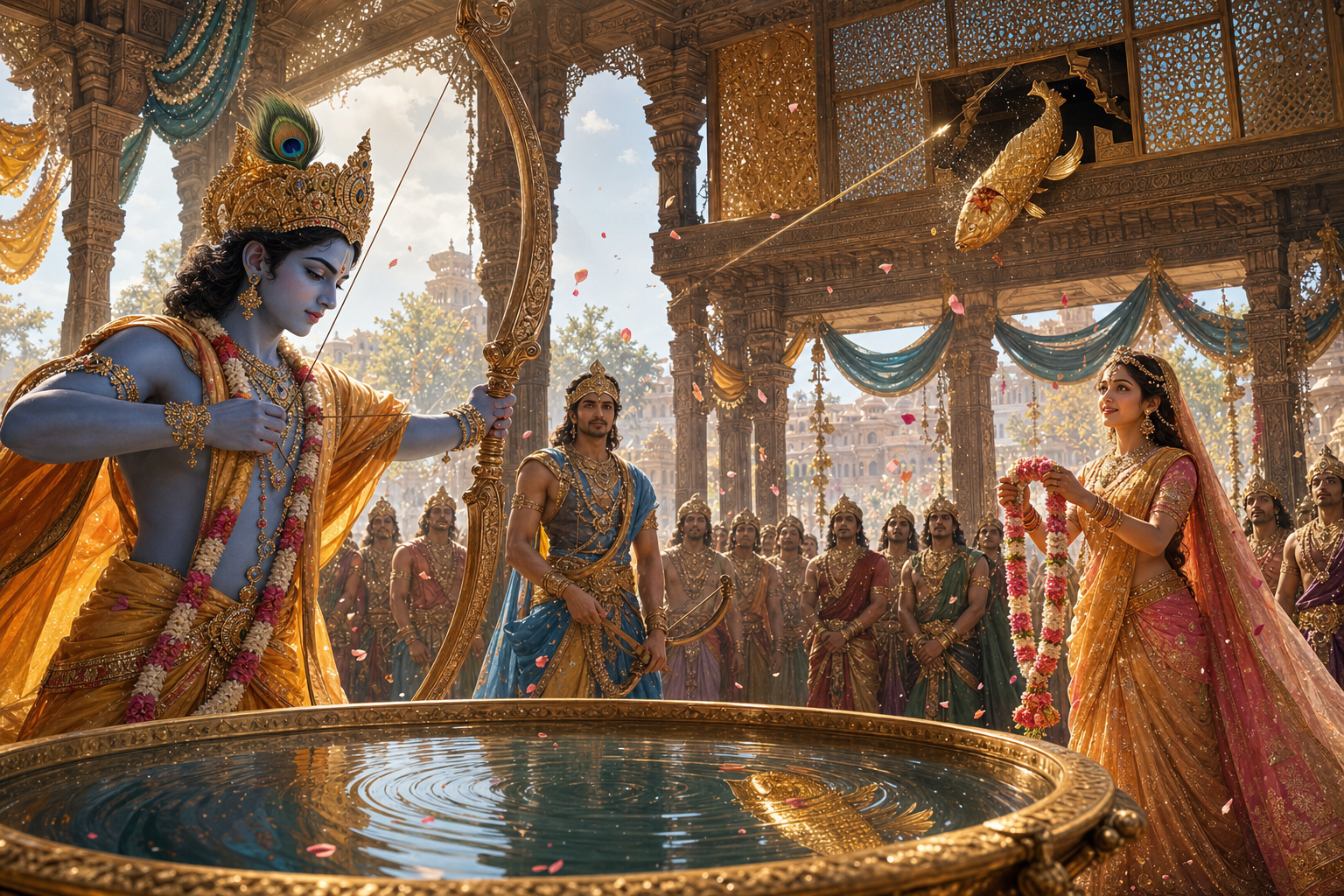
The celebrated fish-eye trial at Draupadi’s swayamvara has made Arjuna an enduring symbol of concentration, technical discipline, and martial excellence. Yet a less frequently discussed passage in the Bhagavata Purana presents an even more demanding archery contest. At the swayamvara of Lakshmana, one of Bhagavan Krishna’s principal queens, the target was completely concealed. The archer could see only its reflection in water. Arjuna came remarkably close, but his arrow merely grazed the hidden fish. Krishna then lifted the bow, strung it effortlessly, looked at the reflection once, and brought the target down with a single shot.
The central claim requires precision. The episode does not establish a universal ranking in which every achievement of Krishna and Arjuna can be reduced to a contest between rival athletes. It records something narrower and more meaningful: in this particular trial, under conditions deliberately made harder than those associated with Draupadi’s swayamvara, Krishna completed the task that Arjuna narrowly failed to complete. The comparison therefore concerns one clearly defined feat of Bhagavan Krishna’s archery, not a dismissal of Arjuna’s stature as one of the Mahabharata’s greatest warriors.
The primary textual setting is found in the Bhagavata Purana, Canto 10, Chapter 83. During a gathering of Krishna’s relatives and companions, Draupadi asks his queens to explain how their marriages took place. Their responses form a sequence of personal testimonies embedded within the larger sacred narrative. Lakshmana’s account occupies verses 17–39, while the decisive archery contest is described most directly in verses 19–26. This narrative frame matters because the story is presented through Lakshmana’s remembered experience rather than as an isolated catalogue of Krishna’s victories.
Lakshmana, whose name is also transliterated as Lakṣmaṇā, should not be confused with Lakshmana, the brother of Sri Rama in the Ramayana. She is identified as the daughter of King Brihatsena and is conventionally included among Krishna’s Ashta Bharya, or eight principal queens. The expression Ashta Bharya is a later classificatory label: ashta means eight, while bharya denotes a wife or consort. The Bhagavata passage itself is more interested in the devotion and distinctive history of each queen than in turning them into a simple numerical list.
Lakshmana begins her account not with the bow but with an interior choice. She explains that she had repeatedly heard Narada describe the appearances and deeds of Acyuta, an epithet of Krishna meaning the infallible or unfallen one. Through this sustained hearing, her mind became fixed on Mukunda. King Brihatsena understood his daughter’s preference and arranged a swayamvara whose challenge could bring that intention to fulfilment. The contest was therefore not an arbitrary exhibition of strength. Within the logic of the narrative, it connected Lakshmana’s prior choice, her father’s affection, royal custom, and the public demonstration of exceptional ability.
The hidden fish made this trial extraordinary. Lakshmana explicitly compares her contest with Draupadi’s swayamvara. Both employed a fish as the elevated target, but her fish was covered on every side. It could not be inspected directly from the shooting position. Its presence and location were available only through its reflected image in a vessel of water below. The contestant consequently had to coordinate two directions at once: vision was directed downward toward the reflection, while the arrow had to travel upward toward an unseen physical object.
This arrangement imposed more than a test of sharp eyesight. A reflection supplies information about a target, but it does not occupy the target’s actual position. The reflected fish is a virtual image created by light returning from the water’s surface. An archer cannot simply shoot toward that visible image, because the arrow must intercept the real fish above. The shooter must infer the hidden target’s location from reversed visual information and then translate that inference into the orientation of the bow. Any error in estimating the geometry becomes increasingly significant as the distance between archer and target grows.
The surface of the water adds another layer of difficulty. A calm surface can behave approximately like a plane mirror, but even slight movement changes the angles at which light reaches the observer. Ripples, vibration, the surrounding crowd, or movement near the vessel could make the image fluctuate. The text does not provide enough engineering detail to reconstruct the apparatus, so claims about its exact dimensions would be speculative. Nevertheless, the stated conditions are sufficient to show that the trial combined indirect perception, spatial calculation, controlled movement, and a precisely timed release.
The bow itself constituted a separate test. Before an arrow could be aimed, the contestant had to lift and string a weapon powerful enough to defeat many celebrated kings. A drawn bow stores elastic potential energy. In mechanical terms, the stored energy can be represented approximately by the integral of draw force over draw distance, E = ∫F(x)dx. Greater draw force can deliver more energy to the arrow, but it also demands greater strength and stability from the archer. Raw power without coordinated posture may cause the bow to twist, rebound, or pull the body out of alignment.
The Bhagavata describes precisely such failures. Some contestants could lift the bow but could not string it. Others drew the string toward the bow tip, only for the weapon to spring back and knock them down. These details distinguish several levels of competence: approaching the apparatus, controlling the bow, stringing it, finding the hidden target, releasing accurately, and finally piercing it. Success required the entire chain. Excellence at one stage did not compensate for failure at another.
News of the swayamvara drew kings and military teachers from many regions. Brihatsena received the participants according to their seniority and strength, after which they attempted the challenge in the assembly. The named contenders included Jarasandha, Shishupala, Bhima, Duryodhana, Karna, and the king of Ambashtha. These were not inexperienced spectators. Several succeeded in stringing the formidable bow, yet the Bhagavata states that they could not determine the target’s position.
The distinction between strength and perception is essential. Jarasandha, Bhima, Duryodhana, Karna, and the others possessed formidable martial reputations, but the concealed target neutralized reputation. The apparatus did not respond to lineage, confidence, or intimidation. It demanded verifiable performance under the same conditions for every contestant. The scene thereby turns royal pride into a technical question: could the archer convert a fleeting reflection into one exact and irreversible movement?
Arjuna advanced farther than every other human competitor. Bhagavata Purana 10.83.24 states that he studied the fish’s reflection, determined its location, took careful aim, and released his arrow. He solved the perceptual problem that had defeated the other kings. His shot reached the real target, demonstrating that his inference was substantially correct. It did not, however, pierce the fish. The arrow touched or grazed it. The difference between near success and success was therefore extremely small, but the condition of the swayamvara was exact: the target had to be pierced and brought down.
This near miss should not be narrated as incompetence. On the contrary, it heightens Arjuna’s reputation by showing how far he progressed under nearly impossible conditions. Every earlier failure establishes the severity of the test, while Arjuna’s grazing shot establishes its outer human limit within this account. He alone among the named challengers before Krishna is described as locating and physically contacting the target. The narrative creates a carefully graded ascent from inability, to strength, to perception, to near-perfect accuracy, and finally to Krishna’s decisive completion.
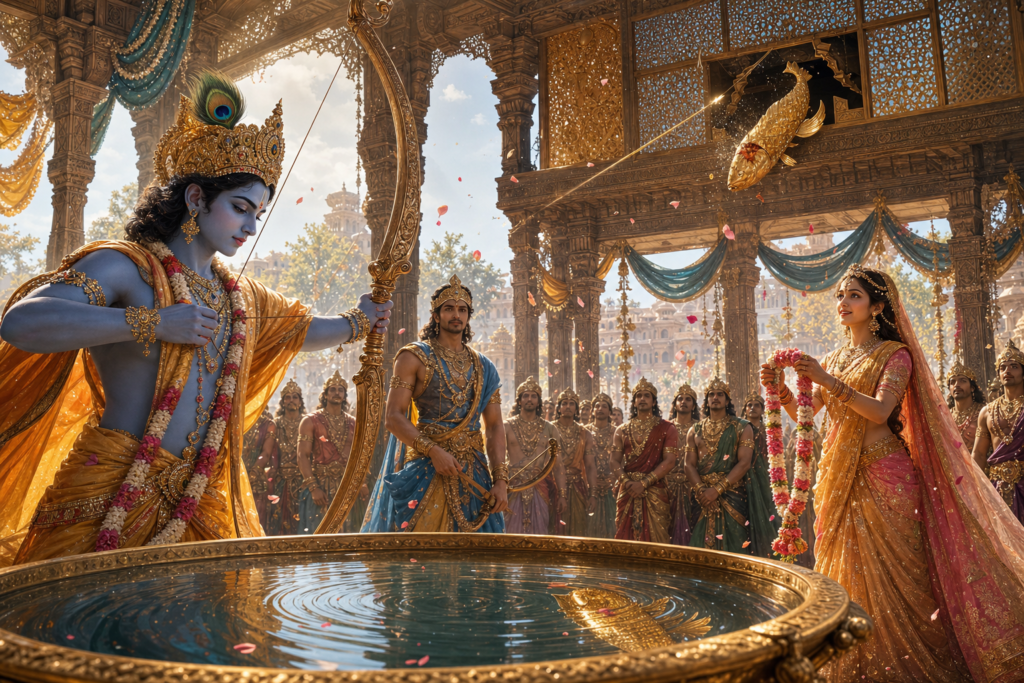
Krishna’s performance is described with striking economy. After the proud kings had abandoned their attempts, Bhagavan Krishna took up the bow. He strung it with apparent ease, placed an arrow upon it, glanced only once at the fish’s image in the water, and pierced the concealed target. The arrow caused the fish to fall. The contrast is deliberate: the other contestants struggle with separate components of the task, Arjuna studies and nearly succeeds, but Krishna unites strength, perception, calculation, and release in one uninterrupted action.
The text places the successful shot while the sun was situated in Abhijit. In the translation and commentarial tradition associated with verses 25–26, Abhijit marks an auspicious period connected with victory. A later explanation attributed to Vishvanatha Chakravarti further identifies the moment with high noon, when intense overhead light would make the reflected target harder to discern. The astronomical or ritual notation should be distinguished from the core mechanical facts, but it contributes to the scene’s symbolism: Krishna acts at the moment named for victory and succeeds without hesitation.
The response is immediate. Celestial drums sound, flowers are said to fall, and the assembly cries Jaya! Jaya! Lakshmana then enters the ceremonial ground, looks across the assembled kings, and places her necklace or garland upon Krishna. Her action completes the swayamvara. The shot establishes qualification, but Lakshmana’s public selection establishes the marriage. Treating her merely as a prize would erase the narrative’s opening premise: her preference for Krishna existed before the contest, was known to her father, and was openly affirmed after the victory.
The contest does not end all opposition. Several kings, unable to accept Lakshmana’s decision, become hostile. Krishna places her on his chariot, prepares for battle, and defeats those who attempt to stop their departure. Daruka drives the chariot, and the Bhagavata describes Krishna taking up his own bow, Śārṅga. The couple then proceeds to Kuśasthalī, another name used for Dvārakā in the passage, where their arrival is celebrated.
A technical textual distinction is important here. The bow used to strike the fish is introduced simply as the contest bow provided at the swayamvara. The narrative names Śārṅga only afterward, when Krishna arms himself against the pursuing kings. It is therefore unwarranted to state confidently that the fish was pierced with Śārṅga. Keeping the two moments separate prevents devotional familiarity with Krishna’s famous weapon from being inserted into a verse that does not explicitly identify it.
How did Lakshmana’s trial differ from Draupadi’s? Popular memory often depicts Draupadi’s swayamvara as requiring Arjuna to pierce the eye of a rotating fish while looking exclusively into water or oil. That familiar image is culturally powerful, but descriptions vary among recensions, translations, and retellings of the Mahabharata. In the English translation of the Adi Parva’s Swayamvara Parva, King Drupada constructs a stiff bow, suspends a mark above a mechanical device, and requires the contestant to send five arrows through the device’s opening. That passage does not provide every detail found in later visual retellings.
The Bhagavata Purana itself supplies the clearest comparison relevant to Lakshmana. It acknowledges that a fish was used to secure Arjuna at Draupadi’s swayamvara, but then introduces a contrast: Lakshmana’s target was covered externally and could be seen only in water. The word translated as “however” marks the distinction. Whatever form of the Draupadi tradition a reader follows, the Puranic narrator intends Lakshmana’s target to be understood as more completely hidden.
A commentary associated with Bhagavata Purana 10.83.19 and attributed to Sridhara Svamin makes the comparison more explicit. It explains that the target at Draupadi’s swayamvara was only partially obscured, allowing its position to be checked by looking upward along the supporting structure. Lakshmana’s fish, by contrast, required the archer to obtain visual information below while directing the shot above. Within that theological interpretation, the challenge demanded what no ordinary mortal could perfectly accomplish, thereby preparing the narrative for Krishna’s success.
From the standpoint of archery, the difficulty can be divided into four interacting problems. First, the bow had to be strung without loss of bodily control. Second, the virtual image had to be read correctly despite reversed and potentially unstable visual information. Third, the position of the hidden object had to be inferred without direct confirmation. Fourth, the arrow had to be released along a trajectory precise enough to pierce rather than merely touch the target. Arjuna completed the first three to a remarkable degree; Krishna completed all four.
Minor angular errors explain why a near-perfect solution can still fail. At the bow, an almost imperceptible change in wrist alignment, anchor position, release timing, or inferred elevation can become a visible displacement at the target. Because Lakshmana’s fish could not be inspected directly, the archer also lacked the ordinary feedback used to correct aim at the final instant. Arjuna’s grazing shot is consequently plausible within the narrative’s technical design: the location was correctly inferred, but the margin required for penetration was not achieved.
Krishna “surpassed” Arjuna only in the properly bounded sense. Krishna produced the successful result after Arjuna’s near success in the same contest. The episode does not say that Arjuna lacked knowledge, courage, or discipline. Nor does it invite contempt for him. A rigorous reading should avoid converting a subtle hierarchy of achievement into partisan rivalry. The story’s force depends upon Arjuna being extraordinarily capable; if he were an insignificant archer, Krishna’s accomplishment would reveal little about the target’s difficulty.
Some modern retellings claim that Arjuna missed intentionally so that Krishna could marry Lakshmana. That explanation is not stated in Bhagavata Purana 10.83.24. The verse describes Arjuna studying the reflection, taking careful aim, releasing his arrow, and merely touching the fish. Unless a separate textual tradition is explicitly cited, the deliberate-miss theory should be identified as interpretation rather than presented as the Puranic account. Academic respect for scripture includes resisting attractive additions when the cited passage does not support them.
Arjuna’s larger martial status remains secure. In the Mahabharata, he masters formidable weapons, wins Draupadi’s contest, fights leading warriors, and becomes the wielder of Gandiva. He is also Krishna’s intimate friend and the recipient of the Bhagavad Gita. The Lakshmana episode adds another dimension to that relationship: the most celebrated human archer can approach the limit of the task, while Krishna crosses it. Arjuna’s greatness and Krishna’s transcendence function together rather than canceling one another.
The scene also clarifies why Krishna cannot be reduced to the familiar role of Arjuna’s noncombatant charioteer at Kurukshetra. His decision not to wield weapons in the Mahabharata war is a chosen limitation within a particular moral and political situation, not evidence that he lacked martial ability. Elsewhere in the textual tradition, Krishna handles bows, discus, mace, sword, and strategic command with mastery. The hidden-fish contest is especially valuable because it displays technical archery outside the conditions of mass warfare.
Balance is both physical and interpretive. Physically, a powerful bow can be controlled only when force is distributed through a stable stance, aligned shoulders, a disciplined draw, and a clean release. Mentally, the reflected target demands composure: the archer must trust indirect information without becoming captivated by the image itself. Interpretively, the episode requires equal steadiness. Krishna’s victory should be acknowledged without diminishing Arjuna, and devotional meaning should be explored without disguising later commentary as the wording of the primary verse.
A modern parallel makes the perceptual challenge easier to appreciate. Reversing a vehicle through mirrors, manipulating an instrument through a camera, or coordinating a hand while watching its reflected movement all require the mind to translate indirect visual data into action elsewhere. Ordinary performance slows as the brain corrects the reversal. Lakshmana’s test adds a heavy bow, a distant target, public scrutiny, and a single consequential release. The analogy is imperfect, but it reveals why the challenge concerns cognition as much as muscular strength.
The episode can therefore be read as a study in disciplined knowledge. The reflection is real as information but not real as the fish’s physical location. Success requires seeing the image, understanding what it represents, and acting toward the unseen reality to which it points. This relationship between appearance, inference, and correct action has philosophical resonance, although the narrative should not be forced into one doctrinal system. Its immediate lesson is practical: perception becomes effective only when it is interpreted accurately and joined to controlled action.
Lakshmana’s agency gives the contest its ethical centre. Her father does not merely seek the strongest stranger; he knows the person toward whom her heart is already directed. The public test reconciles that preference with the political conventions of a royal assembly. After Krishna succeeds, Lakshmana herself performs the choosing gesture. The later violence arises not from ambiguity in her decision but from the defeated kings’ refusal to accept it. The narrative thus contrasts legitimate prowess with wounded entitlement.
The political setting also deserves attention. A royal swayamvara could function simultaneously as marriage ceremony, diplomatic gathering, test of status, and theatre of sovereignty. Brihatsena’s formal reception of the kings according to age and strength shows an ordered court before the contest begins. Their hostile reaction afterward shows how quickly prestige could become conflict when public defeat threatened political identity. Krishna’s victory includes not only hitting the target but protecting Lakshmana’s declared choice during the departure.
From a literary perspective, the narrative is built through escalation. Anonymous kings fail to string the bow. Famous warriors string it but cannot locate the fish. Arjuna locates and touches it. Krishna looks once, pierces it, and makes it fall. Lakshmana then chooses him, the assembly celebrates, opponents attack, and Krishna secures the journey to Dvārakā. Each stage raises the standard established by the previous one. The result feels astonishing because the text has first measured the challenge against an entire spectrum of recognized ability.
An academic reading should call this a scriptural or Puranic narrative unless it is undertaking a separate historical investigation. The passage communicates theology, memory, royal culture, ethics, and technical imagination, but it does not provide the archaeological specifications necessary to reproduce the machine. This distinction does not make the account culturally unimportant. It simply prevents literary description, theological affirmation, and modern empirical reconstruction from being treated as identical kinds of evidence.
The story also supports a constructive dialogue among Dharmic traditions without erasing their differences. Hindu, Buddhist, Jain, and Sikh traditions develop distinct teachings, authorities, and vocabularies, yet all contain serious reflections on disciplined attention, humility, ethical action, and freedom from pride. Lakshmana’s swayamvara belongs specifically to Hindu sacred literature, but its warning against arrogance and its admiration for focused, responsible action can be appreciated across traditions. Such comparison is most respectful when it builds understanding rather than claiming that every tradition teaches precisely the same doctrine.
Several misconceptions can now be corrected. First, Lakshmana’s contest is not simply another name for Draupadi’s contest; it is a separate Puranic episode involving a different princess, father, assembly, and outcome. Second, Arjuna did not fail at the first stage; he was the only earlier contestant described as locating and grazing the fish. Third, the Bhagavata does not state that he missed deliberately. Fourth, Krishna’s contest shot should not automatically be assigned to Śārṅga, because that bow is explicitly named only in the confrontation that follows.
A further misconception concerns the title of “best archer.” Epic and Puranic literature frequently use superlative praise according to narrative setting, relationship, or theological purpose. Such language does not always operate like a modern statistical ranking. Arjuna can remain the paradigmatic human archer of the Mahabharata while Krishna surpasses him in a specific Bhagavata episode. The texts are describing layered identities and purposes, not maintaining a single tournament table across every scripture.
The deepest significance of Bhagavan Krishna’s archery feat lies in this combination of precision and proportion. He does not merely exert more force than the kings. He sees correctly through an indirect image, acts without agitation, meets the exact condition, and then protects Lakshmana when pride turns the ceremony violent. Arjuna’s near success establishes the height of the human achievement; Krishna’s one-glance shot carries the narrative beyond that threshold.
The hidden fish consequently offers a richer lesson than a simplistic comparison between two heroes. Strength must be balanced by perception, perception by inference, inference by execution, and victory by ethical responsibility. The bow reveals what pride conceals: reputation cannot substitute for mastery. In the Bhagavata’s carefully constructed scene, Arjuna reaches the target, but Bhagavan Krishna alone pierces it and brings it down.
Textual references: The central account appears in Bhagavata Purana 10.83.17–39, with the comparison of the concealed target in 10.83.19, Arjuna’s attempt in 10.83.24, and Krishna’s successful shot in 10.83.25–26. The Mahabharata’s description of Draupadi’s contest can be compared with the Adi Parva, Swayamvara Parva, Section 187. Translation wording and verse numbering can vary among editions, so conclusions should remain tied to the edition being cited.
Inspired by this post on Hindu Blog.


Leave a Reply
You must be logged in to post a comment.