
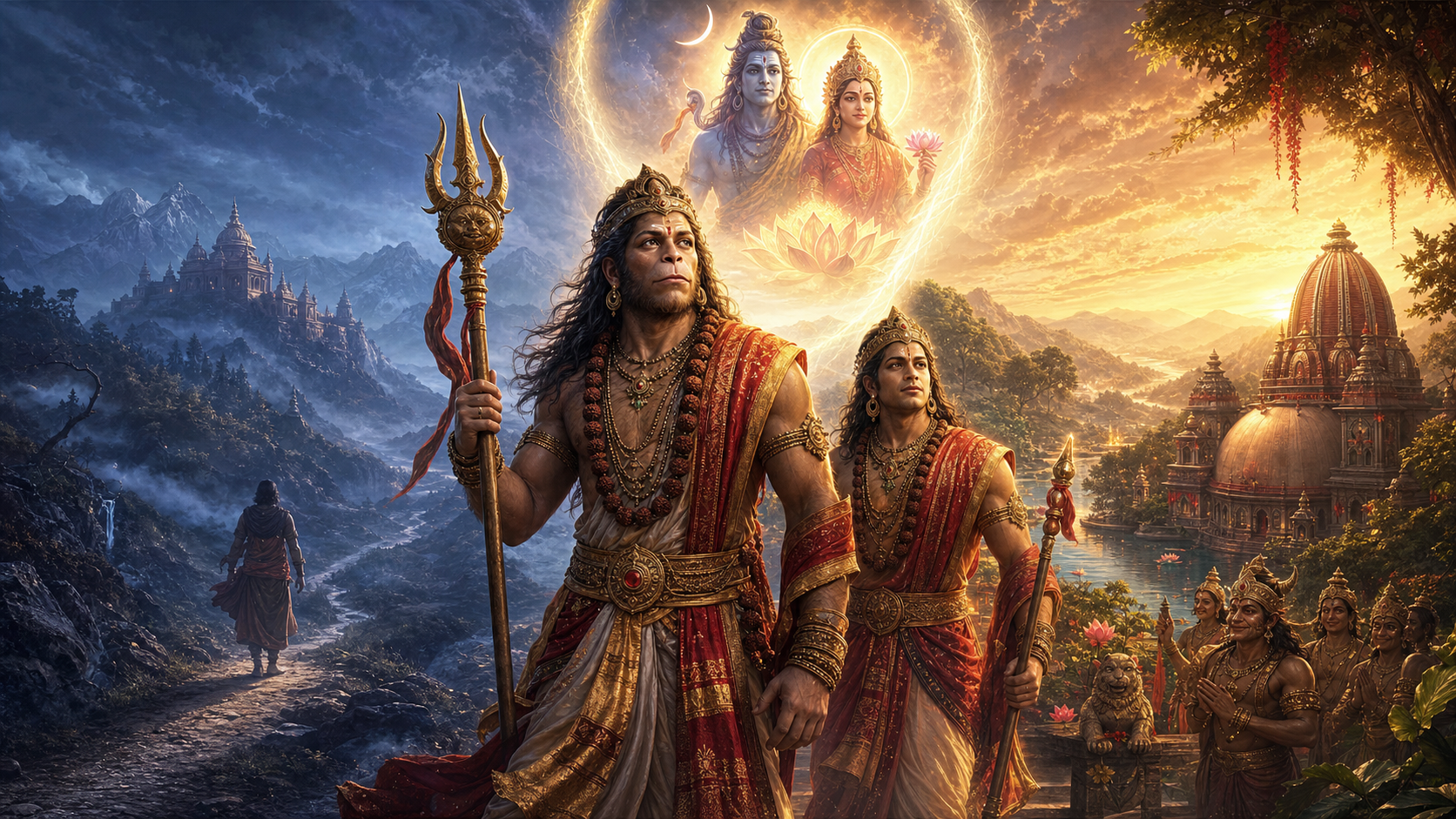
Betal beyond the familiar ghost stories
Betal, also written Vetala, is often associated with the eerie spirit who challenges King Vikramaditya in India’s celebrated cycle of riddle tales. The Kalika Purana, however, preserves a markedly different identity. In this regional Puranic account, Vetala is not merely a wandering being of the cremation ground. He is a divine attendant whose story moves through celestial birth, curse, human embodiment, social rejection, pilgrimage, disciplined worship and final restoration.
This distinction is essential. Sanskrit religious literature frequently allows the same name to operate at several levels: it may identify a class of beings in one work, a particular mythological personality in another and a locally worshipped deity in a third. Consequently, the Betal of the Kalika Purana should not automatically be reduced to every other vetala found in folklore, narrative literature or later popular culture. Within this particular account, Betal is the earthly form of Bhringi and the companion of Bhairava, who represents Mahakala.
The Kalika Purana and its Assamese sacred landscape
The Kalika Purana is commonly associated with the historical region of Kamarupa, corresponding broadly to present-day Assam and adjoining areas. Scholars generally place the extant work around the tenth or early eleventh century, although the precise date and the history of its textual layers remain subjects of discussion. The work gives exceptional prominence to Devi in forms such as Kalika, Mahamaya and Kamakhya while also incorporating Shaiva, Vaishnava and other Puranic traditions. Its religious world is therefore interconnected rather than confined to a single, isolated sectarian identity.
The account of Bhairava and Vetala begins in the section extending from approximately chapter forty-seven onward. Chapter numbering can differ slightly across editions and summaries, but the principal sequence occupies the late forties and early fifties. Academic outlines generally place the human birth of Bhairava and Vetala around chapter fifty and their instruction, pilgrimage and worship in the chapters that follow. This broader context is documented in a study of the Kalika Purana and a separate literary summary of its contents.
Mahakala and Bhringi emerge from Shiva’s power
The story begins with two particles or drops of Hara’s generative energy, originally connected with the divine circumstances surrounding the birth of Skanda. When this energy falls upon the Himalaya, two beings arise from it: Mahakala and Bhringi. They are consequently described as sons of Hara, another name for Shiva. Their origin immediately places them close to the formidable power of the deity, but their future depends upon conduct, responsibility and the transforming consequences of a curse.
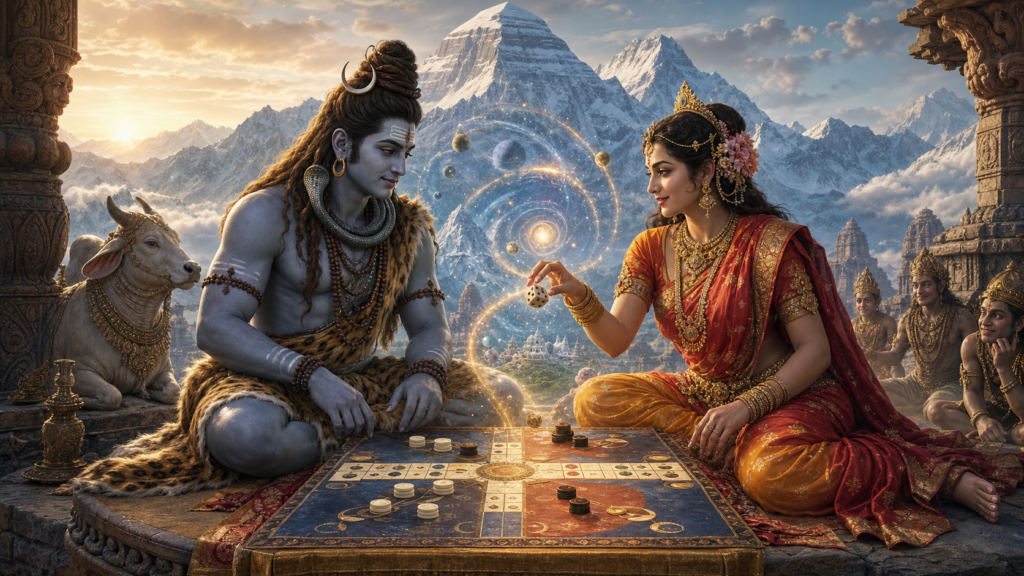
Shiva appoints Mahakala and Bhringi as leaders among his ganas, the varied company of attendants who inhabit his sacred world. They are stationed at the entrance while Shiva and Parvati remain in privacy. The image of the divine gatekeeper is important in Shaiva tradition: a guardian occupies a boundary between ordinary and sacred space, protects what lies within and determines who may cross the threshold. Mahakala and Bhringi therefore possess status and authority before their fall into mortal existence.
The moment of transgression and Parvati’s curse
The crisis occurs when the two attendants happen to see Parvati as she emerges with her clothing disturbed. She regards the sight as a violation of the privacy they were expected to protect. In anger, she curses them to enter human birth with simian faces. Retellings differ in their emphasis: some portray the attendants as innocent witnesses who protest the severity of the punishment, while concise academic summaries stress that they nevertheless remain determined to have Shiva and Parvati as their parents during their mortal existence.
The episode should be interpreted within the narrative conventions of Puranic literature, where a curse is rarely just an expression of anger. It is a mechanism that moves divine beings between cosmic and human worlds, initiates a period of testing and creates the conditions for eventual revelation. The curse does not erase the attendants’ divinity. Instead, it conceals their identity beneath a form that exposes them to vulnerability, fear and rejection.
For many readers, this part of the story carries an unexpectedly relatable emotional force. A person may possess dignity and ability yet still be judged by appearance, circumstance or a single misunderstood event. Betal’s later restoration does not deny the pain of that judgment. It shows that an imposed identity need not become the final measure of a being’s worth.
Shiva and Parvati descend as Chandrashekhara and Taravati
To fulfil the conditions created by the curse, Shiva and Parvati themselves become involved in earthly life. Shiva is born as Prince Chandrashekhara, son of King Paushya, and is also associated with the name Tryambaka. Parvati takes birth as Princess Taravati, daughter of King Kakutstha. Chandrashekhara eventually marries Taravati and rules at Karavirapura in Brahmavarta. The divine parents thus enter the same mortal order into which their attendants have been sent.
This descent is more than a technical solution to a curse. It expresses a recurring Puranic principle: divine relationships can persist through radical changes of form. Parent and child, deity and attendant, curse and blessing remain connected across celestial and terrestrial existence. Shiva and Parvati do not simply observe Mahakala and Bhringi from a distant heaven; they enter the world necessary for the attendants’ destiny to unfold.
Kapota’s curse and the birth of the unusual princes
A second narrative strand introduces the sage Kapota. He sees Taravati bathing in the river Drishadvati and desires her. Taravati attempts to protect herself by sending her sister Chitrangada in her place. Chitrangada, described as a daughter of Urvashi who is living under the effect of another curse, bears Kapota two sons, Tumburu and Suvarchas. When Kapota discovers the substitution, he pronounces a threatening curse upon Taravati: two monkey-faced sons will be fathered upon her by an aged, unattractive, skull-bearing ascetic.
This portion of the account contains disturbing themes of unequal power, sexual pressure, concealment and retaliatory anger. An academic reading need not treat those actions as ethical ideals. Puranic narratives often portray sages and deities as emotionally complex figures whose anger produces suffering as well as cosmic change. The passage is most responsibly read as part of the story’s explanation of fate, embodiment and transformation, not as an endorsement of coercion or punitive authority.
Taravati remains committed to Chandrashekhara, and the seemingly incompatible curses are resolved through divine disguise. Shiva assumes the appearance of the skull-bearing figure described by Kapota. In this form he remains Taravati’s own divine husband, even though his outward appearance has dramatically changed. The episode allows Mahakala and Bhringi to be reborn as the two unusual princes without breaking the deeper identity of Shiva and Parvati as their parents.
The sons are named Bhairava and Vetala. Within this narrative correspondence, Mahakala becomes Bhairava, while Bhringi becomes Vetala or Betal. Their frightening appearance is therefore not evidence of an evil essence. It is the visible mark of a curse carried by beings whose origin remains divine.
Fear, rejection and the loss of belonging
Although the royal household recognizes Bhairava and Vetala as princes, their monkey-like faces inspire unease. Chandrashekhara and his other sons do not extend to them the affection they need. The pair eventually leave the palace and wander in sorrow. Their movement from royal residence to wilderness marks a profound reversal: former leaders of Shiva’s ganas, and then sons born within a royal family, become outsiders without a secure understanding of who they are.
This phase gives Betal’s story much of its emotional depth. The central problem is not physical ugliness but failed recognition. Those around the brothers respond only to their visible forms and do not perceive the sacred history within them. The narrative thereby challenges the assumption that beauty proves virtue or that an unfamiliar body indicates moral corruption. Divine potential can remain hidden beneath an appearance that society fears.
Kapota later encounters the brothers and reveals the chain of events that led to their birth. Knowledge changes the meaning of their suffering. What had seemed like meaningless exclusion becomes part of a larger history involving Shiva, Parvati, celestial identity and unfinished spiritual purpose. Revelation does not undo their past, but it gives them a direction: they must seek their divine parents through pilgrimage and worship.
From Varanasi to the sacred pitha of Kamarupa
Kapota’s instruction introduces a theological distinction between a kshetra and a pitha. Varanasi is praised as an outstanding Shaiva kshetra, a sacred field in which Shiva is supremely present. Kamarupa, however, is described as a mahapitha where Shiva and Parvati are present together. The contrast does not diminish Varanasi. It serves the brothers’ particular need: because their restoration depends upon both divine parents, they require a sacred landscape defined by the union of Shiva and Shakti.
Kamarupa is not a decorative background to the story. The Kalika Purana imagines it as a living sacred geography formed by mountains, rivers, pools, stones and divine presences. A modern scholarly analysis describes this Puranic Kamarupa as a wonder-filled region where terrestrial places embody gods and goddesses and where disciplined seekers may acquire divine status. The study also identifies Vetala and Bhairava as exemplary cursed beings who overcome their condition through worship. This regional theology is examined in the peer-reviewed article “Wonderland: The Image of Kāmarūpa in the Kālikāpurāṇa”.
The brothers travel through this sacred terrain, bathing in holy waters and paying homage at significant sites. Their journey gradually replaces aimless wandering with intentional pilgrimage. The same movement through the landscape that might once have symbolized exile now becomes sadhana, a disciplined path toward recovered identity.
Initiation, worship and the recovery of divine status
Vetala and Bhairava receive spiritual instruction associated with the sage Vasishtha and undertake the worship of Shiva. Their practice is not presented as an instant escape from difficulty. It requires sacred knowledge, ritual discipline, movement through holy geography and sustained devotion. Shiva is pleased, but he explains that their aspiration cannot be fulfilled through his grace alone: they must also worship Parvati.
This is one of the account’s most significant theological statements. Shiva directs his sons toward Shakti, acknowledging that restoration requires the Goddess. The narrative therefore resists any simplistic competition between Shaiva and Shakta devotion. Shiva and Parvati act through mutuality, and the brothers’ journey reaches completion only when both dimensions of the divine are honored.
At Nilachala, the inner sacred seat of Kamarupa associated with Kamakhya, the brothers worship Mahamaya. The Goddess finally appears in a beneficent maternal form. According to the textual summary preserved in the scholarly study of the Upapuranas, she nourishes them with her milk and grants them immortality and leadership among the ganas. Shiva likewise confers immortality and divine status. The frightening princes are thus recognized once again as members of the divine household.
The maternal imagery completes a carefully constructed transformation. The curse had produced separation, distorted appearance and emotional abandonment; Mahamaya’s nourishment restores kinship, dignity and belonging. Betal does not triumph by destroying those who feared him. He is restored through knowledge, pilgrimage, devotion and the compassionate recognition of the Divine Mother.
Why Betal remains fierce after his restoration
Betal’s divinity does not require him to become gentle in outward appearance. Like Bhairava and many other guardian figures, he retains an association with liminal spaces, danger and the unsettling boundaries between ordinary life and the sacred. Fierceness in Hindu iconography does not necessarily mean wickedness. A terrifying form may guard a threshold, confront disorder, expose illusion or protect a community from forces that a serene form is not meant to represent.
His story also cautions against judging sacred figures solely through categories imported from modern horror. The word Vetala may evoke corpses and spirits in other literary settings, but the Kalika Purana deliberately gives this named Vetala a divine genealogy and a path of consecration. He is simultaneously marked by the memory of a curse and elevated through the grace of Shiva and Shakti.
A theology of transformation rather than condemnation
The movement from curse to divinity is the structural heart of the narrative. Mahakala and Bhringi begin as celestial attendants, become vulnerable human sons as Bhairava and Vetala, suffer alienation, discover their origin and return to divine service with a deeper status. The process resembles a spiritual initiation in narrative form: separation is followed by trial, instruction, disciplined practice, revelation and reintegration.
Several philosophical themes emerge from that structure. External form does not exhaust inner identity. Suffering can obscure purpose without permanently destroying it. Sacred knowledge gives direction to those who feel displaced. Pilgrimage turns geography into a medium of transformation. Most importantly, divine grace is presented as relational: Shiva guides, Parvati restores and the seeker must actively undertake worship.
The episode also illustrates the capacious character of Hindu sacred literature. Shakta reverence for Mahamaya and Kamakhya exists alongside devotion to Shiva, respect for sages, Puranic genealogy and the discipline of mantra and pilgrimage. Such interconnectedness offers a constructive model for appreciating the wider family of Dharmic traditions. Hinduism, Buddhism, Jainism and Sikhism possess distinct teachings and histories, yet each has preserved serious reflection on disciplined transformation, ethical responsibility, compassion and the possibility of rising beyond socially imposed identities.
Betal’s enduring significance
Betal’s origin in the Kalika Purana is therefore far richer than the image of a frightening supernatural creature. He is a son of Shiva’s power, a cursed guardian, an unrecognized prince, a pilgrim and finally an immortal member of the divine retinue. His fierce identity preserves the memory of everything he has crossed: anger, embodiment, stigma, exile, knowledge, worship and reconciliation.
The account leaves a durable insight. What appears fearsome may carry a sacred history, and what society rejects may still possess profound dignity. Betal’s journey does not romanticize suffering; it demonstrates that suffering is not necessarily the end of identity. In the sacred geography of Kamarupa, under the combined grace of Shiva and Mahamaya, the condemned outsider becomes an immortal guardian.
Textual note: The surviving source supplied for transformation ended mid-sentence. The expanded account has therefore been reconstructed cautiously from the narrative outline in Studies in the Upapuranas, the literary contents of the Kalika Purana, the scholarly study of Kamarupa in the Kalika Purana and a modern summary of the Bhairava–Vetala narrative. Interpretive observations have been distinguished from the reported sequence of the Purana.
Inspired by this post on Hindu Blog.





Leave a Reply
You must be logged in to post a comment.