
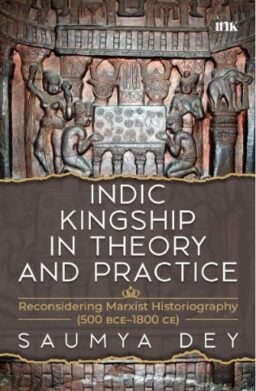
Reassessing the Political Past of India
Saumya Dey’s Indic Kingship in Theory and Practice undertakes an ambitious reassessment of Indian political history between 500 BCE and 1800 CE. Its central argument is both straightforward and consequential: Indic kingship cannot be adequately understood through a historical model that treats monarchy principally as an instrument of class domination, agrarian extraction, and coercive violence. Across philosophical texts, epigraphic records, administrative arrangements, literary representations, and dynastic histories, Dey identifies a different political vocabulary—one organised around dharma, public protection, restrained taxation, distributed authority, and the moral obligations of sovereignty.
The book therefore operates on two interconnected levels. It examines the normative conception of kingship—the political order as it ought to function—and then compares that ideal with the institutions through which Indian rulers actually governed. This movement between theory and practice is essential. Prescriptive texts cannot, by themselves, prove that rulers behaved virtuously, just as records of warfare or taxation cannot, by themselves, establish that an entire political tradition was intrinsically oppressive. Dey’s contribution lies in assembling a broad body of evidence and asking whether the dominant interpretation of that evidence has been too narrow.
For readers who encountered Indian history primarily through compressed textbook narratives, this inquiry can be unsettling. Familiar categories such as ancient, feudal, mediaeval, landlord, peasant, priestly elite, and class exploitation begin to appear less self-evident when tested against the diversity of Indian institutions. The resulting study does not require romanticising every dynasty or denying warfare, hierarchy, political ambition, and administrative coercion. It instead asks a more disciplined question: were those features the essence of Indic kingship, or were they parts of a more complex political order whose ethical and civilisational premises have often been overlooked?
Falsifiability, Historical Explanation, and the Problem of Total Theories
The intellectual point of departure is Karl Popper’s criticism of historicism. Popper’s principle of falsifiability was developed chiefly to distinguish empirical scientific theories from claims that could accommodate every possible observation. A theory that explains success as confirmation and failure as confirmation of a deeper process becomes difficult to test. Although historical inquiry is not identical to experimental science, Popper’s warning remains relevant whenever a framework is treated as universally valid and protected from contrary evidence.
This criticism is directed at deterministic versions of Marxist historiography rather than at every study of economic power or social inequality. Economic conditions plainly matter in history. Land ownership, labour, taxation, trade, military finance, and access to resources shape political institutions. The difficulty arises when these variables are assumed to explain the whole of social life and when politics, law, religion, education, philosophy, and culture are reduced to reflections of an economic base. At that point, evidence is at risk of being selected to preserve the theory rather than used to test it.
Classical historical materialism describes society through forces of production and relations of production. Technology, land, labour, and raw materials constitute productive capacity, while ownership and social organisation determine who controls it. Political and cultural institutions form a superstructure shaped by that material foundation. Historical change is then explained through conflicts between classes competing over the means of production. In its familiar sequence, human society moves from primitive communism through slavery and feudalism to capitalism, followed eventually by socialism or communism.

That sequence originated in European intellectual and historical circumstances. It drew on Enlightenment theories of progress, the experience of European estates and landed aristocracies, industrial capitalism, and French historical thought. Dey questions the universalisation of these categories. A concept developed to explain European feudal relations may illuminate selected features of another civilisation, but resemblance is not identity. Land grants do not automatically establish feudalism; hierarchy does not by itself prove class dictatorship; taxation does not necessarily amount to predation; and royal warfare does not demonstrate that protection, welfare, ritual legitimacy, and local autonomy were politically irrelevant.
Imre Lakatos’s account of research programmes provides an additional insight. A theoretical programme normally contains a protected core surrounded by auxiliary propositions that can be adjusted when anomalies appear. Such flexibility can support productive research, but it can also shield a preferred conclusion indefinitely. Dey’s criticism is that Indian Marxist historiography too often treated class exploitation as the protected conclusion: evidence for hierarchy proved exploitation, evidence for cooperation disguised exploitation, and evidence for religious or ethical motivation became ideological cover for exploitation. A framework organised in this way risks becoming interpretively circular.
History as Evidence, Selection, and Interpretation
Historical knowledge is constrained by surviving evidence and shaped by the questions brought to it. Archives preserve what institutions chose to record. Inscriptions frequently project legitimacy and achievement. Court chronicles may praise patrons. Religious texts articulate ideals, arguments, memories, and metaphysical commitments rather than modern administrative reports. Archaeological remains reveal material conditions but do not interpret themselves. Coins, grants, legal texts, literary works, oral traditions, and foreign travel accounts each illuminate a different portion of the past.
Reliable historiography therefore depends on triangulation. A claim about royal taxation becomes stronger when normative prescriptions, inscriptions, revenue terminology, settlement patterns, and administrative records converge. A claim about political participation must be tested through village institutions, guilds, councils, offices, and evidence of social representation. A literary portrait of the ideal king is historically important because it reveals standards of legitimacy, but it must not be confused with proof that every ruler met those standards.
Herodotus, writing in the fifth century BCE, offers an early illustration of the opportunities and limitations of historical narration. His Histories combined accounts of the Greco-Persian Wars with geographical, cultural, and ethnographic observations. Mythic and improbable episodes coexist with careful attention to peoples beyond the Greek world. The example matters because historical writing has always involved the selection and arrangement of material, even when fairness and curiosity guide the inquiry.
Dey captures the interpretive character of the discipline in the observation that, “Since historians make varying inquiries regarding facts, sources, and causal sequences, they also, all the time, advance ever newer philosophies and imaginations of the past.” This does not mean that every interpretation is equally credible. It means that historical arguments must disclose their assumptions, account for contrary evidence, and remain open to revision. Objectivity is best approached as a method of disciplined comparison rather than as the absence of all perspective.
The Rise of Marxist Historiography in India
Marxist approaches became highly influential in post-independence Indian academia through the work of figures such as SA Dange, DD Kosambi, Romila Thapar, RS Sharma, DN Jha, Irfan Habib, Satish Chandra, and Bipin Chandra. Their contributions were not identical, and they should not be collapsed into a single undifferentiated school. They expanded attention to material culture, agrarian relations, labour, social formations, revenue systems, and communities that older dynastic histories sometimes neglected. Any responsible assessment must acknowledge that contribution.
Dey’s objection concerns the dominance of a particular explanatory pattern. Within that pattern, the early ruler appeared primarily as a war leader supported by priestly and social elites. Expanding agriculture produced increasingly centralised authority, taxation burdened the peasantry, and land grants gradually transferred administrative and fiscal powers to intermediaries. Those intermediaries became a landlord class, producing a form of Indian feudalism in which peasants experienced growing subordination. Political ideals expressed in Sanskrit and vernacular texts were often interpreted as legitimating devices for this material arrangement.
This model presents Indic kingship as progressively class-exclusive and suppressive. Warfare becomes mobilisation of violence, taxation becomes extraction, priestly counsel becomes elite collaboration, and the language of dharma becomes ideological camouflage. Dey argues that such readings import conclusions associated with The German Ideology, The Communist Manifesto, and The Origin of the Family, Private Property and the State into a civilisational context whose political concepts developed along different lines.
The challenge is methodological rather than merely ideological. Comparative categories are indispensable in history, but they must remain responsive to local evidence. If “feudalism” is defined so broadly that every decentralised agrarian monarchy qualifies, the term loses analytical precision. If it retains its narrower European associations—hereditary lordship, dependent tenures, jurisdictional fragmentation, and specific bonds of vassalage—then its application to India must be demonstrated region by region rather than assumed from the presence of land grants.
Dharma as the Grammar of Indic Kingship
The alternative framework begins with the intellectual world of the Indian texts. The Rigveda, Ramayana, Mahabharata, Dharmasutras, Dharmashastras, Puranas, Arthashastra, Tirukkural, and later works on polity do not speak with one voice. They emerged in different periods, regions, genres, and philosophical settings. Yet Dey identifies a recurrent premise: legitimate sovereignty is limited and directed by dharma rather than constituted solely by the personal will of the king.
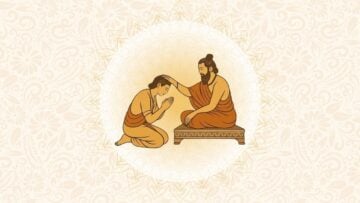
Dharma in this setting cannot be reduced to religion in the modern denominational sense. It includes duty, ethical order, right conduct, legal norms, social responsibility, and the conditions that sustain collective life. Its wider cosmological orientation is associated with Rta, the order through which existence remains coherent. A ruler serves this order by protecting subjects, administering justice, restraining disorder, supporting prosperity, and disciplining personal desire.
The metaphysical background also includes karma, rebirth, the relation between the singular Self and plurality, and three interlinked systems: varna, ashrama, and purusharthas. The four varnas are Brahmin, Kshatriya, Vysya, and Sudra; the four ashramas are brahmacharya, grihastha, vanaprastha, and sanyasa; and the four purusharthas are dharma, artha, kama, and moksha. These classifications have complex textual histories and were not implemented uniformly across the subcontinent. Nevertheless, they form part of the conceptual language through which duty, social location, material welfare, desire, and liberation were discussed.
The distinction between ruling people and serving dharma is the book’s most important formulation. Sovereignty is not represented as unlimited ownership of subjects. The king belongs to the social body and bears intensified obligations within it. The Shanti Parva of the Mahabharata explores Rajadharma through extensive reflection on justice, protection, punishment, crisis, and the moral burdens of power. The dialogue between Sri Rama and Bharata similarly presents political authority as a demanding discipline rather than a private entitlement.
This duty-centred approach also offers a point of connection across dharmic traditions. Hindu, Buddhist, and Jain sources differ in metaphysics and religious practice, yet all developed influential models of ethical kingship, disciplined conduct, restraint, generosity, and responsibility toward living beings. Sikh political thought emerged in a later historical environment, but its integration of spiritual responsibility, justice, seva, and resistance to oppression belongs to the broader civilisational conversation about morally accountable power. Recognising these distinctions and convergences strengthens unity without erasing doctrinal diversity.
Danda: Coercion as a Bounded Political Function
No theory of kingship can avoid coercion. Courts issue judgments, officials collect revenue, armies defend territory, and governments punish conduct considered harmful. Indic political thought addresses this reality through Danda, the power of punishment and enforcement. Dey’s argument is not that coercion disappeared, but that it was normatively subordinated to the welfare of the social order.
Danda becomes legitimate when it is proportionate, procedurally grounded, and directed toward protection. Applied arbitrarily, it destroys the ruler’s moral standing and produces fear, resentment, and disorder. Applied too weakly, it permits predation by powerful individuals and leaves vulnerable communities unprotected. The king is therefore judged not simply by possession of force but by disciplined use of it.
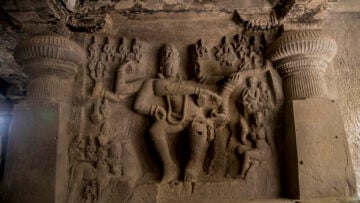
This conception complicates the assumption that every act of punishment demonstrates class suppression. It also prevents an idealised reading in which dharmic kingship is imagined as government without power. The sharper historical question concerns the purposes, limits, procedures, and distribution of coercive authority. Dey finds evidence that local bodies, cooperative institutions, councils, and informal courts frequently participated in judicial and policing functions, reducing the image of an all-controlling monarch acting through a uniform central apparatus.
Kautilya’s Arthashastra and the Sciences of Government
Kautilya’s Arthashastra occupies a central place in any study of ancient Indian statecraft. It is practical, unsentimental, and remarkably detailed in its treatment of administration, diplomacy, intelligence, revenue, commerce, law, defence, agriculture, cities, officials, and royal discipline. Its realism makes it difficult to dismiss Indic political thought as a collection of purely spiritual exhortations. At the same time, its practical orientation does not eliminate the importance of order, public welfare, and the ruler’s obligations.
The text identifies four sciences from which knowledge of righteousness and wealth proceeds: Anvikshaki, encompassing the philosophies of Sankhya, Yoga, and materialism; Trayi, the triple Vedas; Varta, covering agriculture, cattle breeding, and trade; and Danda-Niti, the science of government. This arrangement is intellectually significant. Philosophy clarifies reasoning, the Vedas distinguish righteous and unrighteous conduct, productive activity creates material security, and government protects the conditions under which the other domains can function.
The state is consequently neither a mere night watchman nor an omnipotent owner of society. It safeguards production, regulates officials, manages risks, administers justice, and preserves order. The ruler must be educated, self-controlled, attentive to counsel, and alert to corruption. Far from celebrating arbitrary monarchy, the Arthashastra recognises that royal negligence, excessive taxation, official misconduct, and administrative disorder can weaken the realm.
Revenue is treated as necessary to government but connected to productive capacity. The frequently cited share of one-sixth of produce functions as an important normative benchmark, though historical rates varied across periods, crops, regions, emergencies, and forms of assessment. Exemptions and remissions also appear in the wider record. The crucial point is that taxation was commonly justified through reciprocal obligations: the ruler received revenue because the political order provided protection and maintained conditions for collective prosperity.
Rules of warfare similarly reveal a normative concern with restraint, even though actual campaigns could depart from ideals. Indian texts distinguish forms of conflict and discuss the treatment of noncombatants, cultivated land, sacred places, defeated rulers, and surrendered enemies. These principles should neither be romanticised as universally obeyed nor ignored as politically meaningless. A society’s rules of war reveal the conduct it considered legitimate and provide standards by which violations could be condemned.
An Organic Conception of the State
The Sukraniti presents a seven-fold organic image of political order. The king is the head, the minister is the eye, Mitra is like the ear, Danda is the power, Kosh is the mouth, Durga is the hand, and Janapada is like the leg. The metaphor does not make every component equal in function, but it does make them interdependent. A head without limbs, senses, resources, security, allies, or people cannot constitute a functioning polity.
This model helps explain why Dey resists the representation of the king as an entity standing outside society. The ruler occupies a vital position but remains one element within a larger body. Ministers, treasury, territory, population, defence, alliances, and enforcement all sustain sovereignty. Political authority is therefore relational and distributed, even when ceremonial language presents the monarch in exalted terms.
Indic Kingship in Practice, 500 BCE to 500 CE
The first historical frame encompasses the Nandas, Mauryas, Satavahanas, and Guptas, including Mahapadma Nanda, Chandragupta Maurya, Ashoka, Gautamiputra Satakarni, and Samudragupta. These polities differed considerably in territorial reach, administrative density, military organisation, religious affiliation, and surviving evidence. Their inclusion within one period does not imply institutional uniformity. It permits comparison across major experiments in imperial and regional governance.
The Mauryan Empire demonstrates the capacity of an Indian monarchy to sustain extensive bureaucracy, fiscal organisation, diplomacy, roads, provincial administration, and military power. Ashoka’s inscriptions add a distinctive public language of ethical governance, welfare, restraint, and concern across sectarian lines. They cannot establish that every official followed imperial ideals, but they show that political legitimacy was communicated through more than conquest and revenue. Moral conduct, accessibility, public instruction, and the welfare of diverse subjects had become explicit dimensions of sovereignty.
Satavahana and Gupta evidence presents different configurations of central authority, subordinate rulers, grants, local institutions, and social participation. Dey interprets the subordinate tiers created through conquest as mechanisms for incorporating populations into sovereignty rather than simply as transfers of oppressive power. The phrase “empathetically coopt citizens” captures this interpretation, although the degree of consent would have varied and remains difficult to measure from elite records.

Land grants are especially important to the debate. Marxist accounts often regard grants carrying fiscal or administrative privileges as evidence for a developing feudal order. Dey disputes the inference that such documents necessarily produced a uniform class of suppressive landlords. Grants served multiple purposes, including settlement, cultivation, religious patronage, education, political integration, and compensation. Their effects depended on the rights transferred, the communities already present, local custom, and the authority retained by the crown.
The evidence surveyed supports the presence of hierarchy and imperial ambition but does not reduce governance to a compact between king, priest, and landlord against the peasantry. Administrative offices drew on multiple groups, local arrangements retained importance, and rulers repeatedly sought moral and spiritual forms of legitimacy. Ritual was politically significant, yet priestly mediation was not always the sole source of royal authority. Kings also established legitimacy through protection, public works, generosity, military competence, justice, and adherence to dharma.
Indic Kingship from 501 CE to 1800 CE
The second historical frame ranges across the Vardhanas, Pallavas, Chalukyas, Kakatiyas, Palas, Rashtrakutas, Gurjara-Pratiharas, Cholas, Vijayanagara rulers, Marathas, and Peshwas. Harsha Vardhana, Pulakeshin, Krishnadevaraya, and Chhatrapati Shivaji receive particular attention. The chronological and geographical range is immense, making regional variation indispensable to the analysis.
Works associated with historians such as Nilakanta Sastri, RC Mazumdar, and AS Altekar support the reconstruction of administrative institutions. Evidence from inscriptions and literary sources points to organised governance extending from royal centres to villages, urban bodies, temples, guilds, councils, and local assemblies. These institutions could cooperate, compete, or overlap. Their existence challenges simple images of an omnipotent king directly controlling every level of society.
The period also witnessed greater temple-centred organisation in many regions. Temples could function as sacred institutions, employers, landholders, centres of learning, recipients of gifts, custodians of resources, and nodes of social coordination. Their political importance should not be reduced either to pure spirituality or to pure economic domination. They linked worship, patronage, redistribution, craft production, education, record keeping, and community identity in arrangements that varied substantially across time and place.
Harsha Vardhana’s literary culture illustrates the fusion of political and ethical representation. Works such as Ratnavali and Priyadarsika present images of worthy sovereignty that may be read partly as reflections on royal ideals. Such texts are not transparent autobiographies, yet they disclose the virtues a court considered politically intelligible. A king was expected to display refinement, generosity, courage, learning, accessibility, and moral seriousness in addition to military strength.

Southern dynasties provide rich evidence of local organisation. Pallava inscriptions occasionally indicate women’s participation in governmental or institutional activity. Chola records reveal elaborate fiscal practices and village assemblies, though scholarly debate continues over representation, eligibility, autonomy, and the relationship between local bodies and royal authority. The evidence supports institutional sophistication without requiring the conclusion that every social group enjoyed equal power.
The Kakatiya, Chalukya, and Vijayanagara cases further demonstrate the adaptability of Indic statecraft. Military frontiers, agrarian expansion, temple patronage, commercial networks, and regional elites shaped governance, but these forces operated within moral and sacred languages of legitimacy. Krishnadevaraya’s kingship, for example, combined imperial ambition with literary achievement, religious patronage, administration, and attention to the productive foundations of the realm.
In western India, Chhatrapati Shivaji and the later Peshwas developed revenue, military, fortification, intelligence, and local administrative systems suited to a contested political landscape. Dey emphasises their concern for cultivators and resistance to destructive intermediary extraction. Such claims require attention to changing wartime conditions and regional practice, but they complicate depictions of the Maratha state as merely another predatory monarchy.
Across these cases, the book identifies substantial continuity rather than a sudden transition from a non-feudal ancient order to a feudal mediaeval one. Ritual sacralisation, temple networks, subordinate rulers, landed rights, local institutions, and administrative offices became more elaborate in some regions. Yet greater complexity does not by itself establish a European-style feudal formation. Political evolution remained rooted in Indian institutions and concepts even as those institutions responded to warfare, commerce, migration, ecological conditions, and new imperial pressures.
Taxation, Peasants, and the Question of Exploitation
The treatment of cultivators is central to Dey’s case. Revenue sustained armies, courts, irrigation, public institutions, officials, diplomacy, religious patronage, and relief. The existence of taxation therefore cannot determine whether a system was exploitative. The relevant questions concern assessment, predictability, exemptions, remissions, intermediaries, enforcement, productive investment, and the relationship between payment and protection.
Dey finds no basis for treating extortion as the defining fiscal principle of Indic monarchy. Several traditions prescribe moderation, and historical sources record concern for cultivation and the security of producers. The Cholas, Shivaji, and the Peshwas are presented as particularly attentive to peasant welfare. In many settings, royal administration retained direct access to agricultural revenue rather than surrendering the entire relationship to hereditary intermediaries.

Academic caution remains necessary. Normative rates did not guarantee actual moderation, and fiscal practice could worsen during war, succession struggles, famine, or administrative corruption. Regional evidence is uneven, while inscriptions often communicate legitimacy more readily than hardship. The strongest conclusion is therefore comparative: the available material does not justify treating systematic peasant suppression as the universal essence of Indic kingship.
Pluralism, Sacred Geography, and Civilisational Unity
Political India was frequently divided among kingdoms, yet cultural and sacred networks crossed those boundaries. Pilgrimage routes, monasteries, temples, educational centres, merchants, teachers, poets, artisans, and manuscripts circulated over wide regions. Political fragmentation did not necessarily produce civilisational isolation. Shared narratives and sacred geography created forms of belonging that were not dependent on a single imperial capital.
Religious identity also operated differently from the confessional uniformity pursued by some European monarchies. Indian rulers frequently patronised traditions other than their own or governed communities with distinct practices. The record is not free of conflict, competition, or unequal patronage, but it contains abundant evidence of coexistence and institutional plurality. Hindu, Buddhist, Jain, and later Sikh traditions contributed to a public culture in which spiritual difference did not automatically imply political treason.
This civilisational unity should not be confused with political homogeneity. It was closer to a network: decentralised communities and kingdoms remained distinct while participating in overlapping ethical, intellectual, commercial, and sacred worlds. Such a structure helps explain the durability of Indic civilisation across major dynastic changes. It also offers a historically grounded basis for contemporary solidarity among dharmic traditions—unity through mutual recognition rather than uniformity imposed from above.
What the Book Establishes—and What Still Requires Debate
Indic Kingship in Theory and Practice is most persuasive when it exposes the inadequacy of single-cause explanations. Indian kingship cannot be reconstructed from economic categories alone. Dharma, political theology, public ethics, ritual, sacred authority, jurisprudence, local autonomy, military organisation, and fiscal practice interacted with material forces. Ignoring any of these dimensions produces a partial history.

The distinction between a normative ideal and historical conduct remains crucial. The Ramayana, Mahabharata, Dharmasutras, Dharmashastras, Puranas, Arthashastra, Tirukkural, and Sukraniti establish that Indian thinkers developed sophisticated expectations of rulers. They do not prove that every king protected every subject or that power was never abused. Their historical significance lies in defining standards of legitimacy and supplying a vocabulary through which royal conduct could be praised, criticised, or corrected.
The same caution applies to comparisons with European monarchy. Europe itself contained multiple political arrangements, while Indian institutions changed profoundly across twenty-three centuries. Claims that one civilisation was uniformly suppressive and another uniformly non-suppressive would reproduce the very simplification the book opposes. Dey’s strongest argument is narrower and more defensible: European-derived models of feudalism and class rule cannot be transferred mechanically to the Indian record.
The study is not an apologia for monarchy and does not need to be read as one. Its deeper purpose is historiographical correction. It restores political concepts that become invisible when every institution is translated immediately into the language of class interest. It also encourages closer reading of inscriptions, philosophical texts, administrative evidence, and regional scholarship rather than dependence on inherited summaries.
Why This Reassessment Matters
Historical narratives influence how communities understand their institutions and moral inheritance. When generations encounter Indian rulers chiefly as conquerors, tax collectors, or patrons of privileged elites, the political intelligence embedded in Indic texts becomes difficult to perceive. Conversely, replacing one ideological orthodoxy with uncritical celebration would offer little improvement. A mature historical culture must remain capable of admiration, criticism, comparison, and revision.
Public frustration with inherited historiography is understandable, but anger cannot substitute for scholarship. Social-media abuse, partisan denunciation, and sweeping allegations weaken the case for historical reassessment. The durable response to an inadequate narrative is better evidence: accurate translations, transparent citations, archaeological research, regional studies, epigraphic analysis, and open debate across schools of interpretation.
Dey’s work contributes to that process by bringing Indic categories back into the study of Indic institutions. Its central insight is memorable: the legitimate king does not merely rule people but serves dharma. This principle binds political power to duties extending from the ruler to the ordinary citizen. Rights remain important, but a duty-centred framework asks what each participant owes to the larger social and moral order.
That insight also explains why Indic kingship cannot be assessed solely through the quantity of territory controlled or revenue collected. A ruler’s legitimacy depended upon protection, justice, restraint, prosperity, counsel, moral discipline, and responsiveness to the social body. Dynasties often failed to meet those standards, but failure presupposes the existence of a standard. The persistence of Rajadharma across genres and centuries demonstrates that power was expected to answer to something beyond itself.
Conclusion: Beyond the Binary of Romanticism and Condemnation
Saumya Dey’s reassessment of Indic kingship challenges the assumption that the political history of India can be narrated as an uninterrupted struggle between exploiters and exploited. From the Nandas and Mauryas to the Cholas, Kakatiyas, Vijayanagara rulers, Marathas, and Peshwas, the record reveals changing combinations of central authority, local participation, fiscal responsibility, sacred legitimacy, military power, and ethical restraint.
The book’s rejection of deterministic Marxist historiography does not require the rejection of economic analysis. It requires that economic evidence take its place within a broader account of human motivation and institutional life. Material interests mattered, but so did dharma, reputation, sacred obligation, social consent, philosophical education, customary law, and the ruler’s conception of legitimate conduct.
The resulting picture is neither a flawless golden age nor a monotonous history of oppression. It is a complex political civilisation that developed sophisticated theories of statecraft, tested them across diverse kingdoms, and repeatedly placed sovereignty within a moral order. That conclusion makes Indic Kingship in Theory and Practice valuable not only as a critique of Marxist historiography but also as an invitation to study Indian history through the concepts, evidence, and debates that shaped India itself.
Inspired by this post on Indica Today.





Leave a Reply
You must be logged in to post a comment.