
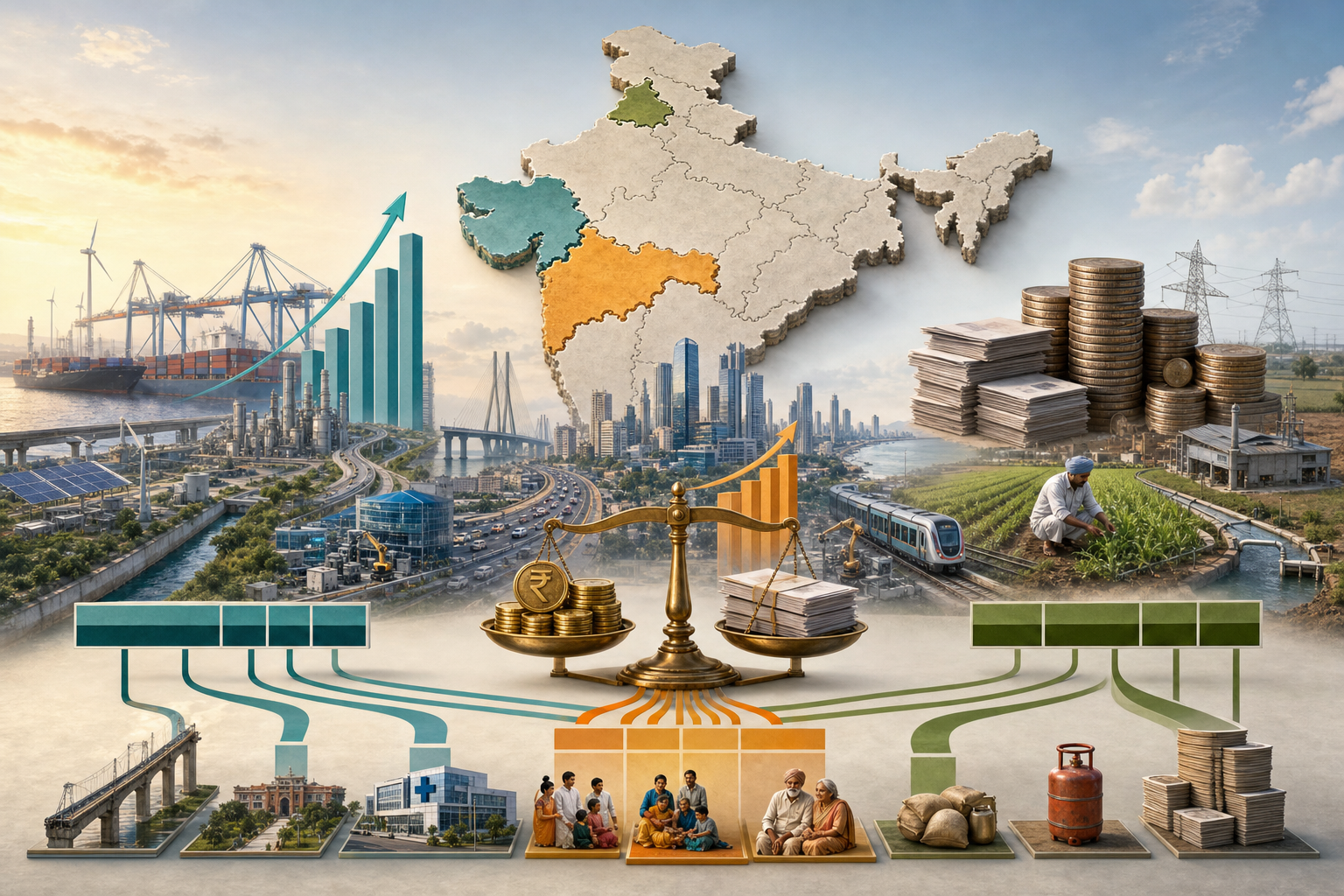
State budgets reveal the practical meaning of India’s development ambitions. Roads, irrigation systems, universities, hospitals, pensions, electricity support and debt servicing do not emerge from abstract policy declarations; they depend on choices recorded in annual accounts. A close comparison of Maharashtra, Gujarat and Punjab therefore offers more than a ranking of three states. It shows how economic structure, revenue capacity, inherited liabilities and political priorities combine to determine whether present expenditure expands future opportunity or restricts it.
India is constitutionally described as a “Union of States.” It has one citizenship and a unified constitutional order, but the states exercise substantial responsibility for agriculture, health, education, policing, transport, local government and other services that shape everyday life. As of June 2026, the Union comprised 28 states and eight Union Territories. The national objective of Viksit Bharat by 2047 consequently cannot be achieved through Union government policy alone; it requires financially capable states that can deliver public services, construct productive assets and manage debt over several decades.
The scale of this responsibility is considerable. The Reserve Bank of India’s analysis of state finances indicates that roughly three-fifths of the combined receipts and expenditure of the Union and state governments were intermediated through the states in 2024-25. State fiscal policy is therefore not a peripheral subject. It is one of the principal channels through which national growth, social development and regional balance are translated into lived outcomes.
The central analytical question is not simply how much a government spends, but what the spending accomplishes. Expenditure that maintains schools, pays nurses or supports agricultural extension is recorded as revenue expenditure even when it produces substantial social value. Capital outlay ordinarily creates durable assets such as roads, hospitals, irrigation networks and public buildings. Salaries, pensions, interest payments and recurring grants are comparatively inflexible commitments. Subsidies can protect vulnerable households or correct market failures, but poorly targeted or open-ended subsidies can displace investment. A serious comparison must preserve these distinctions.
The figures originally highlighted in “A Comparison of Budget Allocation in Maharashtra, Gujarat, and Punjab” were derived from state financial information associated with the Comptroller and Auditor General of India. That comparison reported total 2024-25 outlays of approximately ₹6.0 trillion for Maharashtra, ₹3.3 trillion for Gujarat and ₹2.0 trillion for Punjab. These totals illustrate scale, but they include components that are not always treated uniformly, particularly debt repayment. Comparisons based on expenditure excluding debt repayment provide a cleaner measure of the resources used for current services, asset creation and lending.
Budget scale differed sharply. The contemporaneous 2024-25 budget documents estimated net expenditure, excluding debt repayment, at ₹6,12,293 crore in Maharashtra, ₹2,99,362 crore in Gujarat and ₹1,35,051 crore in Punjab. Maharashtra also budgeted ₹57,198 crore for debt repayment, Gujarat ₹29,085 crore and Punjab ₹69,867 crore. Punjab’s headline budget consequently appeared much larger relative to its programme expenditure because debt repayment formed an unusually substantial component. This is a crucial denominator problem: two states can announce similarly impressive gross totals while retaining very different amounts for public services and investment.
The economic bases supporting these budgets were equally different. Contemporaneous budget projections placed Maharashtra’s nominal gross state domestic product for 2024-25 at about ₹42.68 lakh crore, Gujarat’s at ₹27.9 lakh crore and Punjab’s at ₹8.03 lakh crore. Maharashtra’s diversified base includes finance, manufacturing, information technology, logistics, entertainment and agriculture. Gujarat combines manufacturing, ports, petrochemicals, trade, energy and agriculture. Punjab possesses deep agricultural capabilities, a significant small-industry tradition and an important diaspora, but its recent fiscal position has been constrained by slower structural diversification, high committed expenditure and a large debt burden.
These structural differences mean that absolute rupee totals cannot serve as a complete scorecard. Maharashtra can spend more because its economy and tax base are much larger. Gujarat’s smaller population and strong industrial base affect its per-capita capacity. Punjab’s smaller economy, landlocked geography, agricultural profile and legacy liabilities produce a different set of constraints. Ratios to net expenditure, revenue receipts and GSDP are therefore more informative than standalone totals, while service quality and social outcomes remain necessary complements to every financial ratio.
Maharashtra: scale, diversity and emerging rigidity. Maharashtra budgeted ₹5,19,514 crore of revenue expenditure and ₹85,292 crore of capital outlay in 2024-25. Capital outlay was therefore about 13.9 per cent of planned net expenditure. Its projected revenue receipts were ₹4,99,463 crore, of which approximately 74 per cent was expected from the state’s own resources. This relatively strong own-revenue position gave Maharashtra greater autonomy than a state heavily dependent on transfers, although the budget still projected a revenue deficit of ₹20,051 crore and a fiscal deficit of ₹1,10,355 crore.
Maharashtra’s committed-expenditure bill was also substantial. The 2024-25 budget provided ₹1,59,071 crore for salaries, ₹59,817 crore for pensions and ₹56,727 crore for interest payments, producing a combined commitment of ₹2,75,615 crore. These obligations support public administration and honour legitimate service and retirement claims, but their rigidity matters. Once salaries, pensions and interest are due, they cannot be casually deferred without harming employees, pensioners, creditors or institutional credibility. Rapid growth in these heads can therefore narrow the room available for maintenance, new infrastructure and responses to unforeseen shocks.
Maharashtra’s sectoral allocations demonstrated both breadth and pressure. Education, sports, arts and culture received ₹98,985 crore; transport ₹42,415 crore; agriculture and allied activities ₹35,859 crore; social welfare and nutrition ₹32,754 crore; police ₹29,338 crore; and health and family welfare ₹27,748 crore. These figures capture the demands placed on a large, highly urbanised state that must simultaneously serve metropolitan regions, industrial corridors, drought-prone districts, farming communities and remote rural settlements. Scale creates revenue strength, but it also creates expensive and politically visible service obligations.
The later 2024-25 actuals add an important execution test. Maharashtra’s net expenditure reached ₹6,06,810 crore, only about one per cent below the budget estimate, while capital outlay reached ₹82,773 crore, about three per cent below plan. Revenue receipts were four per cent below estimate, however, and grants from the Union were 37 per cent lower than budgeted. The actual revenue deficit consequently rose to ₹29,995 crore, 50 per cent above the budget estimate, while the fiscal deficit reached ₹1,24,209 crore. Maharashtra largely protected expenditure execution, but weaker receipts translated into larger deficits.
Gujarat: a stronger capital orientation. Gujarat’s 2024-25 budget estimated revenue expenditure of ₹2,19,832 crore and capital outlay of ₹75,689 crore. Capital outlay was approximately 25.3 per cent of net expenditure, the highest proportion among the three states on this harmonised measure. Major provisions included capital outlay for roads and bridges, medium and minor irrigation, urban development and other infrastructure. Such expenditure can expand logistics capacity, reduce transport costs, improve water security and support private investment when projects are well selected, completed on schedule and maintained after construction.
Gujarat budgeted ₹48,980 crore for salaries, ₹26,424 crore for pensions and ₹29,954 crore for interest, producing total committed expenditure of ₹1,05,357 crore. This equalled about 46 per cent of projected revenue receipts, substantially below Punjab’s corresponding burden. The state also projected a revenue surplus of ₹9,821 crore and a fiscal deficit of ₹51,917 crore, or about 1.9 per cent of projected GSDP. A revenue surplus does not automatically prove that every programme is efficient, but it indicates that recurring receipts were expected to cover recurring expenditure, leaving borrowing more closely associated with capital formation and other balance-sheet operations.
Gujarat’s budget was not devoid of subsidies. It estimated subsidy expenditure of ₹31,330 crore, including ₹12,207 crore in power subsidy for agriculture, alongside support for textiles, transport and industry. The distinction is therefore not between a state that subsidises and one that does not. The more useful distinction concerns scale, targeting, transparency, duration and opportunity cost. Agricultural electricity support may protect farm incomes, yet unmetered or poorly designed support can encourage groundwater depletion, weaken distribution companies and conceal liabilities. A fiscally responsible subsidy must be evaluated against measurable social and economic outcomes.
Actual results moderated Gujarat’s initial investment plan without overturning its comparative advantage. Net expenditure in 2024-25 was ₹2,68,591 crore, ten per cent below budget, and capital outlay was ₹65,428 crore, fourteen per cent below budget. Even after this shortfall, capital outlay represented about 24.4 per cent of actual net expenditure. Revenue expenditure stood at ₹1,99,611 crore, while the state recorded an actual revenue surplus of ₹18,943 crore and a fiscal deficit of ₹48,965 crore. The evidence therefore supports Gujarat’s stronger capital orientation, while also showing why announced allocations must not be confused with completed expenditure.
Punjab: high commitments and limited room for manoeuvre. Punjab budgeted ₹1,27,134 crore of revenue expenditure but only ₹7,445 crore of capital outlay in 2024-25. Capital outlay was approximately 5.5 per cent of planned net expenditure, far below the proportions in Maharashtra and Gujarat. The budget projected revenue receipts of ₹1,03,936 crore, a revenue deficit of ₹23,198 crore and a fiscal deficit of ₹30,465 crore. A revenue deficit means that recurring expenditure exceeds recurring receipts; in practical terms, borrowing is required partly to finance present consumption rather than exclusively to create assets or reduce liabilities.
Punjab’s committed expenditure illustrates the depth of the constraint. The budget provided ₹35,168 crore for salaries, ₹19,800 crore for pensions and ₹23,900 crore for interest payments. Together, these heads totalled ₹78,868 crore, equal to approximately 76 per cent of projected revenue receipts. This ratio is more revealing than the absolute amount. Punjab spent far fewer rupees on salaries than Maharashtra, but those salaries consumed a much larger share of the revenue available to Punjab. Fiscal stress is therefore a question of capacity relative to obligation, not merely the nominal size of a payment.
Power subsidy added another major claim. Punjab budgeted ₹20,200 crore for this purpose, equivalent to about 19 per cent of projected revenue receipts and roughly 2.7 times its planned capital outlay. Subsidised power can support farmers and low-income households, and sudden withdrawal could cause genuine distress. Yet a subsidy of this scale creates difficult trade-offs when layered on top of salaries, pensions and interest. The durable policy question is whether benefits can be better targeted while protecting small farmers, improving metering, supporting efficient irrigation and gradually restoring resources for infrastructure and service improvement.
Punjab’s actual 2024-25 outcome was more difficult than the budget anticipated. Revenue receipts reached ₹93,207 crore, ten per cent below estimate, while net expenditure was only two per cent below plan at ₹1,32,946 crore. Capital outlay was ₹6,876 crore, eight per cent below estimate. The revenue deficit widened to ₹32,570 crore, 40 per cent above the budget estimate, and the fiscal deficit rose to ₹39,711 crore, 30 per cent above plan and approximately 4.74 per cent of GSDP. Borrowings exceeded the budget estimate by 15 per cent.
The later accounts also show that Punjab’s actual salaries, pensions and interest payments totalled ₹78,863 crore. Because actual revenue receipts were weaker than expected, committed expenditure absorbed about 85 per cent of those receipts. This left an exceptionally narrow margin for all other revenue responsibilities before subsidies were considered. For an ordinary household, the comparable experience would be receiving income and finding that almost all of it is already assigned to unavoidable instalments and recurring obligations before food, repairs, education or emergency savings can be addressed. A government is not a household, but the loss of flexibility is similarly tangible.
A harmonised comparison confirms the broad ranking. Using actual net expenditure for 2024-25, capital outlay represented about 24.4 per cent in Gujarat, 13.6 per cent in Maharashtra and 5.2 per cent in Punjab. The original comparison reported somewhat different allocation shares—20.2 per cent, 12.4 per cent and 5.7 per cent respectively—because classifications and denominators can vary. The precise percentage changes when debt repayment, loans or broader capital expenditure are included, but the substantive conclusion remains stable: Gujarat devoted the largest share to asset creation, Maharashtra occupied the middle position and Punjab allocated the smallest share.
The original comparison also grouped recurrent grants to local bodies, universities and aided institutions with general expenditure and salaries. That combined category reportedly accounted for 38.4 per cent of Maharashtra’s expenditure, 29.4 per cent of Gujarat’s and 55.5 per cent of Punjab’s. The finding points to greater rigidity in Punjab, but the category should not be dismissed as wholly unproductive. Grants may finance teachers, public health workers, municipal sanitation and university operations. Their economic value depends on institutional performance, staffing quality and public outcomes, even though they do not directly create a physical asset.
A similar caution applies to capital spending. A bridge that is unnecessary, delayed or poorly constructed does not become valuable merely because it is classified as capital expenditure. Conversely, vaccination, teacher training, preventive maintenance and agricultural research may yield long-term returns despite being classified as revenue expenditure. Expenditure quality must therefore be assessed through three linked questions: whether a budget creates fiscal space, whether money is actually spent as authorised, and whether the resulting programmes produce measurable economic and social benefits.
The Fiscal Health Index supplies a broader test. NITI Aayog’s Fiscal Health Index for 2023-24 ranked Gujarat fourth, Maharashtra fifth and Punjab eighteenth among 18 major states. The composite measure evaluates quality of expenditure, revenue mobilisation, fiscal prudence, debt and debt sustainability. Gujarat and Maharashtra were classified as front runners overall, while Punjab was placed in the aspirational group. This multidimensional framework is stronger than a single capital-expenditure ratio because a state can invest heavily while still mobilising revenue poorly or accumulating unsustainable debt.
The detailed rankings also correct an important overstatement in the initial comparison. Punjab ranked seventeenth—not eighteenth—on the quality-of-expenditure pillar, while Kerala ranked eighteenth. Punjab did rank eighteenth on fiscal prudence and on the Debt Index. Gujarat ranked ninth on expenditure quality, third on fiscal prudence and third on the Debt Index. Maharashtra ranked fourteenth on expenditure quality, sixth on fiscal prudence and second on the Debt Index. These variations demonstrate why an overall rank should never be treated as a universal judgement on every aspect of a state’s finances.
NITI Aayog found that Punjab’s liabilities had risen beyond 48 per cent of GSDP by 2023-24 and that interest payments absorbed more than one-fifth of revenue receipts. Gujarat, by contrast, maintained lower public debt relative to GSDP and a contained interest burden, while Maharashtra benefited from diversified revenues and a comparatively manageable interest ratio. Debt is not inherently harmful: borrowing for productive infrastructure can raise future income and revenue. The danger arises when repeated revenue deficits require new debt without producing assets or revenue streams capable of servicing it.
Revenue mobilisation is as important as expenditure restraint. Punjab cannot restore fiscal space through indiscriminate cuts alone. Weak own non-tax revenue, gaps between budget estimates and actual receipts, compliance limitations and an economy requiring broader diversification all deserve attention. Modern property records, better user-charge design with protections for poorer households, improved tax administration, stronger state public enterprises where commercially viable and growth in higher-value manufacturing and services could expand revenue without imposing excessive rates. Administrative capacity is central because ambitious estimates offer little protection when receipts do not materialise.
Maharashtra’s challenge is different. Its large tax base permits broad spending, but rapidly expanding welfare commitments, pensions and subsidies can gradually harden the expenditure structure. The state’s 2024-25 revenue and fiscal deficits exceeded their budget estimates even though overall expenditure was close to plan. Maharashtra therefore requires realistic revenue forecasting, transparent costing of recurring schemes and protection of maintenance and capital budgets during fiscal adjustment. A wealthy state can lose flexibility incrementally if permanent obligations grow faster than recurring income.
Gujarat’s strong capital share also requires scrutiny beyond the headline. Actual capital outlay was fourteen per cent below its 2024-25 budget estimate, indicating an execution gap. Project appraisal, land acquisition, procurement, environmental clearance and coordination with urban and local bodies can all delay investment. Capital budgets should be accompanied by project-level completion schedules, cost revisions, physical milestones and outcome indicators. Otherwise, a high allocation may signal intention without guaranteeing that residents receive functioning roads, water systems, schools or hospitals.
Subsidy reform must protect people while repairing incentives. Abruptly removing agricultural or household support can transfer fiscal adjustment onto families least able to absorb it. Better reform would identify beneficiaries accurately, separate support for small farmers from untargeted consumption, meter use where feasible, encourage water-efficient cultivation, publish the full cost of power support and compensate distribution companies transparently. Time-bound reviews can determine whether each scheme still addresses a valid public need. This approach treats welfare and prudence as complementary rather than opposing principles.
Pension management also demands a long horizon. Participation in the National Pension System limits the accumulation of some future defined-benefit liabilities, but states continue to pay pensions earned under earlier arrangements while contributing for current employees. Demographic change, wage revisions and longevity can keep the transition cost elevated for years. Each state should publish long-term pension projections, reconcile employee contributions promptly and disclose any unfunded liabilities. Fiscal sustainability depends not only on the next annual budget but also on obligations extending across generations.
Local bodies and aided institutions require similar transparency. Grants are indispensable when municipalities, panchayats and universities carry responsibilities without adequate own revenue. Yet unconditional transfers can weaken accountability if funding is disconnected from service standards. Predictable formula-based transfers, audited accounts, digital expenditure tracking and public performance indicators can improve the value of these grants. Strengthening local revenue systems would also reduce the pressure on state budgets while allowing local priorities to be addressed closer to the communities affected.
Budget estimates, revised estimates and actuals tell different stories. Budget estimates express policy intention before a financial year begins. Revised estimates incorporate developments during the year but remain projections. Actuals record the transactions that ultimately occurred. Maharashtra came close to its spending plan but experienced weaker receipts and higher deficits. Gujarat underspent both its total and capital budgets while preserving a revenue surplus. Punjab kept expenditure relatively close to plan despite a significant revenue shortfall, leading to larger borrowing and deficits. The execution record is therefore as important as the initial allocation.
Comparisons must also avoid turning fiscal analysis into regional stereotyping. Maharashtra, Gujarat and Punjab have each made distinctive contributions to India’s prosperity and social life. Punjab’s agriculture, military service, enterprise and diaspora remain nationally significant; Maharashtra’s financial and industrial institutions serve the entire Union; and Gujarat’s manufacturing and maritime networks connect domestic producers with global markets. Identifying fiscal stress is not a judgement on a people or their culture. It is an evidence-based effort to preserve the state’s capacity to serve future generations.
A practical reform agenda follows from the comparison. States should adopt conservative revenue forecasts, publish the medium-term cost of major schemes, disclose off-budget borrowing and guarantees, protect high-return capital projects, and strengthen maintenance budgets so existing assets do not decay. Subsidies should be targeted and periodically evaluated. Procurement and project management should be improved to narrow the gap between allocation and execution. Fiscal-risk statements should cover pensions, public enterprises, power-distribution liabilities and guarantees. Outcome budgeting should connect each major allocation to measurable improvements in learning, health, mobility, water security or productivity.
Punjab’s most urgent task is to create room between recurring revenue and recurring expenditure. That requires a sequenced programme rather than a sudden austerity shock: improve revenue collection, prioritise high-value expenditure, redesign broad subsidies without abandoning vulnerable beneficiaries, manage debt actively and protect capital investment. Maharashtra should prevent new recurring commitments from eroding its diversified revenue advantage. Gujarat should convert its capital orientation into timely, high-quality and inclusive assets while continuing to scrutinise subsidies and sectoral service gaps.
The emotional significance of these choices is easily overlooked in fiscal tables. A delayed irrigation project may mean another uncertain season for a farming family. An underfunded municipal grant may appear as unreliable water supply or uncollected waste. Excessive interest payments represent classrooms, clinics or roads that cannot be financed. At the same time, an abrupt spending cut can affect a pensioner, student or low-income household. Responsible budgeting is therefore not an exercise in favouring numbers over people; it is the discipline required to keep public promises credible and sustainable.
The comparison ultimately concerns national capacity. Gujarat’s relatively high capital allocation, Maharashtra’s scale and revenue diversity, and Punjab’s constrained fiscal space illustrate three different relationships between resources and obligations. No state can remain complacent. Strong states must preserve their advantages, while stressed states require credible reform supported by institutional cooperation and realistic transitions. Progress toward Viksit Bharat by 2047 will depend on whether state budgets can combine growth, social protection, intergenerational fairness and disciplined execution.
The clearest conclusion is that budget size alone says little about development quality. What matters is the proportion available after committed obligations, the balance between revenue and capital expenditure, the sustainability of subsidies and debt, the credibility of revenue estimates and the conversion of allocations into functioning public assets and services. On these measures, Gujarat entered 2024-25 with the strongest capital orientation, Maharashtra retained substantial but tightening fiscal capacity, and Punjab faced the most serious structural pressure. The evidence calls for reform, not fatalism: fiscal trajectories are shaped by policy and can change through sustained, transparent and socially balanced action.
Data note: Budget estimates and later actuals are drawn from the respective state budget documents as compiled in the Maharashtra, Gujarat and Punjab budget analyses, together with the 2026-27 analyses reporting 2024-25 actuals. All rupee figures are nominal. Ratios may differ from other presentations when total expenditure includes debt repayment, loans or a broader definition of capital expenditure.
Inspired by this post on Hindu Post.







Leave a Reply
You must be logged in to post a comment.