
Karna, Yudhishthira, and the meaning of true generosity. Among the many stories inspired by the Mahabharata, the sandalwood test offers a memorable explanation for Karna’s enduring reputation as a danveer—a heroic giver. The story begins with a question that appears entirely reasonable. If both Karna and Yudhishthira were renowned for charity, and if neither ordinarily turned away a sincere petitioner, why did popular tradition reserve its highest praise for Karna? The answer, according to this folktale, lies not simply in how much each man gave but in the speed, freedom, and emotional detachment with which the gift was offered.
An important distinction must be made at the outset. The sandalwood test should not be presented as a verbatim episode from the critical Sanskrit text of the Mahabharata. It circulates primarily as a later didactic folktale that uses familiar epic characters to explore the ethics of dāna, or charitable giving. This distinction does not make the story insignificant. Oral narratives, regional retellings, temple discourses, family traditions, and devotional literature have long extended the moral world of the Indian epics. Such stories reveal how communities have interpreted epic personalities and applied their virtues to everyday life.
Arjuna’s question. In the commonly told version, Arjuna approaches Krishna with a doubt. “Bhagavan, why does everyone regard Karna as a greater giver than Yudhishthira? Neither of them has ever refused anyone who asked for charity. So why is Karna considered the greater danveer?” His question is not merely an expression of rivalry. It identifies a genuine ethical puzzle: if two people perform the same charitable act, on what basis can one be considered more generous than the other?
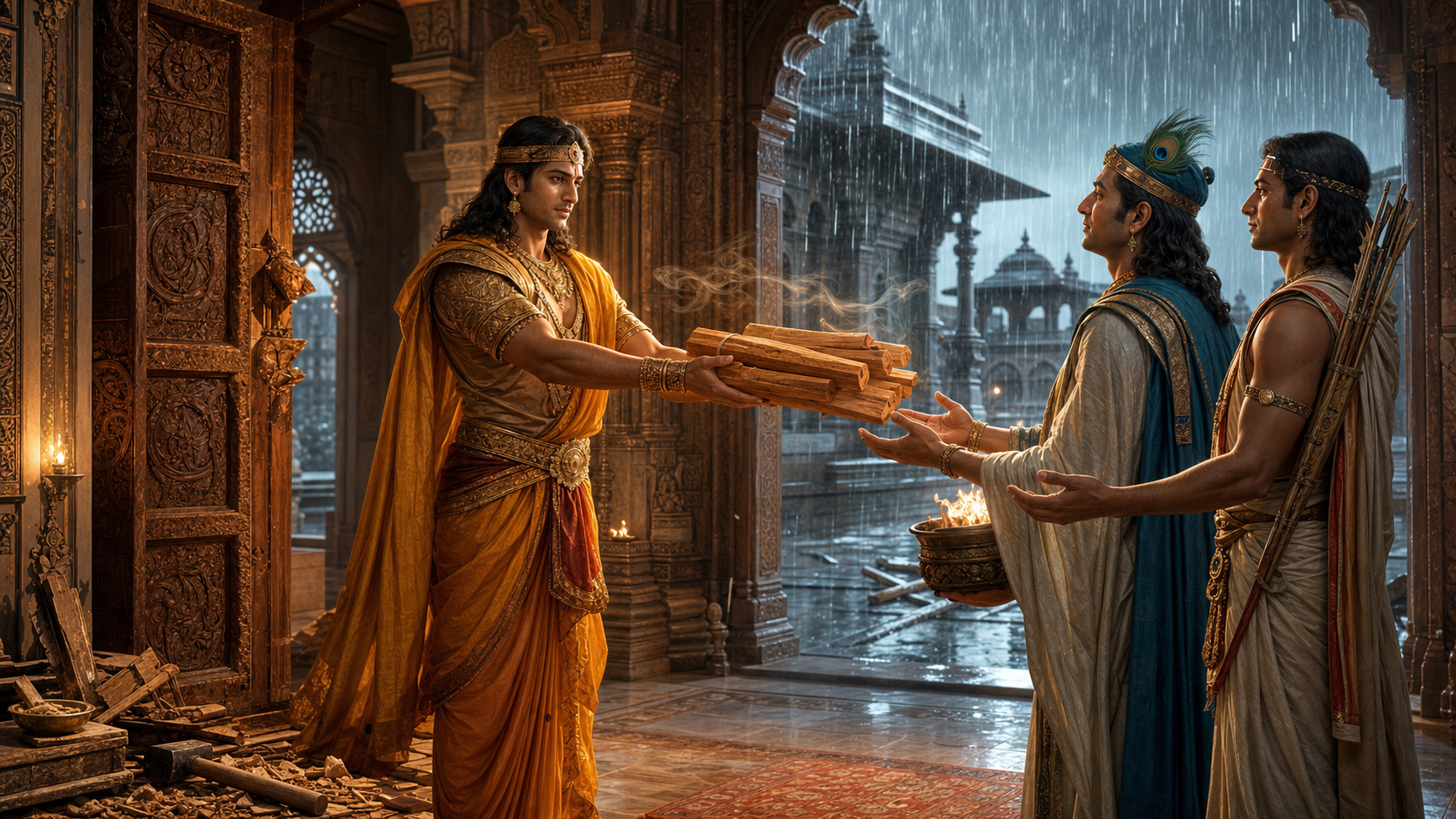
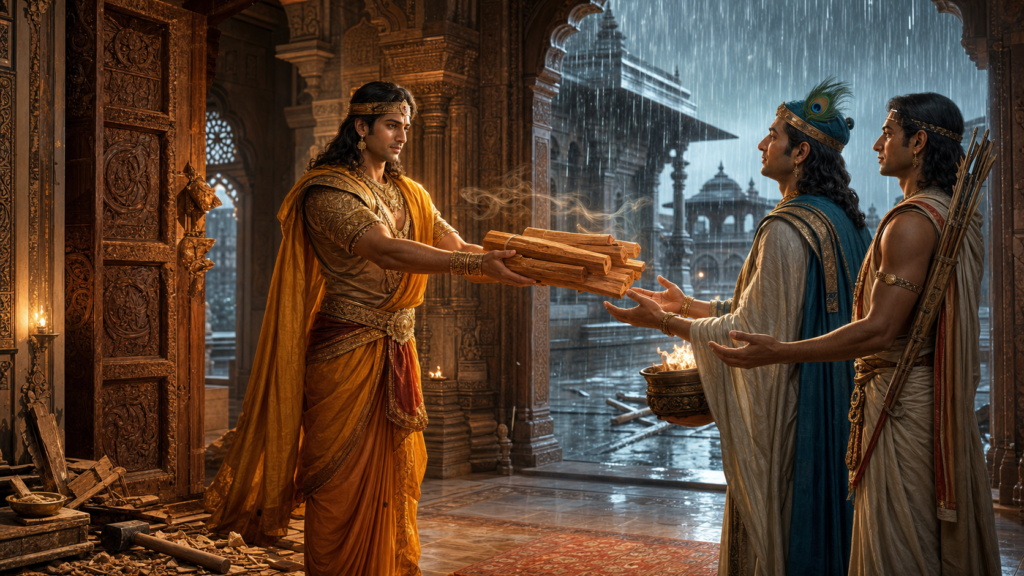
Krishna smiles because the difference cannot be demonstrated adequately through abstract argument. A lecture might produce agreement, but an experience can expose the hidden movement of the mind. Krishna therefore decides to teach Arjuna through a practical test. In several popular versions, Krishna and Arjuna assume the appearance of Brahmins seeking material for a sacred fire. The precise details vary between retellings, but the central request remains the same: they ask for a substantial quantity of dry sandalwood during a period of relentless rain.
Why sandalwood matters. Sandalwood is not an ordinary fuel. It is aromatic, valuable, ritually significant, and difficult to obtain in large quantities. The rain introduces an additional constraint because any wood stored carelessly would be wet and unsuitable for immediate use in a sacrificial fire. The request is therefore deliberately demanding. It tests not only the willingness to give wealth but also the ability to respond intelligently when the requested object is scarce, costly, and urgently needed.
The visit to Yudhishthira. Krishna and Arjuna first present their request at Yudhishthira’s palace. Yudhishthira receives the petitioners respectfully and instructs his attendants to find dry sandalwood. Servants search the royal stores and the surrounding market, but the continuous rain has left no suitable supply. Every conventional source has been exhausted. Yudhishthira is troubled because he sincerely wishes to help, yet his officials report that the requested material cannot be procured.
Some versions state that Yudhishthira offers other kinds of wood, money, or an alternative arrangement. The petitioners, however, explain that dry sandalwood is specifically required. Unable to satisfy the exact request through the normal machinery of the palace, Yudhishthira apologizes. His response is neither cruel nor contemptuous. He has listened, ordered a search, and attempted to meet the need. Judged by ordinary administrative standards, he has behaved responsibly.
The visit to Karna. Krishna and Arjuna then approach Karna with the same request. Karna also discovers that no dry sandalwood can be obtained from the stores or market. The material obstacle is identical, but his mental response is different. Instead of concluding that the gift is impossible, he looks around his palace and notices that its doors, frames, furnishings, or decorative structures are made from sandalwood and have remained dry indoors.
Karna immediately orders that the required sandalwood be taken from the palace itself. In dramatic retellings, he seizes an axe and breaks apart the sandalwood doors and windows with his own hands. He gathers the pieces and presents them to the petitioners without hesitation. The architectural value of the palace does not outweigh the immediate purpose of the gift. What had appeared to be an unavailable resource becomes available the moment attachment to its existing form is abandoned.
Krishna’s explanation. After leaving Karna, Krishna explains the lesson to Arjuna. Yudhishthira was willing to give sandalwood as long as it could be obtained through recognized channels. Karna was willing to transform something already incorporated into his comfort, status, and property. Both men possessed charitable intent, but Karna crossed the psychological boundary between giving from surplus and surrendering something personally useful.
The story does not necessarily imply that Yudhishthira would have refused had the visitors explicitly asked for his palace doors. Its subtler claim is that the possibility did not arise spontaneously in his mind. Karna required no such suggestion. His instinct was to ask what could be relinquished, not merely what was already designated for distribution. In the moral logic of the folktale, this immediacy of insight is the quality that distinguishes an honorable donor from an extraordinary danveer.
The technical meaning of dāna. The Sanskrit term dāna broadly denotes giving, donation, generosity, or the voluntary transfer of something valuable. Within Dharmic ethical traditions, it is not evaluated solely by market price. The worth of a gift may depend on the donor’s intention, the suitability of the recipient, the nature of the need, the timing of the act, the manner in which it is offered, and the degree of attachment surrendered. A large donation made for prestige can be ethically inferior to a modest gift offered respectfully at the moment it is genuinely needed.
The epithet dānavīra, commonly rendered as danveer, combines generosity with heroic resolve. The idea is not simply that a wealthy ruler distributes valuable objects. Heroism becomes relevant because meaningful giving may require courage: courage to lose security, resist possessiveness, act without delay, and place another person’s need before one’s own convenience. Karna’s conduct in the sandalwood story is heroic because he treats attachment itself as the obstacle to be overcome.
Giving from inventory and giving from identity. Yudhishthira initially treats the request as a problem of inventory. Are the required materials present in the royal stores? Can officials purchase them? Can a substitute be found? Karna treats it as a problem of purpose. Where does usable sandalwood exist, and what prevents it from being given? His palace doors have social and symbolic functions, but they remain pieces of wood. Once a higher purpose appears, their role can change.
This distinction is recognizable in modern life. A person may willingly donate clothes that are no longer worn, food that is unlikely to be eaten, or money left after every personal desire has been satisfied. Such acts can still be beneficial and praiseworthy. A deeper test arises when generosity requires time from a crowded schedule, attention during emotional fatigue, professional knowledge without personal advantage, or the surrender of something still valued. The sandalwood test asks whether giving begins only after comfort has been protected.
Speed as an ethical factor. Karna’s decisiveness is central to the narrative. A gift delayed can lose much of its practical value. Food offered after hunger has passed, medicine supplied after a crisis, or assistance promised after an opportunity has disappeared may preserve the donor’s good intention while failing the recipient. Karna understands the urgency embedded in the request. He does not use caution as a disguise for reluctance.
Yet the story should not be interpreted as a rejection of all deliberation. Responsible generosity must consider whether a request is legitimate, whether a gift could cause harm, and whether obligations to dependants are being neglected. The lesson concerns unnecessary hesitation after the need and the means of helping have become clear. Karna’s speed is virtuous because it is joined to discernment and directed toward a constructive purpose.
The psychology of non-attachment. The most technically interesting feature of the folktale is its treatment of ownership. An object may be physically available while remaining psychologically unavailable. The palace contains dry sandalwood throughout the episode, but its identity as a door or royal furnishing conceals its identity as usable wood. Attachment narrows perception: once an object is classified as “mine,” “valuable,” or “necessary to my status,” alternative uses become difficult to imagine.
Karna’s generosity changes perception before it changes possession. He sees that the value of the sandalwood does not reside in preserving the appearance of the palace. Its higher value, at that moment, lies in enabling another person’s sacred undertaking. Non-attachment therefore does not mean indifference toward material things. It means refusing to allow their possession to prevent a morally appropriate action.
Why Yudhishthira should not be diminished. Popular titles sometimes frame the tale as proof that Karna was generous while Yudhishthira was not. That interpretation is too crude. Yudhishthira is widely associated with truth, restraint, duty, consultation, and rajadharma. His virtues are often institutional: he seeks to preserve moral order, honor obligations, and act through legitimate procedures. The folktale itself begins from the premise that he is an eminent giver who normally refuses no sincere request.
The comparison works precisely because Yudhishthira is already generous. Placing Karna beside a selfish king would prove very little. Krishna’s test distinguishes between two high levels of virtue: disciplined generosity and spontaneous self-giving. Yudhishthira represents goodness operating through duty and ordered responsibility; Karna represents generosity erupting beyond conventional limits. The praise of one need not become the humiliation of the other.
Karna’s moral complexity. Karna remains one of the Mahabharata’s most debated figures. He displays loyalty, courage, endurance, martial excellence, and extraordinary generosity, yet he also participates in decisions that the epic presents as morally grave. His support for Duryodhana and his conduct during Draupadi’s humiliation cannot be erased by charitable deeds. Conversely, those failures do not make every virtue attributed to him unreal.
The Mahabharata repeatedly resists the simplification of human beings into flawless heroes and absolute villains. Great virtue can coexist with destructive loyalty, wounded pride, resentment, or failures of judgment. Karna’s title as danveer identifies a specific excellence; it does not issue a universal verdict on every choice he made. This ethical precision is essential when interpreting epic characters academically.
The broader epic basis for Karna’s reputation. Although the sandalwood test belongs to later storytelling, Karna’s association with radical generosity is rooted in the wider epic tradition. The most famous example is his surrender of the natural armor and earrings associated with his birth. Indra approaches him in disguise, and Karna gives away these protections despite understanding the danger. The episode intensifies his identity as a giver because the gift is not decorative wealth; it is bound to his bodily safety and fate.
This form of giving is both admirable and tragic. It displays freedom from possessiveness, but it also raises questions about self-preservation, pride, and the desire to remain faithful to a public vow. Karna may be motivated by compassion, honor, reputation, or a complex mixture of all three. The Mahabharata rarely reduces an important action to a single psychological cause. The sandalwood folktale simplifies that complexity for teaching purposes, while the epic context restores its tension.
Intention, manner, and recipient dignity. Ethical giving concerns not only what leaves the donor’s hand but also what reaches the recipient’s experience. A gift delivered with humiliation, publicity, contempt, or an expectation of obedience can create a hidden debt. Karna’s idealized generosity is remembered as open-handed because the petitioners are not made to feel burdensome. The destruction of the doors is his sacrifice; it is not converted into their shame.
This principle remains relevant to charity and philanthropy. Effective giving respects the knowledge and dignity of those receiving assistance. It avoids treating vulnerable people as instruments for the donor’s image. It also examines whether assistance solves an actual problem rather than merely producing the appearance of benevolence. The sandalwood has value because it meets the stated need at the required time.
Generosity across Dharmic traditions. The ethical importance of giving extends throughout Hinduism, Buddhism, Jainism, and Sikhism, even though each tradition develops its own vocabulary and emphasis. Hindu discussions of dāna connect generosity with dharma, purification of attachment, hospitality, and social responsibility. Buddhist traditions commonly place dāna among the foundational practices that weaken clinging and cultivate compassion. Jain ethics emphasize forms of giving that support life, knowledge, fearlessness, and disciplined nonviolence.
Sikh teachings express generosity through principles such as seva and vand chhakna—selfless service and sharing what one has with others. The institution of langar gives this ideal a powerful social form by joining nourishment, service, and human equality. These traditions should not be collapsed into a single doctrine, but their converging respect for generosity demonstrates a shared civilizational concern: possession acquires moral value when it supports life, dignity, wisdom, and community.
What the palace doors symbolize. A door protects privacy, marks ownership, and separates the inside from the outside. In the folktale, breaking a sandalwood door therefore carries symbolic force beyond the loss of valuable timber. Karna breaks the boundary between private abundance and public need. The palace ceases, momentarily, to be a monument to status and becomes a reservoir of assistance.
The symbolism also suggests that generosity sometimes requires dismantling established categories. Resources may exist but remain locked inside institutions, ceremonial budgets, unused buildings, excessive inventories, or rigid rules. The ethical challenge is not always scarcity. It may be the inability to reimagine how existing resources can serve a more urgent purpose. Karna’s act represents moral creativity as much as personal sacrifice.
Generosity and good governance. The contrast between Karna and Yudhishthira can also be read as a productive tension between individual compassion and institutional procedure. Institutions need rules because arbitrary distribution can create injustice, corruption, or instability. At the same time, procedure can become morally inadequate when it prevents an urgent and reasonable response. Mature governance requires both Yudhishthira’s concern for order and Karna’s ability to recognize when extraordinary circumstances demand flexibility.
This balance applies to charitable organizations as well. Accountability, documentation, and long-term planning protect resources and recipients. However, excessive bureaucracy can cause assistance to arrive too late. The sandalwood test encourages systems that preserve due diligence while empowering responsible people to act quickly during genuine need. Compassion becomes most effective when supported, rather than suffocated, by structure.
Questions the story asks of ordinary life. The folktale invites reflection without demanding theatrical self-deprivation. What useful knowledge is being withheld because sharing it offers no advantage? What time could be given to a lonely relative, an overwhelmed colleague, or a student seeking guidance? Which possessions are being preserved beyond any meaningful use? Which community need remains unmet because everyone assumes that the appropriate resource must come from somewhere else?
These questions shift attention from public declarations to habitual conduct. Generosity can appear in hospitality, mentorship, listening, blood donation, environmental stewardship, community service, and the fair treatment of workers. Financial charity remains important, but the deepest scarcity in a particular situation may be attention, courage, access, knowledge, or human presence. A danveer recognizes the real need rather than offering only what is easiest to surrender.
Necessary limits to sacrificial giving. Karna’s example should not be used to pressure vulnerable people into surrendering necessities or tolerating exploitation. Dharmic generosity is not a license for manipulation. A person has legitimate responsibilities toward health, dependants, livelihood, and existing commitments. Giving that predictably causes serious harm to innocent dependants may reflect poor judgment rather than virtue.
The ethically relevant principle is proportionate non-attachment. Those with abundance can bear greater responsibility, while those with limited means may contribute through smaller gifts or nonmaterial service. The moral quality of dāna cannot be calculated by amount alone. Freedom of intention, appropriateness, compassion, and sustainability all matter. Karna’s broken doors are a symbol of liberating generosity, not a universal instruction to ignore prudent boundaries.
Why the lesson endures. The sandalwood test survives because it identifies a gap between being willing to help in theory and being willing to rearrange life in practice. Many people approve of generosity while assuming that it should draw only from resources already marked as expendable. Karna’s action disrupts that assumption. He demonstrates that the decisive question is not merely, “Is there something available to give?” but, “What can be made available when the need is worthy?”
Krishna’s lesson therefore concerns inner freedom. Yudhishthira sees an exhausted supply chain; Karna sees sandalwood standing before him in another form. Yudhishthira’s response remains respectable, but Karna’s response becomes unforgettable because compassion enlarges his field of perception. The external gift follows an internal release from ownership.
The final meaning of danveer. Karna is remembered as the greater giver in this folktale because generosity has become part of his immediate disposition. He does not wait to be told what sacrifice is possible, and he does not treat comfort, architecture, or royal prestige as untouchable. His first impulse is to remove the obstacle between a sincere petitioner and a legitimate need.
The story’s mature conclusion is not that Yudhishthira lacks virtue or that Karna is morally flawless. It is that virtues possess degrees, textures, and characteristic forms. Yudhishthira embodies conscientious duty; Karna, at his best, embodies fearless giving. The sandalwood test honors the moment when charity ceases to be the distribution of surplus and becomes the courageous transformation of attachment into service.
Inspired by this post on Hindu Blog.





Leave a Reply
You must be logged in to post a comment.