
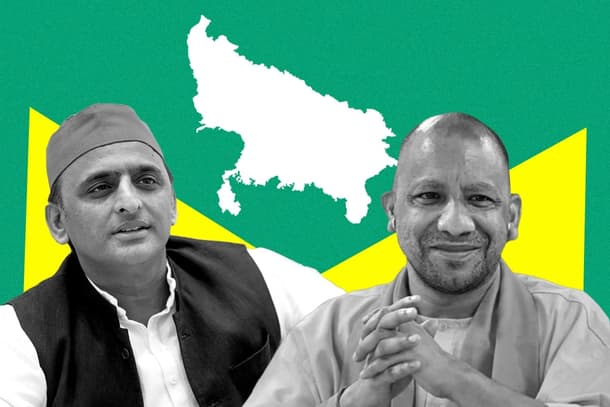
Uttar Pradesh Assembly Election 2027 is already being shaped below the surface. The visible contest places Chief Minister Yogi Adityanath and Samajwadi Party president Akhilesh Yadav at the centre of two rival political projects. Yet the election cannot be understood adequately as a presidential-style duel between two leaders. Its decisive forces are more granular: constituency-level organization, candidate credibility, caste coalitions, alliance management, household economics, public-service delivery and the electorate’s daily experience of the bureaucracy.
The phrase ‘150 vs 150’, used in the original Swarajya analysis published on 7 July 2026, is best treated as an analytical framework rather than a literal opinion-poll forecast. It suggests that the Bharatiya Janata Party-led camp and the Samajwadi Party-led camp may each begin with a substantial universe of constituencies in which their social base, previous performance, local networks or alliance structure makes them strongly competitive. Neither bloc, however, can assume that this foundation automatically produces a government.
The Assembly arithmetic explains the argument. Uttar Pradesh has 403 elected Assembly seats, and 202 are required for a majority. If each principal bloc can establish an initial advantage in approximately 150 constituencies, around 103 seats remain outside those two notional columns. A party beginning from 150 would need roughly 52 additional victories to cross the majority mark. In practice, third parties, rebels and independents complicate that calculation, but the central insight remains valid: the government will be determined by a relatively limited set of highly competitive constituencies rather than by statewide rhetoric alone.
This framework also corrects a common error in election commentary. A constituency described as part of a party’s base is not necessarily safe. It may simply be a seat in which that party possesses a viable starting coalition. A poor candidate, a dissatisfied local organization, an alliance rebellion or a modest transfer of votes can overturn the advantage. Conversely, a party can recover a seat considered difficult if it identifies a locally credible nominee and builds an effective coalition around constituency-specific concerns.
The historical baseline favours neither complacency nor fatalism. In 2017, the BJP won 312 seats on its own, while the wider National Democratic Alliance secured 325. That result reflected an unusually broad social coalition and a strong desire for political change. In 2022, the BJP retained power but fell to 255 seats; with Apna Dal (Soneylal) and the NISHAD Party, the NDA reached 273. The Samajwadi Party rose to 111 seats, while its then-allies Rashtriya Lok Dal and Suheldev Bharatiya Samaj Party helped take that coalition to 125.
The change between 2017 and 2022 demonstrated that the BJP remained formidable but no longer enjoyed the same degree of electoral abundance. It also showed that Akhilesh Yadav had rebuilt the SP into the principal challenger without reaching the level required to form a government. The 2027 contest therefore begins between an incumbent alliance seeking to prevent further erosion and an opposition alliance seeking to convert substantial growth into the final 70-odd seats that eluded it in 2022.
The 2024 Lok Sabha election intensified that competition. In Uttar Pradesh, the SP won 37 parliamentary seats, the BJP 33, the Congress six, the RLD two, Apna Dal (Soneylal) one and the Azad Samaj Party (Kanshi Ram) one. The SP–Congress combination consequently emerged as the largest parliamentary formation in the state. For the BJP, the result exposed weaknesses in candidate selection, cadre motivation, communication and the management of local social discontent. For the SP, it validated a wider candidate-distribution strategy and the political vocabulary of PDA—Pichhda, Dalit and Alpsankhyak.
Nevertheless, a Lok Sabha result cannot be transferred mechanically to an Assembly election. Parliamentary constituencies combine several Assembly segments, national leadership weighs more heavily, and alliance voters may behave differently when choosing a state government. Assembly elections also magnify the importance of the candidate, local factionalism, district administration, municipal services and personal access to an MLA. The 2024 verdict is therefore an important warning to the BJP and a major opportunity for the SP, but it is not a certificate for 2027.
Geography will fragment the statewide contest. Western Uttar Pradesh combines agrarian concerns, Jat politics, a significant Muslim electorate, Dalit communities and rapidly urbanizing districts. The RLD’s position inside the NDA gives the BJP an important organizational bridge, but the durability of vote transfer will depend on local candidates and rural economic sentiment. Sugarcane payments, farm costs, land acquisition, employment, law and order, and civic pressure in the National Capital Region may matter more than a uniform statewide message.
Rohilkhand has its own combinations of Muslim voters, non-Yadav OBC communities, Dalits and upper castes. Awadh and central Uttar Pradesh contain closely contested networks involving Kurmis, Pasis, Yadavs, Brahmins and several smaller communities. Purvanchal combines Yogi Adityanath’s personal influence with the local relevance of parties such as Apna Dal (Soneylal), the NISHAD Party and SBSP. Bundelkhand may respond to water security, agricultural stress, migration and infrastructure, while the large urban belt is more likely to test the government on jobs, housing, transport, pollution, policing and the quality of municipal administration.
These regional differences make statewide vote share an incomplete guide. A party can increase its total vote while losing seats if those additional votes accumulate in constituencies it already wins comfortably. It can also gain many seats through a small vote swing if that swing is efficiently distributed across marginal contests. The relevant question is not only how many citizens support a party, but where those supporters live, whether allies transfer votes to one another and whether the party can convert social approval into turnout.
The BJP’s first challenge is organizational repair. National president Nitin Nabin’s July 2026 organizational visit to Lucknow included meetings with the chief minister, deputy chief ministers, party office-bearers, district leaders, Shakti Kendra conveners and booth-level workers. The design of the visit indicated that the leadership was examining both high-level coordination and the lowest operational units of the campaign. A statewide organization can appear impressive on paper while still failing if local workers feel ignored, tickets are imposed without consultation or government office-holders become disconnected from the cadre.
For the BJP, coordination among the government, state organization, national leadership, allies and the wider Sangh network will be essential. Separate centres of authority need not be damaging when responsibilities are clear, but visible rivalry can confuse workers and create competing candidate lobbies. The party’s task is to convert Yogi Adityanath’s leadership profile, Narendra Modi’s national appeal, welfare beneficiaries and a large booth organization into a unified constituency operation. Any gap between these components would be most costly in the approximately 100 seats where margins are expected to be narrow.
The BJP’s 2026 organizational restructuring also reflects an effort to balance social representation. The appointment of Pankaj Chaudhary, a Kurmi leader, as the state party president and the composition of the new state team signal renewed attention to non-Yadav OBC voters while retaining upper-caste, Dalit, regional, generational and women’s representation. Cabinet changes have similarly been interpreted as an attempt to answer community-specific concerns before candidate selection begins.
Representation, however, cannot be reduced to the number of leaders from a particular community. Voters also evaluate whether those leaders possess authority, whether public resources reach their districts and whether the party responds when local workers report grievances. Symbolic inclusion without organizational influence may produce limited returns. The BJP’s caste-based course correction will therefore succeed only if it is accompanied by access, accountability and credible local leadership.
The SP faces the opposite organizational problem. It has demonstrated that it can assemble a competitive social coalition, but it must give that coalition durable booth-level form across all 403 constituencies. The party’s PDA formulation deliberately seeks to move beyond its traditional Yadav–Muslim base by expanding representation among non-Yadav OBCs, Dalits and smaller communities. Its performance in 2024 showed the potential of this approach, particularly when candidate selection was aligned with local demography and alliance partners avoided unnecessary vote division.
For Akhilesh Yadav, the next test is whether PDA can function as an institutional coalition rather than an election-season slogan. Communities grouped together under a broad acronym do not have identical interests, histories or local rivalries. A ticket distribution that satisfies one district may cause resentment in another. The SP must also persuade new supporters that they will receive meaningful participation in government, not merely campaign-time recognition.
The party must simultaneously address memories of its previous governments. Supporters emphasize infrastructure projects, social-welfare schemes and Akhilesh Yadav’s development-oriented image. Critics continue to raise questions about law and order, partisan local networks and the concentration of influence among traditional elites. A credible 2027 campaign will require more than criticism of the incumbent; it will need a detailed account of how policing, recruitment, administration and investment would be managed differently.
Caste remains influential, but it is not a machine that produces predetermined votes. The BJP’s expansion in Uttar Pradesh depended heavily on bringing non-Yadav OBC groups and non-Jatav Dalit communities into a coalition alongside upper-caste voters. The SP’s current strategy attempts to loosen that coalition by distributing tickets, organizational offices and political attention more widely. Both parties are consequently contesting many of the same intermediate communities rather than relying only on their most loyal supporters.
Caste identity interacts with class, region, age, occupation, gender and candidate reputation. A Kurmi farmer in eastern Uttar Pradesh, a Pasi government employee in Awadh and a young Jatav voter in an urban constituency may assess different issues even when campaign analysis places each inside a social category. Academic analysis therefore treats caste as a probability that influences voting behaviour, not as a command that eliminates individual judgment.
Dalit politics may be especially consequential in close contests. The Bahujan Samaj Party’s recent seat tally has been limited, but its vote base and local presence can still affect margins in numerous constituencies. The Azad Samaj Party’s 2024 victory in Nagina also established Chandrashekhar Azad as an independent political factor. Whether Dalit votes consolidate, fragment among multiple parties or move differently from one district to another could determine a significant share of the ‘150 vs 150’ battleground.
Muslim voters likewise constitute an important part of the opposition’s arithmetic, especially where tactical consolidation can turn a multi-cornered contest into a close BJP–SP race. Yet the SP must combine this support with a substantially broader coalition to approach a majority. The BJP, meanwhile, will seek a high level of consolidation among its existing Hindu support base while emphasizing welfare delivery, security, development and cultural identity.
Uttar Pradesh’s Hindu, Buddhist, Jain and Sikh traditions form a shared civilizational inheritance that is larger than any party’s electoral campaign. Responsible political analysis should distinguish legitimate discussion of heritage, temples, pilgrimage, community institutions and cultural continuity from rhetoric that treats social hostility as an electoral resource. Religious identity may influence voting, but governance remains strongest when civilizational confidence is joined to equal citizenship, social harmony and respect among Dharmic communities.
Alliance management can decide seats before campaigning begins. The BJP must maintain productive relationships with the RLD, Apna Dal (Soneylal), NISHAD Party and SBSP while controlling disputes over tickets. Each ally offers influence within particular regions or communities, but each also seeks enough constituencies to preserve its institutional relevance. Allocating too few seats may weaken enthusiasm; allocating too many to weak nominees may reduce the alliance’s overall strike rate.
The SP’s relationship with the Congress is equally important but not automatically transferable from the 2024 parliamentary election. The parties must determine whether their national-level cooperation can survive negotiations over a 403-seat state contest. Congress may possess concentrated value in a limited number of constituencies even when its statewide organization is uneven. A disciplined agreement could prevent vote fragmentation, whereas prolonged bargaining or rebel candidates could damage both parties.
Candidate selection is therefore the practical centre of the election. In a close seat, the difference between victory and defeat may be a few thousand votes—smaller than the following of a denied aspirant, a dissatisfied caste leader or an inactive booth network. Early mobilization by potential candidates can strengthen local organization, but it can also create parallel camps before tickets are finalized. Both major blocs will need reliable constituency surveys, transparent feedback and a process for reconciling disappointed aspirants.
Anti-incumbency in Uttar Pradesh is unlikely to be uniform. The Yogi Adityanath government retains supporters who cite stronger law-and-order enforcement, action against organized criminal networks, expressways, airports, investment promotion, religious tourism and welfare delivery. These achievements contribute to a durable leadership image and give the BJP a substantial platform from which to seek a third consecutive term.
At the same time, electoral sentiment is often shaped by issues that appear administratively modest but feel intensely personal. A job applicant affected by an examination delay or cancellation does not experience the matter as a statistical footnote. A farmer confronting crop damage, high input costs or delayed payments judges the state through that immediate hardship. A trader repeatedly navigating local permissions, a family seeking a police response or a citizen waiting for a land record encounters government through an office and an official—not through a campaign advertisement.
This is why the bureaucracy is a political variable. A government may announce an effective scheme, but its electoral value depends on implementation. If beneficiaries receive services promptly and without arbitrary demands, administration strengthens trust. If files remain stalled, complaints are closed formally without resolution or local officials appear inaccessible, voters may blame the elected government even when senior leaders were not directly involved.
The concern about an overbearing bureaucracy should be assessed carefully rather than converted into a generalized allegation against public servants. Uttar Pradesh’s administrative scale is enormous, and officials manage policing, welfare, revenue records, infrastructure and local emergencies across a population larger than that of most countries. The relevant questions are whether accountability works, whether grievance systems measure substantive resolution, whether field officers receive realistic targets and whether elected representatives can raise local problems without weakening administrative neutrality.
For the incumbent, administrative correction before 2027 could have greater electoral value than another layer of publicity. Faster grievance redressal, transparent recruitment calendars, accessible land and municipal services, consistent action against petty corruption and better coordination between departments would directly affect lived experience. For the opposition, criticism will be persuasive only when accompanied by institutional remedies capable of preventing political interference and bureaucratic arbitrariness at the same time.
Financial mathematics operates at two levels. At the household level, voters assess food prices, electricity costs, farm income, wages, employment, education, health expenses and the reliability of welfare transfers. Economic statistics may show broad growth while individual families still experience insecurity. The election will therefore test whether large infrastructure and investment claims are visible in household opportunity, especially for young people entering the labour market.
At the governmental level, every promise carries a fiscal cost. Welfare benefits, power concessions, pensions, recruitment, rural roads, irrigation, public hospitals and urban infrastructure compete for budgetary space. A serious manifesto must explain priorities, implementation capacity and measurable outcomes. Voters benefit when parties distinguish durable public investment from announcements that lack funding or administrative preparation.
Campaign resources form a third kind of arithmetic. Parties do not distribute organizational attention evenly across 403 seats. They identify incumbents needing protection, opposition seats vulnerable to conversion and constituencies where an alliance partner provides the most efficient route to victory. In a ‘150 vs 150’ election, strategic deployment of senior leaders, workers, data, transportation and polling-day management across the remaining competitive seats may be more valuable than maximizing crowd size in existing strongholds.
Women and young voters will resist simplistic classification. Women may evaluate welfare transfers, safety, healthcare, cooking fuel, water, housing and local mobility while also holding strong views on cultural and political leadership. Young voters may respond to identity and national aspiration, but recruitment examinations, private-sector employment, education quality, entrepreneurship and migration determine whether that aspiration appears credible. These constituencies cut across caste categories and can create swings that conventional social arithmetic misses.
The contrast between leadership brands remains important. Yogi Adityanath represents administrative authority, Hindutva politics, continuity and a strong personal association with law and order. Akhilesh Yadav presents himself as the principal vehicle for change, social representation and a different development model. Their images will mobilize core supporters, but a voter can approve of a leader while rejecting the local candidate—or support a candidate while remaining uncertain about the party’s statewide leadership.
The most useful election dashboard would therefore track six variables. The first is the quality and social fit of candidates. The second is booth-level organizational activity. The third is alliance vote transfer rather than the mere existence of an alliance. The fourth is constituency-specific satisfaction with public services and the bureaucracy. The fifth is the direction of non-aligned Dalit and non-Yadav OBC voters. The sixth is turnout intensity among women, young voters and each bloc’s committed base.
Three broad scenarios follow from this framework. The BJP-led NDA can retain power if it repairs local organization, manages allies, limits rebellions and converts governance achievements into positive constituency-level experience. The SP-led formation can win if PDA expands beyond its 2024 coalition, its booth network matures and alliance negotiations prevent fragmentation. A fragmented verdict becomes more plausible if both blocs protect their core seats but fail to dominate the competitive field, allowing the BSP, Azad Samaj Party, smaller parties, rebels and independents to influence the final majority.
No serious assessment should treat all 403 contests as settled more than a year in advance. Candidate lists, alliances, administrative decisions, economic conditions and unexpected events can reshape the map. The ‘150 vs 150’ formulation is valuable precisely because it rejects premature certainty. It directs attention away from theatrical claims of a wave and toward the difficult middle ground where organization, trust and narrow margins determine power.
UP 2027 will consequently be decided by addition, subtraction and conversion. Each party must add communities without alienating existing supporters, subtract the effects of factionalism and anti-incumbency, and convert votes into seats with disciplined local strategy. The election may be narrated through Yogi Adityanath and Akhilesh Yadav, but its outcome will emerge from thousands of smaller encounters among candidates, workers, officials and citizens.
The deepest lesson is that electoral strength is not identical to popular visibility. A rally can display enthusiasm but cannot substitute for a functioning booth committee. A caste equation can indicate opportunity but cannot guarantee turnout. A welfare scheme can create goodwill but cannot erase every administrative grievance. A charismatic leader can define the contest, but a majority still has to be constructed seat by seat.
That is the real meaning of the ‘150 vs 150’ battle. Both camps possess enough political strength to imagine victory, but neither can reach 202 through its established base alone. The decisive advantage will belong to the formation that listens more carefully, selects candidates more intelligently, manages social diversity more respectfully and demonstrates that power can improve the ordinary citizen’s encounter with the state.
Inspired by this post on Hindu Post.





Leave a Reply
You must be logged in to post a comment.