
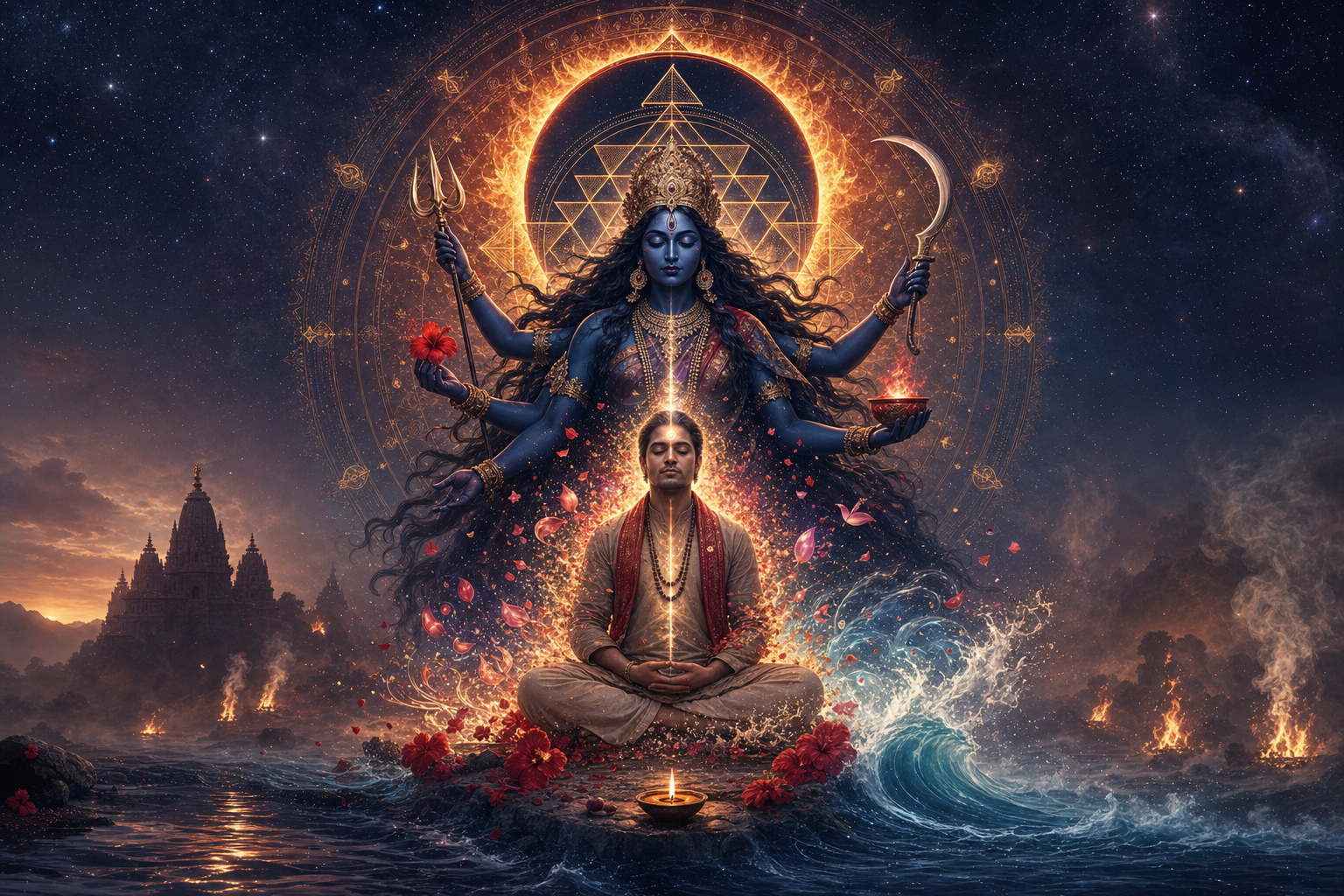
The consuming fire of Shakta Tantra
Some spiritual traditions are presented primarily as sources of consolation, stability, or moral orientation. Shakta Tantra often begins from a more unsettling premise: genuine liberation may require the structures that sustain ordinary identity to be exposed, challenged, and transformed. Its consuming fire is not merely a metaphor for emotional intensity. It describes a disciplined encounter with impermanence, desire, fear, embodiment, and death in which the practitioner can no longer assume that the familiar personality is the final truth of existence.
This path is rooted in diverse Tantric scriptures, Agamic traditions, ritual lineages, philosophical systems, and oral transmissions associated with gurus, Siddhas, Yoginis, and communities of practice. It does not constitute a single, uniform school. Śrīvidyā, Kaula, Krama, Kali-oriented traditions, regional Goddess cults, and Shaiva-Shakta systems may differ substantially in theology, ritual, and contemplative method. What broadly unites them is the affirmation of Shakti: divine power is not secondary to reality but its living, conscious, and transformative dynamism.
The claim that the self is devoured must therefore be interpreted carefully. Shakta Tantra does not necessarily demand the destruction of personality, agency, memory, or ethical responsibility. The self being consumed is the contracted identity that mistakes its temporary boundaries for absolute reality. Liberation is not psychological collapse. It is the loosening of compulsive identification with the body, social status, personal history, pleasure, pain, and the demand to remain permanently in control.
Shakti as the power of reality itself
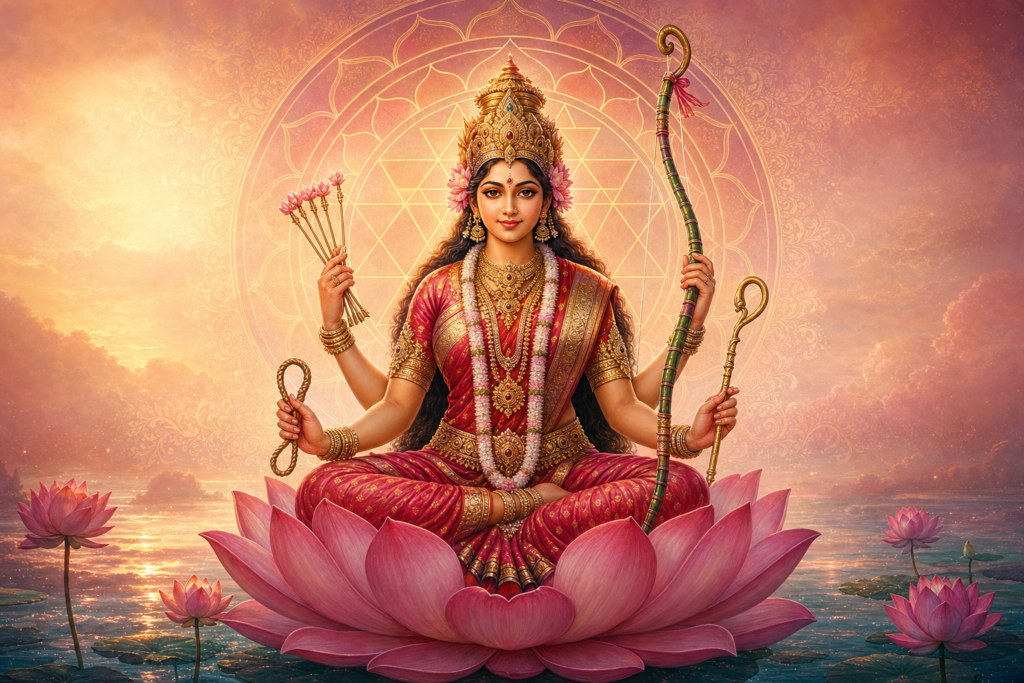
In many Shakta systems, the Goddess is not simply one deity among others. She is the power by which anything appears, acts, knows, desires, conceals, and reveals. The cosmos is not imagined as inert matter standing apart from the sacred. It is the ceaseless expression of Shakti. Thought is Shakti, perception is Shakti, breath is Shakti, and the capacity for spiritual realization is also Shakti. Even limitation is understood as a modulation of divine power rather than an independent principle opposed to it.
This view changes the meaning of spiritual practice. If reality is pervaded by Shakti, liberation cannot be reduced to fleeing the world, rejecting the body, or suppressing every form of experience. The practitioner instead learns to recognize the sacred power operating through experience without remaining enslaved by its changing forms. The body becomes a field of revelation, speech becomes a vehicle of mantra, and the mind becomes both the site of bondage and the instrument through which bondage can be understood.
Shakta philosophies are not all metaphysically identical. Some retain meaningful distinctions between the worshipper and the Goddess, while others articulate a nondual vision in which consciousness and power are inseparable. In strongly nondual interpretations, the individual is not an isolated entity attempting to reach a distant deity. The practitioner is Shakti appearing in a contracted form and gradually recognizing the immeasurable consciousness-power that has always constituted existence.
This recognition does not make ordinary life unreal in the simplistic sense of being worthless. It places ordinary life within a wider horizon. Hunger, grief, love, sexuality, anger, beauty, and mortality remain experientially real, yet they no longer possess unquestioned authority over identity. The world can then be approached as manifestation rather than imprisonment, provided that attachment, ignorance, and harmful conduct are not confused with spiritual freedom.
The historical and textual landscape
Shakta Tantra emerged through a long process rather than a single historical event. Goddess traditions are visible in early Indian religious literature, local cults, epic and Puranic narratives, and the influential Devi Mahatmya. Distinctively Tantric Shakta systems became increasingly prominent during the first millennium CE and developed through Sanskrit scriptures, regional texts, temple institutions, household worship, ascetic networks, royal patronage, and oral transmission. Their ideas also interacted with Shaiva, Vaishnava, Buddhist, and local ritual worlds.
The word Tantra covers a wide and internally varied body of teachings. It may refer to scriptures, systems of ritual, methods of initiation, embodied disciplines, cosmological schemes, or a lineage-based approach to practice. Agama is similarly broad and often overlaps with Tantric literature. Neither term should be treated as the name of one standardized doctrine. Texts such as the Kularnava Tantra, Tripura Rahasya, Yogini Hridaya, and numerous Kali, Kaula, and Śrīvidyā works represent different theological and ritual environments rather than interchangeable manuals.
The role of oral instruction is equally important. Tantric texts frequently presuppose initiation, ritual competence, and explanations received from a qualified teacher. A verse that appears simple may carry technical meanings related to mantra, visualization, ritual sequencing, subtle anatomy, or lineage conventions. This is one reason isolated passages can be misleading when separated from their commentarial and initiatory contexts.
Historical study also reveals that Shakta Tantra has never been restricted to sensational antinomian rites. It includes elaborate temple worship, domestic puja, devotional recitation, philosophical contemplation, mantra practice, festivals, pilgrimage, meditative visualization, and highly regulated initiatory systems. Fierce practices exist, but they belong to a much larger religious ecology. Reducing Tantra to sexuality, intoxication, or transgression reproduces a modern stereotype rather than an accurate account of its complexity.
What liberation means in Shakta Tantra
Liberation is commonly expressed through concepts such as Moksha, spiritual realization, freedom from binding ignorance, or recognition of one’s identity with the highest reality. Some Tantric traditions also emphasize the conjunction of bhukti and mukti: meaningful participation in embodied life and ultimate liberation need not be absolute opposites. This principle does not promise unrestricted pleasure. It proposes that worldly experience can be integrated into a disciplined sacred life rather than automatically condemned as an obstacle.
The deepest bondage is not simply the existence of objects, relationships, or sensations. It is the contraction through which consciousness identifies itself as a separate, deficient, and threatened entity. The ego in this context is a functional structure that becomes tyrannical when it claims absolute status. It organizes experience, but it also constructs narratives of possession: this is mine, this must not change, this insult defines me, this achievement guarantees my worth, and this body must somehow escape impermanence.
Shakta practice places these claims under pressure. A practitioner may discover that spiritual life does not always produce immediate calm. Mantra can reveal distraction; ritual discipline can expose impatience; devotion can uncover grief; meditation can make fear more visible before it becomes less commanding. Such experiences are not automatically signs of failure. They may indicate that previously hidden attachments are entering conscious awareness. Nevertheless, severe distress, dissociation, or instability should never be romanticized as enlightenment.
The ideal of jivanmukti, liberation while living, is especially important for understanding the radical character of the path. Freedom is not postponed entirely until bodily death. It can be embodied as a transformation in how experience is known. The liberated person still acts in a world of consequences but is no longer wholly defined by craving, aversion, and contracted selfhood. Liberation therefore involves both insight and a changed mode of participation in life.
Kali and the devouring of time
Kali is among the clearest expressions of Shakta Tantra’s uncompromising vision. Her name is associated with blackness and can evoke her relationship with kāla, time and death. Her dark form resists containment because darkness cannot be grasped as a bounded object. Her garlands, weapons, dishevelled hair, and cremation-ground associations confront the observer with what polite consciousness attempts to exclude: mortality, dissolution, violence, and the collapse of worldly rank.
Her imagery is not a celebration of cruelty. It is a symbolic and theological disclosure of reality’s power to create and destroy forms. Time devours every identity, possession, institution, and body. Kali makes this fact visible. The terror she evokes belongs partly to the ego’s recognition that it cannot negotiate permanent exemption from change. Her grace lies in revealing that what is ultimately real is not exhausted by the forms that time consumes.
Images of Kali standing upon Shiva communicate several meanings across different traditions. They can express the inseparability of consciousness and power: Shiva without Shakti is inactive, while Shakti is intelligible as the dynamic expression of consciousness. Devotional narratives may offer other interpretations, including Kali’s return from overwhelming fury. No single explanation exhausts the image, and its meaning should be studied within particular textual, ritual, and regional settings.
Other fierce forms, including Chinnamasta, Chamunda, Bhairavi, and Ugra Chandika, intensify this confrontation with impermanence and self-limitation. Chinnamasta’s self-decapitation, for example, can signify sacrifice, the circulation of life energy, and the transcendence of conventional identity. Such images are deliberately difficult. They are not instructions for physical harm but symbolic forms intended to disrupt habitual perception and reveal dimensions of reality that gentler imagery may leave unexamined.
The cremation ground as place and principle
The cremation ground occupies a powerful place in several Tantric traditions. Historically, some ascetics and ritual specialists practiced in actual cremation grounds. These sites confronted practitioners with death, impurity codes, social fear, and the impermanence of the body. Yet the cremation ground also functions as an interior symbol. It is the field in which identities, attachments, and conceptual certainties are offered to the fire of awareness.
Ordinary society protects the personality through names, roles, possessions, and recognition. The cremation ground reveals how little of this survives death. King and labourer, scholar and stranger, admired person and forgotten person all return to elemental processes. For the Tantric practitioner, this recognition is not intended to produce nihilism. It is meant to strip away false permanence so that life can be approached with greater clarity, humility, and intensity.
The inner cremation ground appears whenever a familiar identity collapses. Bereavement, illness, failure, aging, and radical uncertainty can all expose the fragility of self-images. Shakta Tantra does not claim that suffering is inherently sacred or that people should seek trauma. It teaches that unavoidable experiences of loss can become sites of insight when they are held within ethical discipline, spiritual guidance, and a vision larger than the wounded personality.
This perspective can be emotionally demanding because it removes a common spiritual bargain: the expectation that devotion will prevent every painful event. Shakta traditions often offer a different form of trust. The Goddess may not preserve every preferred form, but no transformation occurs outside her power. Creation, preservation, concealment, destruction, and revelation belong to a single sacred dynamism. The practitioner is invited to trust reality without demanding that reality conform to personal comfort.
Mantra, initiation, and the transformation of speech
Despite its fierce imagery, much of Shakta Tantra is built upon precise and repetitive disciplines. Mantra is central. A mantra is not treated merely as an inspirational sentence or an arbitrary affirmation. Within the tradition, it is a sonic form of the deity and a concentrated expression of Shakti. Its syllables, rhythm, pronunciation, visualization, and transmission may all be significant.
Initiation, or diksha, traditionally authorizes and prepares a practitioner for particular methods. It may establish a relationship with a lineage, transmit a mantra, introduce ritual obligations, and symbolically dissolve a previous spiritual condition. The guru’s role is therefore technical as well as devotional. A competent teacher interprets scripture, adjusts practice, corrects errors, and helps distinguish transformative difficulty from destabilizing excess.
Initiation should not be romanticized as surrender to unchecked authority. Traditional claims about the guru do not excuse manipulation, financial exploitation, coercion, secrecy surrounding abuse, or sexual misconduct. Ethical discernment remains essential. A responsible lineage should be capable of explaining commitments, respecting meaningful consent, and recognizing the difference between disciplined challenge and harm.
Through sustained japa, or mantra repetition, ordinary speech is gradually reoriented. The mind that normally repeats anxiety, resentment, and self-protective narratives is given a sacred pattern. The practice may become increasingly subtle, moving from audible recitation to quiet repetition and interior awareness. Its purpose is not simply to silence thought but to reveal the energetic and conscious ground from which thought emerges.
Nyasa, ritual embodiment, and the sacred body
Shakta Tantra frequently treats the body as a ritual field rather than an obstacle to be despised. In nyasa, mantras or divine powers are ritually placed upon different parts of the body. This practice reconceives embodiment as a mandala of sacred presence. The practitioner does not merely worship the Goddess as an external image; the body itself is prepared and recognized as her dwelling.
Bhuta shuddhi, often translated as purification of the elements, similarly involves the contemplative dissolution and reconstitution of embodied existence. Earth, water, fire, air, and space may be withdrawn through visualization and then re-established in a divinized form. The rite dramatizes a central Tantric insight: liberation does not require hatred of embodiment, but it does require the transformation of how embodiment is perceived.
Yantra and mandala extend this sacred anatomy into geometric form. A yantra is not simply decorative symbolism. It can function as a structured representation of divine manifestation, a ritual residence for the deity, and a map of contemplative return toward the centre. In Śrīvidyā, the Sri Chakra presents an especially intricate correspondence between cosmos, Goddess, body, and consciousness. Movement through its enclosures can symbolize the passage from differentiated experience toward the nondual centre.
External worship and internal visualization are therefore not necessarily competing stages. Offerings of flowers, light, water, incense, food, and mantra cultivate attention through embodied action. Internal worship relocates the same sacred relations within consciousness. Advanced nondual contemplation may recognize worshipper, offering, deity, and act of worship as expressions of one Shakti, but that recognition should not be confused with casually abandoning preparatory discipline.
Kundalini and the subtle body
Kundalini is one of the best-known concepts associated with Tantra, but popular accounts often oversimplify it. In many yogic and Shakta systems, Kundalini is the latent or coiled power associated with the subtle body. Through initiation, mantra, breath regulation, meditation, visualization, mudra, and other practices, this power may be awakened and directed through a central channel associated with the sushumna nadi.
Descriptions of Chakras, their number, colours, deities, syllables, and functions vary among texts and lineages. The now-familiar seven-Chakra model is influential but should not be projected onto every Tantric system. Subtle anatomy is a ritual and contemplative technology embedded in particular traditions, not a single anatomical chart accepted in identical form throughout Hindu history.
Kundalini awakening is frequently described in dramatic language, but intensity alone is not evidence of spiritual attainment. Sensations, altered states, involuntary movements, or emotional surges can have multiple causes. Traditional systems surround powerful practices with preparation, ethical discipline, bodily regulation, and guidance for good reason. Anyone experiencing persistent panic, insomnia, dissociation, mania, or physical distress should seek qualified medical or mental-health support rather than interpreting every symptom exclusively through a spiritual framework.
At its philosophical depth, Kundalini is not merely an unusual energy moving through the spine. She is Shakti in contracted form returning to the recognition of her inseparability from supreme consciousness. The ascent therefore symbolizes a transformation of identity. Perception is progressively released from narrow conditioning until the apparent division between individual power and universal power is overcome.
Desire, taboo, and disciplined transformation
Shakta Tantra is often described as a path that uses what other traditions reject. This statement contains some truth but requires qualification. Certain Kaula and related currents ritually employed substances or acts considered impure or forbidden within dominant social codes. Their purpose could include confronting aversion, dissolving rigid distinctions, sacralizing embodied power, or testing freedom from conventional identity. These practices were generally restricted by initiation, ritual rules, and lineage context.
The well-known panchamakara, or five Ms, have received disproportionate modern attention. Traditions have interpreted them literally, symbolically, internally, or through approved substitutes. Their presence in a text does not prove that every practitioner performed the same external rites. Nor does Tantric sacralization of sexuality mean that ordinary desire automatically becomes liberating. Without discipline, consent, ritual competence, and freedom from exploitation, desire remains capable of reinforcing attachment and harm.
Transgression is spiritually meaningful only when it weakens ignorance rather than ethics. Breaking a social rule can become another form of egoic performance, particularly when the practitioner seeks superiority through appearing fearless or unconventional. The deeper challenge is not theatrical rebellion. It is freedom from both compulsive conformity and compulsive opposition. A person who must shock others remains governed by the social order being rejected.
This distinction clarifies why Shakta Tantra cannot be equated with indulgence. Tantric discipline often demands extensive ritual preparation, dietary observance, mantra repetition, secrecy, concentration, devotion, and accountability. Experience is neither denied nor granted unlimited authority. It is placed inside a sacred structure intended to transform its meaning and energetic direction.
Fierce compassion rather than nihilism
The devouring Goddess can appear nihilistic when viewed outside her theological setting. Yet Shakta traditions do not generally conclude that nothing matters. If all beings and processes arise through Shakti, ethical conduct acquires greater depth rather than less. Another person is not spiritually disposable. The same divine power moves through every embodied life, even when obscured by ignorance and conflicting interests.
Fierce compassion differs from sentimentality. It may require confronting deception, setting boundaries, resisting abuse, or relinquishing relationships organized around manipulation. It does not confuse passivity with peace. At the same time, the language of sacred fierceness must never be used to sanctify uncontrolled anger or violence. The test is whether an action reduces ignorance and unnecessary suffering or merely gives spiritual language to retaliation.
The Goddess may be experienced as tender mother, sovereign queen, terrifying destroyer, erotic power, protective warrior, or the silence beyond form. These manifestations are not necessarily contradictions. They express the range of existence itself. Human life includes birth and death, nourishment and separation, beauty and terror. Shakta theology refuses to preserve divine goodness by assigning the difficult dimensions of reality to a power outside the sacred.
This integration can produce emotional honesty. Grief need not be hidden to prove spiritual maturity. Anger can be examined without being worshipped. Desire can be acknowledged without becoming destiny. Fear can be brought into the presence of the Goddess rather than covered with forced optimism. Liberation begins to appear not as emotional numbness but as the capacity to experience deeply without being completely possessed by experience.
The psychology of ego dissolution and its limits
Modern readers often compare Tantric transformation with psychological concepts such as ego dissolution, shadow integration, somatic awareness, or trauma healing. These comparisons can be illuminating when treated as analogies. Both Tantric practice and some therapeutic methods may bring avoided material into awareness and challenge rigid identity. They nevertheless arise from different frameworks, pursue different goals, and should not be treated as interchangeable.
Clinical psychology generally works to support functional agency, emotional regulation, and relational health. Shakta sadhana is oriented toward ritual transformation and spiritual liberation within a sacred cosmology. A healthy functional self may be necessary before its claim to ultimate independence can be safely examined. Weak boundaries, untreated trauma, or dependency on a charismatic teacher do not constitute transcendence of ego.
The phrase beyond self must therefore be distinguished from loss of self-care. A practitioner still needs food, sleep, safety, honest relationships, and the capacity to make decisions. Spiritual insight does not eliminate biological needs or social consequences. Mature non-attachment permits responsible action without absolute identification; it does not require neglect of the person through whom that action occurs.
A useful measure of integration is found in ordinary life. Does practice increase clarity, humility, steadiness, compassion, and accountability? Or does it produce grandiosity, secrecy, contempt, and dependence? Extraordinary experiences may be meaningful, but their value is tested by the quality of conduct that follows them. The ability to speak about nonduality is not equivalent to liberation from self-deception.
Shakta Tantra within the wider Dharmic family
Shakta Tantra belongs to the vast and internally diverse landscape of Hindu Dharma, yet its history also reflects conversations with Buddhist Tantra, Shaiva traditions, local Goddess worship, and wider South Asian ritual cultures. These traditions should not be collapsed into one system. Their doctrines of self, liberation, authority, and ultimate reality can differ significantly. Respectful comparison depends upon preserving those differences.
Meaningful affinities can nevertheless support unity among Dharmic traditions. Hinduism, Buddhism, Jainism, and Sikhism all contain rigorous reflections on attachment, ethical discipline, contemplative practice, service, and liberation from narrow self-centredness. Buddhism may frame this inquiry through anatta and dependent arising; Jainism through the purification of the jiva and freedom from karmic bondage; Sikhism through devotion to the One, Naam, seva, and the overcoming of haumai. Shakta Tantra expresses its own vision through Shakti, mantra, embodied ritual, and the Goddess.
Unity does not require theological homogenization. It can be grounded in intellectual honesty, non-hostility, mutual learning, and protection of each community’s right to transmit its traditions responsibly. Shakta Tantra contributes to this wider conversation by insisting that spiritual freedom must penetrate the embodied sources of fear and attachment. Other Dharmic paths contribute distinct analyses and disciplines that can deepen a shared culture of ethical and contemplative inquiry.
Approaching the tradition responsibly
A responsible approach begins with humility. Introductory devotional practices, study of reliable translations, temple worship, simple japa with an openly taught mantra, and consultation with established communities provide a more stable foundation than experimentation with advanced rites. Practices involving intense breath retention, sexual ritual, intoxicants, cremation grounds, or forceful Kundalini methods should not be improvised from fragmented online instructions.
Textual study should include historical context and, where possible, traditional commentary. The Devi Mahatmya offers a foundational vision of the Goddess as supreme power; the Devi Bhagavata Purana develops extensive Shakta theology and devotion; Śrīvidyā literature illuminates the worship of Tripura Sundari and the Sri Chakra; Kaula and Kali texts disclose more esoteric ritual worlds. No single text represents every form of Shakta Tantra.
Discernment is especially important when evaluating teachers. Antiquity, charisma, supernatural claims, or displays of secrecy do not by themselves establish competence. Students should consider lineage transparency, ethical conduct, knowledge of scripture and ritual, treatment of vulnerable people, financial expectations, consent practices, and willingness to acknowledge limits. A teacher who discourages all independent judgment or isolates students from support networks presents a serious warning sign.
Responsible practice also avoids cultural extraction. Mantras, yantras, Goddess images, and ritual substances are not merely aesthetic accessories. They belong to living communities with languages, histories, temples, domestic observances, and systems of transmission. Respect requires more than fascination with fierce imagery; it requires attention to the people and disciplines that have preserved these traditions.
The freedom found after certainty burns
The uncompromising power of Shakta Tantra lies in its refusal to divide existence into a sacred realm that deserves acceptance and a difficult realm that must be denied. The Goddess is present in beauty, but she is not confined to beauty. She is present in order, but she also appears through the forces that dissolve exhausted forms. She is the power of birth, nourishment, desire, knowledge, time, and death.
When the self is said to be devoured, what disappears is the fantasy of absolute separateness. The practitioner does not become nothing. Rather, identity is released from confinement within a single temporary form. The wave recognizes that its movement has never been separate from the ocean, even though it continues to appear as a wave. This recognition preserves difference at the level of manifestation while overcoming isolation at the deepest level of consciousness.
Such liberation is not gained through dramatic imagery alone. It is cultivated through Sadhana: initiation where required, mantra, puja, meditation, ethical discernment, devotion, study, and sustained self-examination. The fire consumes gradually as well as suddenly. Every relinquished resentment, every honestly examined fear, and every act performed without compulsive self-display weakens the fortress of contracted identity.
The path remains fierce because nothing conditioned can be guaranteed permanent. Yet its final mood need not be despair. When the demand for permanence loosens, existence can be encountered with greater intimacy. Love no longer depends entirely upon possession, action no longer depends entirely upon recognition, and spiritual practice no longer functions merely as an escape from vulnerability.
Shakta Tantra thus presents liberation as a radical recognition rather than a comforting addition to the ego’s possessions. The Goddess does not simply decorate the familiar self with spiritual identity. She exposes its limits, consumes its false sovereignty, and reveals the consciousness-power from which self and world continuously arise. What remains after that fire is not an empty absence, but a more spacious participation in reality: embodied yet unconfined, emotionally alive yet less enslaved, and capable of seeing transformation itself as an expression of Shakti.
Inspired by this post on Hindu Blog.




Leave a Reply
You must be logged in to post a comment.