
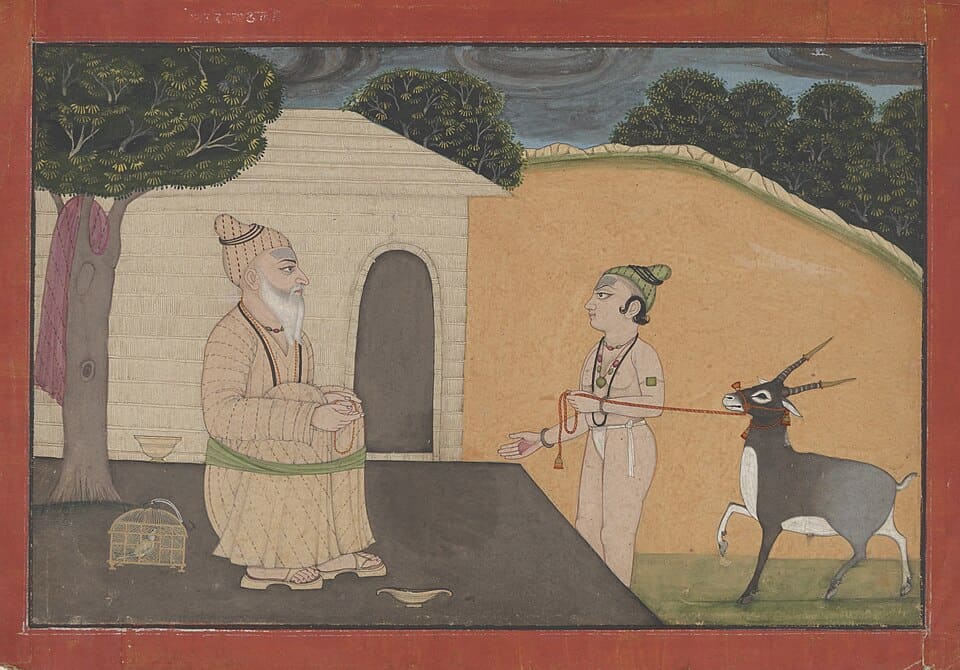
A convocation address for the whole of life. The Taittiriya Upanishad preserves one of the most compelling scenes in the history of Vedic education: a Guru addresses a disciple who has completed formal study and is preparing to enter the wider world. The moment is ceremonial, but its emotional force is immediately recognizable. A student stands at the threshold between the disciplined shelter of learning and the uncertainty of adult responsibility. The Guru therefore offers more than a farewell. The parting counsel, remembered as a Samavartana or convocation address, provides a moral compass for truthful speech, disciplined action, continuing study, responsible prosperity, generosity, family life, and service to society.
The celebrated instruction appears in the eleventh Anuvaka of the Shikshavalli, the first of the three major divisions of the Taittiriya Upanishad. It is frequently described as the “last lesson” or antim vachan because it marks the transition from residence with the teacher to independent life. Yet finality is not its deepest meaning. The student’s institutional education may be ending, but the discipline of learning is expected to continue. The lesson is “last” only in sequence; in practice, it becomes the beginning of lifelong ethical and spiritual education.
The textual setting. The Taittiriya Upanishad belongs to the Krishna Yajurveda and is traditionally transmitted as part of the Taittiriya Aranyaka. Its three principal sections—the Shikshavalli, Anandavalli or Brahmanandavalli, and Bhriguvalli—move across several levels of inquiry. They address phonetics, recitation, contemplation, ethical discipline, the nature of Brahman, the dimensions of embodied existence, food, prāṇa, mind, knowledge, and bliss. This breadth is important because the Samavartana address does not stand apart from the Upanishad’s philosophy. It translates a demanding curriculum into a way of living.
The Shikshavalli begins in the world of disciplined speech. Accurate pronunciation, sound, rhythm, continuity, and attentive recitation are not treated as trivial preliminaries. In an oral knowledge tradition, careless speech can corrupt both a text and the understanding carried by it. Training the voice is consequently also a means of training attention. By the eleventh Anuvaka, that concern with correct utterance has matured into a concern with truthful utterance. The movement from phonetic accuracy to ethical integrity is one of the section’s most significant pedagogical achievements.
Samavartana as transition. Samavartana is associated with the completion of the brahmacarya phase of education and the student’s return from the teacher’s household. The Sanskrit sense of “returning” helps explain the rite’s social dimension. Learning is not completed by withdrawing permanently into private accomplishment. The educated person returns to family and community carrying obligations created by knowledge. Education acquires value when understanding becomes conduct, when disciplined speech becomes trustworthy communication, and when individual accomplishment contributes to collective well-being.
The passage is often called an ancient convocation address, although it should not be reduced to a modern graduation speech projected backward into history. Its institutional setting, ritual assumptions, and vocabulary belong to Vedic culture. Nevertheless, the comparison remains illuminating. Like a convocation address, it asks what a graduate should do after acquiring knowledge. Unlike many ceremonial speeches, however, it gives concise and demanding imperatives rather than general encouragement. The student is not merely congratulated; the student is entrusted with a standard of life.
Guru–śiṣya samvād as formative dialogue. The Guru–śiṣya relationship in this setting is neither a commercial exchange nor the simple delivery of information. The Guru speaks from learning, practice, lineage, and lived accountability. The disciple listens, memorizes, reflects, questions, and gradually internalizes a discipline. Samvad therefore signifies more than conversation in the ordinary sense. It is a communicative process through which knowledge becomes character.
This relationship also contains a productive tension. The Guru commands respect, but the goal of instruction is not permanent intellectual dependence. A mature disciple must eventually act without the teacher’s immediate supervision. The last lesson prepares the student for precisely that condition. It supplies principles, identifies trustworthy exemplars, and explains how to respond when certainty is unavailable. The pedagogy is therefore oriented toward responsible judgment rather than mechanical obedience.
The central injunction. The ethical core of the address is expressed in the following passage, preserved here exactly as transmitted in the source material:
सत्यं वद। धर्मं चर। स्वाध्यायान्मा प्रमदः। आचार्याय प्रियं धनमाहृत्य प्रजातन्तुं मा व्यवच्छेत्सीः।सत्यान्न प्रमदितव्यम्। धर्मान्न प्रमदितव्यम्।कुशलान्न प्रमदितव्यम्। भूत्यै न प्रमदितव्यम्।स्वाध्यायप्रवचनाभ्यां न प्रमदितव्यम्।
The source identifies this as Tettriya Upanishad, Shikshavalli, 11,1 and renders its best-known imperatives as “ Satyam vad” and “Dharamam charah”. Their force is direct: speak truth and practise dharma. These instructions are short enough to remember but broad enough to govern an entire life. They address both speech and action, the two domains in which inner conviction becomes socially visible.
Truth as integrity. Satya is more demanding than factual correctness considered in isolation. Accurate statements are indispensable, but the Upanishadic ideal also concerns the integrity of the speaker. Speech, intention, and action should not contradict one another. Truthfulness requires freedom from deliberate deception, manipulative ambiguity, and the convenient concealment of responsibility. It joins intellectual honesty with moral reliability.
Within the broader Vedic horizon, satya is closely related to ṛta, the principle of order, regularity, and right alignment. Truth is therefore not merely a private preference or a subjective declaration. It asks the individual to bring personal will into responsible relation with reality and the moral order sustaining communal life. Such alignment explains why truthful speech is presented as a stabilizing force: trust becomes possible when words can be relied upon.
Dharma as conscientious action. Dharma in the convocation address should not be confused with blind conformity. It refers to conduct that sustains moral order, relationships, responsibilities, and the conditions of flourishing. The graduate is expected to fulfil obligations conscientiously while exercising discernment. Dharma gives truth a practical body; satya prevents duty from becoming empty performance. Together, they join inward integrity to outward responsibility.
The pairing of truth and dharma also prevents a familiar moral fragmentation. A person may profess high ideals while behaving irresponsibly, or may perform a role efficiently while using deception to preserve it. The Upanishadic formulation refuses both divisions. Right speech without right conduct is incomplete, and duty without truth is unstable. Education must therefore produce coherence between what a person knows, says, and does.
Self-study must not be neglected. The command concerning svādhyāya is among the most educationally significant elements of the address. Formal graduation does not release the disciple from study. It intensifies the obligation to revisit inherited knowledge, test comprehension, preserve memory, and renew understanding as circumstances change. The supplied expression “ Swadhyanma parmad” functions as a lighthouse for the departing student because it warns against intellectual negligence.
Svādhyāya carries more than one implication. It includes disciplined recitation and study of sacred learning, but it also supports reflective self-examination. The student must repeatedly ask whether knowledge has been assimilated or merely stored. In contemporary terms, this distinction separates information retrieval from wisdom. A person may possess abundant data and remain ethically unformed; continuing study becomes transformative only when it corrects judgment and reshapes conduct.
The injunction also joins study with pravacana, teaching or responsible transmission. Knowledge is not to be hoarded. The learner becomes part of a living chain by studying carefully and communicating faithfully. This reciprocal structure protects a tradition from two dangers: repetition without understanding and innovation without memory. Renewal depends upon both preservation and interpretation.
Gratitude and social continuity. The instruction to bring the teacher a valued gift acknowledges indebtedness to the educational relationship. It should not be read merely as a transactional fee. Guru Dakshina represents gratitude, reciprocity, and recognition that learning has been made possible by another person’s labour and care. The accompanying counsel not to sever the thread of continuity reflects the social expectations of its historical setting, including the responsibilities associated with household and family life.
A careful contemporary interpretation distinguishes enduring principle from historical form. The passage need not be converted into a universal demand that every individual follow an identical domestic path. Its durable insight is that education should not produce isolation from social responsibility. The graduate is asked to sustain relationships, transmit what is valuable, and contribute to a future extending beyond personal ambition.
Do not neglect welfare and prosperity. The Upanishadic counsel does not oppose spiritual life to every form of material well-being. It warns the student not to neglect personal and collective welfare. Prosperity is legitimate when acquired and used within dharma. This is an ethically disciplined view of artha: resources are necessary for family stability, hospitality, learning, generosity, and service, but accumulation is not permitted to become the final measure of a human life.
The text consequently enlarges the meaning of wealth. Material resources matter, yet speech, conduct, trustworthiness, learning, and Self-knowledge represent higher forms of abundance. Vāc refined by truth becomes wealth. Ācāra refined by dharma becomes wealth. Understanding refined through contemplation becomes inner wealth. The graduate is invited to move from possession toward cultivation—from having more to becoming more capable of wise and generous action.
Parents, teacher, and guest. The next movement of the address places the student within a network of reverential relationships. The memorable formulations supplied in the source—“ pitra devo bhav, matri devo bhav”, “Guru devo bhav”, and “ atithi devo bhav”—ask the disciple to treat parents, teacher, and guest with a regard comparable to that offered to the sacred. The teaching does not privatize spirituality. Reverence must become visible in care, gratitude, hospitality, and responsible attention to others.
Calling the guest worthy of sacred regard has particular social significance. A guest may arrive without the protections of familiarity, status, or kinship. Hospitality asks the householder to interrupt self-absorption and recognize another person’s dignity. It transforms the household into an ethical space. In a fragmented society, that principle remains potent: social trust is rebuilt through repeated acts of welcome, fairness, and mutual regard.
Reverence, however, should not be mistaken for the suspension of moral judgment. The same teaching tradition directs attention toward conduct worthy of imitation. Respect for a Guru is grounded in the Guru’s responsibility to embody what is taught. The authority of instruction is strengthened by ethical example, not by title alone. This protects the Guru–śiṣya relationship from being interpreted as unconditional submission to personality.
How to act when doubt arises. One of the most sophisticated features of the eleventh Anuvaka is its acknowledgment that rules do not eliminate every moral uncertainty. When doubt arises about conduct, the student is advised to consider how thoughtful, disciplined, compassionate, and dharma-oriented persons would act in the same situation. This is a model of ethical deliberation based on exemplary character rather than a claim that every problem can be solved by literal formula.
The advice is neither crude majoritarianism nor an invitation to imitate social fashion. The exemplars must themselves possess discernment, independence, gentleness, and commitment to dharma. Their conduct offers a practical test when abstract principles admit competing interpretations. Modern professional ethics uses a comparable method whenever it asks how a person of integrity, competence, and impartiality would respond to a difficult case.
The ethics of giving. The address also teaches that generosity is shaped by the disposition of the giver. Giving should be accompanied by faith, abundance according to capacity, modesty, moral seriousness, and understanding. A gift can lose ethical value when used to humiliate, dominate, advertise superiority, or purchase influence. The Upanishadic framework therefore evaluates both the outward act and its inward quality.
This insight makes charity part of character formation. The recipient is not an object through whom the giver displays virtue. Giving becomes a relationship requiring respect and awareness. Such an ethic has relevance to philanthropy, community service, education, and everyday assistance. It asks not only how much is given, but also whether the act preserves dignity and responds intelligently to genuine need.
Food, speech, and breath in the wider Upanishad. The themes of food, speech, and prāṇa belong to the Taittiriya Upanishad’s broader teaching and should be distinguished technically from the specific list of convocation injunctions. The Shikshavalli gives sustained attention to sound and speech, while the later sections investigate food, life-energy, mind, knowledge, and bliss. Reading these sections together reveals the unity of the curriculum, but it should not lead to the inaccurate claim that every theme occurs within the eleventh Anuvaka itself.
Food is treated with unusual philosophical seriousness. It sustains embodied life, connects the individual with soil, water, labour, plants, animals, family, and community, and makes hospitality materially possible. The injunction not to disparage food encourages gratitude and restraint. It also challenges the illusion of complete self-sufficiency: every meal reveals dependence upon ecological and social systems larger than the individual.
Prāṇa, the vital current associated with life and breath, provides another bridge between outer discipline and inner awareness. Breath is ordinarily automatic, yet attention to it reveals the intimate relation between bodily state, emotion, and concentration. The Upanishad is not offering a modern clinical theory of respiration; its framework is philosophical and contemplative. Nevertheless, its recognition that embodied discipline supports mental clarity remains experientially meaningful.
Speech completes this practical triad. What a person consumes affects the body; how a person breathes affects attention; how a person speaks affects relationships and the moral atmosphere of a community. The connection is not a scientific equation but a pedagogical pattern. Ordinary acts become sites of self-knowledge when performed with awareness. Spiritual practice is thereby brought into eating, speaking, listening, studying, working, and welcoming others.
From the outer person to the inner Self. The Anandavalli presents the well-known analysis of the human being through successive dimensions often described as the food-formed, vital, mental, knowledge-related, and bliss-related sheaths. This teaching does not treat the body as worthless. It begins with embodiment and moves through increasingly subtle dimensions of experience. Each level is real within its sphere, yet none by itself exhausts the meaning of the Self.
The Bhriguvalli dramatizes experiential inquiry through another Guru–śiṣya encounter. Bhrigu approaches Varuna seeking knowledge of Brahman and receives a framework for investigation rather than a complete answer to memorize. Through tapas, disciplined inquiry and contemplation, Bhrigu successively examines food, prāṇa, mind, knowledge, and bliss. This method reinforces the central pedagogical principle: instruction becomes wisdom only when it is personally examined and realized.
Against this wider background, the claim that the ultimate teacher becomes the Self can be understood as an interpretive culmination rather than a literal sentence from the convocation passage. The outer Guru awakens the capacity for inward discernment. Instruction, disciplined practice, reflection, and ethical action prepare the disciple to recognize truths that cannot be reduced to borrowed statements. The Guru does not become irrelevant; the Guru’s work succeeds when the disciple develops mature insight without abandoning humility.
Transformation rather than information. The Upanishadic Guru is best understood as a guide to formation. Facts, texts, rituals, and techniques remain important, but their purpose is not exhausted by recall. The student must become truthful, disciplined, generous, discerning, and capable of responsible action. Knowledge is tested by the quality of the person it helps to form.
This educational vision employs several methods: memorized revelation, direct injunction, analogy, ritual discipline, contemplation, dialogue, and the example of the teacher’s life. Silence may also be understood as a contemplative dimension of Upanishadic pedagogy, although it should not be presented as a specific command in the eleventh Anuvaka. A pause after instruction allows the learner to confront questions for which verbal repetition is insufficient. Intellectual analysis and meditative receptivity can then operate together.
A measured comparison with modern education. The Taittiriya model exposes limitations in educational systems dominated by grades, coverage, credentials, and short-term performance. Numerical assessment can measure important abilities, but it cannot fully measure integrity, wisdom, hospitality, courage, or responsible judgment. A student may pass an examination without learning how knowledge should be used.
The comparison should not become a romantic rejection of contemporary education. Modern institutions have expanded access, developed rigorous methods, and created forms of specialized knowledge unavailable in earlier settings. Many also practise mentorship, service learning, and professional ethics. The Upanishadic contribution is complementary and corrective: technical competence should be joined to moral formation, and measurable achievement should remain accountable to human flourishing.
For teachers and mentors, the address suggests that credibility depends upon conduct. Students learn from what institutions reward, what teachers tolerate, and how authority is exercised. A curriculum that praises truth while rewarding expediency teaches contradiction. The Guru–śiṣya ideal therefore places demanding obligations on the teacher as well as the disciple. Education becomes trustworthy when instruction and example reinforce one another.
For students, the passage reframes graduation. A credential records an accomplishment, but it does not certify the completion of inquiry. The graduate remains responsible for svādhyāya, for correcting error, and for sharing knowledge without arrogance. The exhilaration of finishing formal study is thus accompanied by a more durable joy: learning can remain an unending practice of renewal.
Relevance in the digital age. The ancient counsel on food does not explicitly discuss digital media, but a careful analogy can be drawn. Information is also consumed, digested, circulated, and sometimes allowed to shape attention without examination. Mindful consumption today may therefore include evaluating sources, resisting outrage engineered for impulsive reaction, and refusing to pass falsehood onward. This is a contemporary application of truthfulness and self-discipline, not a claim about the literal historical content of the Upanishad.
The discipline of speech is equally urgent online. Digital communication encourages speed, distance, and reaction, while satya requires accuracy, accountability, and coherence. Truthful speech need not be harsh, and kind speech need not conceal truth. The educational challenge is to unite clarity with restraint so that communication serves understanding rather than vanity, manipulation, or hostility.
Attention to prāṇa offers a further counterpoint to overstimulation. A deliberate pause before speaking or responding can create space between impulse and action. The Upanishad does not promise a simplistic technique for every psychological difficulty. It offers a more fundamental insight: disciplined attention allows a person to observe inner states before those states become careless words or harmful conduct.
Relational ethics and social cohesion. The Guru’s counsel binds spiritual development to family, education, hospitality, generosity, and community welfare. Realization is not verified by private feeling alone. It must appear in dependable relationships and responsible action. The spiritual and the social are distinct but inseparable dimensions of an integrated life.
This relational vision can contribute to unity among Dharmic traditions. The passage is specifically rooted in Vedic Hindu tradition and should be understood on its own terms. At the same time, its emphasis on disciplined learning, ethical conduct, compassion, self-examination, and service can enter respectful conversation with Buddhist, Jain, and Sikh teachings. Unity does not require erasing doctrinal differences; it grows through accurate understanding, mutual regard, and cooperation around shared ethical responsibilities.
A compact examination for life. The memorable exhortations resemble a final examination whose answers must be lived rather than written. The disciple is asked to speak truth, practise dharma, continue studying, honour formative relationships, welcome the guest, give responsibly, sustain welfare, and seek wise counsel in moments of doubt. Each instruction is practical, yet together they form a spiritual map.
The emotional depth of the scene lies in its realism. The Guru cannot accompany the disciple into every future decision. No syllabus can anticipate every conflict, temptation, loss, or responsibility. The teacher therefore offers principles capable of travelling with the student. Anyone who has left a place of learning, a family home, or the guidance of a trusted mentor can recognize the gravity of that departure.
Being and becoming. The last lesson finally challenges the assumption that education is primarily the accumulation of external advantages. Its deeper aim is refinement: truthful speech, ethical action, disciplined desire, careful study, generous relationship, and knowledge of the Self. Becoming, in this sense, is not restless self-invention. It is the gradual removal of contradiction between understanding and conduct.
The Taittiriya Upanishad’s Guru–śiṣya samvāda thus culminates in neither dogmatic closure nor vague inspiration. It offers a structured passage from learning to responsibility. Ritual is joined to introspection, prosperity to ethics, reverence to discernment, and individual realization to social duty. Its challenge remains serene but uncompromising: knowledge must become wisdom, and wisdom must become a life aligned with truth.
In an age overflowing with information, the Samavartana address retains unusual power because it asks the question that information alone cannot answer: what kind of person should learning produce? Its response is concise but comprehensive—a person devoted to satya and dharma, committed to lifelong study, grateful to teachers and family, hospitable toward others, thoughtful in uncertainty, and prepared to place knowledge in the service of life. That is why the last lesson continues to feel like a first lesson in becoming fully responsible.
— Chandra Shekhar Dubey
Inspired by this post on Hindu Post.










Leave a Reply
You must be logged in to post a comment.