

Śrīmad-Bhāgavatam 4.24.32-43 presents one of the most theologically rich moments in the Fourth Canto: Lord Śiva, moved by compassion, instructs the Pracetās through a prayer known within the Vaishnava tradition as the Rudra-gītā. The passage is not merely a devotional hymn; it is a compact map of Vedic metaphysics, discipline of the senses, sacred sound, dharma, karma, and the inner transformation required for bhakti. In this class attributed to Pancagauda Prabhu, the focus naturally rests on how Lord Śiva models humility, theological clarity, and spiritual generosity before the sons of King Prācīnabarhi.
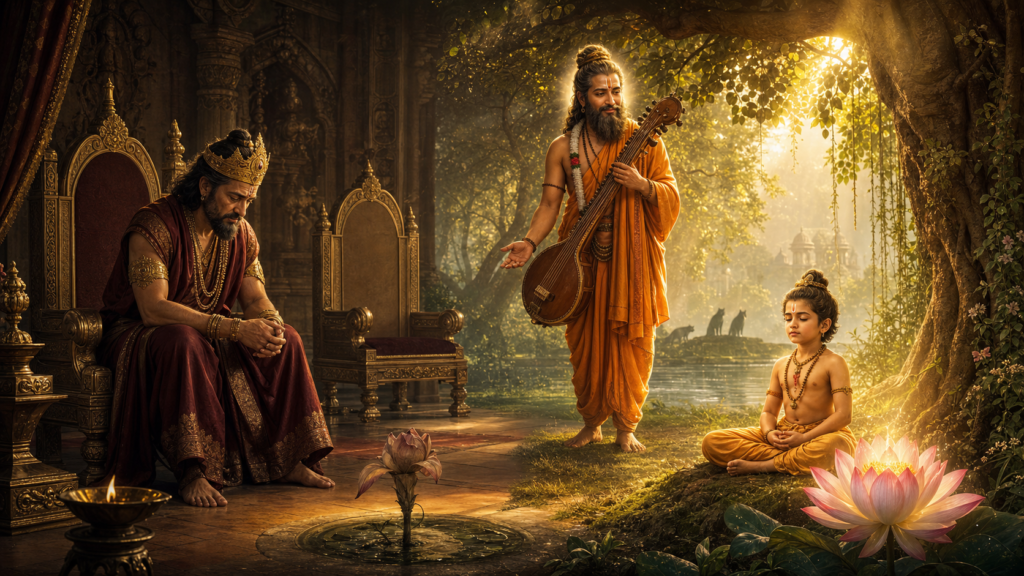
The source passage begins with Maitreya describing Lord Śiva as anukrośa-hṛdaya, one whose heart is full of compassion. This is important because the entire teaching unfolds not as an abstract doctrine, but as mercy offered to seekers. The Pracetās stand with folded hands, and Lord Śiva speaks as nārāyaṇa-paraḥ, a great devotee of Nārāyaṇa. The scene therefore embodies a central principle of Sanatana Dharma: authentic spiritual authority does not create rivalry among divine traditions, but directs the heart toward purification, humility, and service.
For a contemporary reader, this moment has unusual relevance. Many people approach scripture with fragmented attention, inherited assumptions, or sectarian expectations. Yet Śrīmad-Bhāgavatam 4.24.32 immediately frames sacred learning as attentive hearing received through grace. Lord Śiva does not speak to defeat another path; he speaks to guide the Pracetās toward the Supreme Reality. This is a lesson in dharmic unity: Śaiva reverence, Vaishnava devotion, Vedic sound, yogic discipline, and philosophical inquiry all converge when they are purified of ego and directed toward truth.
Verse 33 opens the prayer with glorification of the Supreme Personality of Godhead as the highest among the self-realized. The theological emphasis is precise: self-realization is not only an interior psychological state but an awakening to the relationship between the individual self, the Supersoul, and the Supreme. Lord Śiva seeks auspiciousness not through possession, power, or control, but through continued alignment with divine instruction. This reverses the ordinary human tendency to treat spiritual life as a method for gaining superiority. In the Rudra-gītā, the greater the being, the greater the humility.
Verse 34 addresses Vāsudeva as paṅkaja-nābha, the one from whose lotus navel creation unfolds. The passage moves from devotion into cosmology. The senses, sense objects, and subtle structures of embodied life are understood as dependent on a higher source. This is a deeply technical point in Vedic philosophy: the human being is not an isolated consumer of the world but a participant in a cosmic order. Sense control, therefore, is not repression. It is the reorientation of perception toward its proper center.
The verse also calls the Lord śānta, kūṭa-stha, and sva-rociṣ, indicating peace, unchanging steadiness, and self-illumination. These terms matter because they describe a consciousness not disturbed by hunger, thirst, grief, illusion, aging, or death. Human life is often defined by these pressures. The Bhāgavatam does not deny them; it places them within a larger framework. Spiritual practice becomes the discipline of seeking shelter in that which is not shaken by the transformations that disturb embodied life.
Verse 35 introduces Saṅkarṣaṇa and Pradyumna, names associated with the Lord’s expansions and functions within creation. Saṅkarṣaṇa is connected with integration and disintegration, while Pradyumna is associated with intelligence and development. The prayer here functions as a theology of order: the universe is not random chaos, nor merely mechanical matter. The gross elements, subtle body, mind, intelligence, and ego are held within divine governance. This view does not oppose inquiry; rather, it places inquiry within humility before causes deeper than immediate perception.
Verse 36 turns toward Aniruddha, Hṛṣīkeśa, the master and director of the senses and mind. This is one of the most practical portions of the passage. The mind directs the senses, and the senses shape conduct. When the mind is scattered, devotion becomes sentimental or inconsistent. When the mind is centered, action becomes offering. Lord Śiva’s prayer is therefore a model for every practitioner who has experienced the difficulty of focusing the mind even while sincerely valuing spiritual life.
The class context likely draws attention to this discipline of hearing, chanting, and mental absorption. In the Bhakti Yoga tradition, the mind is not conquered by hatred of the mind. It is trained by engagement. Mantra, śāstra, prasāda, temple service, kīrtana, and satsanga give the senses a sacred direction. This is why Lord Śiva’s prayer is not merely a statement of belief. It is a method: the mind turns toward the lotus feet of the Lord, the senses become purified by service, and the ego gradually loses its false claim of independence.
Verse 37 describes Aniruddha as the doorway to svarga and apavarga, higher attainment and liberation. The distinction is significant. Vedic literature recognizes many forms of elevation, including pious prosperity, higher realms, refined conduct, and liberation from material bondage. Yet the Bhāgavatam repeatedly indicates that the highest liberation is loving devotional service. This creates a hierarchy of aspiration: dharma regulates life, karma gives results, jñāna clarifies identity, yoga disciplines consciousness, and bhakti fulfills the self through loving service.
Verse 38 speaks of satisfaction and the Lord as sarva-rasa-ātmā, the source of all rasa, all meaningful taste and relational fulfillment. The purport traditionally links this with the control of the tongue through prasāda. This is a subtle but profound insight. The tongue speaks and tastes; it can elevate consciousness through mantra and sanctified food, or bind consciousness through uncontrolled speech and consumption. A serious reading of the Rudra-gītā therefore makes spiritual life concrete. Transformation begins not only in grand philosophical insight, but in what is spoken, heard, honored, and consumed each day.
Verse 39 expands the vision to the universal form that contains the bodies of all living beings. This offers a powerful ethical implication. If every body exists within a larger divine body, then life cannot be reduced to exploitation. The body, senses, prāṇa, wealth, intelligence, and words become instruments of responsibility. This supports the broader dharmic principle that spirituality is not escape from embodied duties but purification of embodied action. Service is performed through life itself: through speech that heals, hands that serve, intelligence that clarifies, and resources used for the welfare of others.
Verse 40 emphasizes transcendental sound and the revealing power of śabda. Vedic knowledge gives special authority to sound because many truths cannot be reached by the blunt instruments of unaided sense perception. Sacred sound is not treated as mere poetry or cultural memory. It is a vehicle of knowledge, remembrance, and transformation. The chanting of divine names becomes the distilled essence of this principle because sound, meaning, devotion, and presence meet in practice.
This is where the Rudra-gītā becomes especially relevant in an age of distraction. Modern life is saturated with sound, yet much of it agitates rather than illumines. News cycles, arguments, advertisements, and digital noise shape desire and identity. The Bhāgavatam offers a different anthropology of sound: what is repeatedly heard gradually forms the inner world. When sacred sound is received attentively, the mind gains a different center of gravity. It begins to remember what ordinary life makes easy to forget.
Verse 41 confronts karma, inclination, disinclination, irreligion, suffering, and death. The language is stern because the subject is existential. Human beings are shaped by pravṛtti and nivṛtti, by impulses toward action and restraint. Dharma teaches which inclinations should be cultivated and which should be corrected. Without this discernment, freedom becomes self-harm disguised as autonomy. The verse therefore presents death not as a random terror but as part of the moral architecture of embodied existence.
The passage should not be read as fatalism. Rather, it insists that choices matter because consciousness matters. When action is governed by adharma, suffering follows; when action is offered in devotion, the same life becomes purified. This is one of the enduring gifts of the Bhagavata Purana: it refuses both nihilism and shallow optimism. It teaches responsibility while still grounding the soul in divine mercy.
Verse 42 identifies Kṛṣṇa as the supreme cause of all causes, the master of metaphysical philosophy, the ancient person, and the Lord of Sāṅkhya and Yoga. This verse integrates theology and philosophy. Sāṅkhya analyzes reality through categories; Yoga disciplines consciousness toward realization; bhakti gives the realized relationship its living form. Lord Śiva’s prayer does not reject analysis or discipline. It places them in devotion, where knowledge becomes service rather than pride.
Verse 43 then returns to the practical purification of ego, knowledge, action, and speech. The Lord is praised as the controller of the worker, the senses, and the results of sensory action. False ego is not merely arrogance in a social sense; it is the mistaken identification that claims, “I am the independent doer and enjoyer.” The Rudra-gītā treats this as the central distortion of embodied consciousness. Purification occurs when mind, senses, words, and work are placed under divine direction.
This final movement is technically important for understanding bhakti. Devotion is not anti-intellectual, anti-body, or anti-world. It purifies the intellect, disciplines the body, and sanctifies action in the world. Knowledge without devotion can become dry superiority. Ritual without attention can become habit. Emotion without śāstra can become instability. The Rudra-gītā harmonizes these dimensions: sound, mind, senses, body, knowledge, sacrifice, cosmology, and surrender all become integrated in service.
From the standpoint of dharmic unity, this passage is especially valuable because Lord Śiva teaches devotion without sectarian hostility. He is honored within the Bhāgavatam as exalted, compassionate, and spiritually authoritative, while he himself glorifies the Supreme Lord. Such a portrayal encourages reverence across Hindu traditions rather than competitive reduction. It also offers a bridge for broader dharmic reflection: Buddhism’s discipline of attention, Jainism’s ethical restraint, Sikhism’s emphasis on nām and seva, and Hinduism’s many streams of bhakti, jñāna, karma, and yoga all affirm that transformation requires purification of ego and conduct.
The passage therefore speaks to spiritual life at multiple levels. For the scholar, it preserves a sophisticated theology of divine expansions, subtle elements, karma, sound, and liberation. For the practitioner, it offers a concrete path of attentive hearing, mantra, prasāda, sense control, and service. For the community, it teaches that genuine devotion produces humility and respect. For the individual heart, it gives a quiet but demanding question: are the mind, senses, speech, and work moving toward clarity, or are they being spent in forgetfulness?
The enduring power of Śrīmad-Bhāgavatam 4.24.32-43 lies in this combination of grandeur and intimacy. The verses move through cosmic creation, universal form, sacred sound, and the cause of all causes, yet they remain focused on the ordinary struggle to hear properly, speak purely, eat sanctified food, guide the mind, and act without false ego. Lord Śiva’s prayer is thus not distant mythology. It is a refined manual for devotional consciousness, spoken with compassion to seekers who are ready to listen.
Reference for close study: the Sanskrit text, translations, and traditional purports for Śrīmad-Bhāgavatam 4.24.32-43 are available through Bhaktivedanta Vedabase, beginning at ŚB 4.24.32 and continuing through ŚB 4.24.43.
Inspired by this post on Dandavats.






Leave a Reply
You must be logged in to post a comment.