
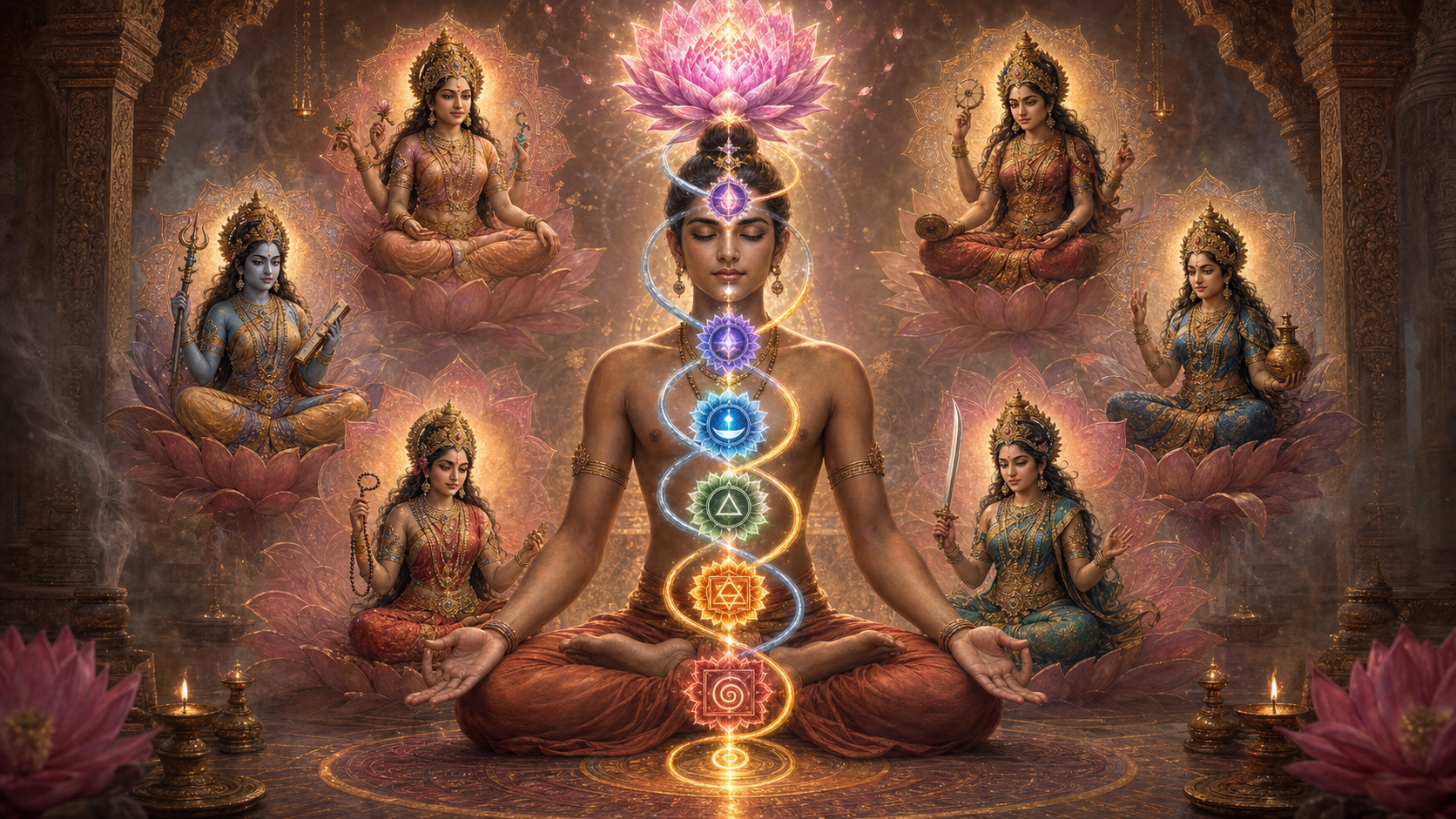
Saptachakra Yoginis: a living map of consciousness
Hindu Tantric traditions frequently present the human body as more than a physical organism. The body is also understood as a living cosmos: a concentrated field in which matter, breath, sound, thought, divine power, and consciousness meet. Within this sacred anthropology, the saptachakra, or sevenfold chakra system, offers a map of inner transformation. Each chakra marks a distinct mode of embodied awareness, while its presiding Yogini personifies the dynamic Shakti through which that level of consciousness becomes active, intelligible, and capable of transformation.
The Saptachakra Yoginis are therefore not decorative additions to an otherwise abstract system. They make the subtle body visible. Through their faces, gestures, implements, colours, seed syllables, bodily associations, and positions within lotus diagrams, they translate a complex contemplative philosophy into memorable sacred art. Their iconography teaches that inner awakening is not achieved by rejecting embodiment, but by recognizing the body as a disciplined field of knowledge and divine presence.
At the same time, the seven-chakra model requires historical care. Hindu Tantra does not contain a single, universally binding chakra chart. Different Shaiva, Shakta, Vaishnava, Kaula, Srividya, and Hatha Yoga sources describe different numbers of centres, different presiding deities, and different sequences of Yoginis. Some systems contain five, six, nine, ten, twelve, or more chakras. What is now popularly called the seven-chakra system generally combines six centres situated along the subtle axial channel with the Sahasrara lotus at or above the crown.
The historical foundations of the chakra tradition
The Sanskrit word cakra literally denotes a wheel, circle, or revolving formation. In Tantric and yogic contexts, it can identify a ritual circle, an assembly of practitioners, a structure of divine powers, or a centre within the subtle body. The familiar spinal arrangement emerged through centuries of textual and ritual development rather than from one foundational diagram accepted by every Hindu community.
Among the most influential sources for the later six-centre model is Pūrṇānanda’s sixteenth-century Ṣaṭcakranirūpaṇa. This text describes six lotuses from Mūlādhāra to Ājñā and culminates in the thousand-petalled Sahasrara. Its imagery became especially prominent after it was included in early modern discussions and translations of Kundalini Yoga. Other sources, including Srividya liturgies and the Lalitāsahasranāma, preserve a sevenfold sequence of chakra Yoginis with a significantly different allocation of names.
This diversity is not evidence of a defective or confused tradition. Tantric diagrams function as practice-specific instruments. Their correspondences are organized according to initiation, mantra, deity, lineage, and ritual purpose. A chakra system should therefore be read as a coherent symbolic grammar within its own context, not as an isolated table assembled from unrelated sources.
The now-familiar rainbow sequence is similarly not a universal feature of premodern Sanskrit descriptions. Classical sources assign colours to lotuses, geometric regions, deities, and syllables, but their arrangements do not consistently match the modern red-to-violet spectrum. Contemporary rainbow charts can serve as useful teaching aids, yet they should not be projected backward as the only authentic Tantric system.
The subtle body as a technical contemplative model
The chakras belong to the sūkṣma śarīra, or subtle body. This body is described through interrelated concepts such as prāṇa, nāḍī, mantra, bindu, tattva, and Kundalini. Prāṇa is vital activity rather than merely inhaled oxygen. Nāḍīs are subtle pathways through which prāṇa is organized. Bindu can signify a concentrated point, seed, or subtle essence. Tattvas are levels or principles through which reality becomes differentiated. Mantra gives audible or mentally apprehended form to sacred power.
Three nāḍīs are especially important in later yogic explanations: Iḍā, Piṅgalā, and Suṣumṇā. Iḍā and Piṅgalā are commonly described as complementary currents, while Suṣumṇā forms the central path associated with contemplative ascent. These channels should not be reduced to the spinal cord, sympathetic nerves, or blood vessels. Modern comparisons with physiology may be suggestive metaphors, but traditional subtle anatomy operates within a ritual and contemplative account of embodiment rather than a laboratory model of anatomy.
The chakras are envisioned as lotuses because the lotus conveys structured unfolding. A closed lotus suggests latent capacity; an opening lotus suggests the manifestation of knowledge and power. Its petals frequently bear Sanskrit phonemes. In one influential arrangement, the petals of the six lower centres total fifty, allowing the Sanskrit sound system to be distributed across the body. The body consequently becomes a field of language, and language becomes a mode through which consciousness takes form.
Geometric figures within the lotuses add another level of meaning. Squares, crescents, triangles, circles, and intersecting forms identify elemental principles, movements of energy, and relationships between stillness and activity. Seed syllables condense these associations into sound. Deities embody consciousness and cosmic function, while Yoginis embody the active powers that animate, guard, nourish, and transform each centre.
Why the presiding powers are Yoginis
A Yogini is not adequately defined as a female practitioner or a minor goddess. In Tantric contexts, the term can denote an accomplished woman, an initiated adept, a fierce divine being, a member of a sacred retinue, or an embodiment of transformative Shakti. Yoginis frequently cross ordinary boundaries between purity and impurity, beauty and terror, nourishment and dissolution. Their iconography resists the idea that spiritual power must always appear gentle or socially conventional.
The chakra Yoginis personify powers already present within embodied existence. Their weapons cut attachment and confusion. Their vessels contain nourishment, vitality, or transformative essence. Multiple arms indicate the simultaneous operation of several capacities, while multiple faces express expanded perception rather than biological anatomy. Fangs and intense expressions communicate the power to consume obstruction. Serene gestures communicate protection, instruction, and the conferral of insight.
These figures also challenge a simplistic opposition between body and spirit. Several Srividya descriptions associate the chakra Yoginis with bodily constituents such as skin, blood, flesh, fat, bone, and marrow. Such associations belong to a ritual physiology in which every layer of embodiment can be sanctified. They should not be interpreted as modern medical claims. Their purpose is contemplative integration: no part of embodied life lies outside the possible field of Shakti.
Two influential Yogini sequences
One widely circulated arrangement, derived from the Ṣaṭcakranirūpaṇa and related presentations, places Dākinī at Mūlādhāra, Rākiṇī at Svādhiṣṭhāna, Lākiṇī at Maṇipūra, Kākiṇī at Anāhata, Śākinī at Viśuddha, and Hākinī at Ājñā. Sahasrara is the transcendent culmination of this six-centre ascent and does not always receive a Yogini in the same manner as the lower lotuses.
A prominent Srividya sequence reflected in the Lalitāsahasranāma places Śākinī at Mūlādhāra, Kākiṇī at Svādhiṣṭhāna, Lākiṇī at Maṇipūra, Rākiṇī at Anāhata, Dākinī at Viśuddha, Hākinī at Ājā, and Yākinī at Sahasrara. The stability of Lākiṇī and Hākinī across these two arrangements can make the differences elsewhere easy to overlook. Responsible interpretation identifies the lineage or text being followed instead of presenting one sequence as universally normative.
Spelling and transliteration also vary. Forms such as Shakini, Sakini, Śākinī, and Sākinī may appear in English-language sources, as may Dakini and Dākinī. The Sanskrit diacritics clarify pronunciation, but familiar spellings remain common in museum descriptions, devotional publications, and modern Yoga literature.
Mūlādhāra: grounding, support, and latent power
Mūlādhāra means the root support. It is commonly visualized near the base of the subtle axis as a four-petalled lotus. In the influential six-chakra system, its principal elemental emblem is a yellow square representing earth, its seed syllable is laṃ, and its animal symbol is the elephant. The square communicates stability and defined structure, while the elephant suggests strength, weight, and dependable support.
The lotus may also contain a downward-pointing triangle, the subtle liṅga, and Kundalini represented as a coiled power. The coiling expresses concentration and potential rather than dormancy in a merely passive sense. Shakti is present before any dramatic experience of awakening; practice reorganizes attention so that this presence can be recognized and directed.
Dākinī presides here in the Ṣaṭcakranirūpaṇa sequence, whereas Śākinī occupies Mūlādhāra in the Srividya sequence. In either framework, the Yogini guards the threshold at which consciousness is most closely identified with solidity, survival, habit, and embodied location. Modern psychological language often describes this as grounding. The traditional symbolism is broader: earth is not an inferior condition to be despised, but the necessary support from which disciplined ascent becomes possible.
A relatable interpretation emerges whenever instability disrupts concentration. A person preoccupied with danger, exhaustion, or material insecurity may find abstract contemplation difficult. Mūlādhāra iconography acknowledges this embodied reality. Stability, ethical routine, appropriate nourishment, and a secure posture are not distractions from spiritual life; they can be its indispensable foundation.
Svādhiṣṭhāna: fluidity, desire, and creative formation
Svādhiṣṭhāna is generally represented as a six-petalled lotus in the pelvic region of the subtle body. Its elemental field is water, commonly shown through a crescent, and its seed syllable is vaṃ. The makara, an aquatic composite being, often serves as its animal emblem. Water suggests continuity, adaptability, fertility, memory, and the capacity to assume the shape of a containing form.
Rākiṇī presides at this centre in the well-known six-chakra arrangement, while Kākiṇī occupies it in the Srividya sequence. Their presence indicates that desire is not treated only as an enemy. Tantric discipline distinguishes uncontrolled compulsion from consciously transformed energy. Attraction, pleasure, imagination, and emotional movement become subjects of observation and ritual refinement.
Svādhiṣṭhāna is sometimes reduced in popular accounts to sexuality. That interpretation captures only part of its symbolic range. The water principle also concerns adaptation, relationship, generativity, and the movement between attachment and release. Its Yogini teaches neither indulgence nor repression. The deeper aim is a lucid relationship with desire in which energy can flow without overwhelming discrimination.
Many practitioners recognize this tension in ordinary experience. Creative work requires receptivity and emotional movement, yet it also requires form. Relationships require openness, yet they also require boundaries. The lotus, crescent, and Yogini together portray this delicate intelligence of fluidity held within conscious structure.
Maṇipūra: fire, digestion, and transformative agency
Maṇipūra, the city of jewels, is usually depicted as a ten-petalled lotus in the region of the navel. Its element is fire, its seed syllable is raṃ, and its geometry commonly includes a downward-pointing fiery triangle. The ram is associated with its elemental force. Fire illuminates, heats, separates, cooks, and transforms, making it an especially rich symbol for both digestion and disciplined will.
Lākiṇī presides over Maṇipūra in both of the influential sequences discussed here. Her relative stability across textual arrangements underscores the strong relationship between this Yogini and transformative fire. Her implements and fierce features vary by source, but they commonly express alert power, the destruction of impediments, and the conversion of raw experience into usable energy.
Traditional references to digestion operate at several levels. Food is digested physically, impressions are digested mentally, and experience is assimilated into understanding. When this capacity is weak, information can accumulate without becoming wisdom. When it becomes excessive or unregulated, determination can harden into aggression and domination. Maṇipūra therefore symbolizes agency governed by discrimination rather than power pursued for its own sake.
The jewel metaphor is significant. A jewel does not emerge without pressure, refinement, and careful cutting. In the same way, inner strength is not identical with impulsive force. It is developed through restraint, endurance, clarity of purpose, and the willingness to transform frustration into disciplined action.
Anāhata: the unstruck resonance of the heart
Anāhata is commonly represented as a twelve-petalled lotus in the heart region. Its name evokes an unstruck sound: a resonance not produced by two external objects colliding. The elemental principle is air, the seed syllable is yaṃ, and an antelope or deer may symbolize its mobility and sensitivity. Intersecting triangles frequently appear within the lotus, conveying the intimate relation of complementary forces.
Kākiṇī presides at Anāhata in the Ṣaṭcakranirūpaṇa sequence, whereas Rākiṇī occupies the heart in the Srividya arrangement. The Yogini’s presence prevents the heart from being reduced to sentimentality. Compassion requires courage, discernment, and the capacity to remain open without becoming unguarded or confused.
Air moves invisibly while making life possible. Anāhata similarly concerns relationship, breath, responsiveness, and the expansion of awareness beyond narrow self-reference. The heart becomes a meeting place where personal emotion can mature into empathy and where power can be tempered by responsibility.
The concept of unstruck sound also points inward. Beneath the noise of reaction, memory, and argument lies the possibility of a more stable attentiveness. This does not require emotional numbness. It suggests the discovery of an inner continuity capable of holding grief and affection without being destroyed by either.
Viśuddha: purification, sound, and truthful expression
Viśuddha, the centre of purification, is generally envisioned as a sixteen-petalled lotus in the throat region. Its element is ākāśa, often translated as space or ether, and its seed syllable is haṃ. A circular elemental field and a white elephant may appear in its imagery. Its sixteen petals are frequently connected with the Sanskrit vowels, emphasizing sound, resonance, and expressive potential.
Śākinī presides at Viśuddha in the six-chakra sequence, while Dākinī occupies this centre in the Srividya system. The shift demonstrates why an image must be identified through its full iconographic context. The Yogini’s number of faces and arms, complexion, implements, gestures, and surrounding syllables can all help determine the textual or ritual family to which an image belongs.
Purification at the throat is not simply moral cleanliness. It is the capacity to distinguish, refine, and transmit. Speech can reveal truth, preserve knowledge, offer comfort, or cause harm. Viśuddha symbolism therefore joins sacred sound with ethical communication. Mantra practice disciplines speech by returning attention to pronunciation, rhythm, breath, intention, and silence.
A familiar human experience gives this symbolism emotional force. Many people know the strain of being unable to articulate grief, conviction, or apology. Others recognize the consequences of speaking before thought has matured. Viśuddha represents the transformation of raw feeling into responsible expression, not the unrestricted discharge of every passing impulse.
Ājñā: command, discernment, and concentrated awareness
Ājñā is commonly represented as a two-petalled lotus between the eyebrows or within the head. The term can mean command, authority, or instruction. The two petals bear syllabic associations that vary by presentation, while Oṃ is frequently connected with the centre in later teaching traditions. The reduced number of petals signals concentration: multiplicity is drawn toward a more unified field of awareness.
Hākinī presides at Ājñā in both major sequences considered here. She is often portrayed with multiple faces, a feature that suggests comprehensive perception. Her iconography can include a rosary, book, skull, drum, or gestures of protection and instruction, although details differ among texts and artistic traditions. These attributes connect contemplative knowledge with memory, mantra, mortality, and awakened intelligence.
Ājñā is popularly called the third-eye chakra, but its classical significance should not be reduced to paranormal vision. It concerns command over attention, discriminative insight, and the integration of previously divided currents. The centre represents the ability to observe mental events without automatically obeying them.
This disciplined understanding is especially relevant in an age of fragmented attention. Constant stimulation can create the impression of knowledge while weakening sustained perception. Ājñā iconography proposes an opposing ideal: awareness becomes powerful when it is gathered, clarified, and directed toward what is genuinely significant.
Sahasrara: plenitude beyond the ordinary elements
Sahasrara, the thousand-petalled lotus, is situated at or above the crown in many later systems. The number one thousand signifies immeasurable plenitude rather than a requirement that every artistic representation display exactly one thousand individually counted petals. Unlike the lower centres, Sahasrara is often described as beyond the gross elements and beyond the ordinary differentiation expressed by the lower lotuses.
In the Ṣaṭcakranirūpaṇa, Sahasrara is the culmination above the six chakras and is not simply another centre of the same order. In the Srividya seven-Yogini sequence, Yākinī presides here. She may be described through inclusive imagery involving many colours, faces, weapons, or forms of nourishment. This comprehensiveness signals integration: the differentiated powers of the lower centres are gathered without being erased.
Sahasrara is frequently associated with the union of Shiva and Shakti. Shiva represents unbounded consciousness, while Shakti represents the power through which consciousness manifests, knows, and returns to itself. Their union is not merely a mythic romance or an encounter between two external beings. It expresses the non-separation of awareness and its inherent power.
The crown should not be imagined as a permanent escape from ordinary life. Tantric realization often includes a return to embodied activity in which perception, speech, relationship, and action are transformed by insight. Transcendence without integration can become spiritual avoidance. The complete map points upward toward recognition and downward toward the embodiment of that recognition.
Kundalini and the meaning of ascent
Kundalini is commonly described as coiled Shakti associated with the root of the subtle body. Through practices involving mantra, visualization, breath, concentration, mudrā, ritual worship, devotion, and the guidance of a guru, this power is said to enter Suṣumṇā and move through the chakras. Knots or granthis may be described as barriers associated with limited identification and attachment.
Ascent should not be interpreted as a simple mechanical journey through seven anatomical switches. Traditional accounts use the language of piercing, opening, dissolving, awakening, and uniting, but these expressions belong to a sophisticated ritual phenomenology. They describe changes in attention, identity, energy, and contemplative perception through symbols shared by a lineage.
The ladder metaphor can also become misleading when it encourages contempt for the lower centres. Earth, water, fire, air, and space are not discarded as failures. They are recognized, purified, and reintegrated. The goal is not to become bodiless but to cease mistaking any limited bodily, emotional, or mental state for the whole of consciousness.
Some traditions also describe a descending movement of grace, nectar, or awakened awareness. This descent matters because insight must reach the conditions of ordinary life. Patience, truthful speech, ethical conduct, emotional steadiness, and compassionate action provide more reliable signs of integration than dramatic sensations alone.
How sacred iconography communicates contemplative knowledge
Tantric iconography is a visual language in which no single attribute should be interpreted in isolation. The lotus establishes the field. Petal counts organize phonemes and powers. Colour differentiates qualities, although pigments may be lost or altered over time. Geometric forms identify elements and energetic relationships. Animals embody movement, temperament, and cosmic function. Seed syllables provide a sonic key, while the presiding deity and Yogini animate the complete structure.
In sculpture, multiple arms allow several powers to be shown simultaneously. An implement can operate on more than one level: a blade may be a weapon, a ritual object, and a symbol of discriminative knowledge. A skull can evoke mortality, impermanence, the transformation of fear, or a specific Tantric observance. A book may signify transmitted wisdom, while a rosary suggests repetition, continuity, and disciplined mantra.
Gesture is equally important. The abhaya mudrā offers freedom from fear, while the varada mudrā communicates generosity or the granting of a boon. Fierce expressions need not indicate moral evil. In Yogini iconography, intensity often represents the uncompromising destruction of ignorance and the power required to cross a threshold of consciousness.
Architectural context can change the meaning of an image. A Yogini placed on an exterior wall, within a circular temple, beside other deities, or inside a manuscript diagram participates in a different ritual environment. Direction, sequence, neighbouring figures, inscriptions, and the path of circumambulation all contribute evidence. Iconographic identification is therefore strongest when visual details, textual descriptions, provenance, and ritual use are studied together.
The great Yogini temples of India demonstrate that Yogini traditions cannot be reduced to the seven chakra deities. Ensembles of sixty-four or eighty-one Yoginis belong to related but distinct ritual and architectural worlds. The seven chakra Yoginis are best understood as one specialized expression within the much larger history of Yogini worship, Shakta Tantra, Hindu Sculptures, and sacred feminine iconography.
Mantra, visualization, and embodied attention
In traditional practice, a chakra is not activated merely by knowing its modern keyword. Visualization can involve constructing the lotus mentally, placing letters on its petals, contemplating its element and geometry, invoking its deity, and installing mantra through forms of nyāsa. Nyāsa ritually places syllables or divine powers upon the body, revealing embodiment as a consecrated field rather than an obstacle to worship.
Mantra adds vibration, memory, and disciplined repetition to the visual form. The seed syllable is not simply an affirmation with a convenient emotional meaning. Within a lineage, it is embedded in rules of pronunciation, initiation, visualization, rhythm, and intention. Sound and image work together: the diagram gives mantra a spatial body, while mantra gives the diagram temporal and experiential life.
Breath practices can support concentration by regulating attention and making subtle sensations easier to notice. Advanced breath retention, forceful bandhas, and attempts to provoke intense Kundalini experiences, however, should not be treated casually. Traditional instruction emphasizes preparation, ethical discipline, appropriate guidance, and gradual development. Individuals experiencing panic, dissociation, sleep disruption, or other distress should prioritize qualified medical or mental-health support rather than interpreting every symptom as spiritual advancement.
A restrained contemplative engagement can begin with posture, natural breathing, and observation of how imagery affects attention. The aim is not to manufacture spectacular sensations. It is to notice whether practice produces greater steadiness, clarity, responsibility, and compassion. Such outcomes remain consistent with the ethical purpose of Yoga even when visionary experiences do not occur.
Chakras, psychology, and the limits of modern comparison
Modern interpreters often correlate chakras with developmental stages, emotions, nerve plexuses, endocrine glands, or regions of the brain. These comparisons can make an unfamiliar system accessible, and some may function as useful therapeutic metaphors. They are nevertheless modern interpretive frameworks rather than straightforward translations of premodern Tantric anatomy.
No established biomedical evidence demonstrates that the chakras are physical organs or independently measurable energy vortices. Research on meditation, breathing, interoception, stress regulation, and attention may help explain some effects of contemplative practice, but it does not by itself verify every traditional chakra correspondence. Academic clarity requires respect for both forms of inquiry without forcing either into the categories of the other.
Psychological language is most helpful when used as analogy rather than replacement. Mūlādhāra can illuminate questions of stability, Svādhiṣṭhāna fluidity and desire, Maṇipūra agency, Anāhata relationship, Viśuddha expression, Ājñā discernment, and Sahasrara integration. Yet these themes do not exhaust the ritual, theological, linguistic, and cosmological dimensions of the chakras.
The Yoginis add a particularly valuable corrective to self-help interpretations. Awakening is not portrayed as a smooth progression toward perpetual comfort. Their fierce and benevolent forms acknowledge that transformation can involve uncertainty, confrontation, surrender, and the reorganization of deeply rooted habits. The imagery remains hopeful because no difficult layer of experience is considered incapable of transformation.
A dharmic perspective without erasing differences
The chakra tradition can contribute to dialogue among Hinduism, Buddhism, Jainism, and Sikhism when similarities are approached with precision. Vajrayana Buddhist traditions employ channels, winds, drops, mandalas, and Yogini or Ḍākinī imagery, but their chakra counts and philosophical interpretations are not identical to Hindu Tantra. Jain contemplative traditions developed distinctive accounts of embodied discipline, karma, meditation, and liberation; some later Jain works also engaged subtle-body language while preserving specifically Jain commitments to ahiṃsā and the purification of the jīva.
Sikh teachings centre Naam, Shabad, Hukam, devotion, ethical labour, remembrance, and service. Certain Sant and yogic vocabularies appear in the wider cultural environment of Sikh scripture and interpretation, but Sikh spirituality should not be collapsed into a Tantric chakra system. Genuine unity does not require every dharmic tradition to possess the same metaphysics. It grows through mutual respect, careful comparison, and recognition of shared commitments such as disciplined awareness, compassion, truthfulness, and freedom from destructive attachment.
The Saptachakra Yoginis can therefore serve as a bridge without becoming a claim of uniformity. Their iconography demonstrates how one Hindu Tantric tradition organizes the relationship between body, cosmos, sacred sound, feminine power, and awakening. Other dharmic paths offer their own equally sophisticated languages of transformation. Dialogue becomes richer when these languages are allowed to meet without being made indistinguishable.
Reading the Saptachakra Yoginis responsibly
A responsible reading begins by asking which text, lineage, region, and period an image reflects. It distinguishes six chakras plus Sahasrara from a fully enumerated seven-chakra scheme. It checks the Yogini sequence rather than assuming that every source places Dākinī at the root. It treats colour, posture, weapons, vehicles, faces, food offerings, bodily constituents, and surrounding letters as parts of a coordinated system.
It also resists two opposite errors. The first dismisses Tantric imagery as irrational fantasy because it does not describe physical anatomy in modern scientific terms. The second treats every symbolic correspondence as a literal medical fact. Between these extremes lies a more productive approach: chakra iconography can be studied as a rigorous contemplative technology, a theology of embodiment, an artistic code, and a historically developing form of sacred knowledge.
For practitioners, the most meaningful question is not whether a chakra has been dramatically opened. A more grounded question asks what kind of person the practice is producing. Greater stability without rigidity, creativity without compulsion, agency without domination, compassion without confusion, speech without harm, insight without arrogance, and transcendence without withdrawal provide an ethical interpretation of the entire ascending map.
The enduring power of the inner map
The Saptachakra Yoginis reveal a vision in which consciousness is neither separate from the body nor confined by it. The body becomes a mandala; sound becomes a formative power; the elements become stages of refinement; and the Yoginis become living embodiments of transformation. Their beauty, intensity, and complexity preserve the insight that awakening involves every dimension of human existence.
Seen in this way, the sevenfold system is not merely an exotic chart of hidden organs. It is an iconographic philosophy of integration. The journey begins with the stability of earth, passes through the movements of water, fire, air, and space, gathers itself in concentrated awareness, and opens into a plenitude that exceeds ordinary conceptual division. Every threshold is guarded by Shakti because every genuine transformation requires power as well as understanding.
The enduring value of this map lies in its refusal to divide sacred knowledge from embodied life. It invites the seeker, scholar, and viewer of Hindu Sculptures to look more carefully at what a lotus, syllable, gesture, or many-armed Yogini communicates. Inner awakening then appears not as an escape into abstraction, but as the patient recognition that consciousness, energy, ethics, and the living body have always been intertwined.
Inspired by this post on Hindu Blog.








Leave a Reply
You must be logged in to post a comment.