

Śrīmad Bhāgavatam 3.27.5 stands as a compact but technically rich instruction on the discipline of consciousness. The verse appears in the Third Canto, in the section where Lord Kapila teaches Devahūti about material nature, bondage, liberation, and the practical psychology of devotional life. Its central claim is direct: a mind absorbed in temporary enjoyment cannot be purified by neglect, suppression, or vague idealism; it must be gradually brought under control through serious bhakti-yoga and detachment.
The Sanskrit verse reads: अत एव शनैश्चित्तं प्रसक्तमसतां पथि । भक्तियोगेन तीव्रेण विरक्त्या च नयेद्वशम् ॥ ५ ॥ In transliteration: ata eva śanaiś cittaṁ prasaktam asatāṁ pathi bhakti-yogena tīvreṇa viraktyā ca nayed vaśam. The meaning traditionally given is that the conditioned soul should engage polluted consciousness, presently attached to material enjoyment, in very serious devotional service with detachment. By this disciplined reorientation, the mind and consciousness come under control.
The verse is not merely devotional poetry; it is a precise map of inner transformation. The word cittaṁ points to the mind or consciousness, not only as a stream of thoughts but as the subtle field where memory, desire, identity, and attention interact. In classical Hindu philosophy, citta is not treated as an accidental by-product of the body. It is a subtle instrument shaped by habit, association, and repeated contemplation. Therefore, any serious spiritual practice must address not only external conduct but the internal direction of consciousness.
The phrase prasaktam asatāṁ pathi is especially important. Prasaktam means attached or deeply absorbed. Asatām pathi refers to the path of the temporary, the unstable, the non-enduring. This does not mean that the material world is dismissed as meaningless. Rather, the verse identifies a problem of misplacement: the mind seeks permanent satisfaction in objects, positions, sensations, and social identities that cannot carry the burden of permanence. The technical issue is not existence itself, but attachment to the temporary as if it were ultimate.
Kapila’s teaching is psychologically realistic because it does not assume that attachment disappears through command. The verse says śanaiḥ, gradually. This single word prevents spiritual practice from becoming violent toward the mind. Habit has been built over time, and purification also requires time, steadiness, and intelligent redirection. Sudden renunciation without inner nourishment can produce frustration, pride, or repression. Gradual discipline, by contrast, allows the senses, emotions, and intellect to be re-educated.
The method offered is bhakti-yogena tīvreṇa, intense or serious devotional service. Bhakti-yoga here is not sentimentality. It is a disciplined re-centering of life around the Supreme, in which action, memory, speech, hearing, service, worship, study, and ethical conduct become connected to Kṛṣṇa. The seriousness of bhakti lies in its totality. It does not ask the practitioner to become inactive; it asks that activity be purified of false proprietorship and redirected toward divine service.
This is where the verse becomes highly practical. The mind is active by nature. The senses move toward form, sound, taste, touch, and smell. The intellect searches for meaning. The heart seeks relationship. A purely negative discipline that only says “do not desire” often fails because it gives the mind no higher engagement. Bhakti-yoga gives the mind a positive center. Hearing sacred texts, chanting divine names, serving others, honoring prasadam, remembering Kṛṣṇa, and living with responsibility all become methods for transforming attention.
The second instrument is viraktyā, detachment. In this verse, detachment is not contempt for the world. It is freedom from the claim that the world exists for personal domination. Vairāgya matures when a person can use resources, relationships, knowledge, and responsibilities without converting them into instruments of ego. Such detachment is not coldness; it is clarity. It allows affection without possession, service without vanity, and action without the anxiety of self-glorification.
The purport traditionally connected with this verse emphasizes three corrective insights: Kṛṣṇa is the proprietor, Kṛṣṇa is the enjoyer, and Kṛṣṇa is the true friend of all living beings. These principles directly challenge the conditioned tendency to think, “Everything is mine, everything is for my pleasure, and everyone exists in relation to my desires.” From a theological standpoint, this is the heart of Krishna consciousness. From a psychological standpoint, it is a profound reordering of the ego.
The idea that the Supreme is the real proprietor does not deny human responsibility. It deepens responsibility. If the world is not owned absolutely by the individual, then wealth, knowledge, influence, family, institutions, and even the body must be handled as trusts rather than possessions. This view can restrain exploitation and encourage humility. It also brings spiritual seriousness into ordinary life, because daily choices become offerings rather than isolated acts of consumption.
The claim that Kṛṣṇa is the enjoyer also has technical significance. In bhakti philosophy, enjoyment becomes distorted when the finite self tries to occupy the position of the infinite. The living being can experience joy, but lasting joy arises from harmony with the divine center, not from pretending to be that center. This distinction protects devotion from both self-negation and self-deification. The self is not worthless; the self is fulfilled in relationship with the Supreme.
The statement that Kṛṣṇa is the friend offers emotional depth to the verse. Spiritual discipline can easily be misunderstood as a lonely struggle against desire. Kapila’s teaching frames it differently: the mind is brought under control not merely by fear of bondage, but by trust in divine friendship. A practitioner who feels guided, protected, and inwardly accompanied can face attachment with greater honesty. Detachment becomes less like abandonment and more like returning home.
For many readers, the most relatable part of this teaching is the restless character of the mind. Modern life constantly trains consciousness toward asatām pathi: endless comparison, digital distraction, consumption, status anxiety, ideological anger, and the pressure to perform an identity. The verse diagnoses this not as a new problem but as an ancient pattern wearing new clothing. The mind becomes what it repeatedly attends to. If it repeatedly attends to temporary stimulation, it becomes dependent on temporary stimulation.
Yet the Bhāgavatam does not recommend hatred of the mind. It recommends mastery through higher engagement. This distinction matters. A person may try to silence anxiety, suppress desire, or forcibly imitate advanced renunciation, but the inner field remains unresolved. Bhakti-yoga works by offering the mind meaningful absorption. Sacred sound, remembrance, study, worship, and service create an alternative pattern of attention. Over time, the mind becomes less fascinated by lower impulses because it has tasted a higher order of meaning.
The technical relationship between bhakti and vairāgya is also central. In many spiritual systems, renunciation is presented as the cause of realization. In the Bhāgavatam’s devotional theology, genuine detachment naturally follows higher attachment. When the heart becomes attached to Kṛṣṇa, lower attachments begin to lose their authority. This is not passivity. It requires practice, discipline, community, and scriptural reflection. But it explains why devotion is not opposed to knowledge; it generates lived knowledge through purified affection.
This teaching also sits within the larger framework of Sāṅkhya as presented by Lord Kapila. Sāṅkhya analyzes the distinction between puruṣa and prakṛti, consciousness and material nature. Bondage arises when the self identifies with the movements of material nature: body, senses, mind, ego, and the three guṇas. Liberation requires discrimination, but Kapila’s Bhāgavata Sāṅkhya is not merely analytical. It culminates in devotion, because the self is not only a witness; it is also a servant and lover of the Supreme.
The verse therefore bridges metaphysics and practice. It teaches that the mind is conditioned by contact with material nature, but it also teaches that the mind can be trained. It recognizes the subtle force of habit, yet refuses fatalism. It values detachment, yet refuses dry withdrawal. It honors knowledge, yet places loving service at the center. This integration is why Śrīmad Bhāgavatam remains a foundational sacred text for Hindu spirituality, Vaishnava theology, and the wider study of Indian philosophy.
In a dharmic context, the verse can also be read alongside broader traditions of disciplined awareness. Hinduism, Buddhism, Jainism, and Sikhism preserve distinct metaphysical commitments, but all give serious attention to the purification of desire, the training of consciousness, ethical restraint, and the movement from ego-centered living toward truth. This shared concern does not erase difference. Rather, it encourages respectful dialogue among dharmic traditions, where each path contributes to a civilizational understanding of self-mastery and liberation.
From a Hindu devotional standpoint, the distinctive contribution of this verse is its insistence that control of the mind is not achieved by emptiness alone but by loving absorption in the Supreme Lord. The mind must rest somewhere. If it does not rest in the eternal, it will run toward the temporary. If it is not trained by sacred remembrance, it will be trained by the loudest objects around it. This is why bhakti-yoga is presented as both a spiritual path and a practical science of attention.
The phrase nayed vaśam, “one should bring under control,” also deserves careful attention. Control does not mean destruction of personality. It means placing consciousness under intelligent guidance. A controlled mind can think clearly, serve steadily, and respond rather than react. An uncontrolled mind may possess information, talent, and social influence, yet remain governed by craving and fear. The Bhāgavatam’s concern is not superficial morality; it is the deep governance of the inner life.
This is especially relevant in spiritual communities. Devotional culture can flourish only when external practice is joined with inner refinement. Ritual without humility can become performance. Knowledge without detachment can become pride. Service without surrender can become control. Śrīmad Bhāgavatam 3.27.5 quietly corrects these distortions by returning attention to cittaṁ, the actual state of consciousness. The question is not only what one is doing, but what consciousness is being cultivated through that action.
A useful way to apply this verse is to examine the daily economy of attention. What does the mind seek immediately upon waking? What subjects repeatedly capture memory? What desires become non-negotiable? What forms of speech agitate consciousness? What activities produce clarity, gratitude, and steadiness? Such questions transform the verse from an abstract doctrine into a daily practice. Bhakti-yoga begins to shape time, speech, food, relationships, work, and rest.
The gradual nature of the instruction also protects practitioners from despair. A distracted mind does not mean spiritual failure; it reveals the field of work. The verse does not say that consciousness already under perfect control should practice bhakti. It says that consciousness attached to temporary enjoyment should be engaged in serious devotion. This is a merciful teaching, because it begins where the conditioned soul actually stands. The path does not require pretending to be purified before beginning purification.
At the same time, the word tīvreṇa prevents complacency. Gradual does not mean casual. Bhakti-yoga becomes transformative when it is undertaken with sincerity, steadiness, and depth. Occasional inspiration may comfort the mind, but disciplined devotion reshapes it. The seriousness called for in the verse includes regular hearing, chanting, study, ethical conduct, association with sincere practitioners, and a willingness to notice where ego still claims ownership.
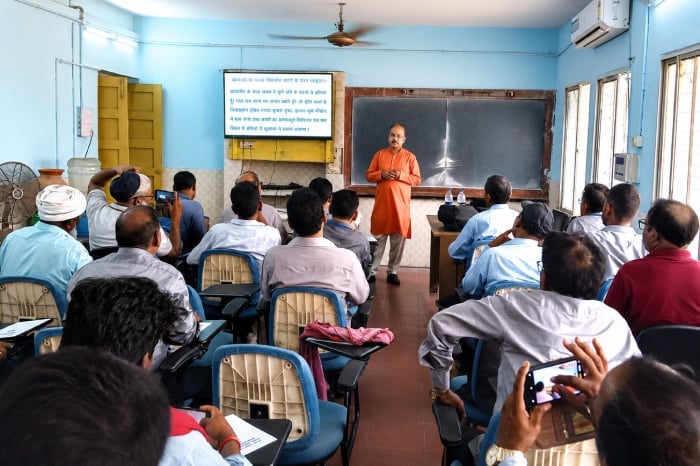
In this sense, H.G. Harilila Das’s selected topic, centered on Śrīmad Bhāgavatam 3.27.5, invites reflection on a timeless challenge: how to live in the world without being mastered by it. The answer is not escapism. It is purified engagement. The senses remain active, the mind remains capable, and the person remains socially responsible, but consciousness is redirected toward Kṛṣṇa. That redirection gradually transforms ordinary life into sādhana.
The enduring power of this verse lies in its balance. It is gentle because it says śanaiḥ, gradually. It is demanding because it says tīvreṇa, intensely. It is analytical because it identifies attachment to the temporary. It is devotional because it prescribes bhakti-yoga. It is practical because it focuses on the mind. It is liberating because it teaches that consciousness, however conditioned, can be brought under divine guidance through devotion and detachment.
Śrīmad Bhāgavatam 3.27.5 therefore remains more than a verse for recitation. It is a disciplined framework for self-realization, a theology of attention, and a compassionate method for mastering the mind. Its message is clear: the path to freedom begins when consciousness, long attached to the temporary, is patiently and seriously offered back to the eternal.
Inspired by this post on Dandavats.









Leave a Reply
You must be logged in to post a comment.