
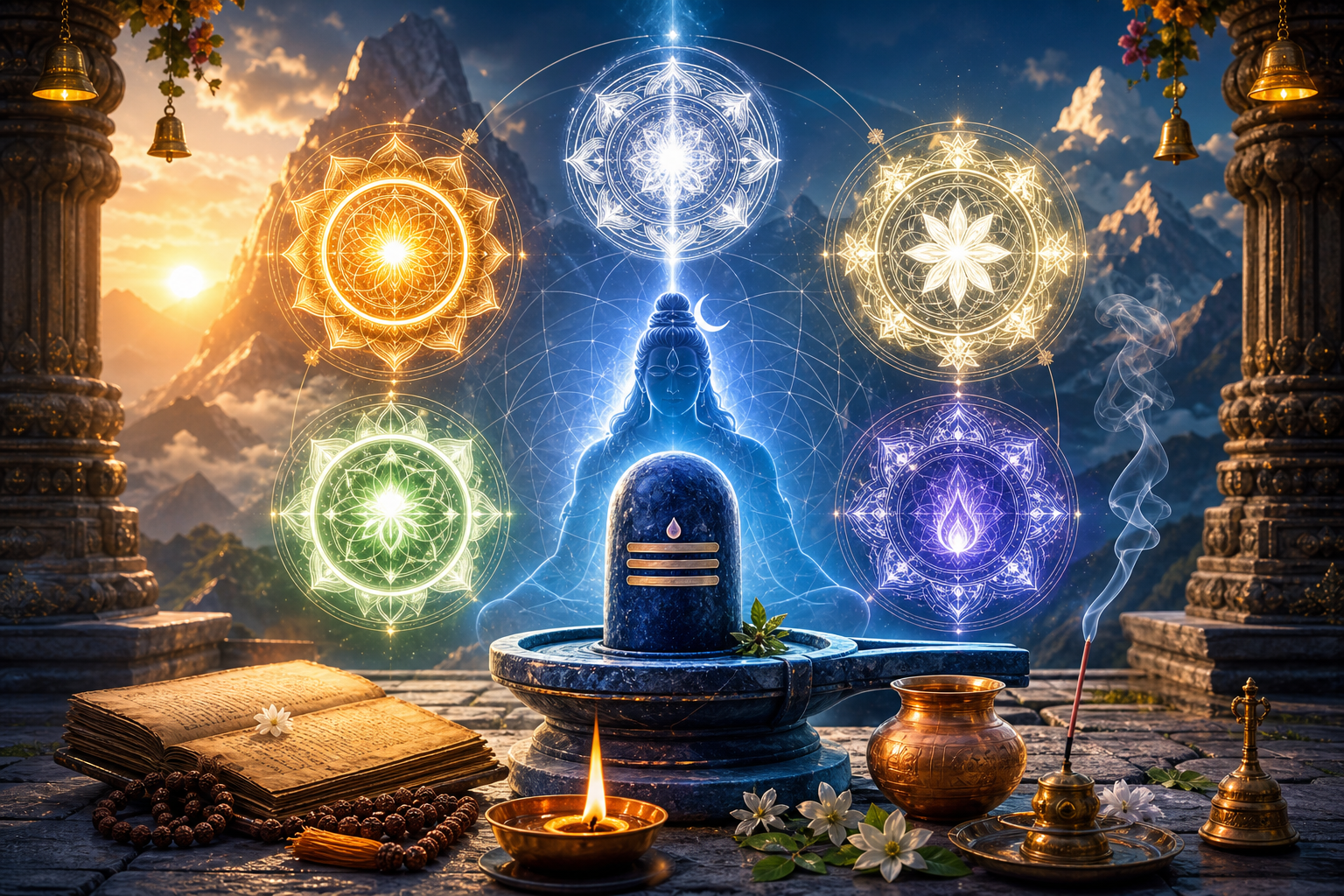
The Pancha Maha Mantras of Shiva occupy a profound place in Hindu spirituality because they bring together mantra, theology, meditation, ritual worship, and inner transformation. Drawn from the Mahanarayana Upanishad, particularly the sections traditionally associated with the five great invocations to Shiva, these mantras are not merely devotional phrases. They are compact expressions of a complete Shaiva vision of reality, in which Lord Shiva is approached as creator, protector, dissolver, revealer, and the supreme consciousness that pervades all beings.
In the tradition of Hindu scriptures, a mantra is not treated as ordinary language. It is sound shaped into sacred meaning. The Pancha Maha Mantras of Shiva are especially important because each invocation is associated with one of the five faces or aspects of Shiva: Sadyojata, Vamadeva, Aghora, Mahadeva, and Ishana. In many Shaiva traditions, these five are also connected with the wider doctrine of Panchabrahma, where Shiva is contemplated through five cosmic functions. The result is a deeply layered spiritual framework that can be studied academically, recited ritually, and experienced inwardly through meditation.
The Mahanarayana Upanishad belongs to the broader Vedic and Upanishadic stream of Hindu thought. Like many Upanishadic passages, it does not reduce spirituality to belief alone. It joins sound, contemplation, metaphysics, and disciplined practice. In this context, the five mantras dedicated to Shiva become a bridge between Vedic mantras and later Shaiva worship. They preserve the ancient reverence for Rudra-Shiva while also presenting him as the supreme principle behind existence, knowledge, and liberation.
The first of these invocations is associated with Sadyojata. The name may be understood as “the one who is born at once” or “the one who brings forth immediate manifestation.” In theological terms, Sadyojata is often linked with creation, emergence, and the visible unfolding of life. This aspect of Lord Shiva reminds devotees that creation is not separate from the divine. Every beginning, whether cosmic, seasonal, intellectual, or personal, can be understood as a movement of sacred possibility.
In meditation, the Sadyojata mantra may be contemplated as an invitation to recognize the sacredness of new beginnings. Human life repeatedly passes through moments of uncertainty: a new responsibility, a new phase of family life, a fresh spiritual discipline, or the difficult beginning that follows loss. The mantra offers a disciplined way to see such beginnings not as random interruptions, but as openings through which inner clarity may arise. This is one reason the Pancha Maha Mantras remain relevant beyond temple ritual; they speak to the rhythm of lived experience.
The second invocation is associated with Vamadeva. This aspect of Shiva carries meanings of beauty, preservation, grace, and auspiciousness. Vamadeva is not merely a gentle form in contrast to Shiva’s fierce dimensions. Rather, it reveals the divine as harmony, balance, and sustaining intelligence. In a broader Hindu philosophical sense, preservation does not mean stagnation. It means the maintenance of dharma, order, and continuity amid change.
The Vamadeva mantra is therefore deeply connected with gratitude and reverence. It encourages reflection on the forces that quietly sustain life: breath, food, family bonds, teachers, community, memory, and sacred tradition. Within dharmic traditions, preservation is not passive. Hinduism, Buddhism, Jainism, and Sikhism each value disciplined continuity in different ways, whether through sadhana, meditation, ethical restraint, seva, or remembrance of divine truth. The Vamadeva aspect of Shiva can be understood as part of this larger dharmic sensitivity toward balance and responsibility.
The third invocation is associated with Aghora. The term Aghora means “not terrible” or “beyond fear,” even though it is often linked with Shiva’s fierce and transformative presence. This is one of the most misunderstood dimensions of Shiva worship. Aghora does not glorify fear; it transforms fear. It teaches that what appears frightening, painful, or destructive may also become a doorway to purification when approached with spiritual maturity.
In Shaiva theology, Aghora is connected with dissolution, but dissolution is not mere destruction. It is the clearing away of ignorance, ego, attachment, and false identification. The Aghora mantra therefore has a psychological depth. It speaks to the human need to face impermanence without denial. When recited with understanding, it becomes a reminder that spiritual growth often requires the courage to release what no longer serves dharma, truth, or inner freedom.
The fourth invocation is associated in the source tradition with Mahadeva, the “Great God,” and is closely related in many Shaiva presentations to the Tatpurusha-Mahadeva current of contemplation. This mantra is widely recognized because it carries a structure similar to the Gayatri form: the seeker meditates upon the divine and prays for illumination. Here Shiva is not approached only as a deity outside the devotee, but as the power that awakens understanding within consciousness itself.
This aspect is especially important for students of Hindu philosophy. The Mahadeva or Tatpurusha-oriented contemplation points toward the inner person, the witness, and the spiritual intelligence that stands behind thought and action. It transforms worship into inquiry. The devotee does not merely ask for worldly success; the deeper prayer is for the mind to be directed toward truth. This is why the mantra has long been valued in meditation, mantra japa, and spiritual disciplines that seek mental clarity and self-realization.
The fifth invocation is associated with Ishana, one of the most exalted aspects of Shiva. Ishana signifies lordship, sovereignty, knowledge, and transcendence. In many Shaiva interpretations, Ishana is linked with the upward direction and with the highest form of spiritual knowledge. This aspect presents Shiva as the lord of all vidyas, the inner ruler of beings, and the supreme reality beyond limitation.
The Ishana mantra gives the Pancha Maha Mantras their culminating force. After contemplating creation, preservation, transformation, and inner illumination, the seeker is led toward the recognition of Shiva as pure consciousness. This is not only a devotional conclusion but a philosophical one. The Upanishadic movement is always toward deeper knowledge of reality. In that sense, Ishana represents the point where worship, knowledge, and liberation meet.
Technically, the Pancha Maha Mantras may be studied through several interrelated lenses. The first is textual: their basis in the Mahanarayana Upanishad and their relationship to Vedic Rudra-Shiva worship. The second is theological: their presentation of Shiva through five aspects. The third is ritual: their use in puja, abhishekam, temple worship, and consecration practices. The fourth is meditative: their role in mantra japa and inner contemplation. The fifth is philosophical: their connection to the Upanishadic search for the ultimate reality behind name, form, and experience.
The fivefold structure is itself significant. Hindu thought often uses structured symbolic systems to help the mind contemplate complex truths. Five elements, five senses, five sheaths, five vital airs, and five sacred functions are examples of this pattern. The five faces of Shiva likewise offer a way to meditate upon the divine as complete rather than one-dimensional. Shiva is not only the ascetic, not only the destroyer, not only the benevolent lord, and not only the cosmic dancer. He is the totality in which all these dimensions are integrated.
For worshippers, this integration has practical value. A devotee may approach Shiva in joy, fear, grief, confusion, discipline, or gratitude. The Pancha Maha Mantras provide language for all these states. Sadyojata sanctifies beginnings. Vamadeva sustains devotion and harmony. Aghora transforms fear and impurity. Mahadeva turns the mind toward illumination. Ishana opens the vision of supreme knowledge. Together they form a spiritual map rather than a disconnected set of invocations.
These mantras also show why Lord Shiva remains central to Hindu spirituality across regions and traditions. In temples, Shiva may be worshipped through the Shivalinga, through Nataraja, through Dakshinamurthy, through Rudra, through Mahadeva, or through countless local and regional forms. Yet the theological core remains remarkably coherent: Shiva is both immanent and transcendent, both personal and beyond personality, both the stillness of meditation and the force of cosmic transformation.
The connection between mantra and transformation should be understood carefully. In Hindu practice, mantra is not treated as mechanical magic. Its power is traditionally linked with correct transmission, sincere recitation, disciplined attention, ethical living, and devotion. The Pancha Maha Mantras are most meaningful when approached with reverence and study. Their sound may calm the mind, but their meaning also educates the intellect. Their repetition may deepen devotion, but their philosophy also challenges the seeker to live with greater awareness.
In a modern setting, these mantras can be especially valuable because they resist superficial spirituality. They do not present spiritual life as escape from difficulty. Instead, they teach that creation, preservation, dissolution, illumination, and transcendence are all part of the sacred order. A person dealing with change may find strength in Sadyojata. A person seeking steadiness may turn toward Vamadeva. A person confronting fear may contemplate Aghora. A person seeking wisdom may meditate on Mahadeva. A person drawn to liberation may rest the mind in Ishana.
The academic study of these mantras also helps correct a common misunderstanding about Hinduism. Hindu worship is sometimes mistakenly viewed as fragmented because of its many deities, forms, and rituals. The Pancha Maha Mantras reveal the opposite. They show a sophisticated theological method in which multiplicity becomes a path to unity. Different names and aspects do not weaken the spiritual vision; they allow the human mind to approach the infinite through meaningful forms.
This insight is important for the unity of dharmic traditions. Hinduism, Buddhism, Jainism, and Sikhism differ in doctrine, vocabulary, and practice, yet each tradition values disciplined transformation, ethical refinement, and liberation from ignorance or bondage. The Pancha Maha Mantras of Shiva belong specifically to the Hindu and Shaiva world, but their larger themes resonate with the dharmic respect for inner purification, self-mastery, compassion, and spiritual awakening.
As a subject of meditation, the Pancha Maha Mantras invite the practitioner to move from outer recitation to inner assimilation. The mouth chants, the ear listens, the mind attends, and the heart gradually learns to dwell in the meaning. This movement from sound to awareness is central to mantra meditation. The mantra begins as something recited, but with sustained practice it becomes a way of seeing. Shiva is then no longer limited to ritual space; the presence of the divine is recognized in thought, breath, duty, silence, and moral action.
The Pancha Maha Mantras of Shiva therefore deserve careful attention not only as sacred formulas but as a concise theology of spiritual life. They preserve an Upanishadic vision in which Lord Shiva is contemplated as the source, sustainer, transformer, illuminator, and supreme lord of knowledge. Their enduring value lies in this completeness. They speak to the temple priest, the scholar, the meditator, the householder, and the seeker who is trying to bring clarity into ordinary life.
Ultimately, these five great invocations teach that Shiva is not confined to one mood, one form, or one function. He is the auspicious reality present in birth, continuity, dissolution, insight, and transcendence. To study the Pancha Maha Mantras is to encounter a refined expression of Hindu scriptures, Vedic mantras, Shaiva traditions, and the living practice of mantra meditation. To contemplate them is to enter a disciplined path where devotion becomes knowledge, knowledge becomes inner steadiness, and inner steadiness becomes a movement toward spiritual freedom.
Inspired by this post on Hindu Blog.






Leave a Reply
You must be logged in to post a comment.