
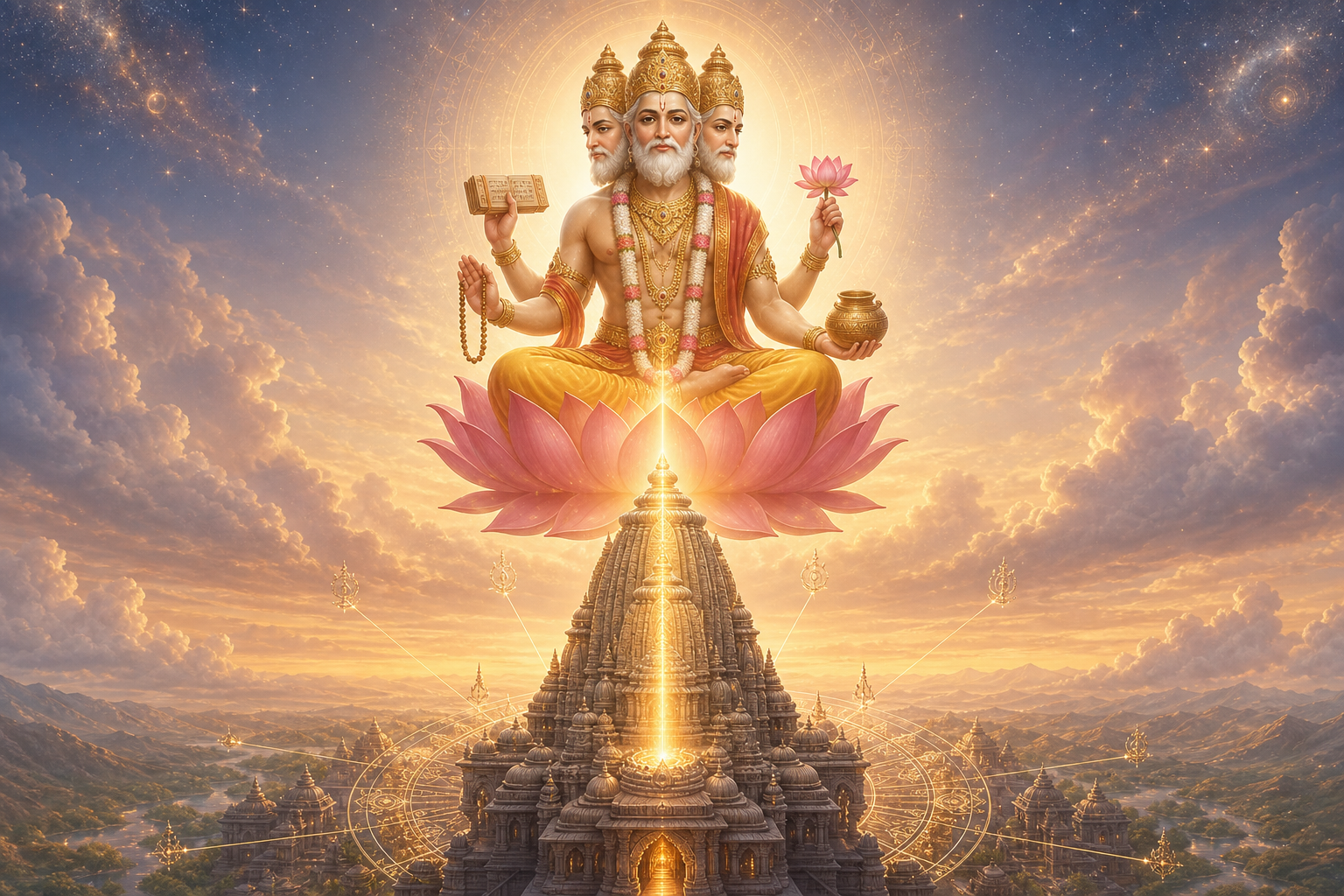
Brahma as Urdhva Dikpala occupies a distinctive place in the sacred geography of Sanatana Dharma. In this vision, space is not an empty container but a living field of meaning, order, consciousness, and divine presence. The directions are understood as ritually charged dimensions, each watched over by a guardian deity whose symbolism helps human beings orient themselves within the cosmos. The tradition of the Dikpalas, the guardians of the directions, therefore belongs not only to mythology but also to Hindu cosmology, temple architecture, ritual worship, iconography, and philosophical reflection.
The phrase Urdhva Dikpala refers to the guardian of the upward direction, the celestial height above the human plane. In many later ritual and architectural traditions, Brahma Dev is associated with this upward axis. This association is deeply meaningful because Brahma represents creation, sacred knowledge, ordering intelligence, and the unfolding of the universe from subtle possibility into manifest form. As the upward guardian, Brahma is not merely placed above as a spatial marker; he symbolizes ascent, expansion, learning, refinement, and the human aspiration to rise toward higher planes of awareness.
The idea of sacred direction is one of the most elegant features of Hindu thought. A direction is not treated as a neutral coordinate. It carries qualities, associations, ritual functions, and theological resonance. East is linked with sunrise, illumination, beginnings, and divine awakening. South is connected with mortality, ancestors, discipline, and the sober remembrance of time. North often evokes prosperity, spiritual ascent, and stability. The upward direction, however, opens the mind toward transcendence. It reminds the devotee that life is not confined to the horizontal concerns of survival, society, and material movement; it also has a vertical dimension of meaning.
The Dasha Dikpalas, or ten directional guardians, extend the better-known system of the eight Dikpalas by including the zenith and nadir. The eight classical guardians are usually associated with the cardinal and intercardinal directions. In widely known lists, Indra guards the east, Agni the southeast, Yama the south, Nirrti the southwest, Varuna the west, Vayu the northwest, Kubera the north, and Ishana the northeast. When the system expands into ten directions, the upward and downward axes complete the sacred enclosure of space. Brahma is often connected with the upward direction, while Ananta, Vishnu, or another cosmic principle may be associated with the lower direction depending on textual, regional, and ritual context.
This sacred mapping reflects a sophisticated cosmological intuition: the universe is ordered in every direction, and the human being stands within a field of responsibility. The devotee is never spiritually isolated. Every movement, offering, temple plan, pilgrimage route, and ritual gesture is placed within a larger cosmic grammar. The Dikpalas make this grammar visible. They transform space into a mandala, and they remind worshippers that dharma is lived through orientation, alignment, discipline, and reverence.
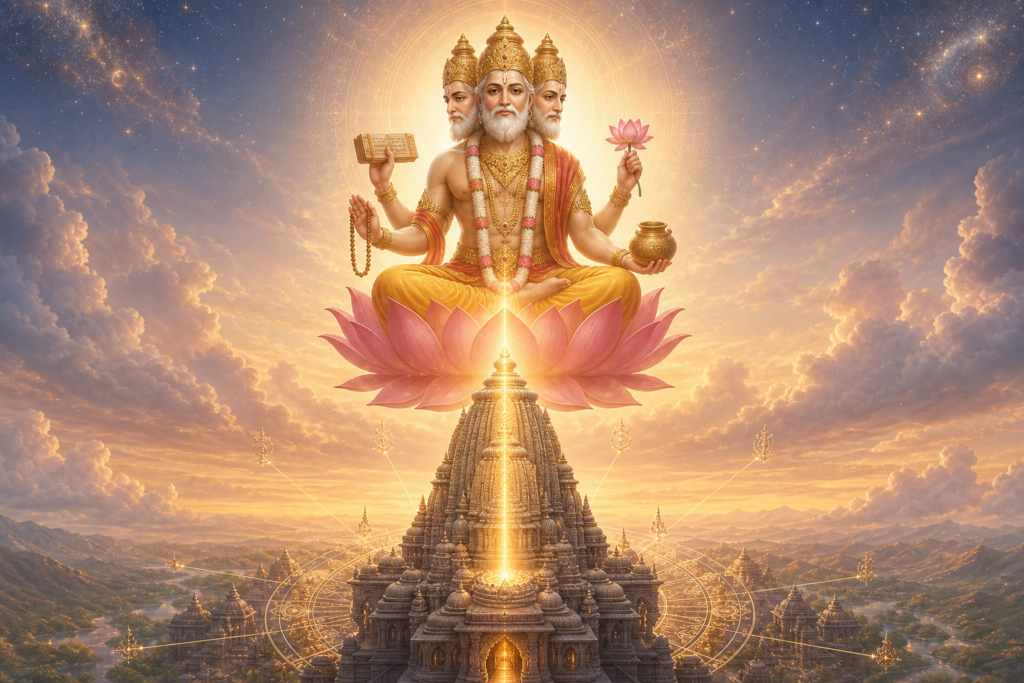
Brahma Dev is especially suited to the symbolism of the upward direction because he is traditionally honored as the creator within the Trimurti. His role is linked with the emergence of names, forms, worlds, beings, and knowledge systems. His four faces are commonly interpreted as facing the four directions, reflecting the completeness of sacred knowledge and the all-sided awareness required for creation. In many theological explanations, the four faces are also associated with the Vedas, suggesting that creation is not chaotic production but an ordered manifestation guided by wisdom.
As Urdhva Dikpala, Brahma becomes the guardian of spiritual elevation. The upward direction is not only physical height but also a symbol of inner growth. It evokes the movement from ignorance to knowledge, from fragmentation to integration, from mere existence to purposeful living. For many devotees, looking upward during worship carries a quiet emotional power. It suggests trust, surrender, and a recognition that life must be measured by more than immediate concerns. The figure of Brahma above the sacred field encourages the mind to seek a wider horizon.
In temple architecture, this theology becomes stone, geometry, and movement. Hindu temples are not designed merely as congregational halls. They are conceived as sacred bodies, cosmic diagrams, and living centers of divine presence. The Vastu Purusha Mandala, the foundational diagram used in many temple and architectural traditions, organizes space according to divine principles. The guardians of the directions are often invoked in relation to boundaries, gateways, walls, corners, and ritual protection. Their presence marks the temple as a complete universe rather than an ordinary structure.
The vertical axis of a temple is especially important. From the garbhagriha, the sanctum, the temple rises toward the shikhara or vimana, visually expressing ascent from the earthly to the celestial. The upward thrust of the superstructure is not accidental ornamentation. It is a theological statement. It draws the eye and mind toward the higher realms, toward the divine source, and toward the possibility of spiritual awakening. Within this architectural language, Brahma as Urdhva Dikpala becomes a guardian of the temple’s ascent, a symbolic protector of the movement from matter to spirit.
The sacred peak of the temple can be read as a meeting point between earth and heaven. Ritualists, architects, sculptors, and devotees participate in this symbolism in different ways. The architect calculates proportion and orientation. The sculptor gives form to divine principles. The priest performs consecration and daily worship. The devotee experiences the space through sight, sound, fragrance, movement, and inner attention. The upward guardian binds these experiences to a larger vision: the temple is a path of ascent, and the human body itself can become a temple through disciplined spiritual life.
Brahma’s association with creation also connects the upward direction with intellectual and spiritual responsibility. Creation in Hindu philosophy is not simply the beginning of a timeline. It is a recurring process of manifestation, preservation, dissolution, concealment, and grace. The universe appears, evolves, withdraws, and reappears in vast cycles. Brahma’s day and night, described in Puranic cosmology, express the immensity of cosmic time and the relative smallness of ordinary human anxieties. This perspective can be humbling, but it can also be liberating. It places human life within a cosmic rhythm that is vast, ordered, and sacred.
The upward direction therefore carries an ethical meaning. To look upward under Brahma’s guardianship is to remember that thought, speech, ritual, and action should be elevated. Knowledge must not become arrogance. Creativity must not become vanity. Power must not become disorder. The creator deity, when understood through dharma, points toward responsible creation: families, institutions, scriptures, arts, sciences, temples, and communities must be built in a way that sustains harmony rather than fragmentation.
This point is especially relevant to the unity of dharmic traditions. Hinduism, Buddhism, Jainism, and Sikhism differ in theology, metaphysics, ritual, and historical development, yet they share a civilizational respect for discipline, ethical life, self-transformation, sacred learning, and liberation from narrow ego-centered existence. The upward axis can be understood as a shared metaphor across dharmic life. It is the movement from confusion toward clarity, from selfishness toward compassion, from violence toward restraint, and from spiritual forgetfulness toward awakened responsibility.
Within Hindu practice, the Dikpalas also appear in rituals of protection and consecration. Before major rites, the sacred space is often purified, bounded, and invoked. Directional awareness helps establish ritual order. The worshipper does not act randomly; the act of worship is placed within a recognized sacred field. This is why temple rituals, homa procedures, vastu rites, and consecration ceremonies often include attention to directions and their presiding powers. Such practices communicate that dharma is not abstract theory alone. It is embodied through space, gesture, sound, offering, and disciplined attention.
The Dikpala tradition also reveals the plural richness of Hindu deities. Each guardian has a distinct personality, vehicle, weapon, symbolism, and theological function. Indra’s sovereignty, Agni’s transformative fire, Yama’s moral seriousness, Varuna’s cosmic order, Vayu’s movement, Kubera’s wealth, Ishana’s spiritual power, and Brahma’s creative knowledge form a complex network of meaning. This is not polytheism in a simplistic sense. It is a sacred language through which different aspects of reality are honored, contemplated, and integrated.
Brahma’s iconography reinforces this theological function. He is commonly depicted with four heads, four arms, a beard suggesting ancient wisdom, and objects such as the Vedas, a rosary, a water pot, and a lotus. The lotus evokes emergence from the cosmic waters and the purity of creation. The rosary suggests time, repetition, mantra, and contemplative discipline. The water pot signifies the life-bearing potential of creation. The Vedas represent sacred knowledge as the foundation of order. When these symbols are read in connection with the upward direction, Brahma becomes a guardian of elevated knowledge and disciplined creativity.
It is important to note that Brahma’s worship as an independent central deity is less widespread than the worship of Vishnu, Shiva, Devi, Ganesha, Surya, or other forms. This has led many readers to underestimate his theological importance. Yet Brahma remains deeply present in cosmology, Puranic narratives, temple symbolism, ritual language, and philosophical imagination. His relative scarcity as the central deity of major temples does not diminish his role in the architecture of sacred thought. As Urdhva Dikpala, his function is precise and profound: he guards the height from which creation, knowledge, and order are contemplated.
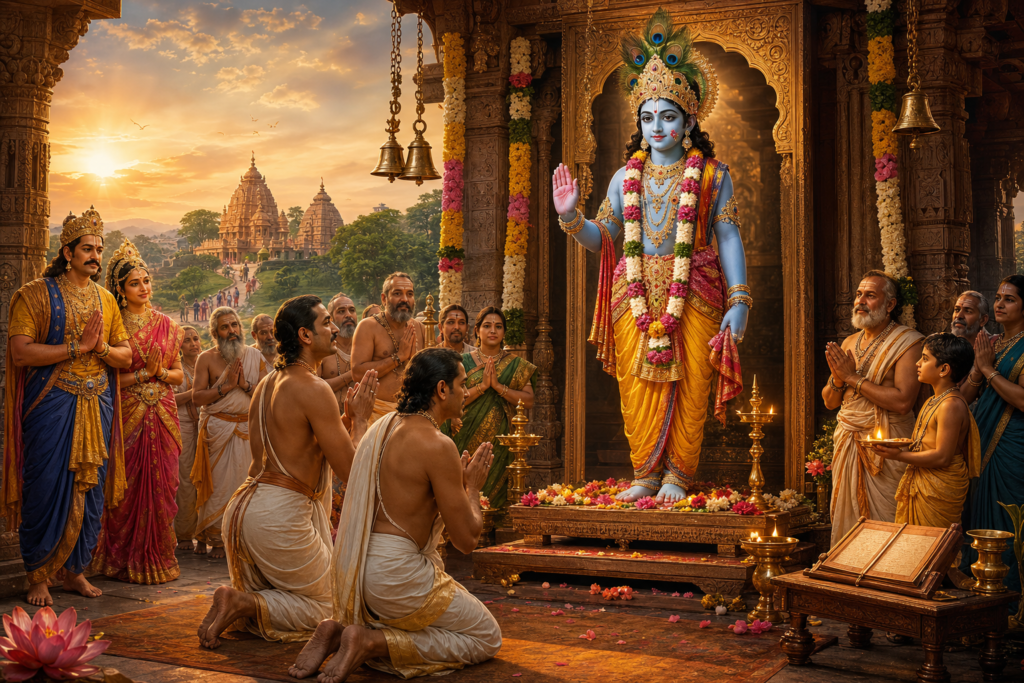
The sacred tradition of the Dasha Dikpalas also supports a broader understanding of Hindu temple experience. A devotee entering a temple may first notice the main deity, the lamps, the bells, the fragrance of incense, or the rhythm of mantras. Yet beneath this sensory experience lies a carefully structured sacred world. The threshold, the circumambulatory path, the sanctum, the tower, the subsidiary shrines, and the outer walls all participate in a larger metaphysical design. The directional guardians help maintain this design as a complete field of divine order.
In this sense, temple worship is both intimate and cosmic. The devotee may arrive with a private grief, a family prayer, a thanksgiving, or a quiet longing for clarity. At the same time, the temple places that personal experience within the larger order of the universe. Brahma as the upward guardian gives special dignity to this movement. Personal life is lifted into sacred perspective. Anxiety is not denied, but it is placed under a higher canopy of meaning. This is one reason traditional temples continue to speak powerfully to modern minds even in an age of speed, distraction, and material pressure.
The upward direction also has a natural relationship with mantra and learning. In many dharmic settings, knowledge is not treated as mere information. It is a transformative force that refines the one who receives it. Brahma’s connection with the Vedas places him near the origin of sacred sound, disciplined memory, and transmitted wisdom. The act of study, when undertaken with humility, becomes a form of ascent. The student rises by listening, reflecting, practicing, and internalizing. This makes Brahma’s guardianship relevant not only to ritual specialists but also to every seeker of knowledge.
There is also a psychological depth in the symbolism of upward guardianship. Human beings often experience life horizontally: career, family, society, conflict, responsibility, and daily movement. These are necessary and meaningful, but they can become exhausting when disconnected from a higher center. The upward axis restores perspective. It asks what kind of person is being formed through action. It asks whether knowledge is becoming wisdom, whether tradition is becoming living practice, and whether ritual is opening the heart rather than hardening identity. Brahma’s place above the sacred field gently redirects attention to these questions.
Academic study of the Dikpalas benefits from this layered approach. The tradition can be examined through texts, inscriptions, sculpture, temple plans, ritual manuals, and regional practice. It can also be understood through lived religious experience. A purely external reading may classify the Dikpalas as directional deities. A deeper reading sees them as a system of sacred orientation. They organize the relationship between body and cosmos, shrine and world, ritual and philosophy, human aspiration and divine order.
The presence of Brahma as Urdhva Dikpala also helps correct a common misunderstanding about Hindu sacred geography. The tradition is not limited to earth-centered fertility, local cults, or sectarian devotion, although it includes all of these in rich forms. It also contains refined cosmological architecture. The vertical dimension links earthly ritual to celestial order. The temple is not merely a place where a deity is housed; it is a symbolic universe through which the devotee learns how to stand correctly within existence.
The Dasha Dikpalas further demonstrate the Hindu capacity to hold multiplicity within unity. Ten directions do not create confusion; they create completeness. Many deities do not necessarily imply disorder; they may express the many-sided nature of reality. Different forms of worship, different philosophical schools, and different devotional temperaments can coexist because dharma recognizes that reality may be approached through multiple valid doors. This insight is essential for preserving unity among dharmic traditions without flattening their differences.
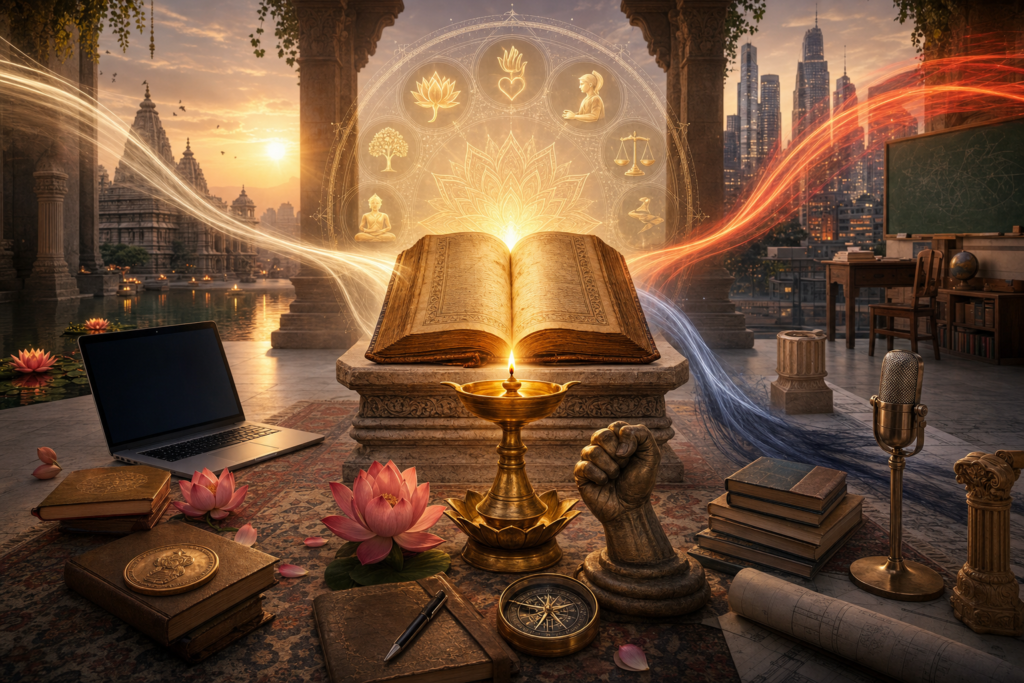
In contemporary life, Brahma as the upward guardian offers a meaningful framework for cultural renewal. Communities that inherit sacred traditions must do more than preserve names and festivals. They must also preserve the intelligence behind them. The Dikpalas teach orientation. Brahma teaches creative responsibility. Temple architecture teaches embodied metaphysics. Ritual worship teaches disciplined attention. Together, these elements show that Sanatana Dharma is not only a set of beliefs but a way of organizing life around sacred order.
This has practical consequences. A home shrine, a temple visit, a recitation, a festival, or a study circle can become more meaningful when placed within the idea of sacred orientation. The question is not only what is worshipped but how space, time, body, speech, and intention are aligned. The upward direction asks the practitioner to lift the quality of attention. Brahma’s guardianship reminds the community that creation begins inwardly, in the formation of thought, intention, and value.
The sacred tradition of the Dasha Dikpalas remains relevant because it speaks to a permanent human need: the need to find one’s place in a vast and complex universe. Modern life often expands information while weakening orientation. It offers movement without always offering direction. The Dikpala tradition answers with a different vision. It says that direction itself can be sacred, that space can be consecrated, that the human being can stand within a universe filled with meaning, and that every ascent must be guarded by wisdom.
Brahma as Urdhva Dikpala, the divine guardian of the celestial heights, therefore represents more than a theological detail. He stands for the upward call of dharma: to create responsibly, to learn deeply, to refine consciousness, and to recognize the sacred order that surrounds and sustains life. In temple architecture, ritual worship, Hindu cosmology, and spiritual reflection, his presence invites the mind to rise. The lesson is quiet but powerful: a civilization remains alive when it remembers not only where it stands, but also toward what height it is meant to grow.
Inspired by this post on Hindu Blog.

Leave a Reply
You must be logged in to post a comment.