
The Nadabindu Upanishad presents one of the most concentrated teachings in the Yoga Upanishadic tradition on Pranava, the sacred syllable Om or Aum. Though brief in form, it is philosophically dense: it treats sound, silence, breath, consciousness, karma, and death as parts of one disciplined movement toward Brahman. Its teaching on the matras of Om before death is especially striking because it does not approach death as a mere biological ending. It approaches death as a decisive moment of consciousness, shaped by the depth of one’s lifelong sadhana.
The text is traditionally counted among the Yoga Upanishads and is associated in manuscript traditions with Vedic recensions connected to the Rig Veda and Atharvaveda. Its central concern is not ritual performance in the external sense, but inner realization through Omkara, Nada Yoga, and contemplative absorption. The Nadabindu Upanishad belongs to that stream of Sanatana Dharma in which sacred sound is not treated as an ornament of worship, but as a subtle bridge between the embodied mind and the unconditioned Self.
The term Nadabindu itself is important. Nada means sound, especially the subtle inner sound recognized in yogic practice, while bindu suggests a point, seed, or concentrated center of awareness. The title therefore points toward a contemplative science of sound as concentration. It does not merely ask the practitioner to chant Om mechanically. It asks for a refined inward turning in which sound becomes subtler, the mind becomes steadier, and the distinction between the seeker, the act of listening, and the object of meditation gradually dissolves.
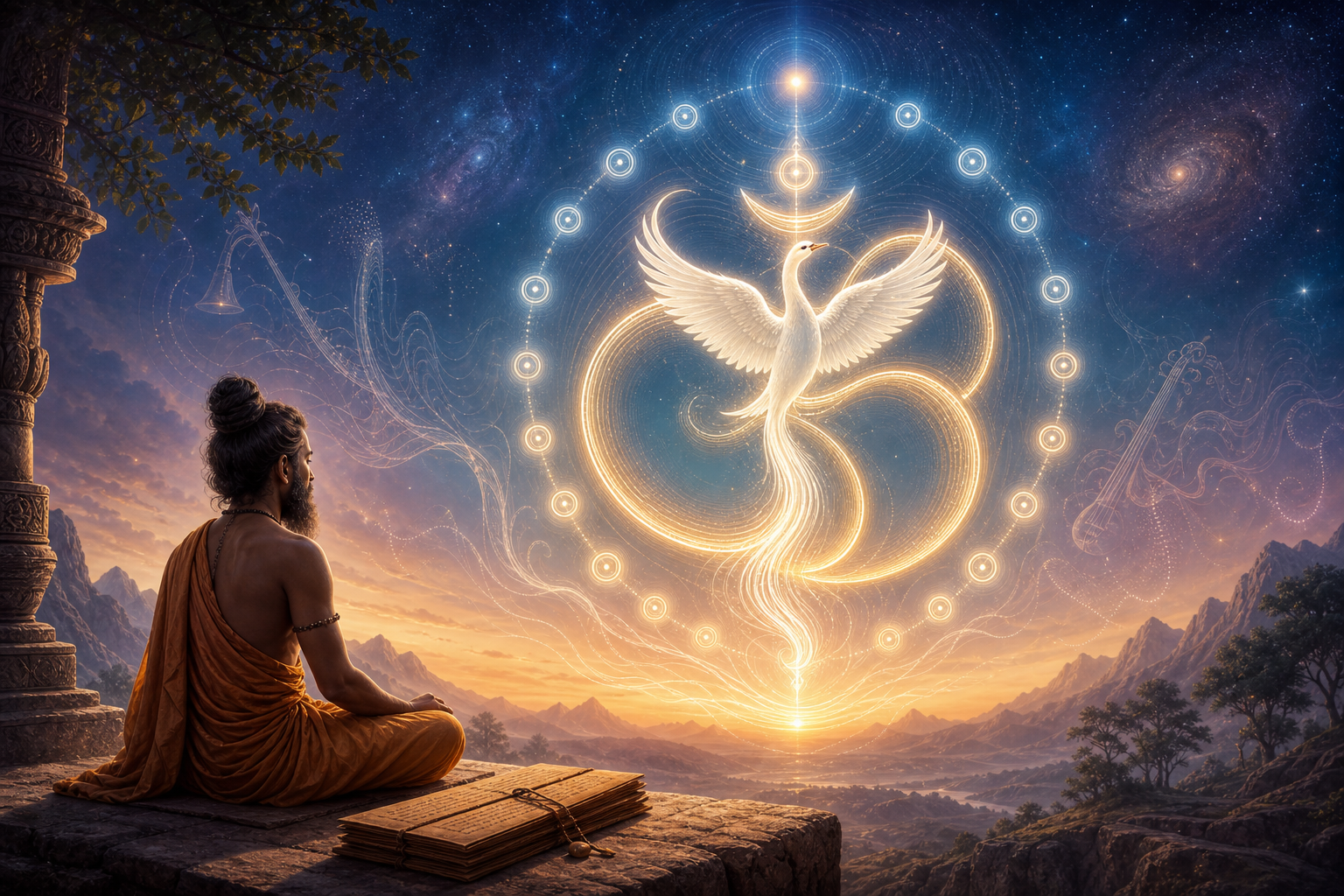
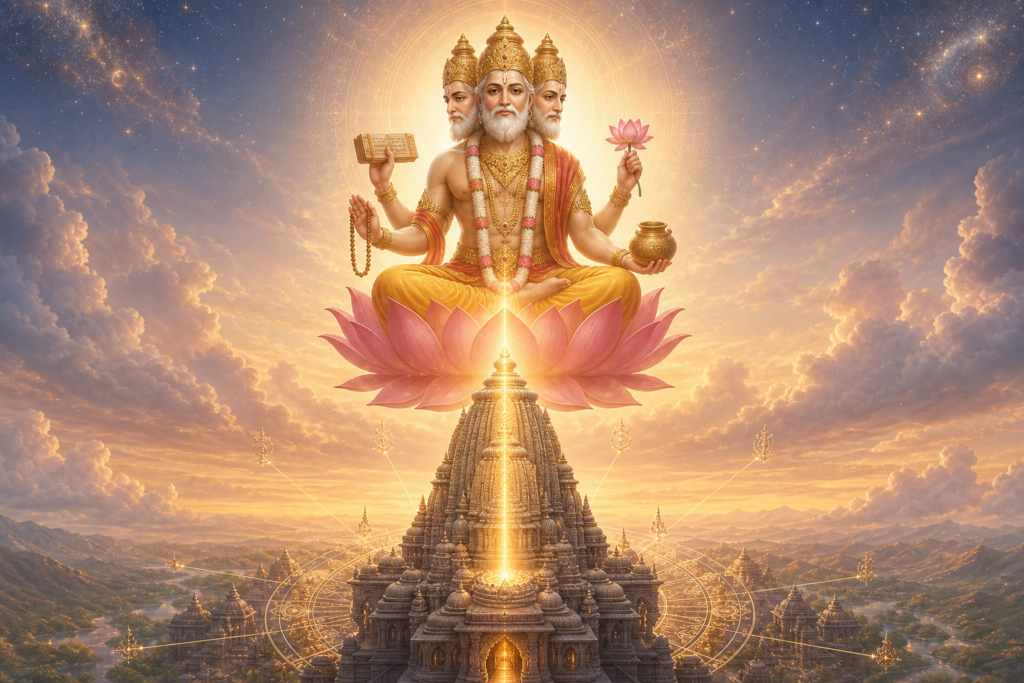
At the opening of its teaching, the Nadabindu Upanishad gives a symbolic body to Om. The sound a is described as one wing, u as the other, m as the tail, and the ardhamatra, the subtle half-measure beyond the audible syllable, as the head. This imagery is often connected with the hamsa, the migratory bird that becomes a powerful symbol of the Self moving through worlds yet belonging ultimately to the infinite. The metaphor is not decorative. It indicates that Om is a complete vehicle of ascent, containing movement, balance, completion, and transcendence.
In Sanskrit phonetics, a matra is a measure of sound, a unit of duration. In the Upanishadic and yogic context, however, it becomes more than a phonetic measure. A matra becomes a doorway of contemplation. The audible components of Aum are not isolated syllables but progressive fields of awareness. The a sound opens the chant and is associated with manifestation. The u sound carries continuity and expansion. The m sound gathers the vibration inward. The ardhamatra is the subtle residue beyond utterance, the silence that is not mere absence but presence without vibration.
This makes the Nadabindu Upanishad a natural companion to broader Upanishadic reflection on Om, especially the Mandukya Upanishad, where Aum is linked with waking, dreaming, deep sleep, and turiya, the fourth state beyond the three ordinary states of experience. The Nadabindu Upanishad develops its own yogic emphasis. It treats Om as a living structure of sound, subtle sound, and silence, while giving special attention to the condition of consciousness at the time of death.
The text states that the matras of Om are established across the three divisions of time: past, present, and future. This is a profound philosophical claim. Om is not presented as a sound produced only in the throat at a particular moment. It is treated as a symbolic and vibratory expression of the whole field of existence. For a practitioner, this changes the meaning of chanting. Om becomes a method of aligning personal awareness with cosmic order, not simply a verbal act.
The Nadabindu Upanishad then gives a more technical enumeration of twelve matras or kalas connected with Om: Ghosini, Vidyunmali or Vidyunmatra, Patangini, Vayuvegini, Namadheya, Aindri, Vaishnavi, Sankari, Mahati, Dhriti, Nari, and Brahmi. Manuscript traditions sometimes vary in the names, but the principle remains clear. Om is contemplated in increasingly subtle measures. The movement is from the grossly audible to the inwardly luminous, from conditioned awareness to the threshold of Brahman.
The most arresting section concerns what happens if a person leaves the body while established in one of these matras. If death occurs in contemplation of the first matra, the text says that the person is born as a sovereign in Bharata Varsha. If in the second, the person becomes a noble Yaksha. In the third, one becomes a Vidyadhara. In the fourth, one reaches the condition of a Gandharva. These outcomes are not to be read as a crude reward system. They are symbolic of increasingly subtle levels of merit, power, refinement, and luminous experience.
The fifth matra is associated with honor in Soma-loka among the devas. The sixth is connected with union or nearness to Indra. The seventh leads to the Vaishnava state. The eighth leads toward Rudra, Pashupati, the lord of beings. The ninth leads to Maharloka, the tenth to Janaloka, and the eleventh to Tapoloka. The twelfth, Brahmi, culminates in the eternal Brahman. This upward sequence shows a graded spiritual cosmology: from earthly sovereignty to celestial refinement, from divine proximity to the final transcendence of all lokas.
The practical teaching is subtle and demanding. Death reveals the tendency of consciousness. The mind at its final threshold does not become pure by accident. It carries the impressions of thought, conduct, devotion, fear, discipline, attachment, and insight cultivated through life. The Nadabindu Upanishad therefore treats meditation on Om before death not as an emergency technique, but as the flowering of long practice. A final remembrance becomes powerful because remembrance has already become natural.
This point has deep emotional force. Human beings often avoid thinking about death until illness, age, or loss forces the question. The Upanishad does not exploit that fear. It dignifies it by giving it direction. To contemplate Om is to prepare consciousness for clarity. It invites the practitioner to live in such a way that the last movement of the mind is not panic, regret, or grasping, but inward steadiness. In this sense, the teaching is not morbid. It is a discipline of living well.
After the enumeration of the twelve matras, the Nadabindu Upanishad points beyond all graded results. It speaks of the pure, all-pervading, stainless, auspicious reality from which the lights themselves arise. When the mind becomes absorbed beyond the senses and beyond the gunas, it enters the incomparable peace of the Supreme. This is the decisive Upanishadic move: even celestial attainments are not the ultimate goal. The final aim is not power, pleasure, fame, or even heavenly residence, but liberation through knowledge of Brahman.
The text also addresses karma with philosophical sharpness. It speaks of the fire of knowledge burning the threefold karma and later reflects on prarabdha, the karma already set in motion. Its reasoning resembles classic Vedantic analysis: ignorance projects the world in the way a rope may be mistaken for a snake. Once the substratum is known, the error loses its authority. This does not encourage ethical carelessness. Rather, it teaches that bondage is rooted in misidentification. The body, mind, and world are experienced, but the Self is not reducible to them.
The Nadabindu Upanishad then turns explicitly toward Nada Yoga. The yogi is described as seated in Siddhasana, applying a contemplative mudra, and listening inwardly to the subtle sound. The early sounds may appear gross and powerful, like the ocean, thunder, drums, or waterfalls. With practice, subtler sounds arise, like bells, flute, vina, or the humming of a bee. The movement from gross to subtle is psychologically precise. The mind first needs an object strong enough to hold it. Later, it can rest in finer and finer vibrations.
The Upanishad gives a practical instruction of great importance: wherever the mind first attaches itself to the inner sound, it should become steady there and merge with it. The practitioner is not asked to chase novelty. The purpose is not to collect mystical experiences. The purpose is steadiness, absorption, and eventual dissolution of restless mental movement. The mind, when joined to nada, becomes like milk mixed with water, losing its separateness in a larger field of awareness.
The text uses vivid metaphors to explain this inner discipline. Just as a bee absorbed in nectar does not seek other fragrances, the mind absorbed in nada no longer craves external objects. Just as a sharp goad can restrain a powerful elephant, inner sound can restrain the intoxicated mind wandering in the garden of sense objects. These images are psychologically accurate even for contemporary readers. Attention is normally scattered by noise, desire, anxiety, and memory. A sacred focus gathers it back into coherence.
The teaching has a wider dharmic resonance. Hindu traditions speak of Om, mantra, nama, japa, and anahata nada. Buddhist, Jain, and Sikh traditions, while distinct in doctrine and practice, also honor disciplined attention, ethical purification, remembrance, sacred recitation, and liberation from egoic grasping. The Nadabindu Upanishad can therefore be read in a spirit of dharmic unity. It does not need to erase differences among traditions. It shows how sound, silence, self-mastery, and inner awakening have served as shared contemplative concerns across Indic civilization.
The ardhamatra is especially important for spiritual interpretation. The audible Om ends, but awareness does not end. The silence after the sound is not empty in the ordinary sense. It is the field in which the sound appeared, vibrated, and dissolved. This is why the half-matra is symbolically placed as the head. It directs the practitioner beyond the syllable into the source of the syllable. The culmination of Om is not louder chanting but subtler recognition.
For this reason, the teaching before death is also a teaching about every moment. Each completed chant of Om contains birth, continuity, withdrawal, and silence. Each breath contains arising and dissolving. Each thought appears and fades. The practitioner who observes this carefully begins to understand impermanence without despair and the Self without abstraction. Death, in this vision, is not isolated from life. It is the final version of a pattern that has been present in every sound, every breath, and every act of awareness.
The Nadabindu Upanishad should not be reduced to a mechanical formula that guarantees a particular post-mortem destination by uttering a syllable at the last moment. Its framework assumes discipline, dharma, renunciation of excessive attachment, meditation, and knowledge. The condition of consciousness at death matters because the condition of consciousness during life matters. Om becomes transformative when it is joined with ethical living, self-restraint, devotion, inquiry, and sustained inward practice.
This is why the text remains relevant. Modern life trains attention outward: toward screens, arguments, speed, comparison, and constant stimulation. The Nadabindu Upanishad trains attention inward: toward sound, breath, silence, and the witnessing Self. Its teaching is technical, but not cold. It recognizes that the human mind needs a path from fear to steadiness. Om provides that path by giving the mind a sacred form, a subtle vibration, and finally a silence in which the mind can rest.
The final spiritual vision of the Nadabindu Upanishad is liberation through absorption in Brahman-Pranava. The yogi becomes free from ordinary agitation, beyond honor and dishonor, beyond heat and cold, beyond pleasure and pain. This does not mean indifference in the shallow sense. It means freedom from compulsive reaction. The one established in the Self is no longer ruled by the fluctuations that normally define identity. Such freedom is the true fruit of contemplating the matras of Om.
In the end, the Nadabindu Upanishad offers a disciplined and compassionate vision of death. It teaches that the final passage is shaped by the quality of awareness cultivated now. The matras of Om map a journey from sound to silence, from worldly identity to cosmic subtlety, and from cosmic subtlety to Brahman. To contemplate Om before death, therefore, is to learn how to live before death: with steadiness, humility, clarity, and a mind gradually drawn toward the immortal Self.
Inspired by this post on Hindu Blog.



Leave a Reply
You must be logged in to post a comment.