
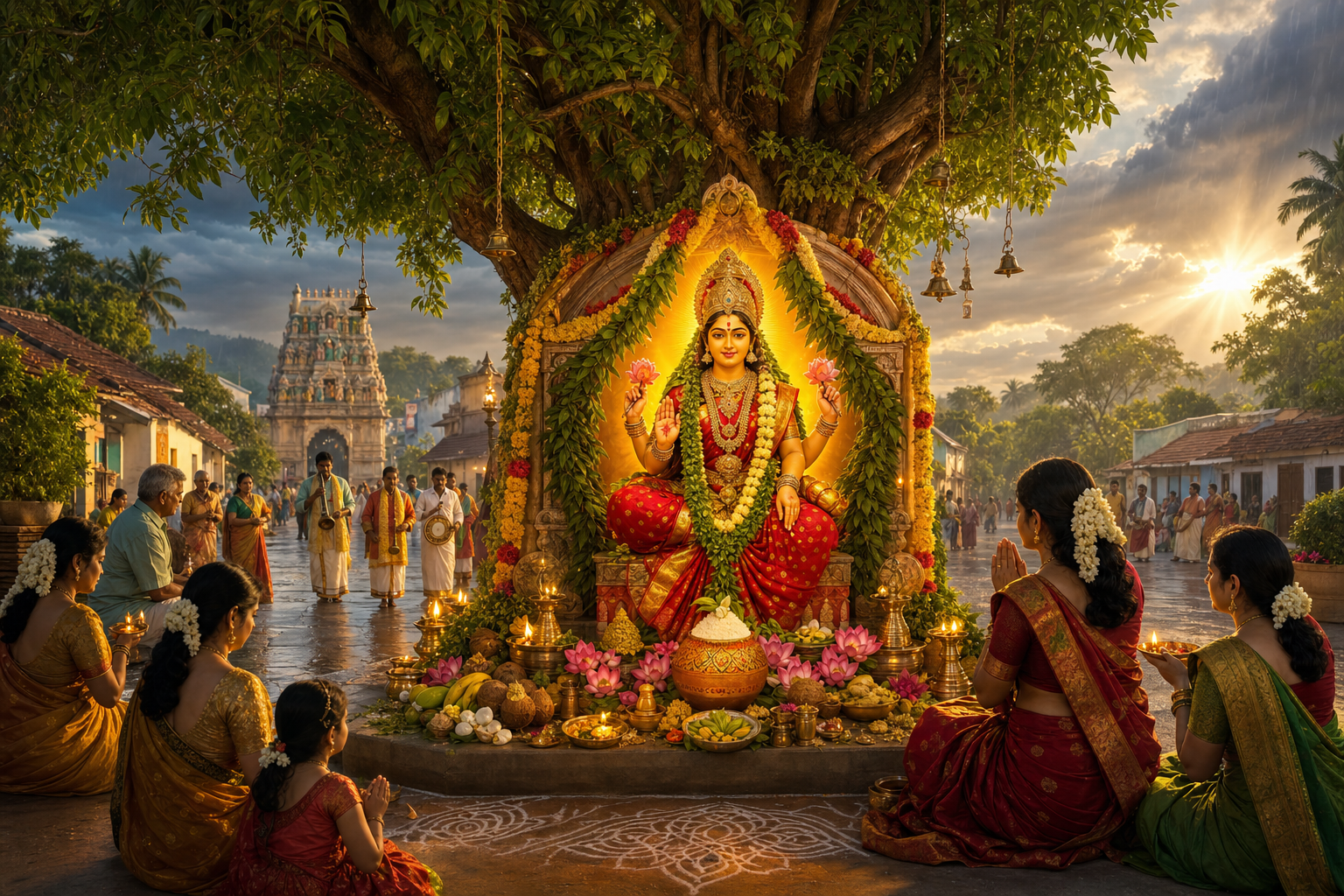
Across South India, especially in Tamil Nadu, Amman worship remains one of the most enduring expressions of Hindu devotion to the Divine Mother. The word Amman means “mother,” yet its religious meaning extends far beyond affection or kinship. It refers to a living sacred presence who guards villages, heals bodies, protects boundaries, receives vows, restores moral order, and embodies Shakti, the dynamic power through which creation itself is sustained.
Amman is not encountered only as a distant theological principle. In many communities, she is experienced as the Mother who stands at the edge of the settlement, the Mother who enters the festival street, the Mother who receives turmeric, neem leaves, pongal, lamps, flowers, and tears, and the Mother who hears the anxieties of ordinary life. Her worship belongs to the temple, the household, the field, the roadside shrine, the village boundary, and the memory of generations.
In academic terms, Amman worship may be described as a layered tradition in which folk devotion, temple ritual, Puranic symbolism, Tantric imagination, agrarian ecology, and local history meet. It is neither outside Hinduism nor reducible to a single textual system. Rather, it reveals how Hindu Dharma has historically preserved both pan-Indian metaphysics and intensely local forms of sacred life. The same village goddess may be understood as Mariamman, Kaliamman, Angalamman, Ellaiamman, Draupadi Amman, Meenakshi Amman, or as a manifestation of Parvati, Durga, Kali, Lakshmi, Saraswati, or Adi Shakti.
The living strength of Amman devotion lies in this ability to unite the intimate and the cosmic. A devotee may approach her for rain, childbirth, protection from fever, relief from fear, family harmony, recovery from illness, or spiritual courage. At the same time, the theology behind her worship points toward the vast Hindu understanding of Devi as the Supreme Mother, the power behind the devas, the source of compassion, and the force that destroys adharma when ordinary order collapses.
Historically, many Amman shrines appear to have grown from ancient village-protective traditions. These shrines were often linked to land, water sources, seasonal cycles, epidemics, fertility, cattle health, and communal safety. Before the development of large stone temples, royal endowments, and formalized Agamic worship, communities were already venerating feminine powers associated with the soil, the threshold, the grove, the anthill, the neem tree, the riverbank, and the cremation ground. Such spaces were not considered spiritually marginal; they were treated as charged centers of presence.
In Tamil Nadu, the Amman temple is often a social and ritual center. It may be architecturally simple or elaborately built, but its importance cannot be measured only by its size. A small shrine beneath a neem tree may command immense devotion because the community remembers healing, protection, ancestral vows, and festival experiences connected with that deity. The sacred authority of Amman is therefore carried not only by scripture, but also by collective memory, ritual continuity, and the emotional life of the people.
Mariamman is among the most widely worshipped forms of Amman. She is traditionally associated with rain, heat, fever, smallpox, pox-like diseases, and epidemic protection. The name is often linked in popular understanding with rain and transformation, though regional interpretations vary. Her worship shows a profound religious insight: disease is not treated merely as a biological event but as a disruption in the relationship between body, community, nature, and sacred order. Rituals to Mariamman seek cooling, purification, surrender, and restoration.
The symbolism of heat and cooling is central to many Amman traditions. Heat may represent fever, anger, drought, social tension, karmic disturbance, or the fierce energy of the goddess herself. Cooling offerings such as turmeric water, neem leaves, sandal paste, curd, tender coconut, and pongal become more than ritual objects; they express a sacred grammar of balance. The devotee does not merely ask for relief but participates in restoring harmony between human life and divine power.
Neem leaves and turmeric are especially important in Amman worship. Neem is associated with purification, protection, and medicinal strength, while turmeric signifies auspiciousness, fertility, healing, and the radiant energy of the feminine. When devotees carry neem, apply turmeric, or decorate the goddess with yellow and green, they are not performing empty custom. They are participating in a symbolic system that links body, ecology, medicine, and Shakti.
Ellaiamman, the boundary goddess, reveals another important dimension of the tradition. The Tamil word ellai refers to a boundary or limit. Ellaiamman protects the margins of the village, guarding the community against visible and invisible dangers. Her shrine may stand at the entrance of a settlement, near a road, or at a liminal point where cultivated space meets wilderness. This placement carries deep meaning: the Divine Mother is not confined to the center; she stands where vulnerability is greatest.
Kaliamman and Angalamman express the fierce, transformative aspect of Devi. These forms remind devotees that the Mother is not only gentle and nourishing but also capable of confronting disorder, ego, injustice, and destructive forces. In Hindu symbolism, fierceness is not cruelty. It is the power required to protect dharma when softness alone cannot heal the world. The frightening imagery of the goddess, therefore, often carries a deeply compassionate purpose.
Draupadi Amman worship demonstrates how epic memory becomes local sacred life. In parts of Tamil Nadu and neighboring regions, Draupadi is venerated as a goddess whose chastity, suffering, courage, and fiery dignity become sources of communal power. Festivals connected with Draupadi Amman may include recitations from the Mahabharata, dramatic performance, fire-walking, vows, and processions. The epic is not treated as a distant literary text; it becomes embodied in ritual, sound, movement, and moral reflection.
Meenakshi Amman of Madurai represents another major expression of the Divine Mother in South India. Unlike many village Amman shrines that emphasize boundary protection and epidemic healing, Meenakshi Amman is also linked to royal power, temple urbanism, classical iconography, and Shaiva theology. Yet she remains unmistakably Amman: a sovereign Mother, a queen, a warrior, a bride, and a cosmic presence. Her temple demonstrates how local goddess worship can become a major center of Sanskritic, Tamil, artistic, and devotional civilization.
Amman worship cannot be understood properly if it is forced into a narrow opposition between “folk” and “classical” Hinduism. Such a division often reflects modern academic categories more than lived reality. In practice, devotees may recite Sanskrit mantras, sing Tamil songs, observe village vows, consult temple priests, participate in Agamic puja, attend folk performances, and identify the local goddess with Durga or Parvati without sensing contradiction. Hindu traditions have long allowed layered belonging.
This layered quality is one reason Amman worship has remained resilient. It speaks to the scholar through symbolism, to the villager through protection, to the devotee through surrender, to the artist through form, to the healer through ritual purification, and to the community through collective participation. The same festival can be read as theology, social organization, embodied memory, ecological prayer, and emotional release.
Annual Amman festivals are among the most intense expressions of South Indian religious life. During these events, the goddess is awakened, decorated, invoked, carried in procession, praised in song, and approached through vows. Streets become sacred routes, households become ritual participants, and the ordinary calendar is transformed into sacred time. The festival is not merely a celebration; it is a renewal of relationship between the deity and the community.
Offerings such as pongal, lamps, flowers, coconuts, bangles, sarees, turmeric, kumkum, and cooked food reflect the domestic intimacy of Amman devotion. The Mother is approached through the language of household care. She is bathed, adorned, fed, praised, cooled, and invited to bless. These gestures reveal a theology in which the divine is not remote from ordinary life but lovingly present within it.
Vows play a central role in Amman worship. A devotee may promise an offering, a fast, a pilgrimage, a fire-walking observance, a milk-pot procession, or a special puja in exchange for divine help or in gratitude after a crisis has passed. These vows are not simple transactions. They express moral seriousness, discipline, memory, and accountability. The body itself becomes a vehicle of devotion, carrying the burden of prayer in visible form.
Fire-walking, known in some contexts as thee midhi, is one of the most discussed ritual practices associated with certain Amman and Draupadi traditions. From the outside, it may appear dramatic or extreme. Within the devotional framework, however, it signifies surrender, purity, courage, and the crossing of danger through divine grace. The devotee walks not as a performer but as one who entrusts fear to the Mother.
Possession and oracle traditions also appear in some Amman contexts. These practices require careful and respectful interpretation. In many communities, the goddess is believed to speak through chosen persons during festival moments, offering warnings, blessings, diagnoses, or moral instruction. Whether studied through anthropology, psychology, performance theory, or theology, such moments show how communities experience divine agency as immediate, embodied, and socially meaningful.
The role of women in Amman worship is especially significant. While men also participate deeply, the rituals often give public sacred expression to women’s concerns, labor, vows, grief, fertility hopes, household responsibilities, and spiritual authority. The goddess becomes a mirror through which female strength is honored in both nurturing and fierce forms. In societies where women’s suffering may remain unspoken, Amman devotion can provide a sacred language for endurance, protection, and dignity.
At the same time, Amman cannot be reduced to a symbol of women alone. She is the Mother of the entire community. Men, women, children, elders, farmers, traders, artisans, priests, laborers, and migrants all approach her. Her motherhood is not sentimental but cosmic and civic. She binds the village, disciplines conduct, protects social boundaries, and reminds every devotee that dependence on the sacred is a shared human condition.
The connection between Amman worship and ecology deserves close attention. Many shrines preserve sacred groves, neem trees, water tanks, ponds, anthills, and open ritual spaces. The goddess is often linked to rain, fertility, crops, epidemics, and seasonal transition. Such devotion reflects a worldview in which nature is not inert matter but a field of sacred relationship. To dishonor land, water, and seasonal balance is to disturb the Mother’s domain.
In this respect, Amman worship offers an indigenous framework for ecological ethics. It teaches reverence for thresholds, trees, water, soil, and community health. Modern environmental discourse often speaks in technical language, while traditional worship speaks through embodied reverence. Both can enrich one another when approached with humility. The ritual care offered to the goddess can become a cultural foundation for protecting the living environment.
Amman traditions also reveal the inclusive genius of Hindu Dharma. Local deities are not erased when larger theological systems develop. Instead, they are often honored, integrated, and interpreted through broader concepts such as Shakti, Devi, Prakriti, Maya, and Adi Parashakti. This is why a village goddess can remain fiercely local while also being understood as part of the universal sacred feminine.
This inclusive approach supports unity among Dharmic traditions more broadly. Hinduism, Buddhism, Jainism, and Sikhism differ in doctrine, practice, and historical development, yet all preserve deep respect for discipline, compassion, truth, sacred memory, and liberation from ego-bound existence. Amman worship, with its emphasis on protection, healing, service, and moral order, can be appreciated within this wider Dharmic landscape as a living example of devotion directed toward the welfare of the community.
The theological foundation of Amman worship is inseparable from Shakti. In Hindu thought, Shakti is not merely “energy” in a vague sense. It is the active power of consciousness, the force through which the divine manifests, protects, nourishes, dissolves, and renews. Without Shakti, Shiva is often described as stillness; with Shakti, creation moves. The Divine Mother is therefore not secondary. She is central to the unfolding of existence.
Texts such as the Devi Mahatmya, Devi Bhagavata Purana, Lalita Sahasranama traditions, and various regional sthala puranas provide theological language for understanding the goddess as supreme, compassionate, and victorious over adharma. Amman worship may not always depend on formal textual recitation, but it resonates strongly with these larger Hindu ideas. The Mother who destroys Mahishasura and the Mother who protects a small village from disease are not separate in devotional imagination; they are different scales of the same sacred power.
Iconography deepens this understanding. The goddess may hold weapons, a trident, a drum, a sword, a bowl, a noose, a lotus, or gestures of blessing and protection. She may be seated calmly, standing fiercely, riding a lion, or represented in aniconic form through a stone, mound, pot, or sacred tree. Each form teaches that divinity is not limited to one visual grammar. The sacred can be anthropomorphic, symbolic, elemental, royal, rural, fierce, or tender.
The red color often associated with Amman suggests power, blood, fertility, heat, protection, and auspicious force. Yellow represents turmeric, blessing, marriage, prosperity, and healing. Green recalls neem, vegetation, rain, and renewal. These colors are not decorative accidents. They create a ritual vocabulary that devotees understand through repeated experience from childhood onward.
Sound is equally important. Drums, folk songs, nagaswaram, devotional cries, women’s ululation, temple bells, and recitations create an atmosphere in which the goddess is not merely seen but felt. In many Amman festivals, sound marks the movement from ordinary time to charged sacred time. The body responds before the intellect analyzes. This embodied participation is central to the tradition’s emotional power.
Food offerings also carry social meaning. Shared prasadam affirms that the Mother’s grace is not private property. During festivals, feeding, distribution, hospitality, and collective cooking become acts of religious merit and social bonding. In many communities, the Amman festival is one of the few moments when dispersed families return, old disputes are softened, and the village remembers itself as a moral unit.
The persistence of Amman worship in cities shows that it is not a relic of rural life. Urban neighborhoods across Tamil Nadu, Karnataka, Andhra Pradesh, Telangana, Kerala, and the global Tamil diaspora continue to build and maintain Amman shrines. Migrants carry the Mother with them because she represents continuity amid change. In crowded urban life, the Amman temple becomes a place of orientation, memory, and emotional refuge.
Modern devotees may be engineers, teachers, business owners, students, domestic workers, doctors, drivers, or software professionals, yet many still participate in Amman festivals with deep seriousness. This continuity challenges the assumption that modernity automatically weakens traditional devotion. In reality, religious forms often adapt. The goddess who once guarded fields may now guard apartment streets, diaspora associations, and families separated by migration.
Academic study of Amman worship must therefore avoid two errors. The first error is romanticization, which treats every practice as untouched antiquity. The second error is dismissal, which treats folk devotion as superstition without philosophical depth. A more responsible approach recognizes that Amman traditions are dynamic, historically layered, socially embedded, and theologically meaningful.
Some practices have changed over time due to ethical reflection, public health concerns, legal frameworks, urban conditions, and reform movements. This is natural in a living tradition. Hindu Dharma has always contained debate, adaptation, and reinterpretation. What remains constant is the central devotional intuition: the Divine Mother protects, receives, corrects, heals, and liberates.
The idea of healing in Amman worship should be understood broadly. It includes physical healing, but it also includes emotional relief, social reconciliation, ritual purification, ecological balance, and spiritual courage. A family that lights a lamp before Amman during crisis is not only seeking a miracle; it is entering a disciplined space of hope, surrender, and moral steadiness.
For many devotees, the Mother is most present when life feels most vulnerable. Illness, childbirth, drought, conflict, financial strain, fear, and grief often bring people to her shrine. This does not make the tradition merely crisis-driven. Rather, it shows that Amman worship addresses the deepest human need for protection and meaning when rational control reaches its limit.
The relationship between fear and devotion is subtle. Amman may be feared because she is powerful, but this fear is not the fear of abandonment. It is reverential awareness that sacred power must be approached with sincerity. The Mother is compassionate, yet she is not casual. Her worship teaches discipline, gratitude, cleanliness, truthfulness, and respect for vows.
Cleanliness and ritual purity in Amman worship are not merely social codes. They reflect the belief that the body, home, street, shrine, and community must be prepared to receive divine presence. Sweeping temple grounds, washing vessels, decorating thresholds with kolam, lighting lamps, and preparing offerings are all forms of embodied theology. The sacred is welcomed through care.
Kolam designs at thresholds are especially meaningful in Tamil cultural life. Though not exclusive to Amman worship, they express auspiciousness, order, hospitality, and the sanctification of domestic space. The threshold is where inside and outside meet, just as Amman often stands at the boundary between safety and danger, illness and health, fear and courage, human limitation and divine protection.
The Amman temple also acts as a cultural archive. Songs, festival routes, family vows, oral legends, ritual roles, caste histories, local conflicts, reconciliations, agricultural memories, and ancestral identities are preserved through repeated worship. Even when written documentation is limited, the festival itself becomes a living record of the community’s past.
This does not mean that every social arrangement around temples has always been ideal. Like all human institutions, temple communities have reflected historical inequalities and tensions. Yet the spiritual heart of Amman worship points toward protection, dignity, healing, and shared dependence on the Mother. Contemporary practice is strongest when it deepens these inclusive Dharmic values and allows all sincere devotees to experience reverence and belonging.
The relationship between Amman worship and caste must therefore be studied with nuance. Many village goddess traditions have involved non-Brahmin ritual specialists, hereditary service communities, women performers, drummers, potters, and local guardians. Some shrines later incorporated Brahmin priests and Agamic procedures, while others preserved older ritual structures. The result is not a single model but a spectrum of practice shaped by region, history, and community negotiation.
This diversity is not a weakness. It is evidence of Hinduism’s capacity to hold multiple sacred grammars within one civilizational field. A Vedic chant, a Tamil folk hymn, a village oracle, a Sanskrit archana, a neem procession, and a classical temple festival can coexist because Hindu Dharma has never depended on one exclusive form of access to the divine.
Amman worship also challenges narrow definitions of philosophy. Philosophy is not only what appears in abstract treatises. It also appears in ritual action, sacred geography, body discipline, symbolic offerings, and community memory. The devotee who cools the heated goddess with turmeric water participates in a practical metaphysics of balance. The community that carries Amman through the streets enacts a theology of divine immanence.
From the standpoint of religious studies, Amman traditions show how sacred power is localized without becoming provincial. The goddess belongs to a particular village or neighborhood, yet her power is understood as universal. She has a name, a legend, a festival date, a tree, a street, and a shrine, but she is also Devi, Shakti, and the Mother of worlds. This combination of specificity and universality is one of the most sophisticated features of Hindu devotional culture.
In South Indian history, goddess worship has also influenced dance, music, theater, sculpture, ritual arts, and oral performance. Traditions such as Therukoothu, Kummi, Karakattam, and other regional forms have often intersected with temple festivals and goddess narratives. Through these arts, theology becomes visible and audible to the community. Learning occurs not only through books but through rhythm, gesture, costume, and collective participation.
The body is central to this learning. Fasting, walking, carrying pots, dancing, singing, receiving sacred ash or turmeric, standing in procession, and bowing before the deity all create a form of knowledge that is experiential. This is especially important in Dharmic traditions, where knowledge is not merely intellectual accumulation but transformation of perception and conduct.
The liberating dimension of Amman worship deserves emphasis. At first glance, the tradition appears mainly protective and healing. Yet protection and healing are themselves steps toward liberation. A frightened person who finds courage, a grieving family that finds meaning, a divided community that gathers under one Mother, and a devotee who surrenders ego before Shakti all participate in a movement toward inner freedom.
In the language of Hindu spirituality, liberation is not always approached through renunciation alone. It may also begin through devotion, gratitude, service, discipline, and recognition of divine presence in daily life. Amman worship teaches that the path to the highest truth can begin with the most ordinary human cry: “Mother, protect.”
This is why the tradition continues to matter. It gives theological dignity to vulnerability. It teaches that illness, fear, uncertainty, and dependence need not be hidden from the sacred. The Divine Mother receives them and transforms them into prayer. Such devotion is emotionally powerful because it does not demand that human beings pretend to be invulnerable.
Amman worship also offers a corrective to overly abstract spirituality. It insists that the divine is encountered through the body, the neighborhood, the soil, the festival, the family, the vow, the lamp, and the shared meal. It brings metaphysics down to earth without reducing its depth. The highest Shakti is present in the smallest shrine.
For the modern reader, the study of Amman worship can deepen appreciation for South Indian culture, Tamil heritage, Hindu Goddess traditions, and the sacred feminine. It also invites a broader reflection on how communities preserve resilience. Where institutions may fail and individuals may feel isolated, the Mother’s shrine often remains a place where suffering is acknowledged, hope is renewed, and continuity is protected.
The tradition’s future depends on responsible preservation. Temples and communities can document oral histories, protect sacred groves, maintain inclusive festival practices, support ethical ritual reform where needed, teach younger generations the meaning behind symbols, and preserve regional songs and stories. Preservation should not freeze Amman worship into a museum object. It should help the living tradition remain meaningful, dignified, and spiritually rooted.
Digital media can also serve this work when used carefully. Recordings of songs, interviews with elders, documentation of festival routes, translations of local legends, and studies of temple history can help younger generations understand what they have inherited. Yet digital attention should not replace lived participation. Amman worship is ultimately learned by standing before the Mother, observing the rituals, serving the community, and feeling the sacred atmosphere of devotion.
The unity of Dharmic traditions is strengthened when such living practices are studied with respect rather than condescension. Hinduism, Buddhism, Jainism, and Sikhism each preserve pathways of discipline, compassion, self-transformation, and reverence for truth. Amman worship contributes to this wider civilizational conversation by showing how devotion can protect both inner life and community life.
Ultimately, Amman is the Mother who guards, heals, disciplines, nourishes, and liberates. She belongs to the village and the cosmos, to the ancient past and the modern city, to folk memory and temple theology, to fear and courage, to suffering and renewal. Her worship remains one of South India’s most profound testimonies to the living presence of Devi Shakti.
To understand Amman worship is to understand that Hindu spirituality is not confined to philosophical abstraction or monumental temples alone. It also lives in the neem leaf, the turmeric mark, the festival drum, the boundary shrine, the mother’s vow, the shared prasadam, and the quiet confidence that the Divine Mother is near. In that nearness, generations have found protection, healing, and the strength to continue.
Inspired by this post on Hindu Blog.



Leave a Reply
You must be logged in to post a comment.