
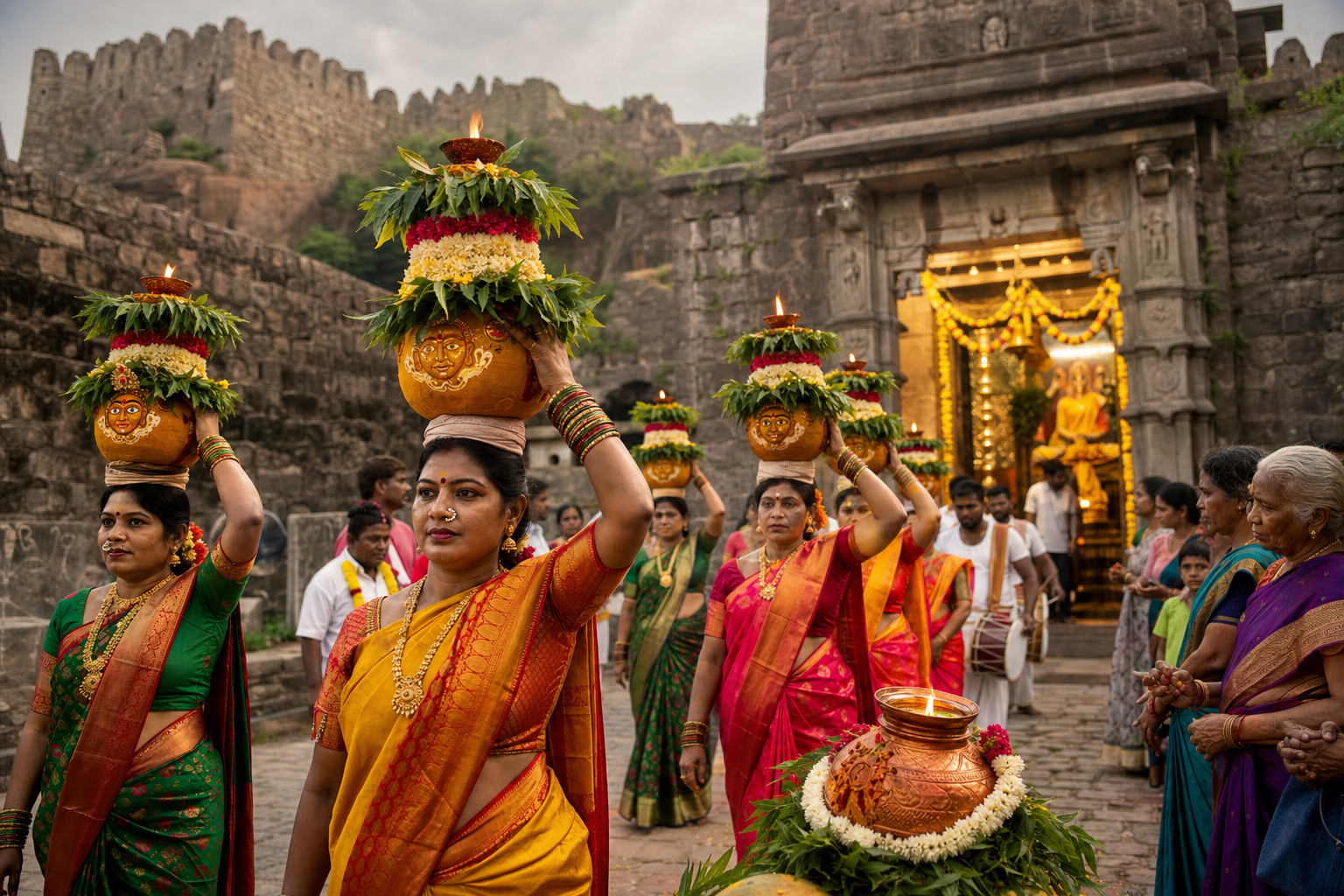
Bonalu 2026 at Golkonda Jagadambika Temple in Hyderabad begins on July 19, 2026, marking the formal opening of the Ashada Bonalu season in Telangana. The festival is especially significant in Hyderabad and Secunderabad, where neighborhood temples, historic shrines, families, artisans, musicians, and local communities come together in a deeply rooted act of devotion to Goddess Mahankali and her regional forms.
Golkonda holds a distinctive place in this ritual calendar because the Bonalu utsavam begins at the Jagadambika Temple located within the cultural landscape of the Golkonda Fort area. From this first observance, the wider Ashada Bonalu celebrations continue across Hyderabad, Secunderabad, and other parts of Telangana, extending into the first half of Shravana masam. The sequence traditionally returns devotional attention to Golkonda again toward the close of the season, creating a circular rhythm of beginning, offering, procession, and thanksgiving.
The word Bonalu is commonly understood through Bonam, derived from Bhojanam, meaning a sacred meal or offering. In ritual practice, women prepare rice cooked with milk and jaggery, place it in a new earthen or brass pot, decorate the pot with turmeric, vermilion, neem leaves, and a lamp, and carry it on the head as an offering to the Mother Goddess. The act is both devotional and domestic: the kitchen, the street, and the temple become connected through food, care, discipline, and gratitude.
At Golkonda Jagadambika Temple, Bonalu is not merely a date on the Hindu calendar; it is a public expression of Shakti worship shaped by Telangana’s local history. Devotees approach the goddess as Jaganmaatha, the protective Mother, and the offering of Bonam becomes a vow fulfilled, a prayer renewed, and a gesture of community resilience. The emotional center of the festival lies in this simple but profound idea: nourishment offered to the Divine Mother is also a reminder that society itself survives through shared nourishment, shared protection, and shared responsibility.
The 2026 date, July 19, falls within the Ashada season, a period associated in Telangana with intense goddess worship, monsoon anxieties, agricultural hope, and collective prayer for health and well-being. In Hyderabad, the first Bonam at Golkonda is followed by major celebrations at other prominent temples, including Haribowli Akkanna Madanna Mahankali Temple, Secunderabad Ujjaini Mahakali Temple, and Lal Darwaza Mahankali Temple in the Old City. Exact local schedules, traffic arrangements, and temple timings should be checked through official temple or civic announcements closer to the festival.
The ritual vocabulary of Bonalu is rich and highly structured. The Ghatam, usually a decorated copper vessel representing the goddess, is carried in procession with drums and devotional music. Pothuraju, traditionally understood as the brother and protective attendant of Mahankali, leads processions with vigorous dance, turmeric-smeared body, bells, and striking physical presence. Rangam, the oracle ritual held in some Bonalu contexts, represents the community’s search for divine guidance, while Thottelu offerings add a visual and artisanal dimension to the celebration.
Historically, Bonalu has often been connected with the early nineteenth-century memory of epidemic disease in the twin cities and the vow to Goddess Mahakali for protection. That memory remains important, especially in relation to the Ujjaini Mahakali tradition of Secunderabad. Recent epigraphical reporting, however, has also drawn attention to a Telugu inscription dated to 1516 CE that refers to Bonalu-related practices, suggesting that the festival’s ritual roots may be far older than the nineteenth-century account alone. A careful academic reading treats these strands as layered evidence: living memory, temple tradition, inscriptional history, and regional devotional practice all contribute to the festival’s meaning.
Golkonda’s role adds another historical layer. The fort region evokes medieval Deccan history, royal power, urban settlement, and the blending of local religious practices with wider South Indian temple culture. Within that setting, Jagadambika worship gives Bonalu a sense of sacred geography: devotees are not only visiting a temple, but also entering a landscape where Hyderabad’s political, cultural, and devotional histories overlap.
Women occupy a central ritual position in Bonalu. Their carrying of Bonam is not decorative participation but the core offering itself. The disciplined movement of women in traditional dress, balancing pots with lamps and neem leaves, communicates theological ideas through embodied practice: the body becomes a vehicle of devotion, the household becomes a source of sacred offering, and the goddess is approached through care, endurance, and reverence.
For many families in Hyderabad and Secunderabad, Bonalu is remembered through sound and movement as much as through doctrine. Drum beats, turmeric, vermilion, jasmine, neem, lamps, crowded lanes, and the sight of Bonam processions create a sensory archive of belonging. Such festivals endure because they do more than preserve ritual; they transmit identity across generations in ways that children, elders, migrants, and returning families can all recognize.
The festival also has a civic dimension. Large gatherings require crowd management, sanitation, drinking water, medical assistance, traffic regulation, and coordination among temple committees, municipal bodies, police, and local volunteers. A traditional festival of this scale depends on both faith and administration. When managed responsibly, Bonalu becomes an example of how cultural heritage and public systems can work together without reducing devotion to spectacle.
Bonalu’s deeper cultural significance lies in its theology of gratitude. The goddess is worshipped not as a distant abstraction but as a protective presence tied to locality, health, fertility, food, and social order. This is why the offering is a meal, not merely a symbolic object. The devotee gives back to the Mother what sustains life, acknowledging that survival is never purely individual.
Within the broader Dharmic framework, Bonalu reflects the Hindu Shakti tradition while also resonating with values honored across Hinduism, Buddhism, Jainism, and Sikhism: gratitude, restraint, service, protection of community, reverence for life, and respect for inherited wisdom. The festival’s public form is specifically Telangana’s, yet its ethical message is widely intelligible across Dharmic traditions. It affirms that sacred practice is strongest when it deepens social harmony rather than narrowing it.
Bonalu 2026 at Golkonda Jagadambika Temple therefore deserves attention as both a religious observance and a living archive of Telangana culture. It connects Ashada masam with Goddess Mahankali, Golkonda with Hyderabad’s urban memory, and household offerings with public celebration. For devotees, it is a day of prayer and fulfillment; for observers of Indian culture, it is a powerful example of how regional Hindu festivals preserve history, emotion, theology, and community life in a single shared ritual cycle.
Inspired by this post on Hindu Pad.





Leave a Reply
You must be logged in to post a comment.