
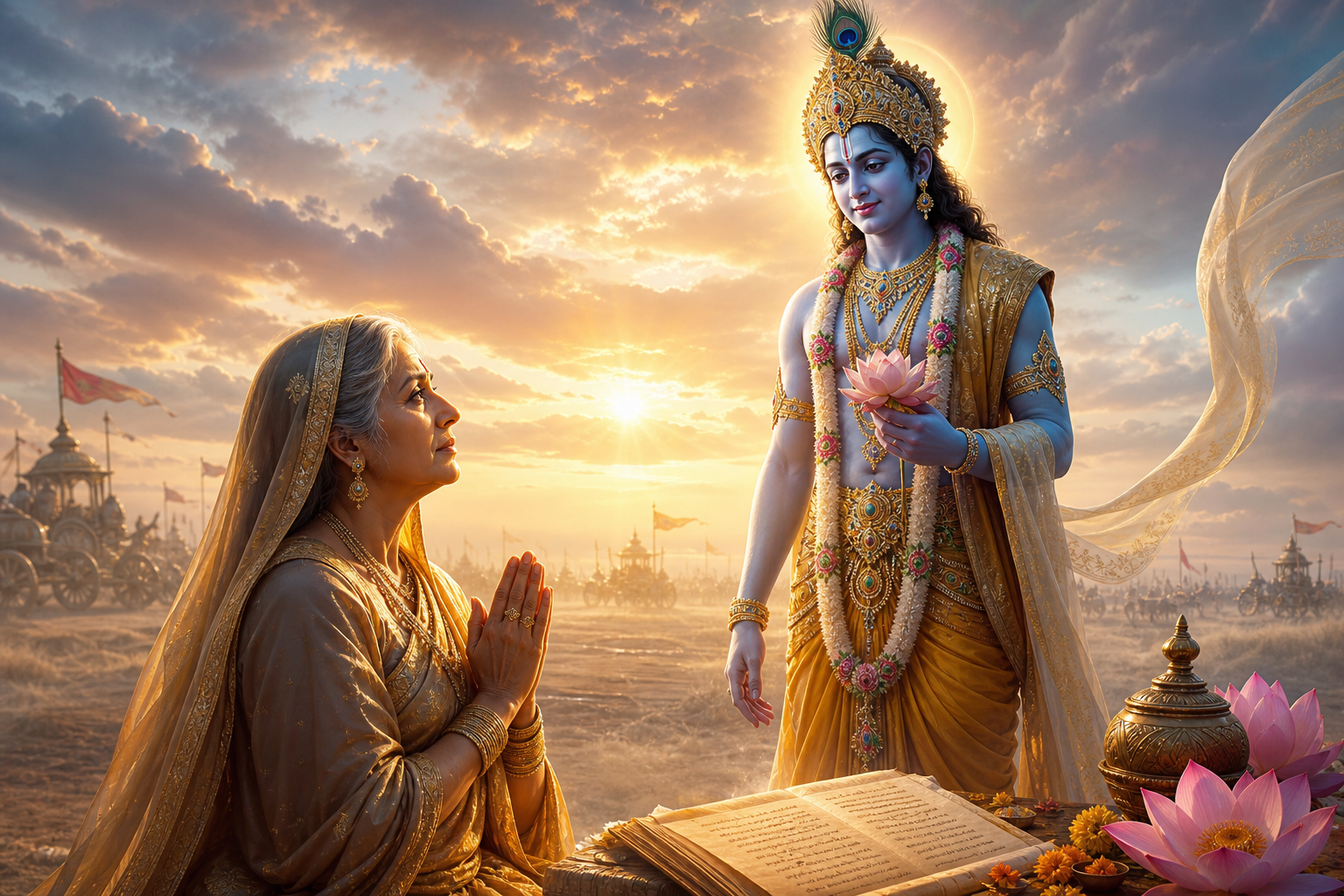
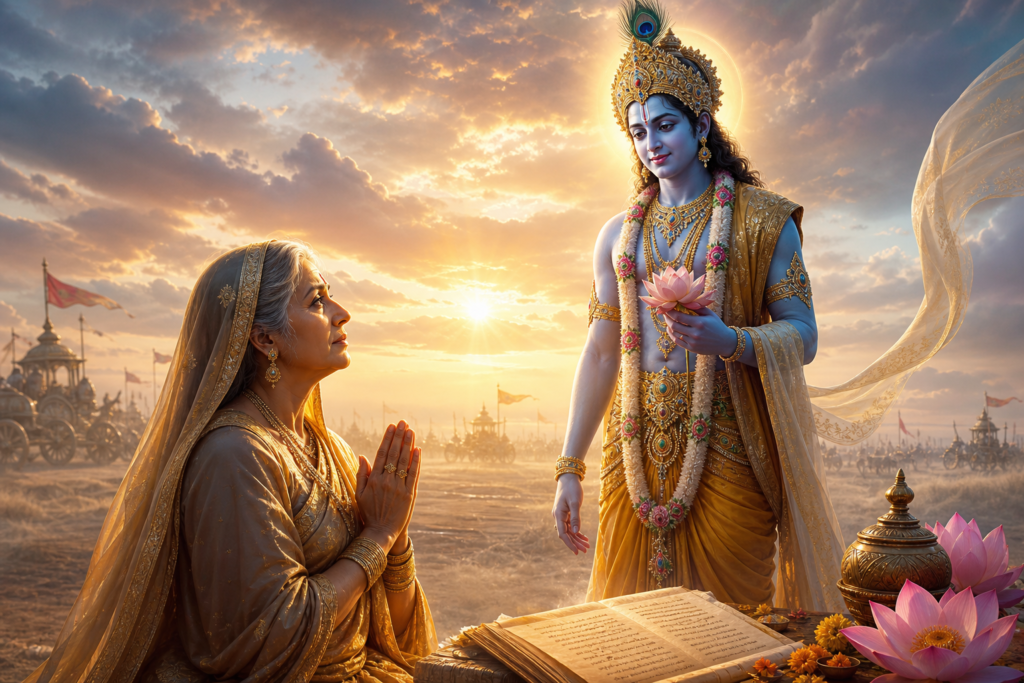
Srimad Bhagavatam 1.8.18-28 presents one of the most intellectually refined and emotionally searching moments in the Bhagavata Purana: Queen Kunti’s prayer to Sri Krishna after the devastation of the Kurukshetra war. The setting is not abstract philosophy delivered in a classroom removed from suffering. It is theology spoken at the edge of grief, public duty, family loss, political collapse, and divine protection. That combination gives these verses their enduring force. They do not merely explain Krishna consciousness; they show how devotion becomes intelligible when life has already tested every ordinary source of security.
The historical and literary frame is essential. The Pandavas have survived repeated attempts at destruction: poisoning, arson, exile, humiliation in the Kuru assembly, battlefield violence, and finally the brahmastra released by Ashvatthama. Kunti does not approach Krishna as a casual observer of divine power. She speaks as a mother, queen, widow, refugee, and witness to history. Her words therefore carry the weight of lived theology, where philosophical clarity arises through direct contact with danger, dependence, gratitude, and surrender.
The opening idea of this passage is that Krishna is both immanent and transcendent. Srimad Bhagavatam 1.8.18 addresses him as the original person, the controller, and the one beyond material nature, while also present within and outside all beings. This is a technically precise theological claim. It avoids reducing the divine either to a distant creator separated from the world or to an impersonal force dissolved into the world. Krishna is near enough to protect the Pandavas in specific historical events, yet beyond the limitations that govern embodied beings.
This double vision is central to Vedantic spirituality. The Supreme is antar-bahir avasthitam, situated internally and externally, yet alaksyam, not easily perceived by ordinary vision. Kunti’s insight is that visibility is not the same as knowability. A person may see Krishna walking, speaking, advising, and driving Arjuna’s chariot, yet still fail to understand his ontological position. The Bhagavatam therefore distinguishes physical proximity from spiritual perception. Devotion is not sentimental familiarity; it is purified recognition.
The next movement in the prayer explains why the divine remains hidden. The image is maya-javanika, the curtain of illusion. Just as an actor may stand on a stage while the audience misunderstands the deeper identity behind the performance, Krishna appears within human society while remaining Adhoksaja, beyond the reach of material measurement. This does not imply irrationality. It means that empirical observation alone cannot exhaust reality when the object of knowledge is the source of both observer and observed.
In academic terms, the passage proposes a layered epistemology. Sensory perception has value, but it is not absolute. Reason has value, but it cannot independently command transcendence. Scripture, disciplined practice, ethical purification, and bhakti-yoga together prepare the consciousness to perceive what untrained perception misses. The Bhagavatam does not reject knowledge; it places knowledge inside a wider discipline of humility, character, and devotion.
Kunti’s humility is especially striking when she asks how women such as herself can truly behold Krishna if even great sages and paramahamsas seek him through purified consciousness. This line should not be read as a denial of women’s spiritual capacity. In the Bhagavata tradition, Kunti herself becomes one of the most authoritative voices of devotion, and the gopis of Vrindavan are repeatedly honored as exemplars of the highest love. The mood is not social inferiority but devotional astonishment: the Supreme Lord, sought by sages, has become personally available to a suffering family.
This humility is a shared value across dharmic traditions. Hindu, Buddhist, Jain, and Sikh teachings all, in their own vocabularies, warn against egoic certainty and spiritual pride. Kunti’s prayer belongs to a Vaishnava theological setting, yet its moral grammar is widely resonant: knowledge must ripen into reverence, suffering can become a teacher, and the heart must be trained to see beyond possession, status, and self-importance.
Srimad Bhagavatam 1.8.21 then gathers Krishna’s identities into a compact devotional formula: Krishna, Vasudeva, Devaki-nandana, Nanda-gopa-kumara, and Govinda. Each name carries theology. Krishna evokes all-attractive divinity. Vasudeva connects him with his father and with the broader principle of divine consciousness. Devaki-nandana remembers his birth in Mathura under threat. Nanda-gopa-kumara places him in the pastoral intimacy of Vraja. Govinda recalls the protector and nourisher of cows, senses, earth, and community.
The names also prevent an overly narrow reading of Krishna. He is not only a metaphysical absolute. He is a son, child, cowherd, protector, and beloved center of a community. This matters because the Bhagavatam’s theology is relational at its core. The divine is approached not merely through speculation but through sambandha, relationship. Kunti’s prayer teaches that names are not decorative labels; they are portals into specific relationships with the Supreme.
The repeated lotus imagery in 1.8.22 deepens this vision. Kunti bows to Krishna’s lotus navel, lotus garland, lotus eyes, and lotus feet. In Sanskrit devotional literature, the lotus suggests beauty, purity, transcendence, and auspiciousness. It grows in water without being stained by mud, making it a fitting symbol for divine presence in the material world. Krishna enters history without being conditioned by history. He accepts relationships without losing sovereignty. He stands among conflict without becoming morally contaminated by it.
The lotus feet are particularly important in bhakti theology. They represent shelter, guidance, and the point where transcendence becomes approachable. Devotees do not begin by claiming mastery over ultimate reality. They begin by taking shelter. This is psychologically significant as well as theological. In a world where human beings often try to convert anxiety into control, Kunti’s prayer offers another discipline: to convert vulnerability into surrender without abandoning responsibility.
Kunti then moves from praise to memory. She recalls how Krishna protected Devaki from Kamsa and protected herself and her sons from repeated dangers. The parallel is deliberate. Devaki’s imprisonment and Kunti’s ordeals are different in circumstance, yet both reveal the same divine guardianship. The Bhagavatam uses these memories to show that grace is not an abstract doctrine. It is recognized retrospectively, when scattered episodes of survival become intelligible as a pattern of protection.
Her list of dangers is historically and emotionally dense. Poison, fire, cannibals, the hostile assembly, exile, battles with great warriors, and the weapon of Ashvatthama are not symbolic inconveniences. They are severe ruptures in family, state, and moral order. By remembering them, Kunti does not glorify suffering for its own sake. She interprets suffering through divine remembrance. The difference is crucial. The prayer does not ask people to seek trauma. It asks whether even trauma can be transformed into spiritual clarity when held in the light of Krishna’s presence.
This prepares the most startling statement in the passage: vipadah santu tah sasvat. Kunti prays that calamities may come again and again because they bring Krishna’s darshana, and Krishna’s darshana ends the repeated vision of material birth and death. The verse is often misunderstood. It is not a romantic celebration of pain. It is a radical reordering of value. If prosperity produces forgetfulness and crisis produces remembrance, then the spiritually mature person must ask which condition is truly beneficial.
For contemporary readers, this is one of the most demanding insights in Srimad Bhagavatam. Modern life often treats comfort as the highest good and disruption as the greatest evil. Kunti’s prayer does not deny the need for safety, justice, health, or social responsibility. Rather, it questions whether comfort without consciousness is truly success. Her voice suggests that the deepest danger is not adversity itself but forgetfulness of the divine, loss of dharma, and intoxication with temporary power.
That concern becomes explicit in 1.8.26, where birth, wealth, learning, and beauty are identified as sources of pride when not governed by humility. The Sanskrit phrase janma-aisvarya-sruta-sribhir names four forms of social capital: high birth, opulence, education, and physical attractiveness. None of these is condemned in itself. The warning is subtler. These advantages can inflate the ego until a person becomes unable to sincerely call upon Krishna, who is akincana-gocara, accessible to those who know their dependence.
This diagnosis is both spiritual and sociological. Privilege can produce insulation. Insulation can produce entitlement. Entitlement can make gratitude feel unnecessary. The Bhagavatam therefore treats humility not as decorative piety but as a condition of accurate perception. A proud mind does not merely behave badly; it misreads reality. It imagines itself independent while depending at every moment on body, society, nature, time, karma, and ultimately the Supreme.
Kunti’s next address to Krishna as akincana-vitta is among the most beautiful expressions of bhakti. Krishna is the wealth of those who have nothing. This does not mean material poverty is automatically holy, nor that social neglect should be sanctified. The verse points to interior poverty: the recognition that no external possession can serve as the final refuge of the self. When all false securities are stripped away, Krishna remains as the inexhaustible wealth of the heart.
The same verse describes Krishna as nivrtta-guna-vrttaye, beyond the operations of the material modes; atmarama, self-satisfied; santa, peaceful; and kaivalya-pati, the master of liberation. These terms give the prayer technical depth. Krishna is not dependent on the world for completion, yet he enters loving exchanges with devotees. He is beyond sattva, rajas, and tamas, yet he guides embodied beings through the ethical and psychological realities shaped by those gunas. He is complete in himself, yet available in relationship.
Srimad Bhagavatam 1.8.28 adds a further dimension: Krishna is understood as time, the beginningless and endless controller, moving equally among all beings. Time is one of the Bhagavatam’s most profound theological categories. It humbles kings, dissolves empires, ages bodies, exposes illusions, and brings karmic consequences to maturity. When Kunti identifies Krishna with time, she recognizes that divine sovereignty is not limited to miraculous rescue. It also operates through the universal lawfulness by which all conditioned arrangements change.
The phrase samam carantam sarvatra indicates divine impartiality. Krishna is equal to all, yet living beings experience conflict because of their own mutual dealings, attachments, and karmic entanglements. This point is ethically important. The Bhagavatam does not make God responsible for human envy, violence, or rivalry. It shows that divine equality coexists with human freedom and consequence. Kunti’s wisdom lies in seeing both: the Lord is impartial, and human beings must still answer for their intentions and actions.
Within the broader Hindu scriptural tradition, this passage stands beside the Bhagavad Gita’s teaching that Krishna is equal to all beings but especially reciprocates with loving devotion. The apparent tension is resolved through relationship. The sun shines equally, yet a person who opens a window receives more light. Similarly, divine grace is not sectarian favoritism; it is relational responsiveness. Bhakti opens the consciousness to grace that was never absent.
The passage also offers a model of dharmic resilience. Kunti does not collapse into bitterness, even though her life gives her every conventional reason to do so. She does not deny injustice. She does not excuse adharma. She does not pretend that the Pandavas’ suffering was easy. Instead, she locates meaning through Krishna’s presence and protection. Her prayer demonstrates that spiritual maturity is not emotional numbness. It is the capacity to remember the divine without falsifying pain.
This is why the verses remain relevant for students of religion, practitioners of bhakti, and anyone studying Hindu philosophy. They integrate metaphysics, ethics, memory, psychology, and devotion. The unseen Lord is also the intimate protector. The transcendent Absolute is also Govinda. Suffering can either narrow the heart or refine perception. Social advantage can either support service or harden into pride. Time can be feared as destruction or understood as an instrument of divine order.
The unity-oriented value of this teaching should not be missed. Kunti’s prayer belongs to the Vaishnava tradition, but its ethical insights encourage respect across dharmic paths. Humility, non-possessiveness, remembrance, reverence for truth, and disciplined self-understanding are cherished across Hinduism, Buddhism, Jainism, and Sikhism, even when expressed through different metaphysical languages. A mature reading of the Bhagavatam can therefore deepen devotion without creating contempt for other sincere seekers.
In devotional practice, these verses encourage a shift from transactional religion to transformative religion. The immature mind may approach the divine only for protection, success, or relief. Kunti certainly remembers protection, but she moves beyond mere survival. She asks for remembrance itself. Her highest concern is not that life remain free of difficulty, but that difficulty never separate the heart from Krishna. This is the emotional and theological center of the passage.
For serious readers of Srimad Bhagavatam, the practical lesson is clear. Study must become remembrance. Remembrance must become humility. Humility must become service. Service must become steady devotion. Kunti’s prayer is not only a historical speech preserved in sacred literature; it is a map for spiritual intelligence under pressure. It teaches that the most powerful faith is not fragile optimism but awakened dependence on the Supreme in the full complexity of life.
Srimad Bhagavatam 1.8.18-28 therefore deserves careful attention as one of the great devotional and philosophical passages of Hindu scripture. It presents Krishna as transcendent, immanent, personal, impartial, protective, and liberating. It presents Kunti as a theologian of gratitude formed by adversity. Above all, it presents bhakti as a disciplined way of seeing: to recognize grace in memory, truth beneath illusion, and divine shelter even when the world appears unstable.
Inspired by this post on Dandavats.








Leave a Reply
You must be logged in to post a comment.