
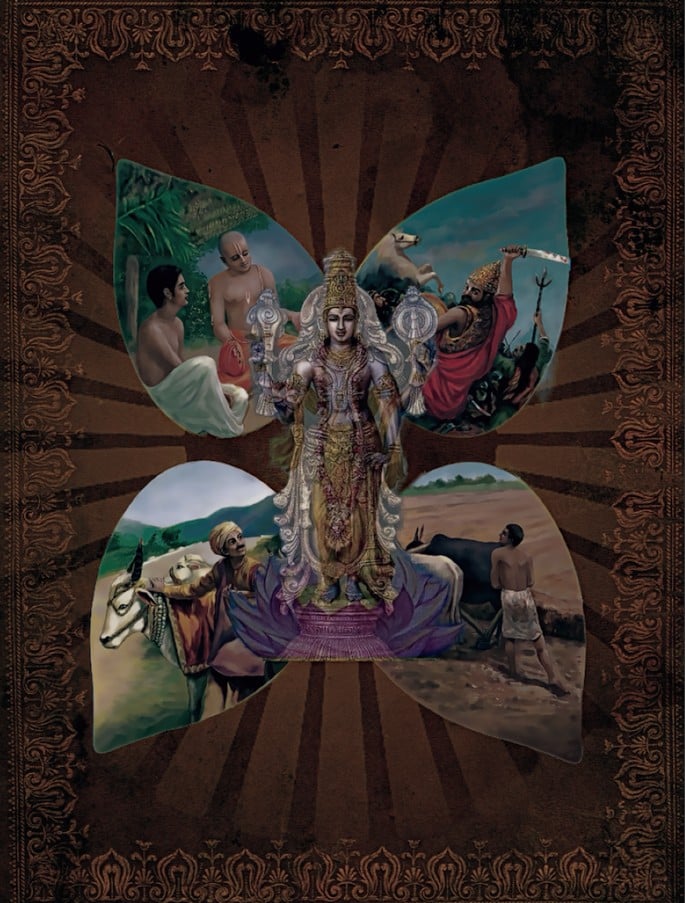
The question of caste in India is often discussed with emotion, urgency, and deep historical pain. Yet a careful reading of Vedic literature, Puranic reasoning, and broader Dharmic ethics shows a crucial distinction that is often lost in public debate: varna, as a principle of social function and spiritual discipline, is not the same as a rigid caste identity fixed by birth.
In the older Vedic framework, Varnashrama was presented as a way to organize human life around aptitude, duty, self-cultivation, and spiritual progress. It included four broad social functions: Brahmanas, associated with learning, teaching, ritual discipline, and spiritual knowledge; Kshatriyas, associated with protection, governance, courage, and public order; Vaishyas, associated with agriculture, trade, wealth creation, and economic stewardship; and Shudras, associated with service, skilled work, labor, arts, and practical support. Alongside these stood the four ashramas: Brahmacharya, Grihastha, Vanaprastha, and Sannyasa.
The central issue is not whether ancient texts mention social classification. They clearly do. The real question is whether such classification was intended to be hereditary, oppressive, and permanent. The strongest scriptural evidence suggests otherwise. In the Dharmic view, a person’s worth is not exhausted by family lineage, bodily identity, inherited label, or social reputation. Character, conduct, knowledge, discipline, service, and realization are repeatedly presented as the more meaningful measures.
This distinction matters because the modern caste system, especially where it reduces human beings to birth-based hierarchy, often moves away from the more flexible logic of varna. A birth-based system can become socially stagnant and spiritually misleading. It can reward ancestry without virtue, deny dignity to the virtuous, and turn a framework meant for social harmony into a mechanism of exclusion. That distortion is precisely what many Vedic and Puranic arguments challenge.
The Bhagavad Gita gives one of the most concise formulations of this principle. In Bhagavad Gita 4.13, the fourfold order is described as arising according to guna and karma, that is, qualities and actions. Later, in Bhagavad Gita 18.41-44, the natural duties of Brahmanas, Kshatriyas, Vaishyas, and Shudras are again described through qualities and work rather than merely through parentage. This is a technical point with major social implications: varna is connected to disposition, responsibility, and conduct.
The Bhavishya Purana, especially in the Brahma Parva passages cited in traditional discussions, develops this logic in detail. It asks whether a Brahmana is recognized by birth, Vedic learning, bodily features, self-realization, behavior, prescribed duty, speech, mind, or action. The answer repeatedly returns to a consistent principle: birth alone is insufficient. Qualities and actions must be examined.
One argument is especially direct. If being born in a Brahmana family automatically made a person a Brahmana, then conduct would become irrelevant. A person could abandon truthfulness, purity, restraint, compassion, and spiritual discipline while still claiming superior status. Such a conclusion is ethically and scripturally untenable. The texts therefore insist that a designation without corresponding conduct is hollow.
The same reasoning applies to every varna. A Kshatriya who does not protect society cannot meaningfully claim the full dignity of Kshatriya duty. A Vaishya who abandons honest economic responsibility cannot claim the ideal of Vaishya dharma. A person assigned to service who develops knowledge, discipline, purity, and spiritual insight cannot be dismissed merely because of birth. In this framework, duty is not a prison; it is a path of growth.
The Bhavishya Purana also argues that bodily features cannot establish varna. Complexion, height, shape, physical strength, family marks, or external dress do not reveal spiritual maturity. Human bodies are made of the same material elements and pass through the same cycle of birth, growth, disease, aging, and death. A social theory based only on the body therefore fails to understand the deeper spiritual identity of the person.
This is where the Dharmic emphasis on atma becomes socially transformative. If all beings are ultimately spiritual in nature, then inherited labels cannot be treated as final truths. Human beings may have different capacities, duties, temperaments, and stages of learning, but their spiritual dignity remains shared. Any social arrangement that forgets this becomes adharmic in spirit, even if it borrows religious vocabulary.
Goswami Tulsidas’s Shri Ramcharitmanas is also invoked in this discussion, especially in the Sabri episode. Lord Rama’s acceptance of Sabri is often read as a powerful statement that devotion, sincerity, and character transcend caste pride. Bhakti is not measured by inherited status but by the heart’s orientation toward the Divine. This principle has shaped Hindu devotional movements across regions and languages.
Many Dharmic traditions echo the same moral intuition. Hindu bhakti saints, Buddhist critiques of ego and social arrogance, Jain emphasis on conduct and ahimsa, and Sikh teachings on equality before the Divine all resist the idea that birth alone determines spiritual worth. Their methods and metaphysics differ, but they converge on a profound ethical insight: dignity must be linked to truth, discipline, compassion, and realization, not inherited pride.
The Puranic passages also criticize external religiosity when it is separated from inner transformation. A person may wear sacred symbols, chant mantras, perform rituals, or speak eloquently about scripture, yet still lack purity, humility, and self-control. Such a person may possess religious appearance without religious depth. This warning remains relevant in every generation, because institutions often decay when symbols survive but character disappears.
The critique of unqualified Brahmanas is therefore not an attack on Brahmanas as an ideal. It is a defense of the ideal against misuse. A genuine Brahmana is described through qualities such as peacefulness, austerity, self-control, purity, tolerance, simplicity, knowledge, wisdom in practice, truthfulness, compassion, and inquiry into the Absolute Truth. These qualities must be lived, not merely inherited.
Likewise, a genuine Kshatriya is not simply someone born into a royal or martial family. Kshatriya dharma requires courage, protection of the vulnerable, generosity, leadership, resourcefulness, and readiness to defend justice. A Vaishya is marked by productive stewardship through agriculture, trade, cow protection, and economic responsibility. A Shudra, in the older functional sense, contributes through service, craftsmanship, labor, and practical support. None of these functions should be treated as spiritually contemptible when performed with integrity.
The problem begins when functional diversity is converted into fixed superiority and inferiority. A society needs teachers, defenders, farmers, merchants, artisans, workers, administrators, and contemplatives. Diversity of function is natural. But hierarchy by birth, contempt toward labor, and denial of spiritual opportunity are not necessary consequences of that diversity. They are distortions of it.
The Bhavishya Purana’s reasoning is especially sharp when it states that a Brahmana can fall and a Shudra can rise. This is not merely a social observation; it is a theory of moral mobility. Human beings are not frozen at birth. They change through education, association, discipline, samskara, tapas, devotion, and conduct. A person’s present condition may be shaped by many factors, but Dharmic life is meaningful precisely because transformation is possible.
The examples of revered sages further challenge birth-based rigidity. Traditions remember figures such as Vyasadeva, Parashara, Valmiki, Viswamitra, Agastya, and others whose lives complicate any simplistic hereditary theory of spiritual authority. The larger lesson is not genealogical curiosity but ethical clarity: realization, tapas, wisdom, and service can elevate a person beyond inherited assumptions.
Swami Vivekananda’s life is also significant in this context. Revered globally as one of the great modern voices of Hindu spirituality, he repeatedly emphasized strength, service, universality, and the divinity within every being. His message continues to remind modern society that spiritual greatness is not a matter of social vanity but of realization, courage, compassion, and service to humanity.
One of the most important technical distinctions in this debate is between jati and varna. Jati refers to birth-community, lineage, and social group, often shaped by region, occupation, marriage networks, and historical custom. Varna, in its more philosophical and scriptural sense, concerns the broad classification of qualities and duties. Confusing jati with varna has produced enormous social and theological confusion.
When jati becomes absolute, society begins to treat social inheritance as destiny. When varna is understood through guna and karma, society has room to recognize aptitude, training, virtue, and growth. This does not mean that every historical practice was ideal or that all social arrangements were fluid in every period. It means that the scriptural and philosophical argument against birth-based determinism has deep roots within the tradition itself.
Samskaras also require careful interpretation. Purificatory rites, initiation, sacred learning, and disciplined training are valuable because they shape character and orient the person toward dharma. But ritual alone cannot substitute for transformation. If a person undergoes ceremonies yet lives without truthfulness, restraint, humility, or compassion, the inner purpose of samskara has been defeated.
This point is especially important in modern religious life. Communities often preserve visible practices while neglecting the ethical and spiritual discipline those practices were meant to cultivate. Sacred thread, tilaka, mantra, lineage, learning, or public status can become signs of responsibility, but they can also become empty markers if separated from conduct. Dharmic tradition repeatedly warns against this separation.
The emotional force of this subject lies in the fact that caste by birth has caused real suffering when used to deny dignity, access, education, worship, or social participation. A serious Dharmic response cannot ignore that suffering. It must recover the deeper principles of dharma: respect for all beings, accountability for conduct, reverence for knowledge, and the possibility of spiritual advancement for every sincere person.
At the same time, an academic treatment must avoid replacing one simplification with another. Varnashrama was not merely a modern egalitarian theory expressed in ancient language. It did assume differentiated duties and social functions. But its most defensible form links those duties to qualities, training, temperament, and ethical responsibility, not to biological inheritance alone. That distinction is essential for fair analysis.
The deepest purpose of Varnashrama-dharma was spiritual evolution. It was meant to help individuals move from instinct to discipline, from ego to service, from social confusion to responsible duty, and from material identity to self-realization. When understood in this way, the system becomes a framework for growth. When reduced to hereditary entitlement, it becomes a barrier to growth.
The Bhavishya Purana lists qualities that increase spiritual excellence: forgiveness, control of the senses, compassion, charity, truthfulness, purity, meditation, respect for others, simplicity, satisfaction, freedom from false ego, austerity, self-control, knowledge, freedom from envy, faithfulness, detachment, service to the spiritual teacher, and discipline of body, mind, and speech. These qualities are not restricted to one birth group. They are human possibilities.
Such qualities also offer a practical standard for contemporary Hindu society and the wider Dharmic world. Communities should ask not only who has inherited status, but who is truthful, learned, compassionate, disciplined, and devoted to the welfare of others. Religious leadership must be accountable to character. Social respect must be linked to service. Education must be open enough to allow genuine talent and aspiration to flourish.
This perspective can help heal divisions across Hinduism, Buddhism, Jainism, and Sikhism. Each tradition has its own scriptures, lineages, disciplines, and philosophical vocabulary, yet all can affirm that spiritual life is degraded when ego, arrogance, and inherited pride dominate. A Dharmic society becomes stronger when it honors learning, sadhana, seva, ahimsa, humility, and justice over empty social boasting.
The argument against caste by birth is therefore not a rejection of dharma. It is a call to return to dharma’s moral center. It asks society to distinguish between authentic spiritual qualification and inherited label, between social function and social oppression, between tradition and distortion. It also asks individuals to examine themselves honestly, because no lineage can compensate for the absence of virtue.
In practical terms, this means that education, temple life, spiritual instruction, and community leadership should be guided by competence, character, training, and devotion. A person who demonstrates knowledge, humility, discipline, and service deserves respect. A person who claims superiority while acting with cruelty, arrogance, or ignorance does not embody the higher ideals of Vedic literature, regardless of birth.
The conclusion is clear: humanity is fundamentally one, while social duties may vary according to qualities and work. Birth may shape circumstance, but it does not define spiritual destiny. The Vedic and Dharmic critique of birth-based caste remains powerful because it combines metaphysical depth with social realism. It recognizes diversity without endorsing contempt, hierarchy without spiritual arrogance, and duty without denying human dignity.
A renewed understanding of varna must therefore be rooted in guna, karma, dharma, and self-realization. It must reject caste arrogance, honor sincere seekers, and protect the unity of Dharmic traditions. When society sees each person as capable of growth and worthy of respect, the original purpose of dharma becomes visible again: not domination, but harmony; not inherited pride, but awakened responsibility; not division, but the spiritual upliftment of all.
Inspired by this post on Dandavats.



Leave a Reply
You must be logged in to post a comment.