
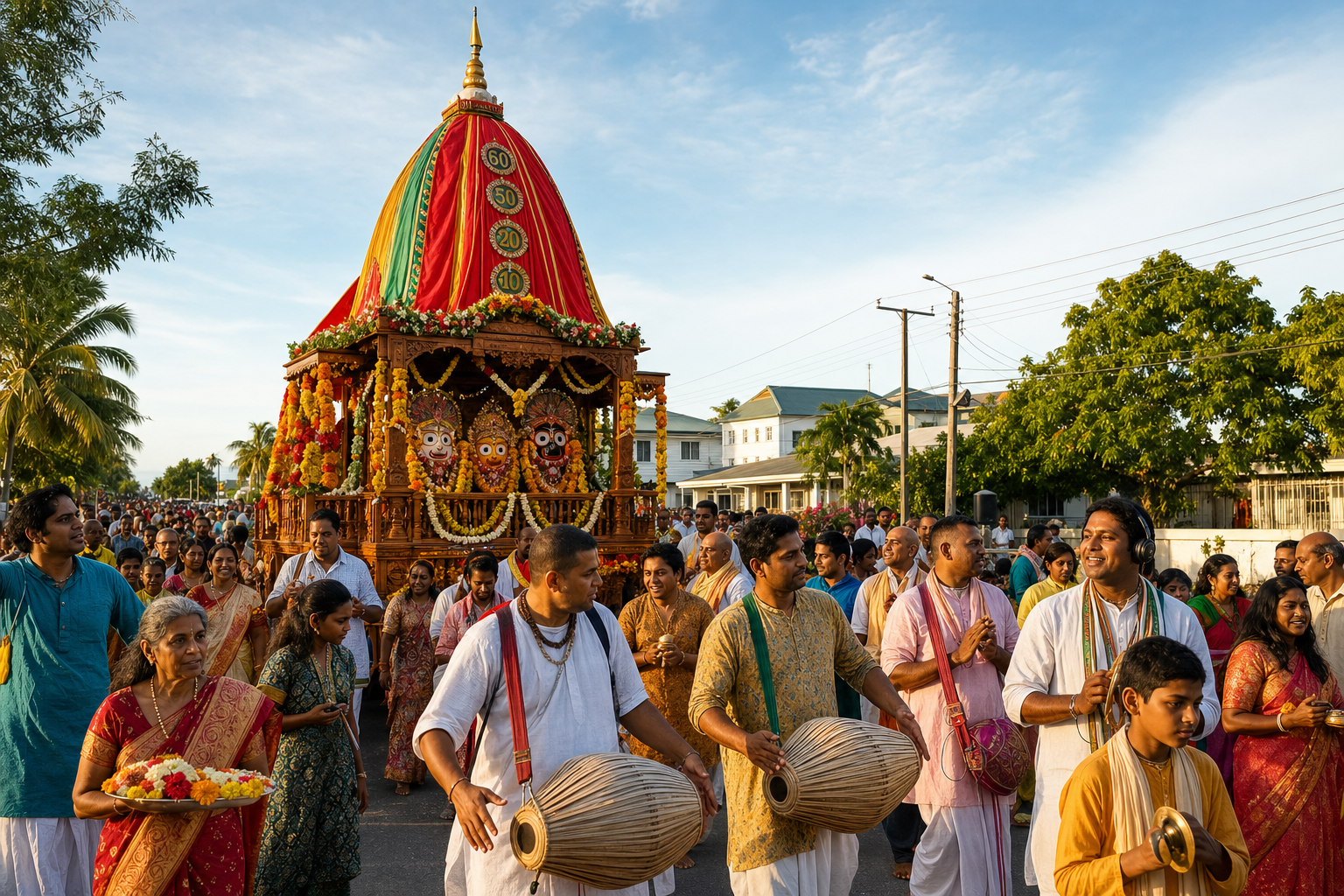
The Hare Krishna Legacy Festival 2026 in Guyana stands as a significant cultural and spiritual observance for the International Society for Krishna Consciousness and for the wider Hindu and Dharmic community of the Caribbean. Scheduled from July 8 to 12 at the ISKCON of Guyana Hare Krishna Study Centre in Cummings Lodge, Georgetown, the five-day gathering will mark a rare convergence of anniversaries: 60 years of ISKCON, 50 years of ISKCON in Guyana, 20 years of organized preaching service across Georgetown, East Coast Demerara, and East Bank Demerara, 20 years of Ratha-yatra celebrations in the region, and 10 years since the inauguration of the Hare Krishna Study Centre.
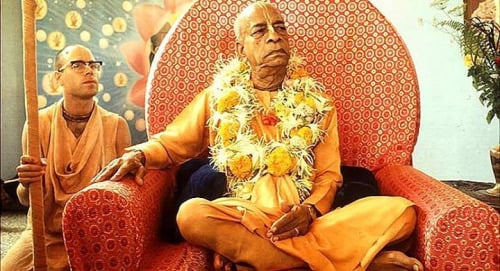
In historical terms, the festival is more than a commemorative event. It is a public reflection on how Krishna consciousness moved from a small storefront in New York City in 1966 into a global Vaishnava movement rooted in the teachings of the Bhagavad-Gita and Srimad-Bhagavatam. The founding work of His Divine Grace A.C. Bhaktivedanta Swami Prabhupada remains central to this story, not only as a matter of institutional memory but also as a living devotional framework carried by families, temples, youth groups, teachers, kirtan leaders, and community servants across continents.
Guyana occupies a distinctive place in this legacy. Its Hindu heritage, shaped by migration, resilience, village life, temple culture, public festivals, and intergenerational devotion, has long allowed Vaishnava traditions to take root in a socially meaningful way. The 50th anniversary of ISKCON in Guyana therefore invites careful attention to the relationship between diaspora identity and spiritual continuity. For many Guyanese families, devotional life is not limited to temple attendance; it is also present in food, music, language, family observances, sacred storytelling, and the repeated experience of gathering for worship during moments of both hardship and celebration.
The festival’s opening program on Wednesday, July 8, will focus on the 60th anniversary of ISKCON. This milestone recalls the movement’s founding in New York City in 1966 and its subsequent expansion through public chanting, book distribution, temple worship, philosophical education, vegetarian prasadam distribution, and cultural outreach. From an academic perspective, ISKCON’s growth illustrates how a modern religious movement can transmit ancient Vaishnava theology through accessible public practices such as kirtan, festival processions, lectures, sacred food distribution, and community-centered ritual life.
The July 8 program is expected to encourage reflection on Srila Prabhupada’s method of making Sanskritic and Vaishnava teachings intelligible to global audiences without severing them from their scriptural foundations. His presentation of Krishna consciousness emphasized bhakti, disciplined spiritual practice, the chanting of the holy names, philosophical study, ethical living, and service. These themes continue to resonate because they speak to ordinary human needs: belonging, purpose, reverence, moral clarity, and the search for a life anchored in something deeper than consumption or social status.
On Thursday, July 9, the festival will commemorate 50 years of ISKCON in Guyana while also recognizing Guyana’s 60th Independence Anniversary. The pairing of these two anniversaries is significant. National independence and religious continuity are not identical historical processes, yet both involve questions of identity, inheritance, public memory, and responsibility toward future generations. In this context, the development of Krishna consciousness in Guyana can be understood as part of a broader cultural story in which communities preserve inherited traditions while adapting them to changing social conditions.
The Guyanese expression of ISKCON has grown through temple worship, public chanting, festivals, educational activities, youth engagement, family participation, and community outreach. Such practices are socially important because they create spaces where spiritual teachings become embodied through shared action. A child hearing bhajans, a family receiving prasadam, a youth volunteering during Ratha-yatra, or an elder recounting earlier devotional efforts all participate in the transmission of Vaishnava culture. This is how religious heritage becomes durable: not merely through formal doctrine, but through repeated, meaningful participation.
On Friday, July 10, the focus will shift to 20 years of preaching service in Georgetown, East Coast Demerara, and East Bank Demerara. This milestone recognizes the sustained effort required to build a stable devotional community. Religious institutions rarely become meaningful through buildings alone. They develop through patient teaching, regular worship, pastoral care, home programs, children’s activities, youth mentorship, and the willingness of devotees to serve consistently even when resources are limited. The history being remembered on July 10 is therefore a history of continuity, discipline, and community formation.
The Hare Krishna Study Centre in Cummings Lodge represents one visible outcome of that long-term service. Its role has expanded beyond the function of a local temple. It has become a place for deity worship, scriptural learning, Vaishnava cultural education, festivals, congregational care, youth activities, and prasadam distribution. For visitors and devotees alike, such a centre often functions as a spiritual home, a classroom, a gathering place, and a bridge between inherited Hindu practice and contemporary devotional life.
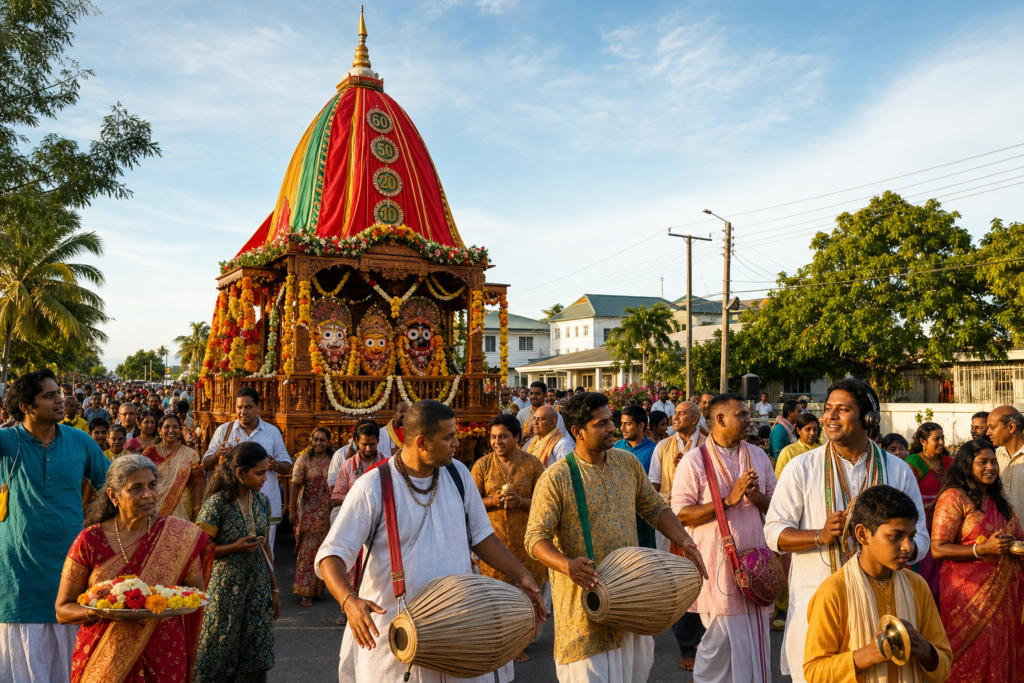
The most publicly visible element of the festival will take place on Saturday, July 11, with the 20th annual Ratha-yatra celebration in the Georgetown and Demerara area. The procession is scheduled to begin at 1:00 p.m. in Success, East Coast Demerara, and proceed to Lusignan Tarmac. A cultural and spiritual stage program is expected to begin there at 5:00 p.m. The route itself gives the celebration a public character, transforming roads and community spaces into temporary sites of devotion, music, movement, and shared cultural memory.
Ratha-yatra is among the world’s oldest religious festivals and is traditionally associated with Jagannatha Puri, Odisha, India. Within ISKCON, the festival gained international visibility after Srila Prabhupada introduced it outside India in San Francisco in 1967. Since then, Ratha-yatra has become one of the most recognizable public celebrations in Hare Krishna communities worldwide. Its theological symbolism is rich: Sri Sri Jagannatha, Baladeva, and Subhadra Devi are brought before the public, allowing devotion to move beyond the temple sanctum and into the shared civic space of the community.
In Guyana, the decorated chariot carrying Sri Sri Jagannatha, Baladeva, and Subhadra Devi will be drawn in procession while devotees and members of the public accompany it with kirtan, dancing, and the chanting of the Hare Krishna maha-mantra. The experience is deeply sensory and communal. Sound, color, movement, sacred food, and shared participation combine to create a form of religious expression that is both devotional and accessible. Even those encountering the tradition for the first time can understand the basic mood of welcome, reverence, and joyful service.
The use of music and movement in Ratha-yatra also demonstrates an important feature of Hindu and broader Dharmic traditions: knowledge is not transmitted only through abstract argument. It is also carried through song, rhythm, gesture, sacred image, food, pilgrimage, and festival. Kirtan and bhajans allow philosophy to enter the heart through sound. Prasadam expresses theology through hospitality. Procession turns memory into movement. In this sense, Ratha-yatra is both a devotional act and a sophisticated cultural form.
The concluding program on Sunday, July 12, will mark the 10th anniversary of the Hare Krishna Study Centre. The temple was inaugurated in July 2016, a year that also marked ISKCON’s 50th anniversary and Guyana’s 50th Independence Anniversary. A decade later, the Study Centre’s anniversary invites reflection on how institutions mature. The first years of any spiritual centre often involve establishing regular worship, building trust, training volunteers, sustaining programs, and forming a shared sense of responsibility among devotees. The 10-year milestone suggests that the centre has become a stable part of the religious landscape of Guyana’s East Coast.
The festival is expected to bring together devotees, well-wishers, families, youth, community members, and visiting guests from Guyana and abroad. Attendees are anticipated from Guyana, India, the United States, Trinidad and Tobago, Suriname, Panama, Brazil, Canada, and other countries. Expected international guests include Bhakti Vasudeva Swami, Bhakti Sundar Swami, Ajamila Das, Gaura Mani Dasi and family, and Baldev Das. Their presence underscores the transnational character of contemporary Vaishnava networks and the continuing importance of the Caribbean within global Hindu and Dharmic life.
The planned activities include kirtan, bhajans, spiritual presentations, cultural performances, devotional drama, classical dance, children’s activities, historical reflections, Ratha-yatra, and the free distribution of vegetarian prasadam. Each of these activities serves a distinct function. Spiritual presentations provide intellectual grounding. Drama and dance make theological themes emotionally accessible. Children’s activities support intergenerational continuity. Historical reflections preserve institutional memory. Prasadam distribution expresses compassion and hospitality in a concrete form.
From the perspective of cultural heritage, the Hare Krishna Legacy Festival 2026 also highlights the importance of youth participation. No tradition survives only by honoring the past; it must also create pathways for younger generations to serve meaningfully. Youth engagement in festivals, music, media, education, logistics, hospitality, and public outreach allows inherited devotion to become personally owned rather than merely received. This is especially important in diaspora communities, where young people often negotiate multiple identities at once.
The festival’s emphasis on family and community is equally important. Dharmic traditions have historically depended on households as much as temples. The home, the temple, and the public festival together form a network of religious life. When families gather for kirtan, attend Ratha-yatra, serve prasadam, or bring children to cultural programs, they participate in a living form of education. The result is not only religious instruction but also the formation of memory, affection, and shared responsibility.
The broader significance of this festival lies in its capacity to strengthen unity among Dharmic traditions while remaining rooted in Vaishnava practice. Hinduism, Buddhism, Jainism, and Sikhism each possess distinct doctrines and disciplines, yet they also share civilizational concerns such as ethical living, self-discipline, reverence for sacred knowledge, respect for teachers, service, compassion, and the search for liberation or spiritual awakening. A festival centered on bhakti can therefore contribute to wider cultural harmony when it is presented with humility, hospitality, and respect for diverse spiritual paths.
The Hare Krishna Legacy Festival 2026 should therefore be understood as both celebration and responsibility. It celebrates the work begun by Srila Prabhupada, the perseverance of ISKCON devotees in Guyana, the public vitality of Ratha-yatra, and the development of the Hare Krishna Study Centre. At the same time, it places a responsibility before the community: to preserve spiritual knowledge with integrity, to welcome sincere seekers, to serve society through compassion, and to help younger generations find meaning in Krishna consciousness without losing connection to the wider Dharmic heritage.
Programs on July 8, 9, 10, and 12 will be held at the Hare Krishna Study Centre, Lot 1, First Street, Cummings Lodge, Georgetown. The July 11 Ratha-yatra procession will begin at Success, East Coast Demerara, and conclude with the evening festival program at Lusignan Tarmac. All programs are free and open to the public, making the festival a community-facing observance as well as a devotional milestone for ISKCON in Guyana.
Inspired by this post on Dandavats.


Leave a Reply
You must be logged in to post a comment.