
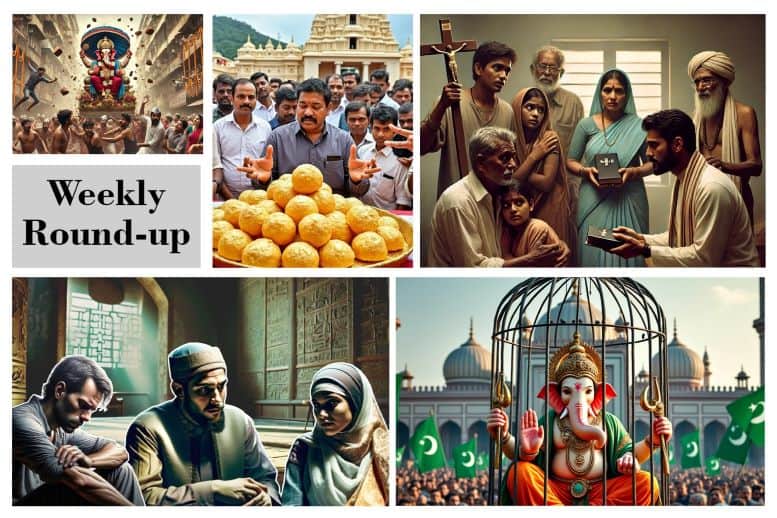
The week from 28 June to 04 July 2026 presents a concentrated view of the pressures faced by Hindu communities in Bharat and parts of the wider region. The reported incidents range from regulatory debates over foreign funding and alleged extremist plotting to questions of religious freedom, child-protection oversight, cultural dignity, and minority rights in Bangladesh. Taken together, these cases show why Hindu human rights, religious freedom, and institutional accountability must be studied as connected civic concerns rather than isolated controversies.
Any serious assessment of Hindu persecution must begin with careful language. Not every conflict involving Hindus is identical in motive, scale, or legal character. Some cases concern criminal violence, some involve administrative conduct, some raise questions of discrimination, and others involve the vulnerability of minority communities in volatile political environments. Yet the recurring pattern matters: when temples, sacred symbols, religious observances, community institutions, or Hindu identity itself become targets of hostility or official indifference, the issue moves beyond ordinary law-and-order reporting and enters the domain of civil rights.
Bharat: Foreign Funding, Conversion Concerns, and Regulatory Oversight
The amendment of the Foreign Contribution (Regulation) Rules, 2011, through a Gazette notification by the Union Ministry of Home Affairs became one of the most consequential developments of the week. Reports described the change as a tighter framework for organisations receiving foreign contributions, especially where funds are linked to religious activity, proselytisation, or objectives that must be clearly declared under the law. The policy debate is technical, but its social implications are substantial because foreign-funded conversion activity has long been a sensitive subject in many Indian communities.
The central legal point is that the Rules, not the parent Foreign Contribution (Regulation) Act, 2010, were amended. This distinction matters because delegated rules can alter compliance conditions, declaration requirements, accounting obligations, and operational boundaries without rewriting the statute itself. For supporters, the new framework represents a necessary mechanism to prevent foreign money from being used for opaque religious conversion networks. For critics, the concern is that regulatory tightening may affect civil society organisations more broadly. A balanced approach requires both transparency in foreign funding and protection for legitimate charitable, educational, and humanitarian work.
From a Dharmic civilisational perspective, the concern is not interfaith coexistence. Hindu, Buddhist, Jain, and Sikh traditions have long lived with diverse paths of worship, philosophical debate, and voluntary spiritual seeking. The concern arises when organised religious activity is alleged to exploit poverty, illness, social vulnerability, or educational dependence to induce conversion. A rights-based policy must therefore distinguish between freedom of conscience and coercive or materially induced religious change. That distinction is central to the ethical debate around FCRA compliance and religious freedom in Bharat.
Alleged Plot Against Ram Mandir and the Security Dimension
Another major case involved the arrest of Mohammad Sohail, a resident of Gangoh in Uttar Pradesh’s Saharanpur district, who was reportedly apprehended in Karnataka after a joint operation by the National Investigation Agency and the Anti-Terrorism Squad. The allegation, as reported, was that he was connected to a plot targeting the Ram Mandir in Ayodhya. Since the Ram Mandir is not only a temple but also a symbol of a centuries-long civilisational memory, any alleged threat against it carries national security, religious, and emotional significance.
The legal process must now determine the facts, evidence, and culpability. At the same time, the case demonstrates why security agencies treat religiously symbolic targets with particular seriousness. Attacks or planned attacks on sacred sites are rarely limited to physical damage; they are intended to produce fear, communal tension, and psychological injury. In a plural society, protection of temples, monasteries, gurudwaras, derasars, and other sacred spaces is part of the state’s responsibility to preserve public order and religious liberty.
Cow Protection, Law Enforcement, and Communal Sensitivities in Uttar Pradesh
In Meerut district’s Sardhana area, Uttar Pradesh Police reportedly foiled an attempted cow slaughter operation and arrested three suspects after a brief exchange of fire. The police recovery was said to include approximately one quintal, or 100 kilograms, of beef, a live bovine, and slaughter equipment. The arrested accused were identified in reports as Monish, Dilshad, and Sartaj.
Cow protection is often misunderstood when reduced to electoral slogans or street-level conflict. In Hindu society, reverence for Gau Mata is rooted in ritual, agrarian memory, ethics of care, and the symbolic association of the cow with nourishment and non-violence. Legal regimes around cow slaughter vary across Indian states, but in Uttar Pradesh the issue is treated as a serious offence. Enforcement must remain lawful and evidence-based, yet the cultural sensitivity cannot be dismissed as merely political. For many Hindus, such cases feel like a direct affront to sacred values and inherited community life.
NHRC Intervention and Child-Protection Concerns in Hyderabad
The National Human Rights Commission’s intervention in a complaint concerning Agape Orphanage in Hyderabad added a different but equally important dimension to the week’s developments. The complaint, filed by activist A.S. Santhosh, reportedly alleged that HIV-affected orphan children linked to the institution were publicly exposed on fundraising platforms. The NHRC directed the Telangana government and the Union Home Ministry to examine the allegations, including possible failures in child protection and regulatory oversight.
This case should be read through the lens of human dignity rather than sectarian rivalry. Children affected by illness, poverty, abandonment, or institutional dependence are among the most vulnerable members of society. Their identities, medical conditions, and personal histories cannot be treated as fundraising material without strict ethical safeguards. If the allegations are established, the issue would involve privacy, consent, child welfare, and institutional accountability. Dharmic ethics, whether expressed through seva, karuna, daya, or ahimsa, require that vulnerable children be protected from exploitation in any institutional setting.
Karnataka CET, Janeu, and the Rights of Hindu Students
The Karnataka CET controversy, in which students were reportedly forced to remove the Janeu or Yajnopaveetha before entering examination halls, renewed public debate over the treatment of Hindu religious symbols in educational institutions. Some students also reported objections to Kalava or similar sacred threads. Exam security is a legitimate administrative concern, but the removal of visible religious symbols raises serious questions when protocols are applied without cultural literacy or proportional reasoning.
The Janeu is not an accessory in the ordinary sense. For those who wear it, it is bound to samskara, discipline, family tradition, and religious identity. Treating it as a suspicious object without clear evidence or a respectful verification method can produce humiliation, anxiety, and a sense of exclusion. Public institutions must be able to prevent cheating while also respecting constitutionally protected religious expression. The deeper concern is selective secularism: when Hindu symbols are treated as negotiable or disposable while other religious markers are handled with greater sensitivity, the result is not neutrality but unequal treatment.
For students, the impact is not abstract. An examination hall is already a stressful environment; being asked to remove a sacred thread can disturb concentration and dignity at precisely the moment when fairness matters most. The solution is neither administrative chaos nor religious privilege. It is a consistent, transparent, and respectful protocol that protects exam integrity while recognising the lived reality of Hindu religious practice.
Workplace Allegations and the Question of Discrimination
Reports concerning LyondellBasell’s Enterprise Architecture division in Mumbai introduced the question of workplace discrimination against Indian Hindu professionals. Former employees reportedly described what began as an organisational change in late August 2025 as a targeted and systematic removal of Hindu employees. LyondellBasell is a major global plastics and chemicals company headquartered in Houston, Texas, which makes the allegations significant beyond a single office dispute.
Such claims require careful scrutiny, documentary evidence, and procedural fairness. Corporate restructuring can occur for many legitimate reasons, including performance, cost, strategy, or managerial reorganisation. However, if employment actions are linked to religious identity, cultural prejudice, or discriminatory networks, they become matters of civil rights and labour justice. The case underlines why Indian professionals, including Hindus in global corporate environments, increasingly discuss bias not only in overtly religious terms but also through hiring patterns, promotion pathways, internal networks, and managerial conduct.
Bangladesh: Minority Rights and the Sri Ram Murti Controversy
Bangladesh remains one of the most important case studies in the regional discussion of Hindu minority rights. Historical demographic decline, recurring reports of temple desecration, land grabbing, mob violence, forced conversion, and threats against Hindu women have made the condition of Bangladeshi Hindus a persistent human rights concern. Scholars and activists have long warned that systemic pressure can empty a community without a single dramatic event; repeated intimidation, property loss, insecurity, and social exclusion can produce gradual displacement.
The controversy over a proposed murti of Sri Ram intensified these concerns. Reports indicated that opposition to the construction of the Sri Ram statue, including alleged threats and protests by Islamist groups, led to broader unrest and demonstrations by Hindu community members. The question at the heart of the dispute is simple but profound: can a religious minority publicly honour one of its most revered deities without facing intimidation or state hesitation?
Bangladesh’s constitutional and political language often invokes religious freedom, minority protection, and civic equality. Yet those principles must be measured by the lived experience of minorities on the ground. If a Hindu community cannot build, preserve, or publicly revere a sacred image without fear, then formal promises of religious liberty are weakened. The issue is not merely about one statue; it is about whether Hindu citizens can inhabit public space as equal members of the nation.
Patterns Behind the Weekly Cases
The cases from this week differ in jurisdiction and subject matter, but several patterns emerge. First, Hindu institutions and symbols often become flashpoints in wider ideological conflicts. The Ram Mandir, the Janeu, Gau Mata, temple murtis, and Hindu festivals are not isolated markers; they carry civilisational memory. Second, the vulnerability of Hindus can be heightened when institutions fail to recognise the specific nature of anti-Hindu prejudice. Third, discrimination may appear in multiple forms: street violence, administrative insensitivity, workplace exclusion, foreign-funded religious pressure, or hostile mobilisation against minority worship.
At the same time, a responsible analysis must avoid collective blame. Anti-Hindu violence and Hinduphobia should be attributed to specific actors, extremist ideologies, institutional failures, or documented patterns rather than entire communities. This distinction is essential for preserving social harmony among Dharmic traditions and for maintaining ethical clarity in public debate. Hindu, Buddhist, Jain, and Sikh communities have a shared interest in protecting freedom of conscience, sacred spaces, cultural continuity, and the dignity of all vulnerable groups.
The broader lesson is that religious freedom cannot be reduced to the right to worship privately. It includes the right to wear sacred symbols, protect temples, preserve festivals, educate children without humiliation, maintain community institutions, resist coercive conversion, and participate in public life without fear. When these rights are weakened for one community, the constitutional and moral order is weakened for all.
This weekly review therefore serves as a civic record. It documents allegations, official interventions, and reported incidents that require legal follow-up, institutional transparency, and public awareness. The goal is not to inflame social divisions but to insist that Hindu human rights be treated with the seriousness routinely extended to other minority and religious freedom concerns. A society committed to justice must be able to name anti-Hindu bias clearly, investigate it fairly, and protect the dignity of every Dharmic community without apology.
Inspired by this post on Hindu Post.







Leave a Reply
You must be logged in to post a comment.