
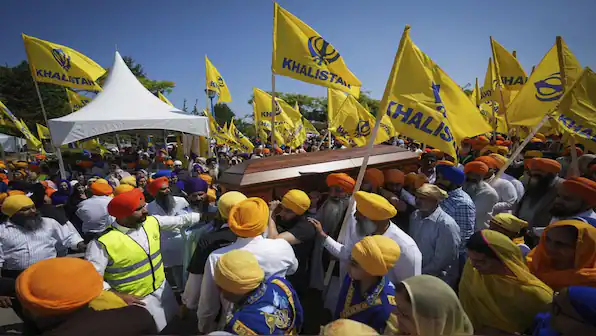
The debate around Punjab, Damdami Taksal, Jarnail Singh Bhindranwale, and the renewed visibility of Khalistani rhetoric is not merely a dispute about one political speech or one public function in Amritsar. It is a larger test of India’s memory, its national security doctrine, and its ability to distinguish Sikh civilisational dignity from separatist political violence. The controversy reported by Firstpost on June 23, 2026, therefore deserves a careful and sober reading rather than a reactive partisan response.
Punjab’s modern history carries deep wounds. It carries the trauma of terrorism, the pain of targeted killings, the scars of Operation Blue Star, the assassination of Indira Gandhi, the anti-Sikh violence of 1984, and the long counterinsurgency that eventually broke the back of armed separatism. These memories cannot be treated casually. They are not slogans to be used for short-term political messaging; they are part of a painful national archive that still shapes families, communities, police institutions, religious leadership, and diaspora politics.
Damdami Taksal occupies an important place in Sikh learning and religious pedagogy. Its association with Gurbani education, traditional exegesis, and Sikh scholarship must be acknowledged with respect. At the same time, its historical association with Bhindranwale during the late 1970s and early 1980s cannot be ignored. The difficulty lies precisely in this dual reality: an institution may have deep religious importance, while a phase of its public history may also be linked to militancy, armed mobilisation, and a separatist political imagination.
The problem in the recent controversy was not a visit to a Sikh religious or educational centre. Public representatives regularly visit temples, gurdwaras, mathas, monasteries, dargahs, churches, and institutions of learning. Such visits can strengthen inter-community trust when handled with humility and care. The concern arises when a public platform is used to confer unqualified moral legitimacy on a figure whose political legacy is inseparable from the rise of violent separatism in Punjab.
Calling Bhindranwale a saintly figure in a political context is not an innocent act of historical interpretation. It becomes a signal. For some, it appears as recognition of militant defiance. For victims of terrorism, it reopens grief. For security institutions, it normalises a vocabulary that once accompanied assassinations, extortion, intimidation, sectarian fear, and attacks on civilians. For ordinary Sikhs who suffered both from militancy and from state excesses, it risks flattening a complex history into a dangerous emotional symbol.
Any serious account of the Khalistan Movement must begin with political complexity. The central government under Indira Gandhi did engage in hard political tactics against the Akali Dal, and the attempt to manipulate religious and factional forces in Punjab proved disastrous. This is now widely recognised as a grave political miscalculation. Yet acknowledging that miscalculation does not absolve militant leaders of responsibility for violence, coercion, and the deliberate radicalisation of religious sentiment for separatist ends.
The Akali leadership too misread the forces it thought it could manage. Pressure politics, religious mobilisation, and federal demands became entangled with armed assertion and absolutist rhetoric. Once militant charisma combines with theological language, moral policing, territorial separatism, and access to weapons, political actors often discover that they cannot control the monster they helped empower. Punjab paid the price for that misjudgment in blood.
This history matters because extremist movements rarely emerge fully formed. They grow through grievance narratives, selective memory, religious symbolism, social intimidation, diaspora financing, foreign sanctuary, and the gradual normalisation of radical vocabulary. What begins as romanticised defiance can become a recruitment pipeline. What begins as coded homage can become ideological rehabilitation. What begins as political ambiguity can become a national security challenge.
The technical challenge of countering Khalistani extremism is therefore not limited to arresting armed operatives. It involves mapping networks, financial flows, propaganda channels, social media amplification, overseas lobbying, religious platforms, criminal syndicates, and cross-border intelligence linkages. Modern separatism is hybrid. It may not always appear as an armed insurgency inside Punjab; it may function through online radicalisation, diplomatic pressure campaigns, targeted intimidation, narcotics-linked financing, and attempts to provoke communal suspicion.
Punjab’s security environment is also shaped by geography. Its border with Pakistan gives hostile actors an opportunity to use drones, smuggling routes, narco-terrorism, and intelligence cut-outs to keep unrest alive at low cost. The Khalistan network has historically overlapped with Pakistan’s strategic interest in weakening India internally. This does not mean every separatist sympathiser is an agent of a foreign state, but it does mean that separatist narratives can be exploited by foreign agencies with long experience in asymmetric conflict.
The diaspora dimension adds another layer. Sikh communities in Canada, the United Kingdom, the United States, Australia, and Europe have contributed immensely to public life, enterprise, academia, defence services, and philanthropy. They are not reducible to fringe extremism. However, small but organised Khalistani groups abroad have used liberal democratic spaces to glorify violence, intimidate moderates, influence gurdwara politics, and frame India through a one-sided narrative of persecution. This distinction is essential: the Sikh diaspora is not the problem; extremist capture of platforms within the diaspora is the problem.
Air India Flight 182 remains one of the darkest reminders of what overseas extremism can become when ideology, grievance, and operational capability converge. The 1985 bombing killed hundreds of innocent people and remains central to any serious discussion of Khalistani terrorism. It also demonstrates why foreign governments cannot treat extremist mobilisation as a distant ethnic dispute. When violent ideology is ignored because it is politically inconvenient, ordinary citizens become vulnerable.
Yet counterterrorism must never become a licence for collective suspicion. Sikhism is a dharmic tradition rooted in courage, seva, sangat, justice, and devotion to the One. The Khalsa tradition has historically stood against tyranny and protected the vulnerable. Any attempt to equate Sikh identity with separatism is both morally wrong and strategically foolish. It alienates the very community whose cooperation is indispensable for defeating extremism.
The unity of dharmic traditions requires this clarity. Hinduism, Sikhism, Buddhism, and Jainism have distinct theological, philosophical, and institutional histories, yet they share civilisational conversations across centuries. Punjab’s sacred geography, from Shri Durbar Sahib to innumerable gurdwaras associated with the Gurus, belongs to a larger Indic memory of tapas, seva, sacrifice, and social responsibility. Khalistani separatism attempts to sever Sikh identity from that civilisational context and recast it through grievance, exclusivism, and political rupture.
This is why the response to Khalistani radicalisation must be both firm and culturally intelligent. A purely coercive approach cannot resolve an ideological challenge. A purely conciliatory approach can embolden radicals. India needs a layered strategy: lawful policing, credible intelligence, financial enforcement, digital monitoring, community partnership, historical education, diplomatic pressure, and a public language that honours Sikh pride while rejecting separatist violence without hesitation.
Historical education is particularly important. Young Indians, including young Sikhs, deserve an honest account of Punjab’s turmoil. That account must include political manipulation by the Congress establishment, extremist violence by Khalistani militants, the suffering of Hindu and Sikh civilians, the trauma of 1984, the failure to deliver timely justice for anti-Sikh violence, the assassination of Beant Singh, and the role of police and political leadership in restoring order. Sanitised history produces resentment; weaponised history produces radicalisation. Responsible history produces maturity.
KPS Gill and Beant Singh are often credited with decisively defeating the insurgency in Punjab. Their roles remain central to the security history of modern India. At the same time, any academic assessment must also acknowledge that counterinsurgency in Punjab remains contested because of allegations of human rights violations, disappearances, and excesses. A mature republic does not need to deny complexity in order to defend national unity. It can recognise the necessity of defeating terrorism while also insisting that the state remain accountable to law.
The assassination of Beant Singh in 1995 showed that even after the militant movement had been weakened, extremist networks retained the capacity for spectacular violence. This pattern is common in insurgencies: when territorial control collapses, militants may shift to assassinations, symbolic attacks, diaspora propaganda, and attempts to revive memory through martyrdom narratives. The current challenge is therefore not a return to the exact conditions of the 1980s, but the possible reactivation of old symbols through new media and transnational networks.
Social media has changed the mechanics of radicalisation. Earlier, extremist messaging required physical meetings, pamphlets, cassette recordings, religious gatherings, and local networks. Today, a clip, slogan, song, poster, or selective historical claim can travel instantly across continents. Algorithms reward outrage, victimhood, and identity conflict. This allows fringe actors to appear larger than they are, especially when political parties and media ecosystems amplify controversy without adding historical discipline.
Political leaders therefore carry special responsibility. A minister, legislator, party functionary, or public intellectual cannot speak about Bhindranwale, Khalistan, or Punjab’s insurgency as though words have no consequences. Public memory in Punjab is still sensitive. Families remember fear. Security personnel remember ambushes. Journalists remember threats. Villagers remember coercion by militants and suspicion by the state. The emotional burden of this history requires precision, not provocation.
The moral error in glorifying extremist-linked figures lies in the conversion of political violence into spiritual prestige. Sikh tradition has its own vocabulary of sant, sipahi, shahadat, seva, and dharma. These terms cannot be casually transferred to modern separatist militancy without distorting religious memory. Reverence must be reserved for those who upheld truth, protected society, and deepened spiritual discipline, not for those whose political methods contributed to cycles of fear and bloodshed.
At the same time, condemning Khalistani extremism must not become an excuse to ignore legitimate Sikh concerns. Justice for 1984, protection of gurdwara autonomy from criminal capture, respect for Punjabi language and culture, fair treatment of farmers, and dignified engagement with Sikh religious leadership are not concessions to separatism. They are obligations of a constitutional democracy. Extremism feeds on grievance; good governance drains grievance of its manipulative power.
Punjab also needs economic and social renewal. Drug abuse, youth unemployment, agrarian stress, migration anxieties, and declining trust in institutions create conditions in which radical narratives can find emotional entry points. Security policy must therefore be integrated with development policy. A young person with education, work, family stability, cultural confidence, and civic belonging is less vulnerable to romanticised calls for violent rupture.
Religious institutions have an equally important role. Gurdwaras have historically served as centres of worship, community kitchen, moral instruction, and collective decision-making. Their credibility depends on keeping them free from intimidation, criminal financing, and extremist capture. Community elders, granthis, scholars, and Sikh organisations can do what the state cannot: draw a clear theological line between Gurmat and separatist hatred, between courage and fanaticism, between remembrance and revenge.
India’s diplomatic posture must also be sharper. When extremist groups abroad threaten Indian diplomats, vandalise temples or consulates, glorify assassins, or organise violent demonstrations, host governments must be pressed to act under their own laws. Free speech does not protect incitement, targeted intimidation, terror glorification, or foreign-backed destabilisation. Democracies that demand responsibility from India must apply the same standard to extremist networks operating on their soil.
The media has a responsibility to avoid two failures. The first is sensationalism, which turns every fringe provocation into a national panic. The second is denial, which pretends that organised separatist propaganda is harmless theatre. A responsible media framework would identify actors, funding patterns, historical claims, legal violations, and community responses. It would separate Sikh religious life from Khalistani politics and ask difficult questions without stoking communal suspicion.
The most dangerous narratives are often those that contain partial truths. It is true that the Indian state made grave errors in Punjab. It is true that Sikhs suffered terribly in 1984. It is true that justice was delayed and often denied. But it is also true that Khalistani militants killed innocents, targeted moderates, intimidated religious spaces, and sought to fracture India. A truthful public memory must hold all these facts together. Selective truth is the raw material of extremism.
Punjab’s moment of truth is therefore not simply about confronting Khalistan. It is about confronting political cowardice, historical amnesia, diaspora radicalisation, institutional complacency, and the habit of using sacred symbols for electoral advantage. The challenge must be addressed before nostalgia hardens into mobilisation and before online radicalism acquires operational form.
A durable response will require confidence rather than anxiety. India does not need to fear Sikh assertion, Sikh pride, or Sikh global influence. These are strengths of Bharat. What must be confronted is the attempt to detach Sikh identity from India’s civilisational fabric and place it in the service of separatism, foreign strategy, and political violence. The distinction is not merely semantic; it is the foundation of a just and effective national response.
The path forward must combine justice, firmness, and unity. Terrorism must be defeated by law. Historical wounds must be addressed by truth. Religious traditions must be protected from politicised distortion. Public officials must speak responsibly. Communities must remain alert to extremist capture. Above all, Sikh society and the wider dharmic family must not allow a violent fringe to define a tradition whose deepest inheritance is spiritual discipline, courage, service, and the defence of righteousness.
Punjab has already endured the cost of delayed clarity. The lesson of the past is not that every grievance is separatism, nor that every security response is oppression. The lesson is that ambiguity toward extremism is dangerous, and injustice is equally dangerous. A united Bharat can confront the Khalistani challenge only when it refuses both denial and demonisation. That balance is difficult, but it is the only path worthy of Punjab’s history and India’s future.
Inspired by this post on Hindu Post.





Leave a Reply
You must be logged in to post a comment.