
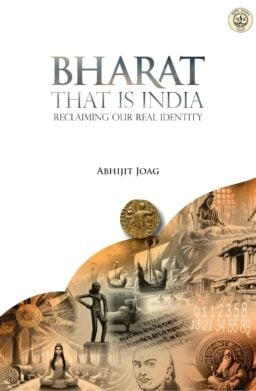
Bharat That Is India: Reclaiming Our Real Identity by Abhijit Joag is best understood as a civilizational argument rather than a conventional political history. The book, published in December 2025 and reviewed by Indica Today on June 28, 2026, enters a public conversation in which the meaning of Bharat, the memory of Indian civilization, and the continuing influence of colonial categories are no longer abstract academic questions. They shape education, public policy, cultural confidence, interfaith dialogue, and the way Indians understand their place in history.
The significance of the book lies in its central claim: India’s identity did not begin with the modern constitutional state, nor can it be adequately explained only through colonial, postcolonial, or European political vocabulary. The idea of Bharat is presented as a long civilizational continuum, sustained through sacred geography, dharma, philosophical inquiry, social institutions, pilgrimage networks, knowledge traditions, languages, arts, temples, monasteries, gurukulas, trade routes, and everyday practices that gave the subcontinent a shared cultural grammar across great regional diversity.
This framing makes the title itself important. The phrase “India, that is Bharat” echoes Article 1 of the Constitution of India, but Joag’s argument appears to move beyond the constitutional formulation into the deeper historical and cultural resonance of the term Bharat. In this reading, Bharat is not merely an alternate name. It is a civilizational memory, a way of describing a land shaped by dharma, knowledge, self-discipline, plurality, spiritual striving, and the continuous search for truth.
The review highlights the book as an ambitious cultural history and identity manifesto. That description is appropriate because the work does not seem content with recounting events in chronological order. It asks a more demanding question: what makes a civilization aware of itself? Political boundaries can change, dynasties can rise and fall, and institutional forms can be redesigned, but a civilization survives when its people retain a shared vocabulary of meaning. In the Indian case, that vocabulary includes dharma, moksha, karma, yajna, seva, shastra, parampara, tirtha, sampradaya, and the pursuit of inner refinement.
One of the strongest elements of the book, as described in the review, is its refusal to reduce Indian history to statecraft alone. Modern readers are often trained to see history through kings, wars, treaties, invasions, and administrative reforms. Those elements matter, but they do not exhaust the Indian experience. A civilizational approach must also include philosophical schools, ritual systems, artistic canons, ecological habits, family structures, monastic lineages, oral traditions, mathematical thought, medicine, music, architecture, and the living continuity of sacred places.
The emphasis on dharma gives the book its conceptual center. Dharma is not easily translated as religion, law, duty, ethics, or social order, though it touches all of these. In the Indian knowledge tradition, dharma refers to that which sustains: the moral, cosmic, personal, and social order that enables life to remain meaningful and balanced. A dharmic civilization is therefore not defined by a single creed imposed from above, but by an ethical orientation that asks individuals, families, rulers, communities, and institutions to act in accordance with responsibility, restraint, truth, and harmony.
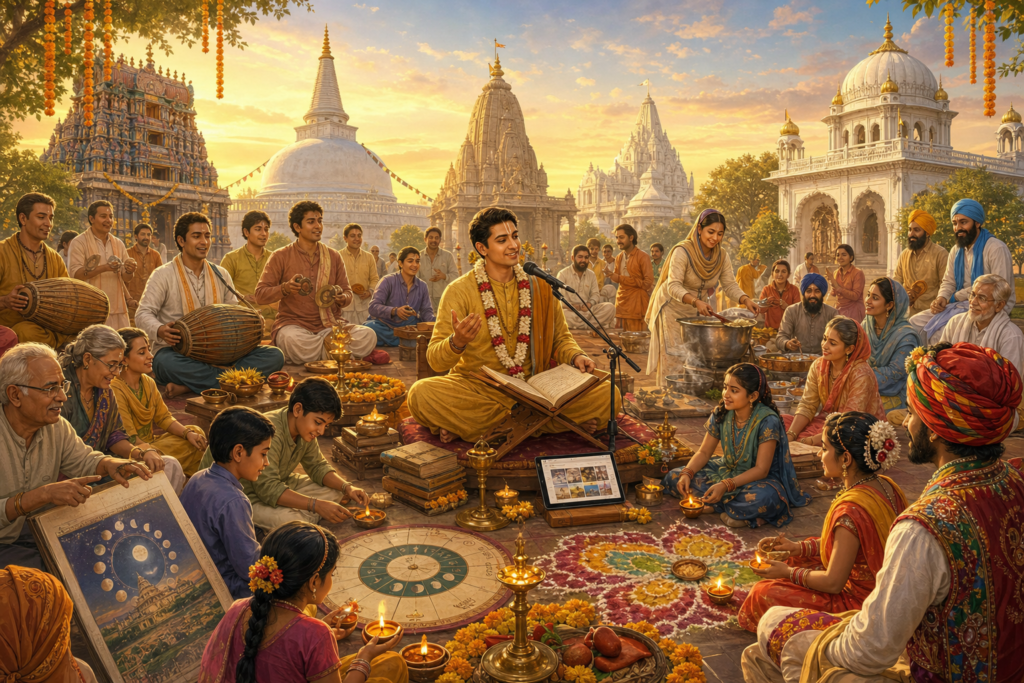
This matters especially for a blog committed to unity among Hinduism, Buddhism, Jainism, and Sikhism. The dharmic traditions have distinct doctrines, practices, scriptures, and historical developments, yet they share a broad civilizational environment in which liberation, self-discipline, compassion, non-possessiveness, moral accountability, spiritual practice, and the refinement of consciousness remain central. A serious discussion of Bharat should therefore avoid narrow sectarian reduction. It should show how diversity within dharmic life has often been held together by debate, pilgrimage, shared ethical vocabulary, and mutual recognition of multiple paths.
The reference to Advaita Vedanta in the review is also significant. Advaita is not merely a philosophical doctrine about non-duality; it represents the sophistication of Indian metaphysical inquiry. Its presence in a book on national identity suggests that Joag treats Indian civilization as an intellectual civilization, not only a devotional or ritual one. From the Upanishads to Vedanta, from Buddhist logic to Jain anekantavada, from Sikh teachings on the Divine to the discipline of yoga, Indian thought has repeatedly returned to questions of consciousness, reality, suffering, freedom, and ethical conduct.
That intellectual inheritance is often difficult to present in modern public language because colonial education encouraged Indians to view their past through borrowed categories. Colonial knowledge systems classified, translated, ranked, and often distorted Indian traditions by forcing them into European religious, racial, and political frameworks. The result was not merely academic misunderstanding. It produced mental colonization: a habit of seeing Indian civilization as fragmented, irrational, static, or derivative unless validated by Western approval.
The book’s project of reclamation therefore has contemporary relevance. Reclaiming Bharat does not require rejecting the modern world, constitutional democracy, science, or global exchange. A mature civilizational confidence does not need isolation. It requires the ability to participate in modernity without forgetting inherited categories of thought. The question is not whether Indians should engage the world, but whether they can do so from a position of self-knowledge rather than insecurity.
For many readers, this is where the emotional force of the book becomes clear. The recovery of identity is not only a scholarly exercise. It can feel like the restoration of a family memory long buried under institutional neglect. When a person encounters the depth of Indian philosophy, the complexity of temple architecture, the precision of Sanskrit grammar, the discipline of yoga, the compassion of Buddhist and Jain ethics, or the courage of Sikh tradition, the past stops being a museum object. It becomes a living inheritance.
The review suggests that Joag’s narrative spans more than 5000 years of continuity. Such a claim must be handled carefully, because civilizational continuity does not mean that nothing changed. India has seen migrations, kingdoms, debates, reform movements, invasions, regional transformations, linguistic developments, social tensions, and religious innovation. Continuity in this context should be understood as a persistent civilizational pattern rather than an unbroken sameness. Bharat endured because it adapted while retaining core frameworks of meaning.
This distinction is essential. A simplistic identity narrative can become brittle, but a civilizational narrative can be both rooted and dynamic. Indian history contains Vedic traditions, Shramanic movements, the rise of Buddhism and Jainism, the development of classical Hindu darshanas, the Bhakti movement, Sikh teachings, regional devotional cultures, temple networks, philosophical commentaries, vernacular literature, and modern reform movements. These currents often disagreed with one another, yet their debates took place within a recognizable Indic field of inquiry.
The book’s broad cultural sweep appears to be one of its major strengths. By connecting Indian knowledge systems with national identity, it encourages readers to view Bharat not only as territory but as a layered civilizational ecosystem. Sacred geography is central to this ecosystem. Pilgrimage routes connected distant regions long before modern transport and bureaucracy. Kashi, Rameswaram, Puri, Dwarka, Kedarnath, Bodh Gaya, Shravanabelagola, Amritsar, Kanchipuram, Ujjain, and countless other sacred centers shaped a mental map in which the land was experienced as spiritually interconnected.
This sacred geography produced a form of unity that was not identical to modern nationalism but helped prepare the ground for it. A farmer, monk, scholar, merchant, pilgrim, warrior, poet, or artisan could belong to a region and language while also participating in a larger civilizational imagination. This is one reason why India’s unity cannot be explained only through administrative centralization. It was also carried through stories, festivals, vows, temples, monasteries, mathas, akharas, gurudwaras, trade guilds, philosophical debates, and shared reverence for knowledge.
The review also points to the book’s critique of Western frameworks. Such a critique is valuable when it remains analytical rather than reactive. Western scholarship has produced important tools, but it has also carried assumptions shaped by Christian theology, Enlightenment secularism, colonial administration, race theory, and modern nation-state models. When those assumptions are applied mechanically to Indian civilization, they can misread dharma as “religion,” varna and jati as a single frozen category, murti puja as idolatry, and plurality as disorder.
A technically careful reading of Indian identity must therefore distinguish between indigenous categories and imported categories. Dharma is not the same as religion in the Abrahamic sense. Sampradaya is not the same as church denomination. Shastra is not merely scripture in the Protestant sense. Murti is not simply an idol. Tirtha is not only a place of worship. These distinctions are not semantic luxuries; they determine whether Indian civilization is understood on its own terms or through a framework that distorts it at the first step.
At the same time, a balanced review must recognize the challenge of any identity manifesto. The recovery of civilizational confidence must not flatten internal diversity or ignore social complexity. Bharat’s strength has never been uniformity. It lies in a disciplined plurality, where different paths can coexist within a larger ethical and spiritual order. Hindu, Buddhist, Jain, and Sikh traditions have each contributed to this civilizational fabric, and their shared future depends on clarity without hostility, rootedness without exclusion, and truth-seeking without triumphalism.
In this sense, Bharat That Is India appears to offer a counter-narrative to deracination. Deracination is not simply forgetting the past; it is losing the ability to interpret oneself. A deracinated society may possess economic growth, technology, and political institutions, yet remain unsure of its deeper purpose. A civilization that remembers itself can modernize with greater confidence because its people know what should be preserved, what should be reformed, and what should be creatively renewed.
The book is also relevant to current debates about Indian education. If the teaching of history is limited to colonial conquest, medieval conflict, and post-independence politics, students may never encounter the civilizational architecture that made India resilient. Indian mathematics, astronomy, grammar, logic, medicine, philosophy, aesthetics, statecraft, metallurgy, ecology, and spiritual psychology deserve serious study. This does not mean replacing scholarship with sentiment. It means expanding scholarship so that Indian knowledge systems are treated as knowledge, not as folklore awaiting external validation.
Joag’s work, as presented in the review, seems especially valuable for readers seeking a bridge between cultural pride and intellectual seriousness. Pride without study becomes shallow. Study without rootedness becomes sterile. A meaningful engagement with Bharat requires both: emotional belonging and disciplined inquiry. The best civilizational writing helps readers feel the weight of inheritance while also pushing them toward evidence, nuance, and responsibility.
The launch of the book at the Indira Gandhi National Centre for the Arts adds another layer of context. IGNCA is associated with cultural research, arts, textual traditions, and civilizational studies, so the setting reflects the book’s intellectual ambition. The presence of scholars, cultural thinkers, and policymakers, as noted in the review, indicates that questions of identity are no longer confined to private nostalgia. They now influence institutions, curricula, diplomacy, heritage preservation, and public discourse.
The most persuasive aspect of the book’s argument is the insistence that India should not be viewed merely as a geopolitical unit. A geopolitical unit can be measured through borders, population, military capacity, GDP, and diplomatic influence. Bharat includes all of that, but also exceeds it. It is a civilizational field shaped by memory, meaning, discipline, art, sacredness, knowledge, and ethical aspiration. This distinction is crucial for understanding why India continues to evoke civilizational language even in a modern democratic republic.
For contemporary readers, the benefit of such a book lies in orientation. It helps explain why debates over names, textbooks, temples, languages, and historical interpretation carry such intensity. These are not merely symbolic disputes. They concern the deeper question of who has the authority to define India: colonial archives, ideological schools, political convenience, or the civilizational memory of its people. A mature response must combine historical evidence, philosophical literacy, and social responsibility.
The book also encourages a more generous understanding of unity. Unity does not require erasing regional languages, local customs, sectarian lineages, or philosophical disagreements. Indian civilization has long accommodated difference through layered belonging. A person can be Tamil, Bengali, Punjabi, Odia, Marathi, Assamese, Gujarati, Kashmiri, Kannada, Telugu, Nepali-speaking, Sanskritic, tribal, urban, rural, Shaiva, Vaishnava, Shakta, Smarta, Buddhist, Jain, Sikh, or part of many overlapping identities while still participating in the larger story of Bharat.
This is where the book’s relevance to dharmic unity becomes strongest. Hinduism, Buddhism, Jainism, and Sikhism should not be treated as interchangeable, but neither should they be artificially severed from their shared civilizational environment. Their traditions of tapas, meditation, seva, compassion, renunciation, discipline, truth, liberation, and reverence for realized wisdom offer a basis for mutual respect. A renewed Bharat must protect this plurality while recognizing the deep cultural relations that bind these traditions together.
As a book review, the Indica Today piece positions Bharat That Is India as a valuable contribution to the recovery of Indian historical consciousness. Its strength appears to be synthesis: the ability to connect identity, dharma, philosophy, cultural memory, and national self-understanding in one argument. Its likely limitation, as with many works of civilizational recovery, may lie in the difficulty of compressing vast historical complexity into a single narrative. Yet that ambition is also what makes the book important.
The deeper takeaway is that Bharat cannot be reclaimed through slogans alone. It requires reading, reflection, institutional reform, intergenerational transmission, preservation of heritage, respect for regional diversity, and serious engagement with Indian knowledge systems. Civilizational confidence is built slowly, through scholarship and practice. A book like this matters because it invites readers to move from inherited confusion toward conscious belonging.
Bharat That Is India: Reclaiming Our Real Identity therefore stands out as more than a book about the past. It is a call to rethink the categories through which the present is understood. In an age of globalization, ideological polarization, and cultural amnesia, the book’s central message is timely: a society that forgets its civilizational foundations becomes vulnerable to borrowed definitions, while a society that studies its roots can engage the future with clarity, dignity, and balance.
Inspired by this post on Hindu Post.


Leave a Reply
You must be logged in to post a comment.