
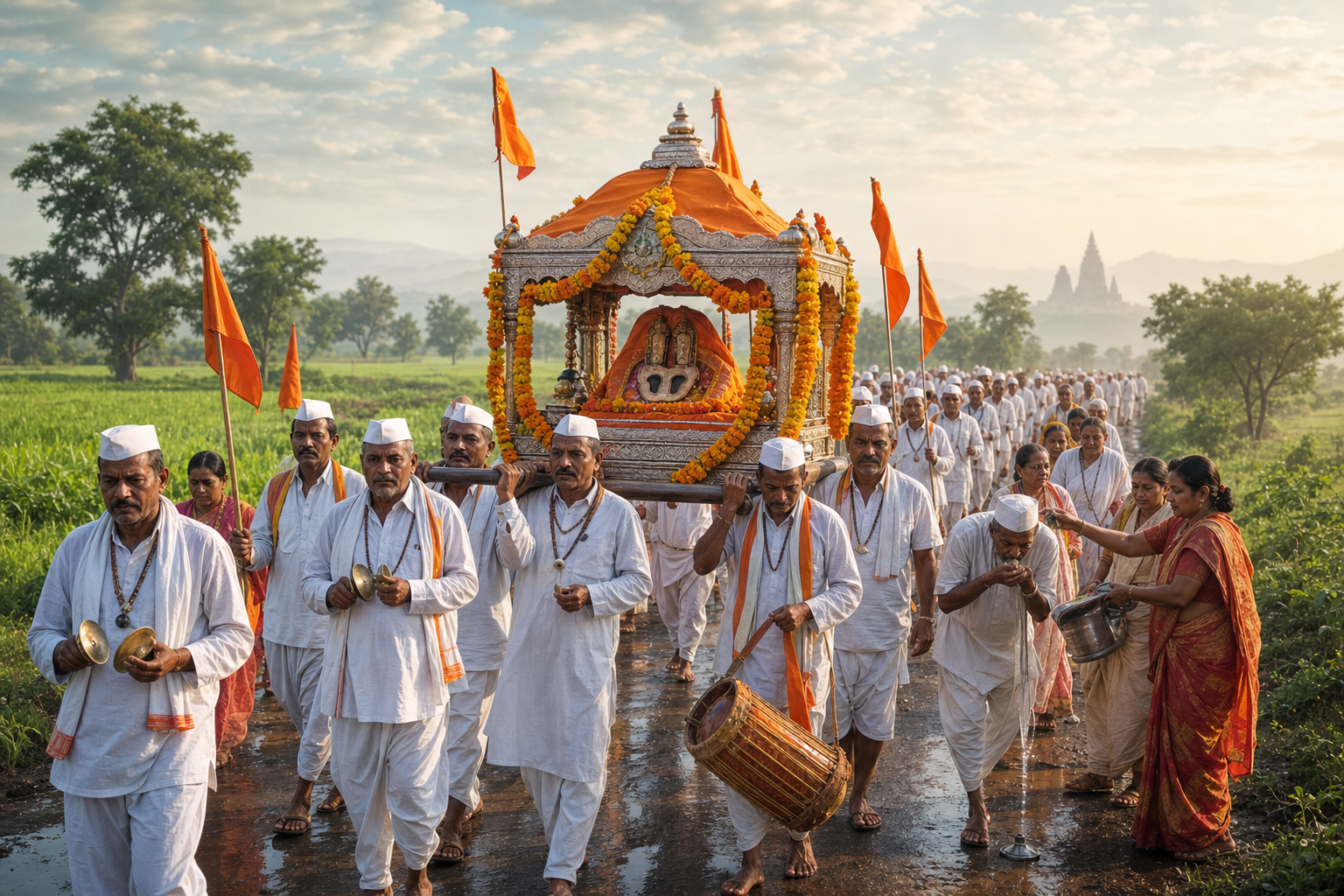
Sant Gajanan Maharaj Palkhi 2026 refers to the annual devotional procession associated with Sant Gajanan Maharaj of Shegaon and the wider Pandharpur Wari tradition of Maharashtra. It is not merely a religious event; it is a disciplined social institution, a moving school of bhakti, and a living example of how pilgrimage can organize devotion, service, self-restraint, and community life into one sustained journey.
The procession is commonly understood as a Payi Wari, a pilgrimage undertaken on foot. In this tradition, warkaris move in disciplined groups, sing abhangs, chant the name of the Divine, and travel toward Pandharpur, the sacred town associated with Lord Vithoba and Rakhumai. The invocation “Mauli” gives the journey its emotional language: the Divine, the saint, the fellow pilgrim, and the path itself are approached with maternal tenderness, reverence, and trust.
The Sant Gajanan Maharaj Palkhi has a special identity within Maharashtra’s pilgrimage culture because it begins from Shegaon, the principal seat of Sant Gajanan Maharaj’s samadhi tradition. Shegaon is often described with great affection by devotees as a major spiritual center of Vidarbha, and the Palkhi carries that regional devotion into the broader Vaishnava sacred geography of Pandharpur. The movement from Shegaon to Pandharpur therefore becomes both a physical journey and a symbolic meeting of two devotional centers.
Sant Gajanan Maharaj is remembered in Maharashtra as a saint, mystic, and spiritual guide whose life is associated with simplicity, direct experience, compassion, and inner discipline. Biographical traditions generally place his public appearance in Shegaon in the late nineteenth century and his samadhi in 1910. His devotees often read his legacy through the integrated lens of bhakti, karma, and jnana: devotion, service, and knowledge are not treated as rival paths but as mutually sustaining dimensions of spiritual life.
This integrative approach is central to understanding why the Palkhi Sohala has remained meaningful. A pilgrimage of this scale cannot be sustained by sentiment alone. It requires timekeeping, group discipline, food arrangements, rest halts, sanitation, traffic coordination, medical awareness, and respect for village communities along the route. The devotional frame is visible in chant and worship, but the deeper structure is an ethic of responsibility.
The chant “Gan Gan Gणात Bote” is among the most recognizable sound markers of devotion to Sant Gajanan Maharaj. In the Palkhi context, such chanting performs several functions at once. It keeps rhythm during walking, creates shared concentration, reduces the loneliness of long-distance travel, and reinforces the sense that the pilgrim is not moving as an isolated individual but as part of a disciplined spiritual body.
The word Palkhi refers to the palanquin that ceremonially carries the saint’s paduka or sacred presence. In the Varkari imagination, the Palkhi is not treated as a decorative vehicle. It is the ritual center of the procession. Warkaris align their movement, singing, and conduct around it, and the Palkhi becomes a public reminder that the saint’s teaching is carried through collective action rather than private belief alone.
The 2026 observance belongs to the larger cycle of Ashadhi Wari, the pilgrimage season connected with Ashadhi Ekadashi and Pandharpur. Since dates, halts, traffic rules, and local arrangements follow the lunar calendar, weather conditions, and administrative planning, participants should verify the latest official schedule through Shri Sant Gajanan Maharaj Sansthan, Shegaon, local authorities, and current Wari notices before beginning travel.
The Shegaon-Pandharpur journey is often discussed in public reports as a many-week pilgrimage covering a long outward route to Pandharpur and a return journey to Shegaon. Its scale is important because it transforms the Palkhi from a local devotional procession into a regional institution. Hundreds of warkaris, dressed in simple traditional clothing, often carrying saffron flags and tulsi malas, participate with a seriousness that makes discipline itself a form of worship.
The broader Pandharpur Wari tradition is among the most influential pilgrimage traditions in India. It has historically linked saints, villages, farmers, artisans, householders, ascetics, singers, and ordinary devotees into a shared devotional network. Its defining strength is not social spectacle but repetition: year after year, the journey teaches that spiritual memory is preserved by walking, singing, serving, and returning.
Within this tradition, the Sant Gajanan Maharaj Palkhi is especially admired for orderliness. The discipline of a dindi, or organized group of warkaris, offers a technical model for managing movement. A dindi has internal leadership, expected conduct, shared timings, and collective accountability. The group format prevents the pilgrimage from becoming an unregulated crowd and allows devotional enthusiasm to remain aligned with safety and mutual care.
The technical demands of the Palkhi are substantial. Daily walking requires careful pacing, hydration, foot care, basic medical readiness, and attention to the monsoon climate. The route requires coordination with villages, police, health workers, volunteers, and local service groups. At its best, the Palkhi shows how traditional religious systems developed practical solutions to problems that modern crowd management also studies: flow, rest, communication, waste control, and emergency response.
The spiritual meaning of the Palkhi is inseparable from such practical details. A pilgrim who walks without regard for others has not understood the Wari. A pilgrim who keeps time, shares water, respects women and elders, avoids waste, follows the dindi’s instructions, and does not obstruct local residents is practicing dharma in public form. The journey turns ordinary conduct into a measurable test of humility.
The Sant Gajanan Maharaj Palkhi also reveals the democratic quality of the Varkari ethos. The shared chant, shared road, shared dust, and shared fatigue soften visible differences of wealth, profession, education, and status. This does not mean that social realities disappear, but it does mean that the pilgrimage creates a disciplined space where devotion is valued above display.
This is one reason the Palkhi remains emotionally powerful even for observers who may not walk the entire route. To watch warkaris move with cymbals, flags, abhangs, and folded hands is to see memory made public. The scene carries a rare combination of austerity and warmth: the body is tired, but the collective mood is lifted by rhythm, song, and the conviction that the journey itself is sacred.
Pandharpur gives the pilgrimage its destination and theological focus. Lord Vithoba, standing on the brick, is central to the devotional imagination of Maharashtra. The form of Vithoba is accessible, intimate, and deeply connected with saint-poets such as Dnyaneshwar, Tukaram, Namdev, Chokhamela, Janabai, Eknath, and other figures of the bhakti movement. The Sant Gajanan Maharaj Palkhi enters this landscape not as an isolated sectarian claim but as one stream within a larger river of devotion.
The unity of dharmic traditions can be seen clearly here. The Palkhi’s emphasis on seva resonates with Sikh traditions of service and langar. Its self-restraint and simplicity echo Jain respect for discipline and non-harm. Its mindful walking, chanting, and attention to inner transformation can be meaningfully compared with Buddhist practices of collective discipline and awareness. Its devotional center remains Hindu and Varkari, yet its ethical vocabulary speaks to a wider dharmic civilizational pattern.
This comparison should not erase the distinctiveness of each tradition. Hinduism, Buddhism, Jainism, and Sikhism have different histories, scriptures, practices, and theological frameworks. Yet the Palkhi demonstrates a shared dharmic grammar: the body is disciplined, the ego is reduced, the community is served, food and shelter are treated as sacred responsibilities, and the journey becomes a means of inner refinement.
The 2026 Palkhi should therefore be understood not only as an event calendar entry but as a case study in living heritage. It preserves oral traditions through abhangs and chants. It preserves embodied knowledge through walking formations and group discipline. It preserves sacred geography by linking Shegaon, village routes, and Pandharpur. It preserves social ethics by turning service into a public norm.
For first-time participants, preparation should begin well before the day of joining. Walking practice is essential, especially for those unaccustomed to long distances. Footwear should be tested in advance, not used for the first time during the pilgrimage. Light clothing, rain protection, prescribed medicines, basic identity documents, and a small medical kit should be carried without overloading the body.
Food discipline is equally important. The Wari tradition values simplicity, and overeating during a walking pilgrimage can quickly become a health problem. Clean water, moderate meals, and respect for community food arrangements help maintain stamina. Participants should avoid creating pressure on host villages and should accept local hospitality with gratitude and restraint.
Health awareness is not a modern intrusion into pilgrimage; it is part of responsible dharma. Elderly participants, children, pregnant women, and people with chronic conditions should seek medical advice before joining long stretches. Those on medication should carry sufficient supplies and keep companions informed. The Palkhi is sacred, but it is still a demanding physical undertaking.
Environmental responsibility has become increasingly important in large pilgrimages. Plastic waste, discarded food packets, and careless littering contradict the spirit of the Wari. A pilgrim walking in the name of Sant Gajanan Maharaj and Vithoba should treat roads, fields, rivers, temples, and village spaces as shared sacred environments. Clean conduct is not secondary to devotion; it is devotion made visible.
Modern technology can support the Palkhi when used with restraint. Mobile phones help families remain informed, maps assist with orientation, and digital advisories can communicate weather or traffic changes. At the same time, excessive filming, loud personal entertainment, and intrusive photography can weaken the contemplative dignity of the journey. The camera should not become more important than the darshan of the path.
The role of local communities deserves special recognition. Villages along the route do not merely witness the Palkhi; many become temporary hosts, organizers, donors of food and water, and guardians of the devotional atmosphere. Their contribution turns the pilgrimage into a distributed network of service. The road to Pandharpur is therefore built not only of geography but of hospitality.
The Palkhi also offers a lesson in leadership. The best leadership in such a setting is not loud or self-promotional. It is procedural, calm, punctual, and service-oriented. Dindi leaders, volunteers, medical workers, police, temple representatives, and village organizers all contribute to an order that allows devotion to remain safe and inclusive.
In academic terms, the Sant Gajanan Maharaj Palkhi can be studied as ritual movement, collective memory, sacred geography, public religion, and community logistics. In emotional terms, it is simpler: people walk because the saint matters, because Vithoba matters, because inherited devotion still has the power to shape daily conduct, and because the road itself teaches what books alone cannot.
The phrase Sant Gajanan Maharaj Palkhi 2026 will attract attention from devotees searching for dates, route information, and travel guidance. Yet the deeper search is for meaning. The Palkhi asks whether devotion can be disciplined, whether community can be organized without losing tenderness, and whether tradition can remain alive without becoming chaotic or merely performative.
The answer offered by the Warkari tradition is practical and profound. Walk with humility. Sing with attention. Serve without display. Respect the group. Care for the weak. Keep the road clean. Remember the saint. Move toward Pandharpur not as a tourist of sacred culture but as a participant in a living discipline.
For 2026, the most responsible approach is to combine devotion with verification. Before joining the procession, participants should confirm the official schedule, expected halts, local restrictions, health advisories, and weather updates. The sanctity of the Palkhi is strengthened when preparation is careful and conduct is mature.
Ultimately, the Sant Gajanan Maharaj Palkhi remains one of Maharashtra’s most meaningful expressions of bhakti in motion. From Shegaon to Pandharpur, the pilgrimage carries more than a palanquin. It carries a civilizational memory of disciplined devotion, shared service, dharmic unity, and the enduring human desire to walk toward the Divine with others.
Reference note: This overview draws on the Sant Gajanan Maharaj Palkhi listing at HinduPad, public context from Shri Gajanan Maharaj Sansthan, Shegaon, and contemporary reporting on Maharashtra’s Wari and Palkhi traditions. Devotees should rely on current official notices for final 2026 travel decisions.
Inspired by this post on Hindu Pad.







Leave a Reply
You must be logged in to post a comment.