
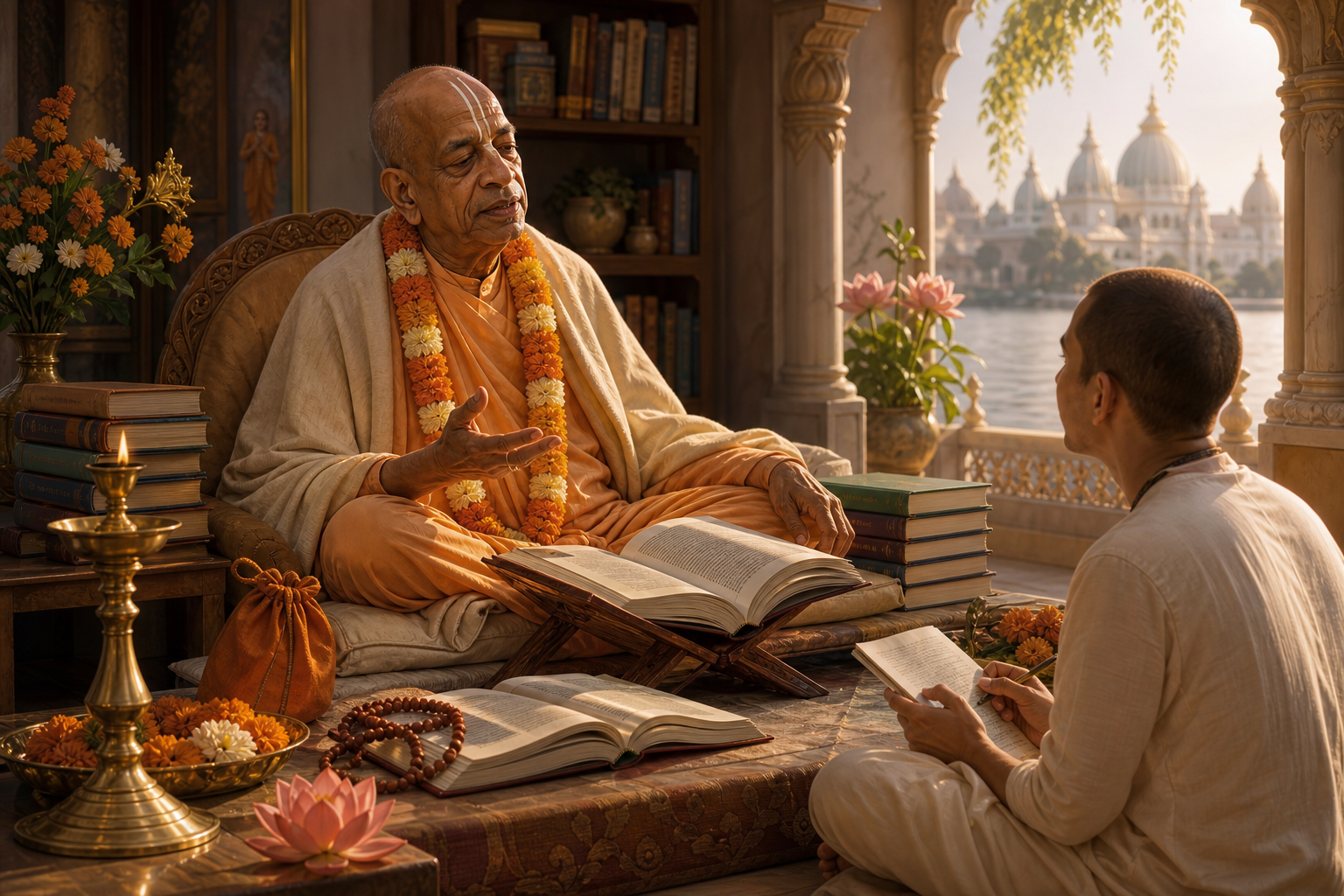
The remembrance of Srila Prabhupada by Tranakarta das belongs to an important category of modern Vaishnava historical testimony: the lived memory of a disciple who encountered a spiritual teacher not merely as a public founder, but as a daily presence, guide, reformer, and example of disciplined devotion. Such recollections are valuable because they preserve details that formal biographies often cannot fully capture. They show how Srila Prabhupada’s teachings moved from books, lectures, and temples into the lives of individuals who tried to practice Krishna consciousness under his guidance.
Srila Prabhupada, born Abhay Charan De in 1896, became globally known as the founder-acharya of the International Society for Krishna Consciousness, commonly known as ISKCON. His contribution was not limited to the establishment of institutions. He translated and commented on foundational Vaishnava texts, including Bhagavad-Gita, Srimad-Bhagavatam, and Caitanya-caritamrita, and presented bhakti-yoga in a vocabulary that could be understood by readers far beyond India. For many disciples, including those whose memories are preserved by VanimediaMayapur and Vanipedia, his influence was simultaneously theological, cultural, personal, and practical.
The video titled Tranakarta das Remembers Srila Prabhupada, shared through the VanimediaMayapur channel, should be understood as part of this broader archive of oral history. These recordings matter because spiritual traditions are transmitted not only through doctrine but through relationship. In the guru-shishya tradition, knowledge is received through attentive hearing, disciplined practice, service, and the gradual formation of character. A disciple’s memory, when presented carefully, becomes a window into how teachings were embodied in real circumstances.
What makes such remembrance especially compelling is the human scale of the narrative. Srila Prabhupada is often discussed in terms of global religious expansion, the spread of the Hare Krishna movement, temple construction, book distribution, and the public presence of kirtan in cities across the world. Yet the memories of disciples reveal another dimension: the atmosphere of a room, the force of a few words, the discipline of daily sadhana, the correction of mistakes, the encouragement given to young seekers, and the way a guru could make ancient dharma feel immediate and practical.
Tranakarta das’s remembrance, by its very nature, invites reflection on how personal testimony functions within a dharmic community. It is not a replacement for scripture, nor is it merely nostalgia. It is a form of cultural preservation. In traditions such as Hinduism, Buddhism, Jainism, and Sikhism, memory has always played a central role in transmitting values across generations. Saints, acharyas, gurus, monks, sadhus, granthis, teachers, and household practitioners have preserved living traditions through stories of conduct, humility, courage, discipline, compassion, and surrender.
In the case of Srila Prabhupada, remembrance is inseparable from mission. His work carried Gaudiya Vaishnava teachings from Bengal and Vrindavan into a global context during the twentieth century. He did this while insisting that spiritual life required serious practice rather than vague sentiment. Chanting the holy names, studying scripture, honoring prasadam, living ethically, avoiding intoxication and exploitative habits, and serving Krishna with sincerity were not presented as cultural accessories. They were presented as a complete spiritual discipline.
The technical dimension of Srila Prabhupada’s teaching is sometimes underestimated. His presentation of Krishna consciousness involved a coherent theological framework. At its center is the understanding that the jiva, the individual living being, is eternal, distinct from the temporary body, and naturally related to Krishna through loving service. Bhakti is therefore not merely emotional worship; it is a structured path of consciousness purification. Hearing, chanting, remembering, serving, worshiping, praying, becoming a servant, cultivating friendship with the Divine, and offering oneself are all recognized as limbs of devotional practice.
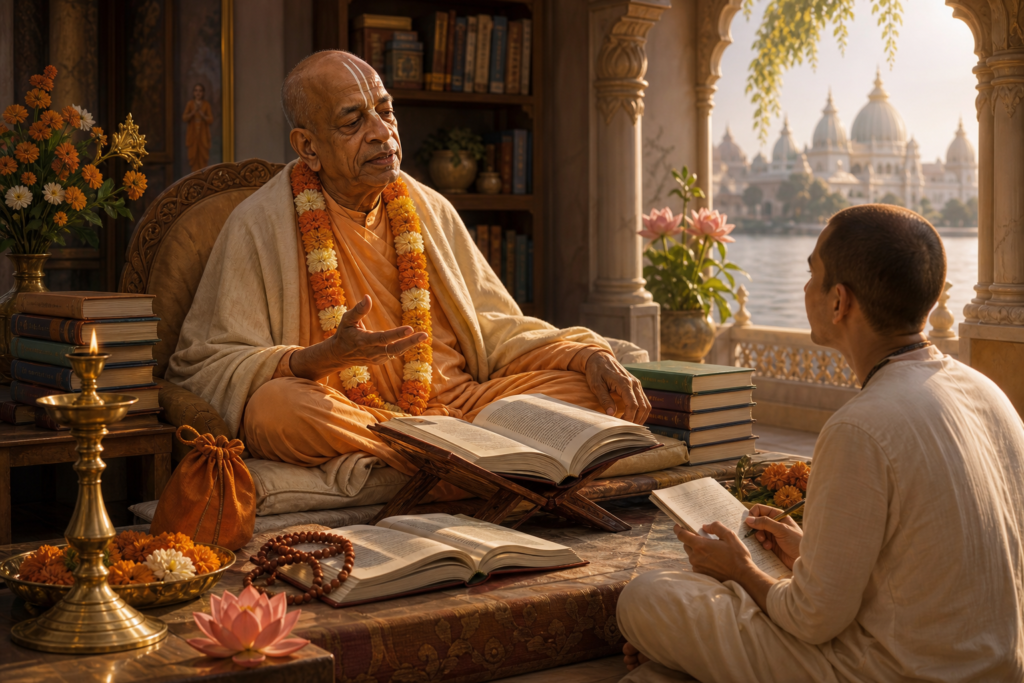
Such a framework also helps explain why disciple recollections are spiritually significant. When a disciple remembers Srila Prabhupada’s habits, instructions, gestures, discipline, or compassion, the memory often illustrates a principle already found in shastra. A teacher’s conduct becomes a commentary on the text. A brief correction may illuminate detachment. A moment of kindness may reveal the nature of seva. A stern instruction may express responsibility rather than anger. A simple daily routine may become an example of steadiness in sadhana.
This is why Vanipedia’s archival project has enduring value. The preservation of Srila Prabhupada’s lectures, conversations, letters, translations, and disciple memories supports a more complete understanding of the Hare Krishna movement and its place within Sanatana Dharma. It allows students, devotees, scholars, and future generations to examine not only what was taught, but how it was received, practiced, and remembered. In that sense, a single reminiscence can become part of a much larger civilizational archive.
There is also an emotional seriousness in these memories. Devotional recollection is not sentimental in the shallow sense. It is often marked by gratitude, humility, and the recognition that a life was redirected by contact with a spiritual teacher. Many people encounter dharma first as philosophy, ritual, culture, or identity. But the presence of a realized teacher can transform these categories into lived conviction. Through such contact, abstract ideas about surrender, compassion, discipline, and transcendence become concrete.
Srila Prabhupada’s legacy also has to be situated within the broader dharmic commitment to plural spiritual pursuit. Although he taught from within the Gaudiya Vaishnava sampradaya, his work contributed to a wider recognition of Hindu spirituality, Sanskrit texts, kirtan, prasadam, temple worship, and bhakti-yoga across continents. His mission did not erase the diversity of dharmic traditions; rather, it demonstrated how one disciplined lineage could speak with clarity in a plural world. This matters for any serious effort to foster unity among Hindu, Buddhist, Jain, and Sikh communities while respecting their distinct teachings and practices.
The guru-shishya relationship at the heart of such remembrance is not a personality cult when properly understood. It is a disciplined pedagogical relationship rooted in humility, inquiry, service, and transformation. The guru is honored because the guru connects the disciple to truth, scripture, and the Divine. The disciple is not asked to become passive or unthinking; rather, the disciple learns to refine intelligence, regulate conduct, and align life with dharma. Srila Prabhupada repeatedly emphasized study, reasoned understanding, and practical application, which gave his movement a strong educational character.
In this context, Tranakarta das’s recollection can be read as more than a personal memory. It becomes a testimony to how spiritual authority is experienced by those who live near it. The most meaningful memories of great teachers are often not grand public events but small moments of clarity. A disciple may remember how the teacher listened, how he corrected, how he insisted on standards, how he protected devotional service, or how he carried responsibility without losing dependence on Krishna. These details help preserve the texture of a spiritual movement.
For contemporary readers, especially those who encounter Srila Prabhupada primarily through books, videos, or digital archives, such recollections provide a necessary bridge. They remind the modern mind that dharma is not only information. It is formation. It shapes habits, speech, diet, relationships, time, intention, and the meaning of work. The transformation described by disciples of Srila Prabhupada often began with hearing but matured through service, discipline, and community life.
The setting of Mayapur adds further significance. Mayapur is central to Gaudiya Vaishnava sacred geography as the birthplace of Sri Chaitanya Mahaprabhu, whose sankirtan movement emphasized the congregational chanting of Krishna’s names. Srila Prabhupada’s global mission drew deeply from this current. Therefore, a remembrance preserved through VanimediaMayapur is not merely a media item; it is connected to a sacred landscape, a theological lineage, and a living devotional culture that continues to draw practitioners from across the world.
Academic analysis should not flatten the devotional force of the subject. The phrase “All glories to Srila Prabhupada” expresses a devotional mood of gratitude and reverence. In a scholarly frame, it can be understood as a traditional mode of honoring a guru whose teachings and sacrifices are seen as spiritually transformative. Such language reflects the inner culture of bhakti, where remembrance is itself a form of service and gratitude is treated as a discipline of the heart.
At the same time, factual clarity is essential. Srila Prabhupada’s historical achievement was extraordinary because he began his major global preaching work late in life, traveled from India to the United States in 1965, and built an international institution in a short span of years. His translations and commentaries remain among the most widely circulated presentations of Vaishnava theology in the modern world. His disciples’ memories, including those of Tranakarta das, should therefore be read alongside his books, letters, recorded lectures, and institutional history.
One of the most relevant lessons from such remembrance is the importance of spiritual seriousness in an age of distraction. Srila Prabhupada taught that devotion requires attention, steadiness, and disciplined hearing. Modern life often fragments attention and reduces spiritual traditions to aesthetics, slogans, or identity markers. The memory of a demanding yet compassionate teacher challenges that reduction. It asks whether spiritual life is being practiced deeply enough to change conduct, not merely admired from a distance.
Another lesson concerns transmission. Dharmic traditions survive when knowledge is preserved accurately and lived sincerely. Books are essential, temples are essential, rituals are essential, and institutions are essential. Yet without practitioners who remember, embody, and transmit the spirit of the teachings, even strong institutions can become hollow. Disciple recollections help guard against that loss by keeping attention fixed on lived standards: humility, service, chanting, study, restraint, compassion, and devotion.
Srila Prabhupada’s influence also demonstrates the relationship between local tradition and global communication. He did not abandon Sanskritic and Vaishnava categories to gain popularity. Instead, he translated them, explained them, and built practices around them. Terms such as bhakti, karma, jiva, guru, prasadam, kirtan, dharma, and Krishna consciousness entered global religious vocabulary through repeated teaching and disciplined community practice. This model remains important for all dharmic communities seeking to communicate deeply without diluting their foundations.
Tranakarta das’s remembrance is therefore best approached as a contribution to spiritual memory, Vaishnava history, and the study of modern Hindu movements. It invites careful listening rather than casual consumption. It also encourages readers to ask what makes a teacher’s life memorable. The answer, in the case of Srila Prabhupada, lies not only in public achievement but in the capacity to awaken devotion, discipline, and purpose in others.
The enduring power of such memories is that they bring the past into the ethical present. They ask what should be preserved, what should be practiced, and what kind of inner life should be cultivated. For devotees, the answer may be renewed commitment to chanting, seva, and study. For scholars, the answer may be a deeper appreciation of how oral testimony enriches institutional history. For the wider dharmic community, the answer may be a reminder that unity is strengthened when traditions honor their teachers while recognizing shared commitments to truth, discipline, compassion, and liberation.
In that sense, the remembrance of Srila Prabhupada by Tranakarta das is not merely about one disciple looking back. It is about how a living tradition remembers its sources of strength. It affirms that spiritual legacy is preserved through text, practice, place, sound, and memory. Above all, it shows that the real measure of a guru’s influence is found in transformed lives that continue to carry forward dharma with gratitude, clarity, and devotion.
Inspired by this post on Dandavats.



Leave a Reply
You must be logged in to post a comment.