
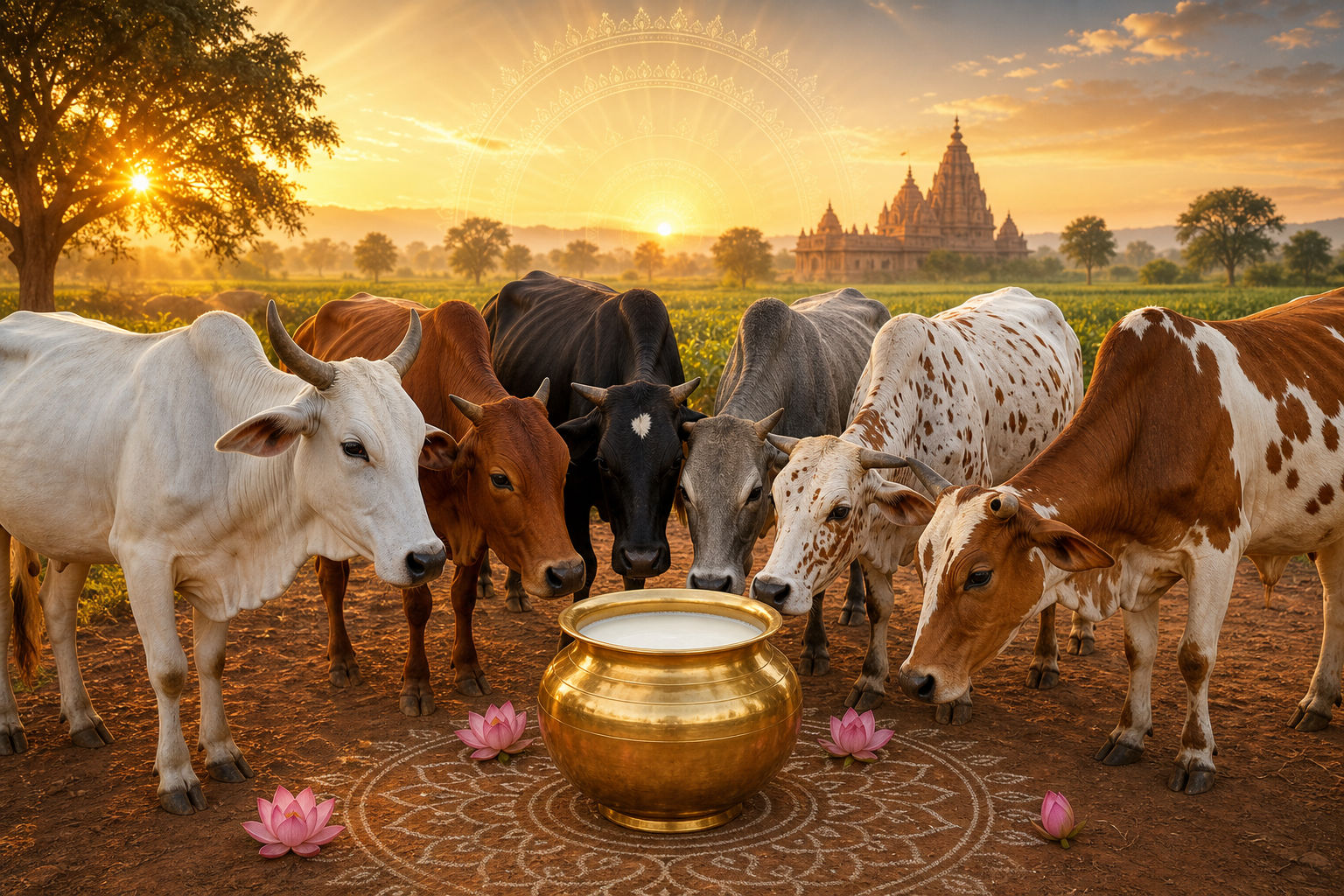
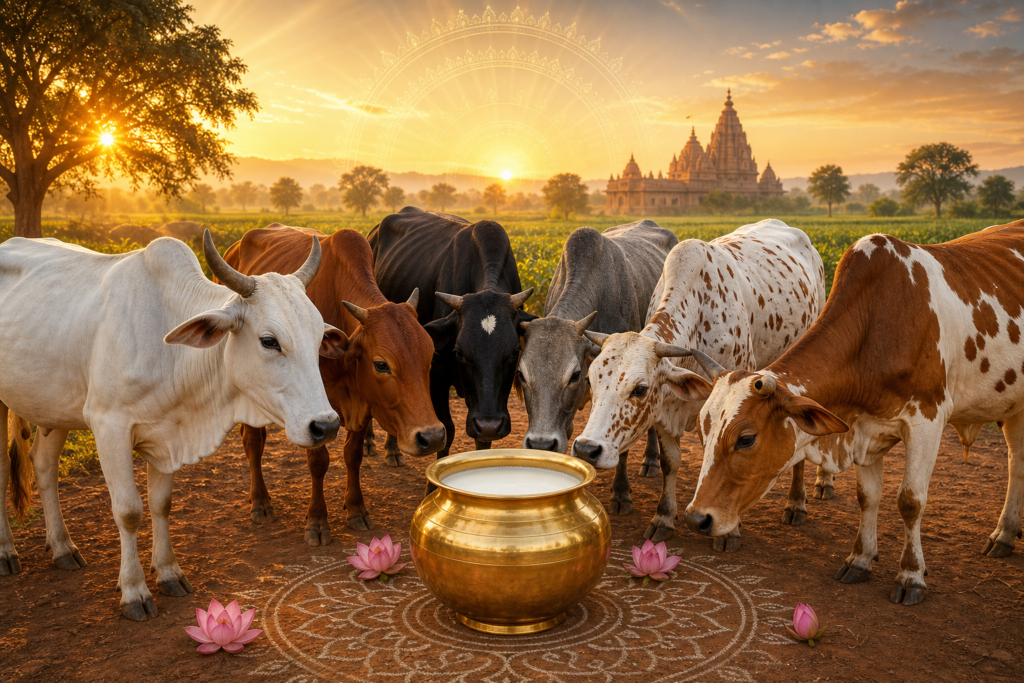
The teaching, “Cows come in different colors but milk of all cows is one color,” presents a compact and memorable expression of unity in diversity. In Hindu thought, such images are not ornamental sayings alone; they function as philosophical tools that convert abstract metaphysical insight into ordinary experience. A person may not immediately grasp the language of Brahman, Atman, dharma, or spiritual pluralism, but the image of cows of many colors producing milk of one essential nature is simple, earthy, and intellectually durable.
The meaning of the statement rests on a visible contrast. Cows may be white, brown, black, spotted, grey, or reddish. Their outward appearance differs, and those differences are real at the level of perception. Yet the milk they produce is broadly recognized by its common nourishing quality. The teaching therefore does not deny difference. It asks that difference be understood without losing sight of the deeper sameness that sustains life.
In Hindu philosophy, this insight is closely related to the principle that diversity is not necessarily fragmentation. The world presents many names, forms, customs, languages, rituals, temperaments, and spiritual disciplines. Hindu traditions have historically responded to this diversity through a wide range of paths: bhakti, jnana, karma, yoga, mantra, temple worship, meditation, household duty, renunciation, and philosophical inquiry. These paths differ in method, mood, and emphasis, but they are often understood as valid approaches to truth when practiced with sincerity, discipline, and ethical awareness.
The metaphor also resonates with the Hindu idea of an underlying reality beneath changing appearances. Vedantic traditions, especially Advaita Vedanta, speak of Brahman as the ultimate reality that remains beyond surface distinctions. Other Hindu schools interpret ultimate reality differently, with stronger emphasis on devotion, difference, qualified unity, divine personality, or cosmic order. Even so, many Hindu traditions share the conviction that the visible world cannot be understood only by its external separations. A deeper order, dharma, gives coherence to life.
This is why the saying remains spiritually powerful. It does not flatten all traditions into sameness, nor does it erase the meaningful differences between communities. Rather, it teaches that difference should not become a reason for arrogance, contempt, or spiritual isolation. Just as the color of the cow does not determine the nourishing value of milk, the outer form of a sincere spiritual path does not alone determine its worth.
A technical reading of the metaphor also enriches its force. Milk generally appears white because light is scattered by its casein micelles and fat globules. In practical life, the color of milk can vary slightly due to breed, diet, fat content, and carotenoid levels, but its broad identity as milk remains recognizable. This biological detail strengthens the philosophical lesson rather than weakening it. Unity is not mechanical uniformity; it is a shared nature that can exist alongside variation.
Hinduism’s acceptance of multiple approaches to the sacred is often captured through the broader idea of spiritual pluralism. The Rig Vedic expression often rendered as “Truth is one, sages call it by many names” has long been invoked to explain this orientation. The point is not that every claim is identical or equally examined, but that human access to the sacred is shaped by language, culture, temperament, discipline, and level of realization. This produces variety without necessarily destroying unity.
The same insight can be seen in the idea of Ishta, the chosen form or preferred mode of approaching the Divine. One devotee may worship Shiva, another Vishnu, another Devi, another Ganesha, Surya, Subrahmanya, or a formless absolute. These choices are not merely personal preferences in a shallow sense; they reflect temperament, lineage, family tradition, regional culture, and inner disposition. Hindu spiritual practice often recognizes that different people require different disciplines, symbols, and devotional languages.
This is also why the teaching is socially relevant. Human societies are filled with visible differences: caste background, region, language, ritual custom, dress, food habit, profession, education, and family structure. When these differences are treated as ultimate, they can harden into pride or exclusion. When they are interpreted through dharma, they can become part of a larger moral order in which dignity, restraint, compassion, and mutual responsibility matter more than external identity.
The cow metaphor carries emotional force because it is drawn from daily life. It does not speak from an abstract classroom alone; it comes from the world of household, field, nourishment, care, and dependence. Milk evokes childhood, family, food, offering, hospitality, and ritual purity in many Indian settings. The lesson therefore reaches the mind through the senses. It reminds society that spiritual truth is not distant from ordinary life; it can be seen in the most familiar acts of nourishment.
Within the wider family of Dharmic traditions, the principle can be extended with care and precision. Buddhism, Jainism, Sikhism, and Hinduism do not teach identical doctrines, and each must be respected in its own integrity. Yet these traditions share a deep concern for discipline, ethical conduct, self-transformation, compassion, liberation from ignorance, and the overcoming of ego-centered life. Their differences are real, but so are their civilizational affinities.
Jain philosophy offers the important principle of Anekantavada, the doctrine that reality is complex and cannot be exhausted by a single partial viewpoint. This does not mean that truth is meaningless; it means that intellectual humility is necessary. The cow and milk metaphor similarly warns against judging reality by surface alone. What appears different from one angle may participate in a deeper continuity when examined more carefully.
Buddhist thought adds another related insight through the teaching of interdependence. Beings and events do not exist in isolated self-sufficiency; they arise through causes, conditions, relationships, and consequences. From this perspective, social harmony requires awareness that one community’s suffering cannot be permanently separated from another’s. Diversity without compassion becomes fragmentation, while diversity guided by wisdom becomes a field for mutual awakening.
Sikh teachings, especially the affirmation of Ik Onkar, place profound emphasis on the oneness of ultimate reality and the dignity of human life. The Sikh tradition’s stress on seva, remembrance, courage, and equality offers a practical expression of unity that is not merely theoretical. The principle behind the cow metaphor therefore finds an ethical echo across Dharmic life: external difference must never obscure the shared sacred worth of beings.
The teaching also challenges a common modern misunderstanding. Unity in diversity is sometimes treated as a polite slogan, useful for speeches but weak in practice. In Hindu spiritual thought, however, it has demanding implications. It requires control of ego, restraint in speech, intellectual humility, openness to learning, and the ability to honor a path without needing to erase other paths. It asks individuals and communities to distinguish between conviction and contempt.
There is also a necessary caution. Unity should not be confused with indifference to truth. Hindu traditions contain debate, logic, scriptural interpretation, disagreement, and rigorous philosophical inquiry. Vedanta, Samkhya, Yoga, Nyaya, Mimamsa, Shaiva, Shakta, Vaishnava, and other traditions often disagree deeply. Yet these disagreements exist within a larger culture that has often allowed multiple ways of seeking, arguing, worshipping, and realizing. The ideal is not silence, but disciplined plurality.
In this sense, the metaphor of cows and milk is not sentimental. It is intellectually mature. It recognizes the empirical fact of difference, the social fact of plurality, the psychological fact of varied temperaments, and the spiritual possibility of underlying unity. A society that understands only difference becomes divided. A society that understands only sameness becomes coercive. Dharma seeks a more balanced vision: difference honored, unity remembered.
The teaching also speaks directly to religious coexistence. A temple, gurdwara, vihara, Jain mandir, monastery, household shrine, or meditation space may look different in architecture, ritual rhythm, language, and symbol. Yet each can become a place where human beings confront suffering, seek meaning, cultivate discipline, remember the sacred, and attempt moral refinement. The external forms vary, but the aspiration toward transformation is widely recognizable.
At a personal level, this teaching can soften the habit of instant judgment. People often evaluate others by accent, clothing, ritual practice, sectarian identity, food habits, or inherited custom. The metaphor asks for a slower and more humane intelligence. What is the ethical quality of the person? What nourishment does the path produce? Does it cultivate truthfulness, compassion, courage, humility, self-control, and service? These questions are closer to the spirit of dharma than superficial classification.
The teaching therefore has a practical application in family life and community life. In many households, different members may have different forms of devotion: one may be drawn to Krishna bhakti, another to Shiva, another to Devi, another to meditation, another to seva, and another to philosophical study. A mature Dharmic household need not experience this as contradiction. It can see these variations as different streams of spiritual temperament flowing toward refinement of life.
The same principle can guide education. Children introduced to Hinduism and other Dharmic traditions should not be taught diversity as confusion. They should be taught that diversity has structure, history, and meaning. Different festivals, deities, scriptures, sects, teachers, and practices are not random fragments. They are part of a long civilizational conversation about truth, duty, liberation, devotion, knowledge, and right conduct.
For contemporary society, the phrase also offers an antidote to identity-based hostility. Modern public life often rewards exaggeration of difference. Social media, political rhetoric, and cultural conflict can turn communities into opposing camps. The cow and milk teaching introduces a quieter but more durable civilizational wisdom: outward distinction is not a license for inner division. The shared human search for meaning must remain visible.
Vasudhaiva Kutumbakam, the vision of the world as one family, belongs to the same moral universe. A family is not made of identical persons. It contains elders and children, contemplatives and workers, scholars and artisans, ritualists and skeptics, quiet people and expressive people. Its unity is sustained not by sameness but by relationship, obligation, affection, and shared responsibility. The cow metaphor offers the same insight in a shorter form.
In Hindu ethics, the highest value of such a teaching is not merely intellectual agreement. Its purpose is transformation of conduct. If all beings participate in a deeper sacred order, then arrogance becomes spiritually crude. If sincere paths can differ, then contempt becomes unnecessary. If nourishment matters more than appearance, then the fruits of a practice must be judged by the character it produces.
The statement “Cows come in different colors but milk of all cows is one color” is therefore a small teaching with a wide philosophical range. It speaks about metaphysics, society, religious pluralism, family culture, interfaith respect, and inner discipline. It encourages people to see difference without fear and unity without domination. Its enduring value lies in this balance: the many are real, the one is real, and wisdom lies in learning how to honor both.
Inspired by this post on Hindu Blog.







Leave a Reply
You must be logged in to post a comment.