
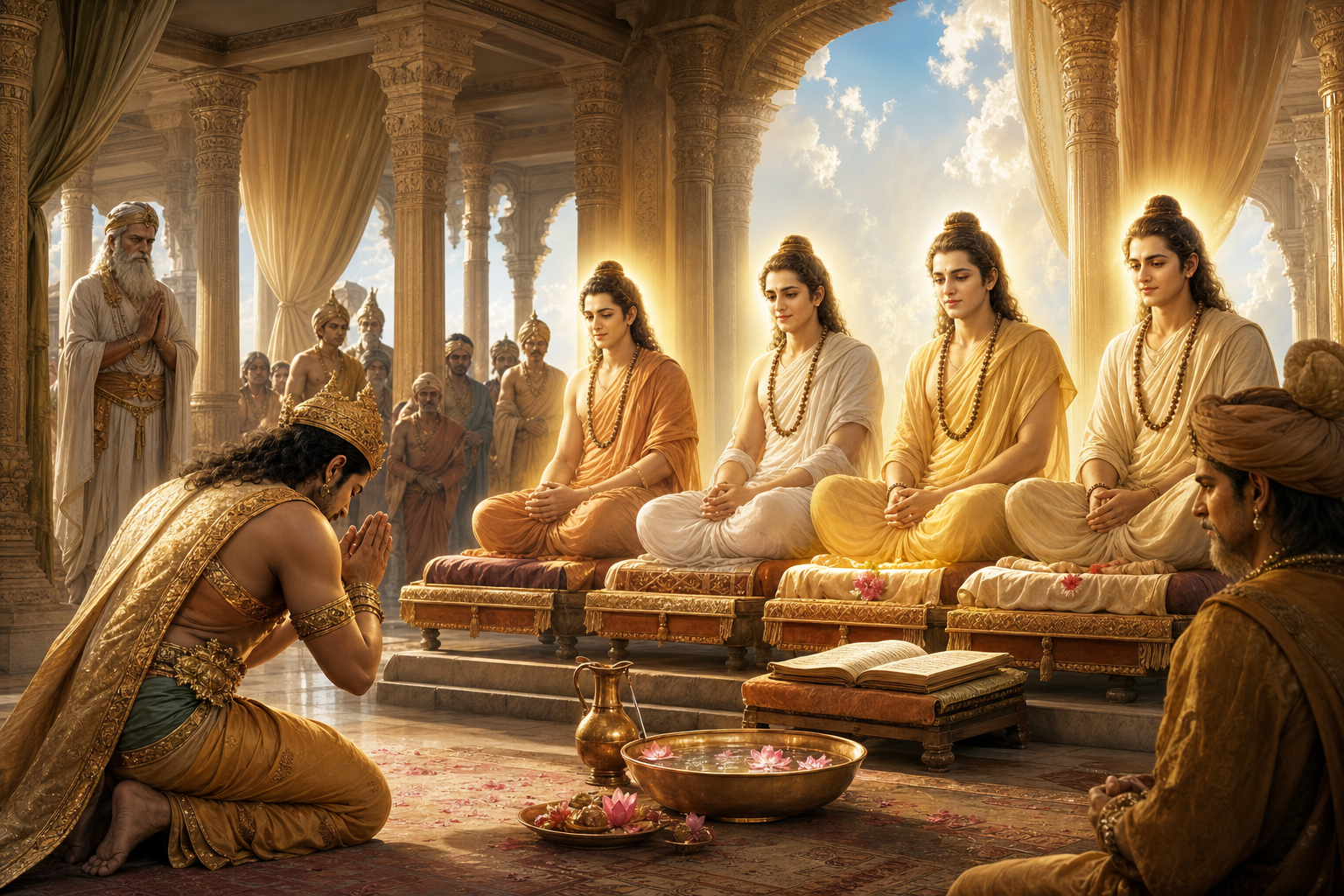
A class on Śrīmad-Bhāgavatam 4.22.1-16 with Advaita Acarya Prabhu naturally centers on one of the most refined meetings in the Fourth Canto: the arrival of the four Kumāras before King Pṛthu. The passage is brief in narrative action, yet dense in theological, ethical, and social meaning. It presents a king at the height of royal dignity who responds to realized sages not with pride, display, or political calculation, but with humility, ritual hospitality, philosophical urgency, and concern for the welfare of all beings.
The chapter, traditionally known as “Pṛthu Mahārāja’s Meeting with the Four Kumāras,” follows the public glorification of Pṛthu by his citizens. At precisely the moment when royal praise might have intensified self-importance, the narrative introduces Sanaka, Sanātana, Sanandana, and Sanat-kumāra, the ancient sons of Brahmā. Their presence redirects attention away from worldly authority and toward spiritual authority. In that shift lies one of the Bhagavatam’s recurring lessons: good governance and genuine spirituality are not enemies; the ruler becomes complete only when temporal power bows before transcendental wisdom.
Śrīmad-Bhāgavatam 4.22.1-2 describes the Kumāras as luminous beings arriving from the sky, recognized by Pṛthu and his assembly through their extraordinary effulgence. The imagery is not merely decorative. In Purāṇic literature, radiance often signifies inner realization, purity of consciousness, and freedom from material contamination. The sages do not need armies, insignia, titles, or wealth to establish their status. Their authority is embodied in self-mastery, celibacy, knowledge, detachment, and direct absorption in the Supreme.
Pṛthu’s reaction is especially revealing. The king rises quickly with his ministers and attendants, eager to receive the Kumāras. The text compares his eagerness to the sudden pull experienced by a conditioned being whose senses are drawn toward the modes of material nature. The comparison is striking because it turns a familiar psychological pattern toward a sacred end. Ordinary attraction binds the mind to objects of enjoyment, but Pṛthu’s attraction is toward saintly association. The same intensity that often drags the human being outward can be purified and redirected toward sat-saṅga, the company of the spiritually awakened.
This is one of the passage’s most practical teachings. Spiritual life is not built only by rejecting desire in an abstract way. It is also built by educating desire, redirecting admiration, and learning to feel urgency for what genuinely liberates. A society becomes spiritually healthy when it teaches people to honor wisdom more than spectacle, restraint more than consumption, and self-realization more than status.
Verses 4.22.3-5 emphasize hospitality according to śāstra. Pṛthu offers seats, bows before the sages, worships them, and takes the water that washed their feet, sprinkling it on his head. These gestures may seem distant from modern habits, yet their ethical structure is still intelligible. The point is not empty ritualism. The point is disciplined reverence. In the Bhagavata Purana, reverence is a mode of knowledge because it trains the ego to perceive value beyond itself.
The washing of the feet of saintly persons, known in many devotional settings as pāda-sevana or pādodaka reverence, expresses the conviction that spiritual realization sanctifies ordinary space. Pṛthu does not merely “welcome” the Kumāras in a polite social sense. He treats their arrival as a divine opportunity. The home, palace, and kingdom become meaningful when they become places where wisdom is received. Without that opening to transcendence, even luxury remains spiritually barren.
In verse 4.22.6, the Kumāras are described as elder even to Lord Śiva, and when seated, they resemble blazing fire on an altar. This metaphor deserves attention. Fire in Vedic ritual transforms offerings, carries sacrifice, illuminates darkness, and purifies what it touches. The sages function in a similar way. Their presence transforms the royal court from a political assembly into a sacrificial space. The altar is no longer only a physical structure; it is the field of dialogue between power and wisdom.
Pṛthu then speaks with restraint. That restraint is important. The Bhagavatam repeatedly presents speech as an ethical act. Speech can flatter, manipulate, wound, distract, or liberate. Pṛthu’s speech is measured, humble, and purposeful. He does not use the opportunity to advertise his achievements. He asks about the ultimate good. In academic terms, the passage models a hierarchy of inquiry: practical life, social duty, and royal responsibility are meaningful only when ordered toward the highest aim of life.
In verses 4.22.7-8, Pṛthu confesses that the sight of such sages is extremely rare, even for mystic yogīs. He wonders what pious act could have brought them to him so effortlessly. This humility is not theatrical self-deprecation. It is a theological recognition that saintly association is grace. The king understands that some gifts cannot be purchased, commanded, or produced by administrative power. They arrive through divine arrangement and must be received with gratitude.
The verse also establishes an important Vaiṣṇava principle: the blessings of brāhmaṇas and Vaiṣṇavas bring access to rare attainments, because saintly persons carry the favor of Viṣṇu and Śiva. This should not be read as sectarian competition. The passage harmonizes dharmic reverence by presenting divine personalities and realized beings as aligned in the upliftment of the living entity. In the broader spirit of Sanatana Dharma, the genuine saint is not a threat to another path of truth-seeking; the saint is a bridge from ego-centered existence to God-centered life.
Verse 4.22.9 compares the hidden movement of the sages to the hidden presence of the Supersoul, Paramātmā, within the heart. This comparison is philosophically rich. The Paramātmā is near yet unseen, intimate yet unrecognized by those whose perception remains externalized. Similarly, the realized sages may move through the worlds, but ordinary people may fail to identify their significance. The limitation lies not in the saint’s absence but in the observer’s lack of spiritual sight.
This idea has enduring relevance. Modern life is saturated with visibility, but visibility is not the same as value. The most advertised voice is not necessarily the wisest. The most viral message is not necessarily the most truthful. Bhagavatam 4.22 invites a disciplined reevaluation of recognition itself. Whom does society notice? Whom does it ignore? What kind of presence is considered successful? Pṛthu’s greatness is shown in his ability to recognize greatness when it appears before him in the form of renounced sages.
Verses 4.22.10-11 develop a theology of the home. Pṛthu says that even a poor householder becomes glorified when saintly persons enter the home and are offered water, a seat, and respectful reception. Conversely, a materially prosperous house where devotees are never welcomed is compared to a dangerous place inhabited by venomous serpents. The contrast is severe, but its purpose is ethical clarity. Wealth without sanctity can become spiritually poisonous; simplicity joined with devotion becomes glorious.
The gṛhastha, or householder, is not dismissed in this passage. Household life is honored when it becomes hospitable to dharma. A home becomes sacred not by income level, architecture, or social prestige, but by the values it receives and transmits. In this sense, the Bhagavatam offers a constructive model for family life across dharmic traditions: the home should nourish learning, humility, service, compassion, and remembrance of the Divine.
Verse 4.22.12 praises the Kumāras as lifelong brahmacārīs who remain childlike though deeply experienced in liberation. The paradox is central to their identity. They are ancient yet youthful, learned yet innocent, renounced yet active in compassion. Their childlike form does not imply immaturity. It indicates freedom from the hardened ego, social vanity, and acquisitive anxieties that often accompany worldly adulthood. The Bhagavatam therefore distinguishes between childishness and spiritual simplicity.
This distinction carries emotional force. Many seekers recognize that the burden of spiritual life is not only ignorance but also accumulated defensiveness. The heart becomes layered with ambition, disappointment, comparison, and fear. The Kumāras represent a consciousness that has not been conquered by these layers. Their presence suggests that liberation is not a loss of depth but the recovery of luminous simplicity.
In verse 4.22.13, Pṛthu asks the essential question: what hope exists for persons trapped in dangerous material existence because of previous actions and absorbed in sense gratification? The question is compassionate rather than merely theoretical. Pṛthu is a ruler, and a ruler cannot seek liberation only for himself. His inquiry includes citizens, householders, laborers, rulers, ascetics, and all who experience the pressures of karma, desire, and mortality.
The phrase “dangerous material existence” should not be understood as contempt for the world. The Bhagavatam does not deny the world’s beauty, relational tenderness, or moral possibilities. Rather, it diagnoses the instability of life lived without spiritual orientation. Pleasure fades, bodies age, status changes, loved ones depart, and the mind remains restless when it has no higher anchor. The danger lies in mistaking the temporary for the ultimate.
Verse 4.22.14 shows Pṛthu’s philosophical sensitivity. He says there is no real need to ask about the welfare of the Kumāras because they are absorbed in spiritual bliss, beyond mental constructions of auspicious and inauspicious. This is not indifference to their wellbeing. It recognizes that realized beings live from a level of consciousness not governed by ordinary dualities. For them, good and bad fortune are not measured by comfort, praise, loss, or gain.
The point is subtle and technically important. In Vedantic and bhakti traditions, liberation does not mean emotional numbness or social withdrawal. It means freedom from false identification. The liberated person may still act, teach, travel, bless, and guide, but such action is not driven by insecurity. The Kumāras are therefore fit to answer Pṛthu’s question precisely because they are not entangled in the anxieties that trouble ordinary judgment.
Verse 4.22.15 gives the heart of the passage: saintly persons are the real friends of those burning in the fire of material existence, and Pṛthu asks how the ultimate goal of life can be achieved quickly. The metaphor of fire is psychologically exact. Desire burns. Anxiety burns. Competition burns. Regret burns. Even success can burn when it deepens attachment. The saint becomes a friend not by encouraging escapism, but by pointing toward the cooling reality of devotion, wisdom, self-discipline, and surrender to the Supreme.
The word “quickly” does not imply impatience with discipline. It expresses urgency. Human life is brief, and spiritual negligence carries consequences. Pṛthu’s question is therefore not casual curiosity. It is the question that should arise whenever mortality becomes visible: what is the most direct path toward the highest good? In the broader Bhagavatam, the answer will unfold through bhakti-yoga, hearing and chanting the glories of the Supreme, detachment from bodily identification, and attachment to the lotus feet of the Lord.
Verse 4.22.16 completes Pṛthu’s welcome by identifying self-realized persons as embodiments of divine compassion. The Supreme Lord desires the upliftment of living entities, and for their benefit He moves through the world in the form of realized teachers. This statement does not reduce saints to mere symbols; it elevates the function of saintly presence. The teacher becomes a living channel of grace, not because of institutional power, but because realization has made the heart transparent to divine purpose.
This teaching has special significance for the guru-śiṣya relationship. A guru is not honored as an ordinary celebrity or as a personality cult. Genuine reverence belongs to the degree that the teacher carries śāstra, sādhana, compassion, and fidelity to the Supreme. Pṛthu’s example shows that spiritual authority must be received with humility, but the passage also implies that such authority is defined by self-realization and service, not by social domination.
When read in the context of dharmic unity, Bhagavatam 4.22.1-16 offers an inclusive framework. It honors Vaiṣṇava devotion while also affirming wider principles recognizable across Hindu, Buddhist, Jain, and Sikh traditions: reverence for realized beings, disciplined speech, hospitality, detachment from ego, compassion for those caught in suffering, and the pursuit of liberation beyond mere consumption. The language and theology are distinctly Bhagavata and Vaiṣṇava, but the ethical resonance is broadly dharmic.
The passage also speaks to leadership. Pṛthu is not weak because he bows. He is strong enough to bow. His humility does not diminish his kingship; it purifies it. In a world where authority often protects itself through image management, Pṛthu models a higher political and spiritual anthropology. The best leader is teachable. The best ruler asks questions. The best public authority recognizes that social order without spiritual wisdom becomes brittle, and spiritual insight without social responsibility remains incomplete.
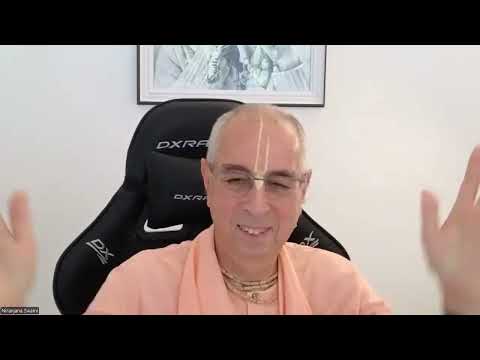
Advaita Acarya Prabhu’s class title situates this scriptural episode within the living practice of Bhagavatam study. Such study is not simply literary appreciation. It is an exercise in hearing, reflection, and transformation. The listener is invited to ask whether the heart rises when wisdom appears, whether the home welcomes sanctity, whether speech is restrained and purposeful, and whether life’s central question has been asked with sufficient seriousness.
The technical structure of the passage moves in three stages. First, the realized beings arrive and are recognized. Second, they are received through śāstric hospitality and reverence. Third, Pṛthu converts the encounter into philosophical inquiry for universal welfare. This structure is itself a model for spiritual culture: perception must lead to reverence, reverence must lead to inquiry, and inquiry must lead to transformation.
There is also a quiet emotional beauty in the scene. A celebrated king, surrounded by citizens and power, becomes almost vulnerable before the sages. He does not pretend to be complete. He admits need. He asks for guidance. This vulnerability is not sentimental; it is spiritually intelligent. The Bhagavatam suggests that the doorway to wisdom opens when the ego stops performing sufficiency.
For contemporary readers, the lesson is demanding but practical. Every household, institution, and community must decide what it treats as sacred. If comfort, wealth, and recognition occupy the highest place, then even abundance can become spiritually dangerous. If wisdom, devotion, compassion, and self-discipline are welcomed, then even ordinary spaces become places of pilgrimage. Pṛthu’s palace becomes holy not because it is royal, but because it becomes receptive to the Kumāras.
The episode therefore turns a royal reception into a theology of civilization. A civilization is not measured only by its architecture, economy, military strength, or artistic achievement. It is measured by whether it honors those who have conquered greed, anger, vanity, and delusion. It is measured by whether leaders seek counsel from the wise. It is measured by whether householders make room for dharma. It is measured by whether the suffering of conditioned beings becomes a serious subject of inquiry.
Śrīmad-Bhāgavatam 4.22.1-16 ultimately presents humility as the beginning of knowledge. Pṛthu’s question prepares the ground for Sanat-kumāra’s later teachings on detachment, devotion, hearing, chanting, and the realization of the Supreme within the heart. The verses do not merely tell readers that saints are valuable; they demonstrate how a spiritually alert person behaves when grace appears. Recognition, reverence, inquiry, and service become the natural sequence of awakened life.
The passage may be studied alongside the Sanskrit and translation of Śrīmad-Bhāgavatam 4.22 at https://vedabase.io/en/library/sb/4/22/. Its enduring power lies in its clarity: the human being burns when life is governed by sense gratification alone, but becomes blessed when guided by saintly association and devotion to the Supreme. King Pṛthu’s humility before the four Kumāras remains a profound model for leadership, household life, spiritual inquiry, and the unity of dharmic values.
Inspired by this post on Dandavats.






Leave a Reply
You must be logged in to post a comment.