
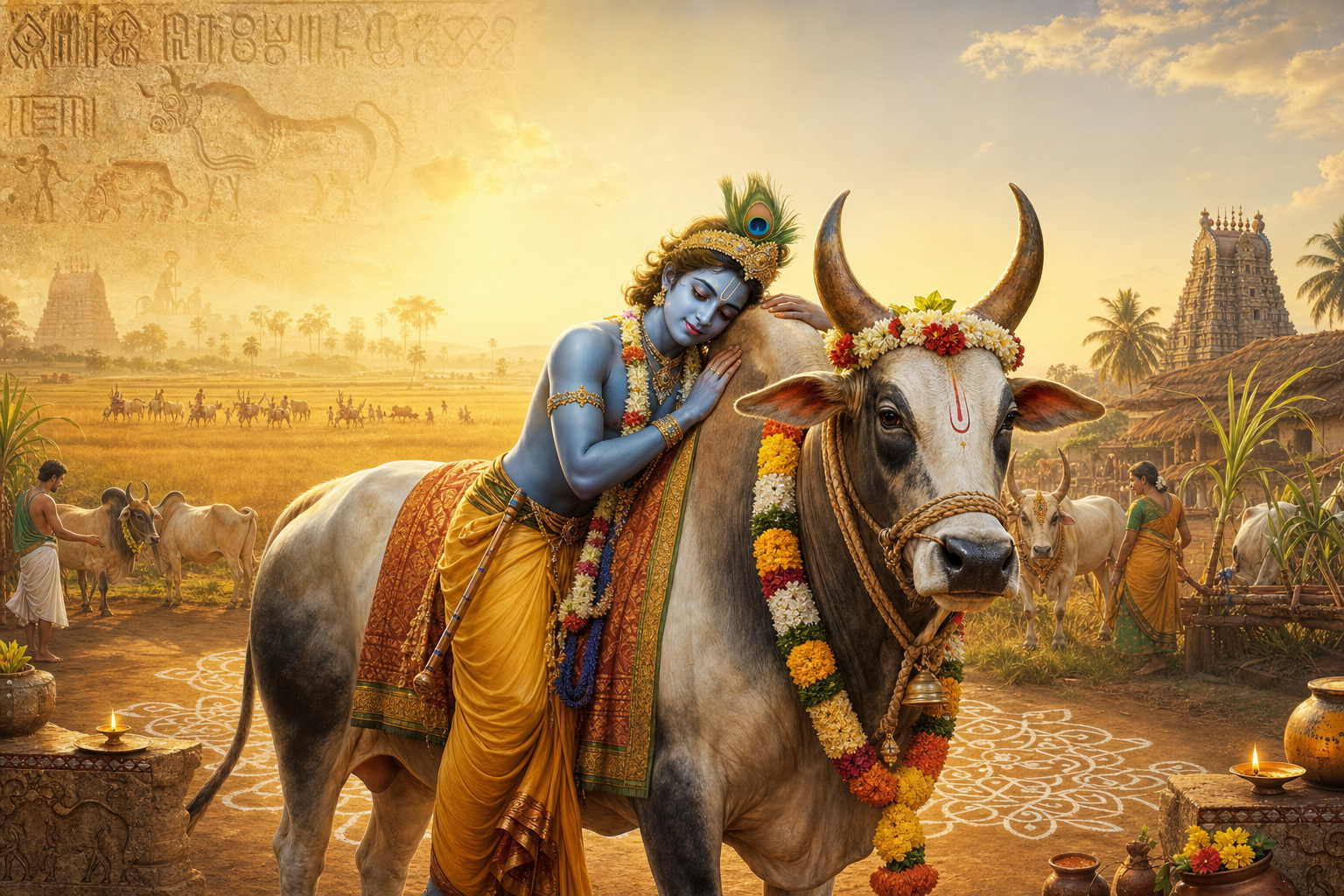
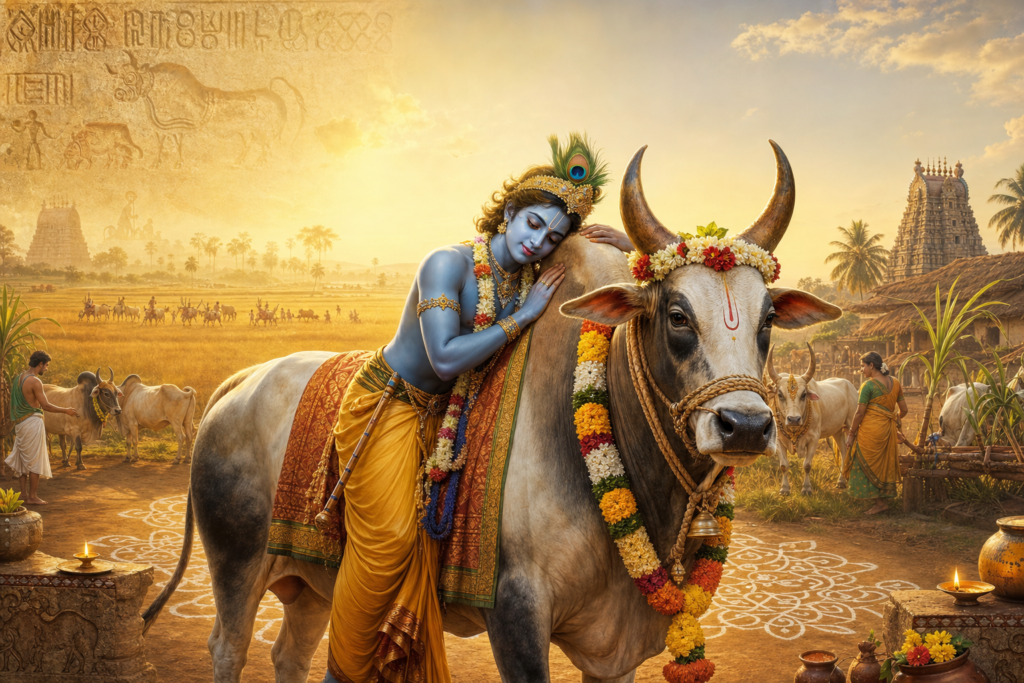
The history of Jallikattu cannot be understood merely as the history of a rural sport. It belongs to a much older civilizational relationship between human beings, cattle, agriculture, courage, fertility, community honor, and sacred memory. In the Indian subcontinent, the bull was never only an animal of strength. It was a sign of wealth, a partner in agrarian life, a marker of social responsibility, and, in many Hindu traditions, a being surrounded by ritual reverence. This wider context explains why the story of Krishna as a bull-tamer continues to resonate so deeply in discussions of Tamil culture, Hindu tradition, and the history of bovine sport.
The bull occupies a striking place in the earliest visual culture of South Asia. Archaeological material from the Indus Valley civilization includes seals and motifs that repeatedly foreground powerful humped bulls. Some interpretations of Indus imagery have associated human contact with bulls with early forms of ritual contest or physical display, although such readings must remain cautious because the script remains undeciphered and the visual evidence cannot be treated as a direct manual of sport. Even so, the recurrence of bovine imagery shows that the bull already possessed symbolic weight in the subcontinent’s ancient imagination.
In later Vedic, epic, Puranic, and regional traditions, cattle became even more deeply interwoven with social and religious life. Sanskrit terms connected with cattle often carried associations of wealth, nourishment, land, and ritual order. The cow and bull were linked with agrarian stability, yajna, pastoral prosperity, and kingship. In Shaiva traditions, Nandi stands before Shiva as the devoted bull, embodying strength disciplined by devotion. In Vaishnava traditions, Krishna’s identity as Gopala and Govinda places him among cowherds, calves, bulls, forests, flutes, and the intimate world of pastoral dharma.
Krishna’s association with bovine life is not ornamental. It is theological, social, and emotional. The child of Gokula grows among cowherds, protects cattle from danger, lifts Govardhana to shelter the community, and transforms ordinary rural life into a field of divine play. His relationship with animals is not one of conquest for spectacle; it is one of guardianship, courage, and intimate belonging. This is why the figure of Krishna the bull-tamer is important. It presents strength as service, not aggression; skill as protection, not cruelty; and masculine courage as a form of responsibility toward community and creation.
Several Krishna traditions preserve memories of contests involving bulls. In the Bhagavata Purana and related Sanskritic traditions, Krishna subdues seven fierce bulls in order to marry Satya, also known as Nagnajiti, the daughter of King Nagnajit. The episode is not merely a heroic feat. It reveals mastery without chaos, courage without needless destruction, and divine control over unruly force. In Tamil devotional memory, the motif of Krishna winning the beloved through the taming of bulls is also connected with Nappinnai, a cherished figure in Tamil Vaishnava imagination. These strands show how the bull-taming theme traveled across Sanskritic and Tamil worlds while remaining attached to Krishna’s pastoral identity.
Jallikattu, especially in Tamil Nadu, belongs to this wider cultural world of cattle, village honor, seasonal renewal, and ritualized courage. It is most strongly associated with Pongal, particularly Mattu Pongal, when cattle are decorated, honored, and recognized for their contribution to agricultural life. The term Jallikattu is often explained through the words for coins or prize money tied to the bull, while the older Tamil expression Eru Thazhuvuthal means “embracing the bull.” That older phrase is significant because it distinguishes the Tamil practice from forms of bullfighting where the bull is killed. In Jallikattu, the central act is to hold on to the bull’s hump for a prescribed distance or duration, not to slay it.
Classical Tamil literature gives the practice a strong historical and emotional foundation. Sangam texts, especially in the pastoral Mullai landscape, refer to young men, cattle wealth, village gatherings, and the prestige attached to handling powerful bulls. Bull-embracing appears in literary settings where courage, marriage, community approval, and cattle culture intersect. These references are not modern inventions projected backward into antiquity. They show that the cultural grammar of bull-taming was already meaningful in early Tamil society, where pastoral skill and social honor could be linked through public contest.
The comparison with global bull sports is useful, but it must be made carefully. Mediterranean bull-leaping, Iberian bullfighting, Portuguese bull spectacles, and Tamil Jallikattu all involve human confrontation with bovine power, yet their aims and moral structures differ. Spanish corrida traditionally culminates in the killing of the bull by the matador. Tamil Jallikattu, by contrast, historically treats the bull as a prized animal that returns to its owner and often gains prestige as a breeding bull. The distinction does not remove animal welfare concerns, but it does prevent inaccurate claims that Jallikattu is simply the Indian version of European bullfighting.
The social role of the Jallikattu bull is also technically important. Native breeds such as Kangayam, Pulikulam, Umbalachery, Bargur, and Alambadi have often been discussed in relation to Tamil cattle culture. Supporters argue that the prestige of Jallikattu encourages farmers to maintain strong indigenous stud bulls, protecting genetic diversity in an era of mechanized agriculture and cross-breeding. This argument deserves serious attention because traditional animal economies often preserve breeds through pride, utility, and local memory rather than through formal conservation programs alone.
At the same time, cultural continuity cannot excuse cruelty. A Dharmic reading of Jallikattu must include ahimsa, restraint, and accountability. Hindu, Buddhist, Jain, and Sikh traditions differ in theology and practice, yet they converge in valuing compassion, self-discipline, and responsibility toward living beings. Any practice claiming sacred or cultural legitimacy must therefore reject abusive handling, intoxication of animals, irritants, tail-twisting, beating, overcrowding, unsafe enclosures, and negligent crowd control. Reverence for the bull becomes meaningful only when it is visible in the treatment of the bull.
The modern legal history of Jallikattu reflects this tension between cultural rights and animal welfare. The Prevention of Cruelty to Animals Act, 1960 created the broader statutory framework for animal protection in India. In 2011, bulls were included in restrictions on performing animals, intensifying the legal scrutiny of Jallikattu. In 2014, the Supreme Court of India, in Animal Welfare Board of India v. A. Nagaraja, held that Jallikattu and similar events raised serious concerns under animal cruelty law and constitutional principles. That judgment became a major turning point in the public debate.
The 2017 protests in Tamil Nadu demonstrated the depth of public attachment to Jallikattu. Students, villagers, cultural organizations, and ordinary citizens framed the issue not simply as sport but as Tamil heritage, rural dignity, and indigenous cattle preservation. The Tamil Nadu legislature responded through the Prevention of Cruelty to Animals (Tamil Nadu Amendment) Act, 2017, creating a legal pathway for regulated conduct of Jallikattu. In May 2023, a five-judge Constitution Bench of the Supreme Court upheld state amendments permitting Jallikattu, Kambala, and bullock-cart races, while leaving regulation and animal welfare safeguards central to their lawful practice.
This legal development does not end the ethical debate. It clarifies that Jallikattu may be recognized as part of cultural heritage when regulated by law, but it also places responsibility on organizers, veterinarians, district administrations, participants, and spectators. The future of Jallikattu depends less on slogans and more on enforceable standards. A humane framework requires pre-event veterinary checks, identification of bulls, limits on participant behavior, safe arena design, emergency medical care, independent monitoring, transparent reporting of injuries, and penalties for cruelty. Tradition survives with dignity when it is disciplined by dharma.
Krishna’s bull-taming episodes offer a valuable interpretive lens for this modern challenge. Krishna does not represent reckless domination over animals. He represents the harmonizing of wild energy through intelligence, grace, and courage. When he subdues dangerous bulls, he does so as one who protects order, not as one intoxicated by violence. This distinction matters because it allows a culturally rooted defense of Jallikattu to remain morally serious. The sacred memory of Krishna cannot be used to justify cruelty; it can be used to demand higher standards of conduct.
The emotional force of Jallikattu lies in the rural world from which it emerges. A decorated bull entering the arena is not merely an object of competition. It carries the labor of a household, the pride of a village, the memory of ancestors, and the agricultural rhythms of Tamil Nadu. The young participant who faces the bull is not simply performing athletic bravery. He stands before a public test shaped by custom, risk, restraint, and reputation. For many families, the event condenses a year of care, training, and expectation into a few intense seconds.
That emotional world must be understood without romantic exaggeration. Rural heritage is not automatically pure, and modern criticism is not automatically hostile to tradition. The most constructive approach recognizes both truths: Jallikattu is a historically rooted Tamil practice with deep connections to Hindu pastoral symbolism, and it is also a high-risk event requiring strict ethical governance. A serious cultural analysis should resist both careless dismissal and uncritical celebration. The task is to preserve what is noble while reforming what is harmful.
In this sense, the history of Jallikattu becomes part of a wider Indian conversation about tradition and modernity. Many inherited practices face similar questions: how can ancient forms remain alive without becoming museum pieces, and how can they adapt without losing their identity? The answer cannot be found in imitation of Western categories alone, nor in a refusal to examine inherited customs. It must arise from within the ethical resources of Indian civilization itself: dharma, ahimsa, seva, community duty, and respect for all beings.
The unity of Dharmic traditions provides a powerful framework for this renewal. Hindu reverence for the cow and bull, Jain emphasis on non-violence, Buddhist compassion toward sentient beings, and Sikh commitment to disciplined courage can all enrich the conversation. Together, these traditions suggest that bravery is incomplete without compassion and that cultural pride is incomplete without self-regulation. A Jallikattu rooted in Dharmic ethics would honor the bull before, during, and after the event, treating the animal not as a disposable instrument but as a respected participant in a shared cultural world.
Krishna’s presence in this history therefore offers more than mythological ornamentation. It supplies a moral vocabulary. The same Krishna who moves among cattle in Vrindavan, protects the vulnerable, subdues destructive force, and delights in rural life reminds society that strength must be beautiful, controlled, and protective. If Jallikattu is to be defended as heritage, it must be defended in that spirit. Its deepest legitimacy will not come from noise, anger, or political mobilization alone, but from the visible union of courage, compassion, and cultural memory.
The sacred roots of Jallikattu lie in this union. From ancient bull imagery and Tamil pastoral literature to Krishna’s bull-taming narratives and the living festivals of Tamil Nadu, the bull has stood at the center of a complex civilizational story. It is a story of agriculture, masculinity, fertility, village honor, divine play, legal contest, and ethical reform. Read carefully, it does not ask society to choose between heritage and compassion. It asks for a higher synthesis in which heritage is preserved precisely because compassion disciplines it.
Jallikattu’s future will depend on whether that synthesis can be made real. If the sport becomes merely entertainment, it will lose its sacred and cultural depth. If it becomes cruelty hidden behind tradition, it will violate the very Dharmic values often invoked in its defense. But if it remains tied to cattle care, native breed preservation, village responsibility, regulated safety, and reverence for life, it can continue as a distinctive expression of Tamil heritage within the broader Hindu and Dharmic civilizational landscape. In that form, the memory of Krishna the bull-tamer remains not a relic of the past, but a guide for the ethical renewal of tradition.
Inspired by this post on Hindu Blog.



Leave a Reply
You must be logged in to post a comment.