
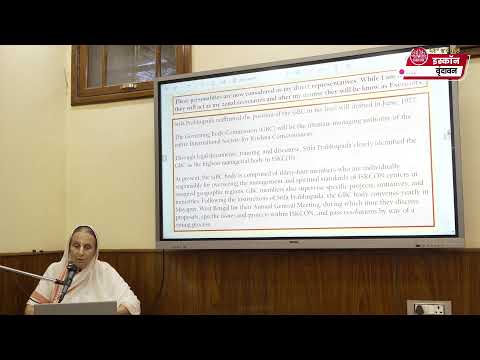
Watch the featured video: HG Daivi Shakti Mataji || Srila Prabhupada Lilamrita || 28.06.2026
The featured discourse by HG Daivi Shakti Mataji on Srila Prabhupada Lilamrita, dated 28.06.2026, invites a careful reflection on the life, mission, and enduring spiritual legacy of Srila A. C. Bhaktivedanta Swami Prabhupada. The subject is not merely biographical; it belongs to the wider study of bhakti, guru-shishya tradition, Vaishnava theology, and the modern global history of Krishna consciousness. A serious engagement with Srila Prabhupada’s life reveals how disciplined sadhana, scriptural fidelity, compassion, and institutional clarity can reshape religious consciousness across cultures without weakening the spiritual roots from which that consciousness emerges.
Srila Prabhupada Lilamrita, traditionally understood as a sacred biographical account of Srila Prabhupada’s life and work, functions as more than a historical record. In the devotional world of ISKCON and the broader Hare Krishna Movement, it serves as a pedagogical text, a memory tradition, and a practical guide for spiritual seriousness. Through narratives of struggle, travel, teaching, translation, worship, and community-building, it presents the life of a spiritual teacher who carried the teachings of Sri Krishna and Chaitanya Mahaprabhu into the modern world with remarkable determination.
The term lilamrita itself suggests a devotional approach to biography. It does not reduce a saintly life to dates, locations, and institutional milestones, although those details remain important. It also asks the listener to consider the deeper rasa, the living devotional mood, and the spiritual meaning behind visible actions. In this sense, Srila Prabhupada’s life becomes a study in applied Vedanta: how scriptural truth is translated into daily discipline, public teaching, community service, and personal transformation.
HG Daivi Shakti Mataji’s presentation, by its title and devotional context, belongs to a long-standing practice within dharmic traditions: remembering the lives of saints not for sentiment alone, but for instruction. In Hinduism, Buddhism, Jainism, and Sikhism, sacred biography often becomes a vehicle for ethical formation. Lives of gurus, acharyas, tirthankaras, bhagats, siddhas, and realized teachers are preserved because they show how metaphysical principles become embodied conduct. Srila Prabhupada’s biography can be approached in this same civilizational spirit, as a record of lived dharma.
Srila Prabhupada’s mission was grounded in the Bhagavad Gita, Srimad Bhagavatam, Chaitanya Charitamrita, and the devotional inheritance of the Gaudiya Vaishnava sampradaya. His work emphasized bhakti as a complete spiritual science, not a narrow emotional impulse. Bhakti, in this framework, includes hearing, chanting, remembering, serving, worshipping, praying, surrendering, and cultivating a disciplined life centered on Krishna. The accessibility of these practices is one reason Krishna consciousness found sincere practitioners across India, Europe, North America, Africa, and beyond.
The narrative of Srila Prabhupada’s journey to the West in 1965 is often remembered as a turning point in modern Hindu and Vaishnava history. Advanced in age, with limited material resources and deep dependence on Krishna, he crossed the ocean carrying sacred texts and a clear theological mission. From a sociological standpoint, this was an extraordinary moment of religious transmission. From a devotional standpoint, it was an act of surrender, courage, and service to the instruction of his guru, Srila Bhaktisiddhanta Sarasvati Thakura.
One of the most technically significant aspects of Srila Prabhupada’s legacy is his translation and commentary work. His editions of the Bhagavad Gita, Srimad Bhagavatam, and other Vaishnava texts combined Sanskrit and Bengali sources with English exposition intended for a global readership. This was not a casual literary project. It required philological attention, theological commitment, institutional planning, and an understanding of how modern readers encounter ancient scriptures. His books became the intellectual backbone of ISKCON and continue to shape the study of Hindu spirituality worldwide.
The phrase “as it is,” associated especially with Bhagavad-gita As It Is, reflects a central concern in Srila Prabhupada’s teaching method: fidelity to parampara. In academic language, this may be described as a tradition-centered hermeneutic. Rather than treating scripture as merely symbolic literature or detached philosophy, Srila Prabhupada interpreted it through the disciplic succession of Gaudiya Vaishnavism. This approach placed Krishna, bhakti, surrender, and devotional service at the heart of scriptural interpretation.
At the same time, Srila Prabhupada’s work was not confined to the study room or temple hall. He built institutions, trained disciples, established temples, encouraged prasadam distribution, promoted kirtan, supported cow protection, initiated educational projects, and emphasized regulated spiritual life. This combination of theology and organization is important. Durable spiritual movements require not only inspiration but also structure, accountability, daily practice, and a shared vocabulary of service.
The Guru-Shishya relationship stands at the center of this discussion. In Srila Prabhupada’s life, discipleship was not presented as passive admiration. It required hearing carefully, serving sincerely, regulating habits, studying scripture, and accepting correction. This is deeply consistent with the broader dharmic understanding that knowledge is not merely informational. True knowledge transforms character. It reshapes speech, diet, time, relationships, priorities, and the inner orientation of the heart.
For many practitioners, the emotional force of Srila Prabhupada Lilamrita lies in its portrayal of perseverance under difficulty. The life of Srila Prabhupada was not a smooth public success story. It included illness, poverty, misunderstanding, institutional challenges, cultural resistance, and the burden of carrying a vast spiritual responsibility. Yet the narrative repeatedly returns to steadiness. That steadiness is one of the most relatable elements for contemporary readers who struggle to balance spiritual aspiration with uncertainty, fatigue, and worldly pressure.
This point has practical relevance. Modern seekers often imagine spiritual life as a matter of mood, inspiration, or personal preference. Srila Prabhupada’s example suggests something more demanding and more reliable: spiritual life matures through regulated practice. Chanting, study, worship, seva, and association with sincere devotees gradually create inner clarity. The process may feel ordinary on a given day, but its cumulative effect can become profound. This is one of the enduring insights of bhakti tradition.
The practice of chanting the holy names, especially the Hare Krishna maha-mantra, occupies a central role in Srila Prabhupada’s teachings. In devotional theology, nama is not treated as a symbolic sound alone; the divine name is understood as spiritually potent and non-different from Krishna. From the perspective of religious practice, chanting also creates rhythm, concentration, humility, and communal identity. It gives the practitioner a portable form of worship that can be carried into daily life, whether in a temple, home, workplace, or public street.
Another major theme is prasadam, sanctified food offered to Krishna. Srila Prabhupada consistently emphasized prasadam as a form of mercy, hospitality, and spiritual culture. Food is never merely biological in dharmic traditions; it is connected to ethics, consciousness, gratitude, ecology, and community. In ISKCON communities, prasadam distribution became a powerful bridge between theology and public service. It allowed people to encounter Krishna consciousness not only through doctrine but through taste, care, and shared humanity.
Srila Prabhupada’s global mission also raises important questions about cultural translation. How can a tradition rooted in Sanskrit, Bengali Vaishnava literature, Indian temple culture, and devotional discipline speak meaningfully to people raised in very different societies? His response was neither cultural erasure nor superficial adaptation. He preserved core practices such as deity worship, kirtan, japa, scriptural study, tilaka, prasadam, and regulated conduct, while using modern tools such as printing, travel, recorded lectures, public festivals, and organized outreach.
This model remains instructive for all dharmic traditions. Hinduism, Buddhism, Jainism, and Sikhism have each faced the challenge of transmitting ancient wisdom in modern conditions. The healthiest form of transmission does not dilute the tradition into vague spirituality, nor does it freeze it into inaccessible formalism. It presents the tradition with clarity, respect, discipline, and compassion. Srila Prabhupada’s example offers one influential case study in how this can be done.
The academic significance of Srila Prabhupada’s work also lies in the creation of a global Vaishnava public sphere. Through temples, books, festivals, schools, farms, restaurants, and congregational communities, ISKCON made Gaudiya Vaishnavism visible beyond its earlier geographic centers. This visibility brought both opportunity and scrutiny. It required devotees to explain concepts such as karma, reincarnation, deity worship, guru, dharma, bhakti, and moksha in languages shaped by modern secularism, Christianity, consumer culture, and postcolonial identity.
In that context, Srila Prabhupada Lilamrita serves as a corrective to shallow readings of the movement. It shows that ISKCON did not emerge as an improvised cultural phenomenon. It was rooted in a lineage, a theological canon, a disciplined practice system, and a specific historical mandate. Understanding the life of Srila Prabhupada helps readers see the movement as part of a larger continuity within Sanatana Dharma and the bhakti renaissance associated with Chaitanya Mahaprabhu.
The role of women teachers and speakers, such as HG Daivi Shakti Mataji in this featured discourse, is also important for contemporary reflection. The dharmic world has always preserved examples of spiritually learned and devoted women, from the voices of Andal, Akka Mahadevi, Mirabai, and other bhakti figures to women who sustain temple culture, home worship, education, music, and community service. A discourse delivered by a respected Mataji continues this living pattern of devotional education and shared responsibility.
Such presentations are especially valuable because they make sacred biography accessible to listeners who may not yet have read the full text. A well-delivered talk can open the door to deeper study. It can connect historical episodes with lived questions: How should one respond to discouragement? What does loyalty to a guru require? How can spiritual practice remain steady in unstable circumstances? What does it mean to serve without seeking personal recognition? These questions are not abstract; they are part of everyday spiritual life.
Srila Prabhupada’s life also offers a strong example of intellectual confidence without contempt for others. His teachings were clear, often direct, and firmly rooted in Vaishnava siddhanta. Yet the broader purpose was not social division. It was spiritual awakening. For a blog committed to unity among dharmic traditions, this distinction matters. The goal of serious religious study is not to flatten differences, but to understand them respectfully while recognizing shared concerns: liberation, ethical conduct, self-discipline, compassion, truthfulness, and reverence for realized wisdom.
Within this larger dharmic unity, Gaudiya Vaishnavism contributes a distinctive emphasis on loving devotion to Krishna, the chanting of divine names, and the theology of divine grace. Jain traditions offer profound disciplines of ahimsa and aparigraha. Buddhist traditions illuminate suffering, mindfulness, compassion, and insight. Sikh traditions emphasize naam, seva, sangat, and courageous devotion to the Divine. Hindu traditions in their many sampradayas hold a vast range of ritual, philosophical, yogic, and devotional paths. A mature spiritual culture can honor these contributions without confusion or hostility.
Srila Prabhupada’s emphasis on books deserves special attention in the digital age. Contemporary audiences often consume spiritual content in short clips, isolated quotations, and fragmented social media impressions. The discipline of reading a full text like Srila Prabhupada Lilamrita trains the mind differently. It builds continuity, context, patience, and historical understanding. It also protects the reader from reducing a spiritual teacher to a few memorable lines. Lives of saints require sustained attention because their teachings were tested through time, sacrifice, and service.
The historical structure of Srila Prabhupada’s mission also shows the relationship between personal holiness and public responsibility. He was not content to remain a private practitioner. He saw the suffering of a world increasingly shaped by materialism, loneliness, intoxication, consumerism, and spiritual confusion. His response was not merely critique. He offered a complete alternative culture centered on Krishna, including worship, music, philosophy, food, community, education, and disciplined daily practice.
This alternative culture continues to attract attention because it addresses a persistent human need: the need for meaning that is embodied, communal, and sacred. Many people today experience disconnection despite technological abundance. The temple, the kirtan hall, the shared meal, the morning program, and the study circle all answer this disconnection in a practical way. They give rhythm to life. They place the individual within a tradition larger than personal preference.
From a philosophical standpoint, Srila Prabhupada’s teaching returns repeatedly to the distinction between the self and the body. The atman is not reducible to temporary material identity. This principle, shared in different forms across several dharmic systems, has deep ethical consequences. If the living being is spiritual in nature, then exploitation, cruelty, addiction, and selfishness become symptoms of ignorance. Spiritual practice becomes a process of recovering proper identity and acting from that recovered understanding.
The life of Srila Prabhupada also illustrates the importance of time. He used time with unusual urgency. Translation, travel, initiation, correspondence, temple management, public lectures, and personal guidance were all woven into a demanding schedule. For modern readers, this can be both inspiring and uncomfortable. It challenges the casual assumption that spiritual life can be postponed indefinitely. Human life is finite, and dharmic traditions repeatedly teach that time should be used for self-realization, service, and the cultivation of wisdom.
Yet the emotional appeal of Srila Prabhupada’s life does not rest only on achievement. It rests on care. Accounts of his dealings with disciples often show a teacher concerned with their food, health, chanting, moral choices, intellectual doubts, and spiritual progress. This combination of strictness and compassion is characteristic of a serious guru. Guidance is meaningful because it is oriented toward liberation, not mere approval. Love in the guru-shishya tradition often appears as instruction, correction, protection, and patient encouragement.
The relevance of this featured video therefore extends beyond a single date or a single online post. It represents an invitation to return to foundational questions: What kind of life is worth remembering? What kind of discipline produces lasting spiritual influence? How does one carry ancient wisdom into a modern world without losing its essence? Srila Prabhupada’s life does not answer these questions theoretically alone. It offers a tested example through action.
For students of Hinduism, ISKCON history, Krishna consciousness, and bhakti tradition, the study of Srila Prabhupada Lilamrita remains valuable because it combines history with practice. It can be read as biography, devotional literature, institutional history, and spiritual instruction. Each mode of reading reveals something important. Together, they show how one life, rooted in guru, shastra, and Krishna bhakti, became a catalyst for a worldwide devotional movement.
The most enduring lesson may be simple but demanding: devotion becomes powerful when it is organized around service rather than self-display. Srila Prabhupada’s example demonstrates that spiritual influence does not arise from charisma alone. It arises from surrender, discipline, scriptural depth, compassion, and the willingness to work steadily for the welfare of others. In that sense, Srila Prabhupada Lilamrita continues to nourish not only memory, but practice.
Viewed in this way, the discourse by HG Daivi Shakti Mataji is best understood as part of a living educational tradition. It preserves remembrance, strengthens devotion, and encourages renewed study of Srila Prabhupada’s life. For sincere seekers across dharmic paths, such remembrance can cultivate humility, steadiness, and reverence for the teachers who carry wisdom forward. The value of the video lies not merely in watching it, but in allowing its themes to deepen one’s own relationship with sadhana, seva, and spiritual responsibility.
Inspired by this post on Dandavats.



Leave a Reply
You must be logged in to post a comment.