
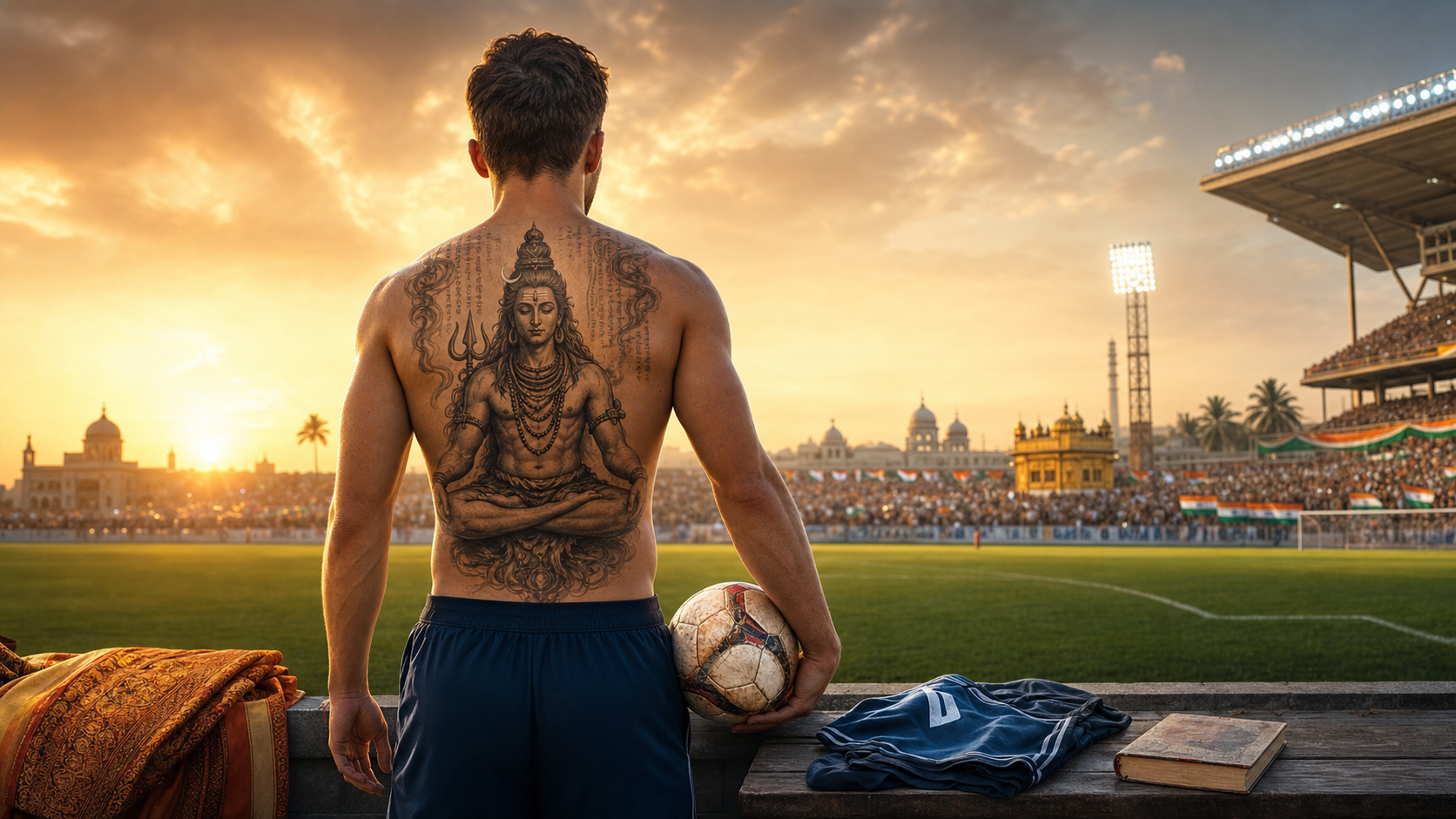
Luka Majcen’s viral moment among Indian football fans is not merely a passing social-media curiosity. It is a layered story about sport, migration, cultural encounter, religious symbolism, and the way India can become a lived spiritual landscape for someone born far beyond the subcontinent. The Slovenian striker, who built a substantial chapter of his professional career in Indian football, has drawn attention because of the large Lord Shiva tattoo on his back, accompanied by the sacred Mahamrityunjaya mantra. For many supporters, the image is striking because it joins two forms of discipline that are often treated separately: the discipline of the footballer’s body and the discipline of spiritual self-cultivation.
Majcen’s connection with India did not begin as a public gesture designed for attention. According to accounts of his own reflections, the first doorway was literary and intellectual. Reading Shantaram encouraged him to look more closely at Indian culture, and that curiosity grew into a more personal engagement with Hindu spirituality. This detail is important because it shows how cultural influence often travels through unexpected routes. A novel, a conversation, a teammate’s family, a phrase searched online, and years spent living in Indian cities can together create a transformation that is deeper than tourism and more durable than fascination.
The figure that became central to Majcen’s inner vocabulary was Rudra, one of the powerful and ancient forms associated with Shiva. A teammate’s mother reportedly introduced him to the name and idea of Rudra, and the concept appears to have resonated with his own temperament. In Hindu thought, Rudra is not a simple symbol of anger or violence. The name carries intensity, force, healing, dissolution, and renewal. It points toward the power that breaks rigidity, burns impurity, and clears the ground for transformation. For a professional athlete, especially a striker living under pressure, that symbolism can be psychologically meaningful.
Majcen has spoken of finding in Rudra a way to understand and regulate intensity rather than merely suppress it. This is where the story becomes more than a tattoo story. Competitive sport rewards aggression, speed, and emotional force, but it also punishes loss of control. A forward must remain alert, brave, and physically combative, yet he must also make quick decisions with calm precision. The ability to turn heat into focus is central to elite performance. In that sense, the symbolism of Shiva and Rudra can be read as a framework for mindful self-command, not as an ornamental identity marker.
The Mahamrityunjaya mantra deepens that meaning. Traditionally associated with Rudra-Shiva, the mantra is among the most revered Vedic and Shaiva invocations. It is widely understood in Hindu practice as a prayer for healing, protection, longevity, liberation from fear, and inner resilience. When placed on the body of an athlete, it carries a particular resonance. Football is a profession shaped by injury risk, physical recovery, mental pressure, public judgment, and the short arc of a playing career. A sacred mantra in that context becomes a reminder of vulnerability as much as strength.
The tattoo’s public impact also reflects the emotional character of Indian football fandom. Indian supporters have long celebrated overseas players who respect local culture and commit themselves fully to the domestic game. Majcen’s case stands out because his Indian journey has not been superficial. He arrived in India during the 2020-21 football period and became associated with major I-League chapters, including Churchill Brothers, Gokulam Kerala, and RoundGlass Punjab, later Punjab FC. His work in India was not defined by a single viral clip; it was built through goals, league campaigns, title races, and visible commitment to clubs and supporters.
His Indian football record explains why the story has travelled so quickly. Majcen was part of Gokulam Kerala’s successful I-League phase and later became an important figure in RoundGlass Punjab’s rise, including the 2022-23 I-League title campaign that helped move the club into the Indian Super League structure. He was also recognized individually during his I-League years, especially for his goal-scoring output and attacking influence. These achievements matter because they prevent the spiritual story from floating without context. Indian fans are responding not only to a foreign footballer with Hindu symbols, but to a proven player whose sporting life in India has had real competitive weight.
There is also a wider cultural lesson in the response to Majcen’s Lord Shiva tattoo. Hindu culture has historically travelled through texts, trade, pilgrimage, performance, art, migration, yoga, temple traditions, philosophical exchange, and personal practice. In the modern world, it also travels through football dressing rooms, digital media, tattoos, novels, friendships, and everyday acts of hospitality. The path may look contemporary, but the deeper pattern is old: Indian spiritual traditions often become meaningful when they are encountered as living practices rather than as museum objects.
From an academic perspective, Majcen’s story can be understood as an example of embodied cultural reception. A tattoo is not only a visual sign; it is a permanent inscription on the body. It suggests commitment, memory, and identity. When the image is Lord Shiva and the accompanying text is the Mahamrityunjaya mantra, the body becomes a place where sport, devotion, discipline, and gratitude meet. This does not mean that every act of cultural borrowing is automatically deep or respectful. It does mean that careful attention should be paid to intention, understanding, conduct, and the relationship between symbol and lived practice.
In Majcen’s case, the available narrative points toward appreciation rather than casual appropriation. He has credited India with changing his outlook on life, and he has connected the symbolism to mindfulness and temperament. His admiration appears to come from years of living and working in India, not from a brief aesthetic trend. This distinction matters in contemporary discussions of Hindu symbols in global culture. Sacred imagery should not be reduced to fashion, but neither should sincere cross-cultural reverence be dismissed simply because it comes from someone outside India by birth.
The story also supports a broader dharmic principle: truth and spiritual discipline can speak across geography, language, and ethnicity. Hindu, Buddhist, Jain, and Sikh traditions all contain strong reflections on self-mastery, inner transformation, disciplined conduct, and the refinement of emotion. Majcen’s association with Shiva and mindfulness can therefore be read within a wider dharmic civilizational frame, where the goal is not narrow identity performance but the cultivation of awareness, restraint, courage, and gratitude. This is why the response among Indian fans has been so emotional. They see in his journey a sign that Indian spiritual culture can touch lives far beyond inherited boundaries.
For Indian football, Majcen’s journey is also a reminder that the domestic game is not only a sporting ecosystem but a cultural meeting ground. Players from Europe, Africa, Latin America, and Asia arrive in India to compete, but some also absorb the country’s languages, foods, festivals, friendships, and spiritual references. Football clubs become places where regional India and global mobility meet. A striker from Slovenia can play in Kerala, Punjab, and Bengal, and in doing so become part of stories that exceed match reports and league tables.
The viral attention around the tattoo should therefore be treated with seriousness but also with proportion. The tattoo does not make Majcen a spokesman for Hinduism, nor should any athlete be burdened with representing an entire civilization. What it does show is that personal transformation can emerge from sustained cultural contact. His story is valuable because it is specific: a footballer reads Shantaram, becomes curious about India, learns about Rudra through a personal connection, tattoos Lord Shiva and the Mahamrityunjaya mantra on his back, and credits India with changing the way he understands himself.
There is a quiet emotional force in that sequence. Many people encounter India first through noise, crowds, contradiction, or intensity. Over time, some begin to notice another layer: a civilization that has developed sophisticated vocabularies for inner conflict, impermanence, power, surrender, discipline, and renewal. Shiva’s symbolism is especially suited to that recognition because Shiva is both ascetic and householder, destroyer and benefactor, stillness and cosmic movement. For a player whose profession demands both explosive motion and mental steadiness, this symbolic universe can feel personally relevant.
Majcen’s viral moment among Indian fans is therefore best understood as a story of reciprocal belonging. India gave him a footballing platform, supporters, clubs, competition, and a spiritual language through which he could interpret his own intensity. In return, he offered commitment on the field and a visible gesture of reverence toward a tradition that shaped him. That exchange is why the image has moved so many people. It is not only about ink on skin. It is about the possibility that a sportsperson’s journey can become a bridge between Indian football, Hindu spirituality, and the global search for meaning.
Inspired by this post on Hindu Human Rights Blog.




Leave a Reply
You must be logged in to post a comment.