
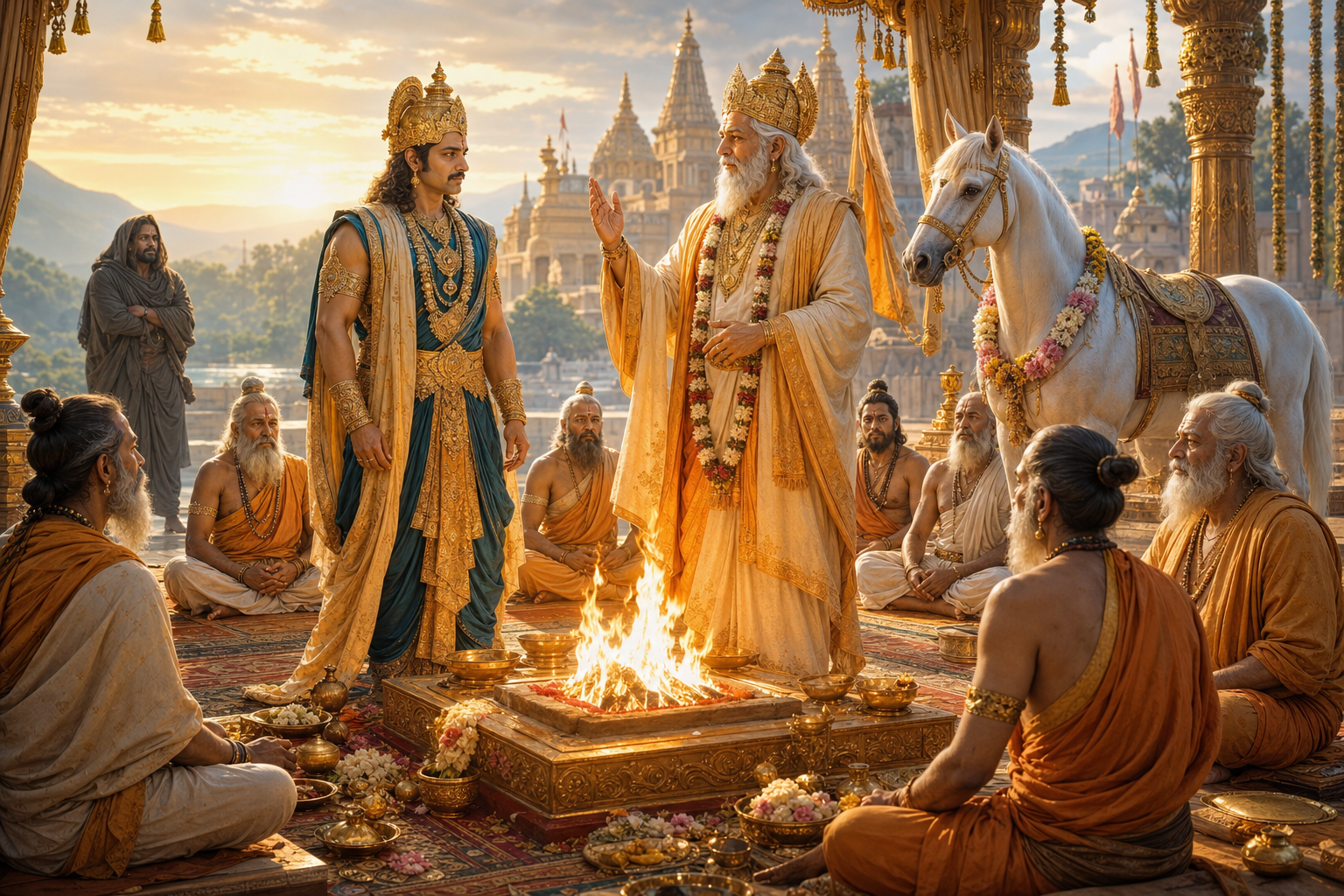
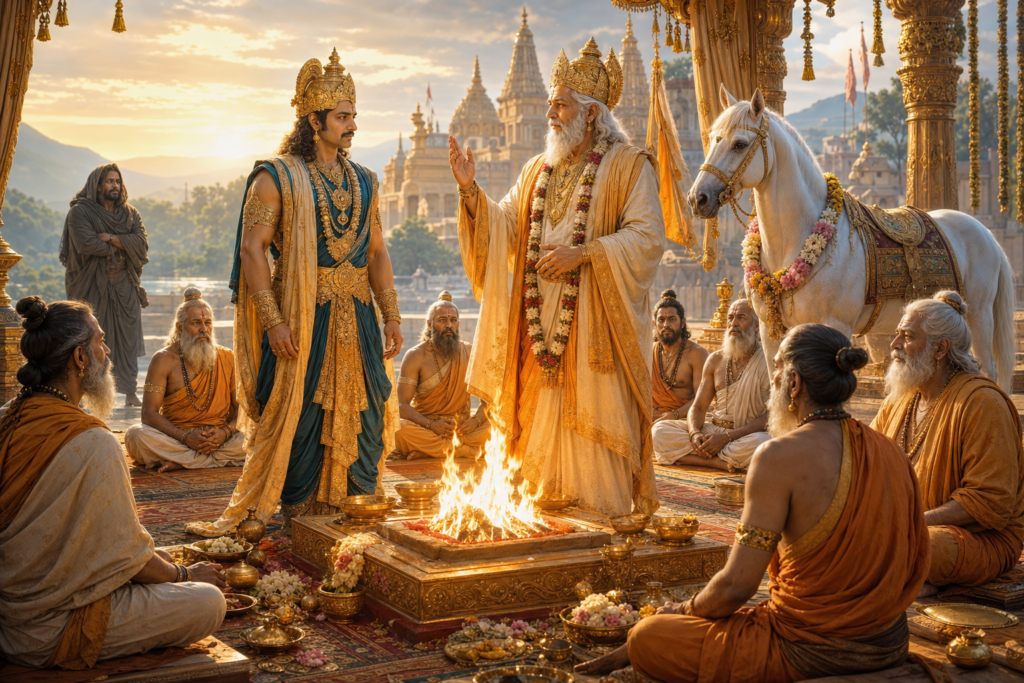
ŚB 4.19.24-25 occurs at a tense and philosophically rich moment in the Fourth Canto of the Śrīmad-Bhāgavatam. King Pṛthu, celebrated as an ideal ruler and empowered servant of the Supreme Lord, is conducting a series of aśvamedha sacrifices. The ritual setting is not merely ceremonial; it represents royal responsibility, cosmic order, public virtue, and the king’s duty to align political power with dharma. Yet the episode becomes dramatic because Indra, disturbed by the possibility that Pṛthu may surpass him in sacrificial prestige, repeatedly obstructs the rite by stealing the sacrificial horse.
The immediate narrative context is important. Indra does not obstruct the sacrifice through open debate, principled objection, or transparent disagreement. He acts through concealment and imitation. Earlier in the chapter, he adopts external signs of renunciation to hide his act, thereby creating a disturbing confusion between genuine spiritual discipline and religious disguise. The Bhāgavatam presents this as a serious ethical problem: when sacred symbols are used to shelter envy, ambition, or deceit, society begins to lose confidence in religious life itself.
In ŚB 4.19.24, Lord Brahmā intervenes when the priests prepare to retaliate against Indra through the sacrificial fire. The verse teaches that Indra should not be killed by the sacrifice, because sacrifice itself is connected with the body of Bhagavān, and the devas function within that divine arrangement. This is not an excuse for Indra’s misconduct. Rather, it is a theological boundary: even justified anger must remain governed by dharma. A ritual meant for divine satisfaction cannot become a vehicle for revenge.
ŚB 4.19.25 deepens the lesson by drawing attention to the danger created by Indra’s actions. Brahmā asks the assembled brāhmaṇas to observe the grave disruption of dharma caused by Indra’s attempt to obstruct King Pṛthu’s sacrifice. The focus shifts from personal offense to institutional consequence. Indra’s envy has produced more than a theft; it has introduced a pattern in which external marks of holiness can be manipulated for selfish ends. The verse therefore becomes a study in how spiritual institutions are harmed when appearance becomes detached from inner discipline.
The technical vocabulary of this episode is significant. The aśvamedha represents royal yajña, public order, and the king’s obligation to govern for the welfare of the people. The term dharma-vyatikara, implied in the traditional understanding of this passage, points to a disturbance or deviation in religious order. The criticism is not directed at diversity of spiritual practice. Hinduism, Buddhism, Jainism, and Sikhism each preserve profound disciplines of restraint, truthfulness, compassion, and liberation. The concern here is different: it is the misuse of religious form without corresponding moral substance.
This distinction is vital for a dharmic reading of the passage. Genuine renunciation is not condemned. Authentic vairāgya is honored throughout the scriptures, whether expressed through devotion, meditation, ethical restraint, selfless service, or disciplined inquiry. What is criticized is performative spirituality, especially when religious clothing or symbolic identity is adopted to conceal adharma. The Bhāgavatam is therefore not sectarian in its warning; it is universal in its moral analysis.
King Pṛthu’s anger is understandable. A ruler who has committed himself to yajña, public welfare, and divine order sees his sacred undertaking deliberately undermined. In ordinary human terms, the emotional response is relatable: when sincere effort is obstructed by envy, the instinct is to expose, punish, and correct immediately. Yet the Bhāgavatam places this human emotion under the supervision of higher wisdom. Brahmā does not deny the injury, but he prevents the response from becoming spiritually disproportionate.
This is one of the most powerful lessons of the passage. Dharma is not simply the punishment of wrongdoing; it is the preservation of right order even while addressing wrongdoing. A person may be correct about the offense and still become incorrect in the method of response. The priests’ proposed retaliation would have transformed a sacrificial act into an instrument of destruction. Brahmā’s restraint preserves the sanctity of yajña and prevents a further collapse of moral clarity.
From the standpoint of Hindu philosophy, this episode also reveals the difference between karma-kāṇḍa and bhakti-centered discernment. Ritual action has power, but ritual power must be subordinated to divine intention. Sacrifice is not an independent machine for fulfilling anger, status, or rivalry. Its purpose is alignment with Bhagavān. When ritual becomes separated from humility and devotion, it can be misdirected by ego. ŚB 4.19.24-25 therefore functions as a warning against technical religiosity without spiritual maturity.
The character of Indra in this episode is psychologically realistic. He is not portrayed as ignorant of dharma. He knows the sacred order, yet envy clouds his judgment. This makes the passage especially relevant for students of scripture, because the danger is not limited to the irreligious. Even a powerful celestial administrator can be shaken by insecurity. The Bhāgavatam repeatedly shows that spiritual rank, social position, learning, or ritual authority do not automatically eliminate the subtle force of pride.
For contemporary readers, the episode invites sober reflection on religious leadership and public trust. Communities often suffer not because sacred principles are weak, but because representatives of those principles fail to embody them. When external symbols are used without integrity, sincere seekers may become confused or disillusioned. ŚB 4.19.24-25 calls for a recovery of inner accountability: dress, title, ritual, lineage, institution, and public influence must be supported by truthfulness, humility, and service.
The passage also cautions against overcorrection. Once hypocrisy is seen, some may be tempted to reject all religious forms. The Bhāgavatam does not take that route. It does not dismiss yajña, renunciation, devas, kingship, or priestly authority. Instead, it purifies their use. This is a refined theological position: the abuse of a sacred form does not invalidate the sacred form itself. It demands discernment, reform, and a return to purpose.
Such discernment can strengthen unity among dharmic traditions. Hindu, Buddhist, Jain, and Sikh communities have distinct metaphysical languages and practices, yet they share concern for ethical discipline, self-mastery, compassion, and liberation from ego-centered life. The Bhāgavatam’s warning against false externalism can therefore be read as a shared civilizational lesson. Spiritual authenticity is measured not by costume or claim alone, but by conduct, restraint, wisdom, and the capacity to reduce suffering.
Brahmā’s intervention also illustrates the role of wise counsel in moments of collective heat. The priests are learned, Pṛthu is righteous, and the cause of anger is real. Still, a higher perspective is needed. This is a recurring pattern in the scriptures: even noble people require guidance when emotion and principle collide. The presence of a wise mediator prevents dharma from being narrowed into reaction. In practical life, this suggests the importance of elders, gurus, śāstra, and reflective dialogue before irreversible decisions are made.
Theologically, the reference to yajña as connected with the divine body invites a holistic vision of sacred life. The devas are not independent rivals to the Supreme; they operate within a cosmic order sustained by Bhagavān. This vision discourages fragmented religious thinking. When one part of the sacred order is attacked through anger, the larger body of dharma is affected. Thus, the passage calls for reverence toward the whole structure of divine service while still acknowledging moral failure within it.
King Pṛthu’s greatness is ultimately shown not only in his power to act, but in his capacity to be checked by wisdom. In many narratives, heroism is measured by victory over an opponent. In the Bhāgavatam, a deeper heroism appears when a ruler accepts correction for the sake of dharma. This is a demanding ideal of leadership. A dharmic leader must be strong enough to confront disorder, yet humble enough to restrain himself when a wiser course is revealed.
The episode also exposes the fragility of prestige. Indra’s anxiety emerges because another’s excellence feels like a threat. This remains a familiar human problem. In institutions, families, spiritual communities, and public life, envy often disguises itself as principle. The Bhāgavatam asks readers to look carefully at motivation. Is opposition rooted in genuine concern for dharma, or in fear of losing recognition? This question remains uncomfortable, but it is essential for self-examination.
ŚB 4.19.24-25 therefore offers a layered teaching. It protects the sanctity of yajña, critiques religious disguise, restrains retaliatory anger, exposes envy, and calls leaders toward humility. Its message is not merely historical or mythological. It speaks to every age in which sacred language can be used for status, and in which righteous anger can become destructive if not governed by wisdom.
A mature reading of these verses leads to neither cynicism nor blind institutional loyalty. It leads to responsible faith. Sacred traditions deserve reverence, but reverence must include moral seriousness. Leaders deserve respect, but respect must include accountability. Ritual deserves preservation, but preservation must include purity of intention. In this balance, the Bhāgavatam offers an enduring model for Sanatana Dharma: devotion joined with discernment, authority joined with humility, and justice joined with restraint.
For spiritual seekers, the practical lesson is direct. Outer practice should be matched by inner transformation. A mantra should soften the heart. A ritual should increase gratitude. A title should deepen service. A robe, mark, or public identity should never become a shield for ego. When ŚB 4.19.24-25 is studied in this way, it becomes more than a commentary on King Pṛthu and Indra. It becomes a mirror for every practitioner who wishes to protect dharma first within the self, and then within society.
Inspired by this post on Dandavats.





Leave a Reply
You must be logged in to post a comment.