
Panihati Chida-Dahi Festival and the making of a saint
The Panihati Chida-Dahi Festival occupies a distinctive place in the devotional history of Gaudiya Vaishnavism because it joins public celebration with interior transformation. On the surface, the event appears simple: chipped rice, yogurt, milk, bananas, sugar, ghee, camphor, earthen pots, the bank of the Ganga, and a large gathering of devotees. Yet its remembered meaning is far deeper. The festival marks a decisive turning point in the life of Srila Raghunatha dasa Gosvami, one of the Six Gosvamis of Vrindavan and among the most influential ascetic theologians in the Vaishnava tradition.
Traditional accounts, especially those preserved in Śrī Caitanya-caritāmṛta, Antya-līlā, Chapter 6, describe the Panihati event as both a festival of prasādam and a festival of mercy. Raghunatha dasa did not simply feed a crowd; he learned how wealth, social capacity, humility, and longing could be redirected toward seva. The lesson is strikingly practical. Spiritual life is not portrayed as an escape from responsibility, but as the purification of responsibility through service, discipline, and sincere dependence on grace.
The historical setting is Bengal in the age of Śrī Caitanya Mahāprabhu and Lord Nityananda Prabhu, a period in which ecstatic kirtan, scriptural learning, pilgrimage, and community feasting shaped a broad devotional culture. Panihati, now associated with the northern Kolkata region near Sodepur, stands on the bank of the Ganga. The geography matters because Gaudiya Vaishnava memory repeatedly places transformative meetings at riverbanks, roads, courtyards, gardens, and homes. Sacred life is not confined to remote solitude; it unfolds in public spaces where ordinary people can gather, eat, chant, and participate.
Raghunatha dasa was born into a prosperous family connected with Saptagram in present-day West Bengal. His father, Govardhana Majumdar, and uncle, Hiranya Majumdar, were wealthy landholders and influential revenue administrators. From a worldly perspective, Raghunatha possessed nearly everything that could secure comfort: status, family protection, financial abundance, and a socially desirable future. Yet the tradition presents him as inwardly detached from these advantages from an early age. The contrast between outer privilege and inner longing gives his story its enduring emotional force.
His family tried repeatedly to hold him within household life. Guards were placed around him, and attempts to leave home were frustrated. This tension should not be read merely as a conflict between spirituality and family. In a more careful reading, it reveals a human problem familiar across generations: the difficulty of honoring social obligations while recognizing a call that cannot be silenced. Raghunatha was not impulsively rejecting family affection; he was struggling to understand when attachment becomes bondage and when responsibility becomes an offering.
When Raghunatha earlier approached Śrī Caitanya Mahāprabhu, he did not receive permission to abandon home immediately. Mahāprabhu advised him to return and behave externally like an ordinary person while remaining inwardly steady. This instruction is central to the tradition’s theology of maturity. Renunciation is not theatrical rejection. It is not restlessness dressed in religious language. It is the gradual alignment of conduct, intention, and surrender. Raghunatha’s later greatness is meaningful precisely because he was first asked to wait, serve, and ripen.
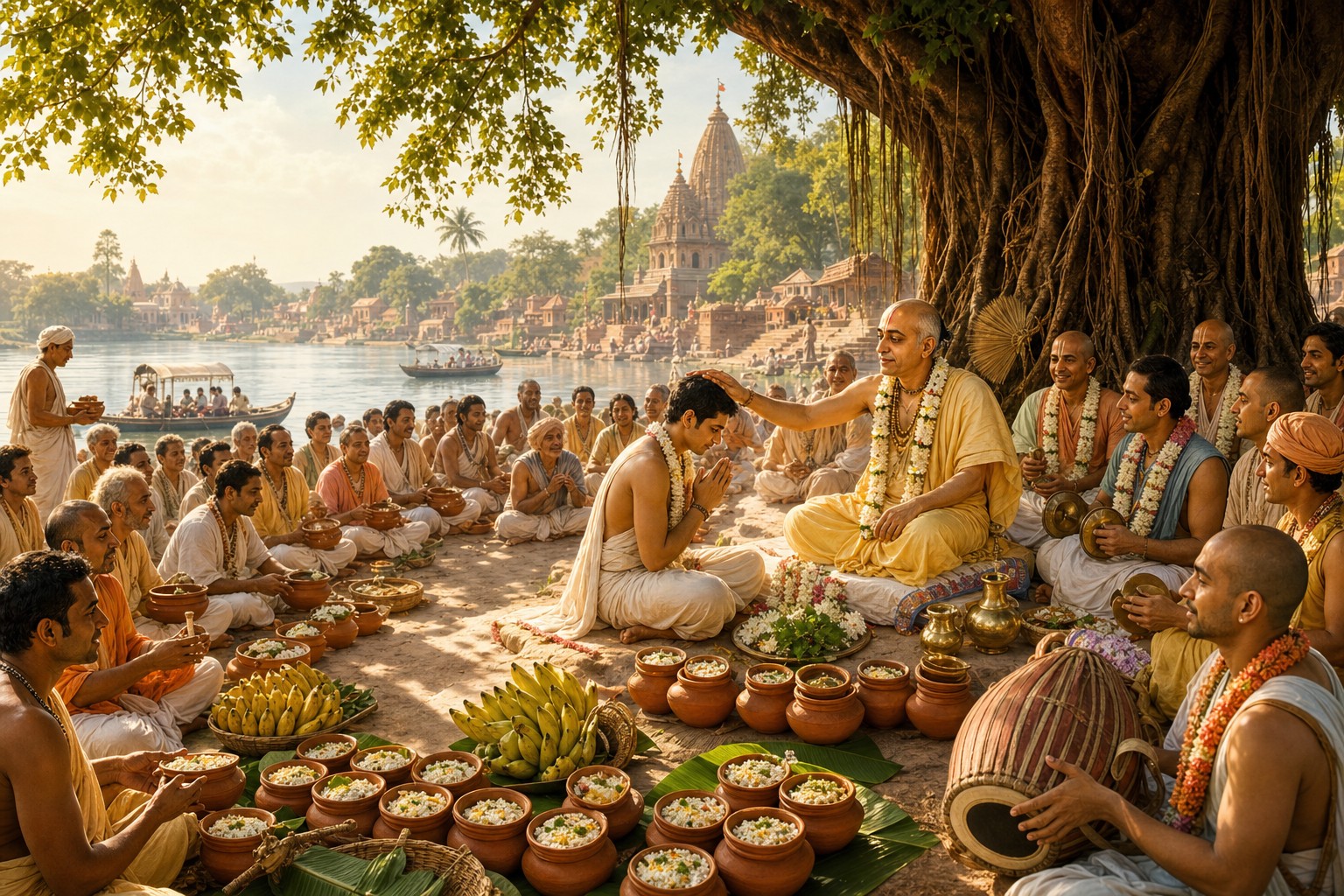
The Panihati episode begins when Raghunatha went to see Lord Nityananda Prabhu, who was seated beneath a tree on the bank of the Ganga, surrounded by kirtan performers and devotees. Seeing Nityananda from a distance, Raghunatha offered obeisance but hesitated to come close. Nityananda, in a mood remembered as playful and deeply merciful, called him a thief for staying away and ordered that he be brought near. Then Nityananda placed his feet on Raghunatha’s head and gave him a distinctive “punishment”: he must organize a feast of chipped rice and yogurt for all the devotees.
This playful punishment is the heart of the Chida-Dahi Festival. In ordinary terms, punishment deprives; in this devotional narrative, punishment becomes the opportunity to serve. Nityananda did not ask Raghunatha for abstract declarations of devotion. He asked him to feed people. That detail deserves attention. The test of bhakti is embodied in hospitality, generosity, and the ability to honor others. Food becomes theology in action.
Raghunatha responded immediately. He sent men into the village and surrounding areas to purchase chipped rice, yogurt, milk, sweetmeats, sugar, bananas, and other ingredients. As the crowd expanded, he arranged more supplies from nearby villages and gathered hundreds of earthen pots. The account emphasizes scale, coordination, and abundance. Seva here is not vague sentiment; it requires planning, procurement, distribution, and attention to the needs of a rapidly growing assembly.
Two principal preparations were made. In one, chipped rice was soaked and mixed with yogurt, sugar, and bananas. In another, it was mixed with condensed milk, sugar, ghee, and fragrant camphor, with special bananas also mentioned in the tradition. These preparations were not luxurious for their own sake. Their sweetness expressed welcome. Their simplicity allowed mass distribution. Their cooling quality suited the season and the riverbank setting. The festival thus joined ecological appropriateness, culinary intelligence, and devotional symbolism.
The scene soon became vast. Important associates of Lord Nityananda sat near him, while many others sat around the platform, along the Ganga bank, and even in the water when space ran out. Each person received two pots: one with chipped rice in yogurt and another with chipped rice in condensed milk. The image is socially powerful. Scholars, brāhmaṇas, villagers, pilgrims, and curious onlookers were all fed. Anyone who came was included. The Chida-Dahi Festival therefore functioned as a public model of prasādam-based community cohesion.
The tradition further describes Lord Nityananda invoking the presence of Śrī Caitanya Mahāprabhu. Some devotees could perceive Mahāprabhu present with Nityananda, sharing the chipped rice in a mood of divine intimacy. For Gaudiya Vaishnavas, this moment links the Ganga bank at Panihati with the cowherd picnic pastimes of Krishna and Balarama on the Yamuna. The festival is therefore remembered not merely as a historical meal but as a sacred re-enactment of divine companionship.
The chant that resounded through the gathering remains central to the devotional mood: HARE KRISHNA HARE KRISHNA KRISHNA KRISHNA HARE HARE | HARE RAMA HARE RAMA RAMA RAMA HARE HARE ||
From an academic perspective, the Panihati festival illustrates a key feature of bhakti traditions: theology is transmitted not only through texts but also through performative memory. A festival teaches by repetition. People remember what they cook, what they serve, where they sit, whom they honor, and how they chant together. In this sense, Panihati is a living archive. It preserves doctrine through taste, gesture, sound, and shared participation.
Raghava Pandita, an important associate in the tradition, also appears in the account. He had prepared offerings at his home, and Nityananda later went there for kirtan and a further meal. This detail expands the meaning of the event from a single public feast into a network of devotional households. The homes of devotees, the riverbank, the temple, and the public gathering space all become linked through prasādam and kirtan. The sacred is distributed through relationship.
The day after the festival, Raghunatha submitted his longing to Nityananda through Raghava Pandita. He desired the shelter of Śrī Caitanya Mahāprabhu but felt unable to reach him because of family restrictions. Nityananda blessed him, assuring him that the obstacles to his bondage would be removed and that he would soon attain Mahāprabhu’s shelter. This blessing is the theological pivot of the narrative. The feast was not a transaction, but service opened the path to grace.
After returning home, Raghunatha’s inner detachment intensified. He no longer entered the inner quarters of the house but remained near the Durgā-maṇḍapa, watched by guards. Eventually, a circumstance involving his spiritual guide Yadunandana Ācārya allowed him to leave unnoticed. Rather than taking the public route, he traveled by lesser-used paths, moving quickly toward Jagannath Puri. The journey took twelve days, and he ate only on three of them. This episode shows the severity of his determination, but it should be read carefully. The tradition does not present hardship as self-harm; it presents single-pointed longing as stronger than bodily convenience.
When Raghunatha reached Jagannath Puri, Śrī Caitanya Mahāprabhu received him with affection and entrusted him to Svarūpa Dāmodara Gosvāmī. From then on, he became known as Svarūpera Raghu, the Raghunatha of Svarūpa Dāmodara. This entrusted relationship is significant. Even after dramatic renunciation, Raghunatha did not live as an isolated spiritual individualist. He entered discipline under guidance. The tradition thereby places guru-seva, humility, and accountability at the center of authentic renunciation.
Mahāprabhu’s instructions to Raghunatha are among the most cited teachings in Gaudiya Vaishnava literature. He was told not to indulge in ordinary gossip, not to dress finely, not to seek honor, and not to eat merely for the tongue’s pleasure. He was instructed to offer respect to others, chant constantly, and internally serve Radha and Krishna in Vrindavan. These teachings are severe in form but compassionate in purpose. They free the practitioner from the endless social economy of approval, comparison, and appetite.
Raghunatha’s later life at Puri became a model of radical simplicity. At first he accepted prasādam through Govinda, then begged at the Siṁha-dvāra gate of the Jagannath temple, and later took food from public charity booths to avoid dependence on particular donors. Eventually, the tradition describes even more austere practices, including his acceptance of discarded rice after washing it. These accounts can be difficult for modern readers, but their purpose is not to romanticize deprivation. Their purpose is to show how completely Raghunatha wanted to remove vanity, entitlement, and sensory domination from his life.
Śrī Caitanya Mahāprabhu later gave Raghunatha a Govardhana-śilā and a garland associated with sacred devotion. Raghunatha worshiped the Govardhana stone with water and tulasī, experiencing profound spiritual joy through the simplest possible form of worship. This moment returns the story to a central principle: bhakti is not measured by external display but by concentration of love. A small offering made with sincerity can become greater than elaborate ritual performed without inner absorption.
After the disappearance of Śrī Caitanya Mahāprabhu and Svarūpa Dāmodara, Raghunatha went to Vrindavan, where he associated with Rupa Gosvami and Sanatana Gosvami and later resided at Radha-kunda. He became a major transmitter of Mahāprabhu’s later pastimes and inner teachings. Krishnadasa Kaviraja Gosvami, the composer of Śrī Caitanya-caritāmṛta, received essential accounts from Raghunatha, which makes Raghunatha not only a saint of renunciation but also a crucial source for Gaudiya Vaishnava historical memory.
At Radha-kunda, Raghunatha dasa Gosvami came to be revered as the Prayojana Acarya, the teacher who revealed the ultimate goal of devotional life: pure loving service. His works, including Manah-siksa, Vilapa-kusumanjali, Stavavali, Dana-carita, and Mukta-carita, are treasured for their intensity, theological refinement, and emotional depth. They show that his renunciation was not dry negation. It was the protective discipline around a highly refined devotional interiority.
The meeting with Srimati Jahnava Devi, the revered consort of Lord Nityananda and a leading figure in the Gaudiya Vaishnava community, further demonstrates Raghunatha’s standing among devotees. Traditional narratives describe her journey to Radha-kunda and her encounter with Raghunatha in a mood of profound reverence and affection. This meeting is important for another reason as well: it reminds readers that women such as Jahnava Devi held recognized spiritual authority within the devotional movement and helped preserve its continuity after the departure of its founding figures.
Raghunatha dasa Gosvami departed in 1586, according to the tradition cited in the source narrative, on Shukla Dvadashi tithi in the month of Ashwina. His samadhi at Radha-kunda remains a place of pilgrimage. The continuity from Panihati to Puri to Vrindavan is striking. The young man who once organized a public feast on the Ganga became the renunciate whose inner life nourished generations of practitioners, poets, theologians, and pilgrims.
The Panihati Chida-Dahi Festival also carries a broader dharmic significance. Across Hindu, Buddhist, Jain, and Sikh traditions, one finds recurring values of self-discipline, compassion, food sharing, humility, pilgrimage, and service to the community. The forms differ, and the theologies are distinct, but the ethical resonance is recognizable. Panihati’s enduring message supports unity among dharmic traditions by showing how spiritual culture becomes most credible when it feeds people, reduces ego, honors teachers, and turns resources toward the common good.
For modern readers, the most relatable aspect of Raghunatha’s life may be the conflict between abundance and meaning. Many people today live amid opportunity yet feel spiritually undernourished. The story does not condemn material capacity; Raghunatha used his resources to create a festival that served everyone. What it critiques is possessiveness. Wealth, skill, family position, and intelligence become sacred when they are offered in seva rather than guarded as extensions of ego.
The festival also challenges narrow ideas of spirituality as private feeling alone. At Panihati, devotion became visible through logistics, cooking, distribution, inclusion, and collective chanting. The most interior longing in Raghunatha’s heart was answered through a public act of hospitality. That paradox is worth preserving. Spiritual depth does not always appear as withdrawal from society; often it appears as the ability to serve society without seeking domination or applause.
Panihati remains a powerful pilgrimage memory because it gives a complete devotional grammar: humility before the guru, joyful punishment transformed into service, prasādam as social unity, kirtan as shared sacred sound, blessing as divine permission, renunciation as disciplined freedom, and scholarship as living remembrance. Srila Raghunatha dasa Gosvami’s life cannot be reduced to the spectacle of austerity. It is better understood as the journey from privilege to surrender, from longing to service, and from service to a refined theology of love.
In that sense, the Panihati Chida-Dahi Festival is not merely a commemoration of a past event. It is a recurring invitation. It asks communities to feed without exclusion, chant without vanity, honor saints without sectarian harshness, and remember that the simplest offering can carry immense spiritual force when made with humility. The chipped rice and yogurt of Panihati continue to speak because they embody a timeless dharmic principle: devotion becomes transformative when love is organized as service.
Inspired by this post on Dandavats.





Leave a Reply
You must be logged in to post a comment.