
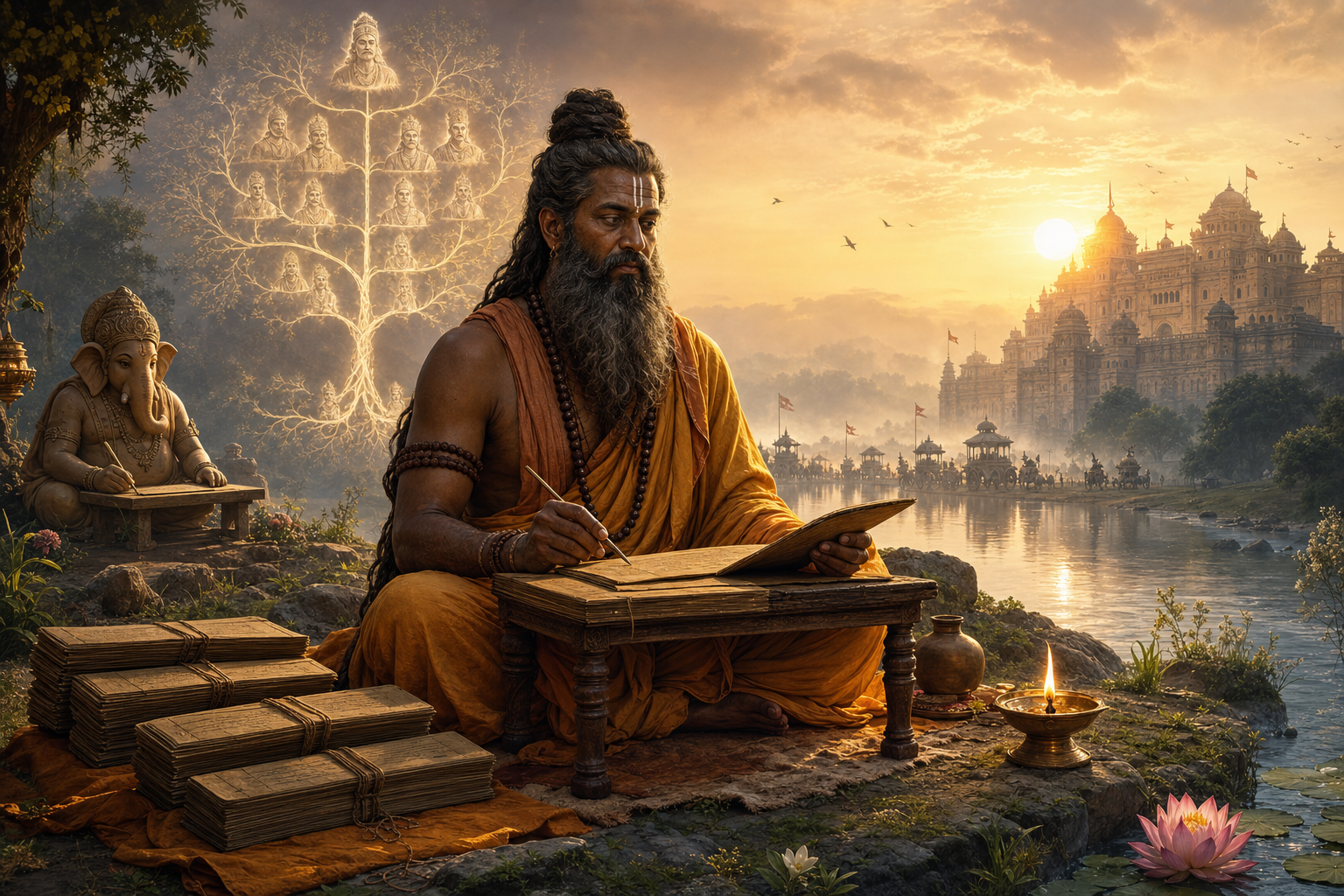
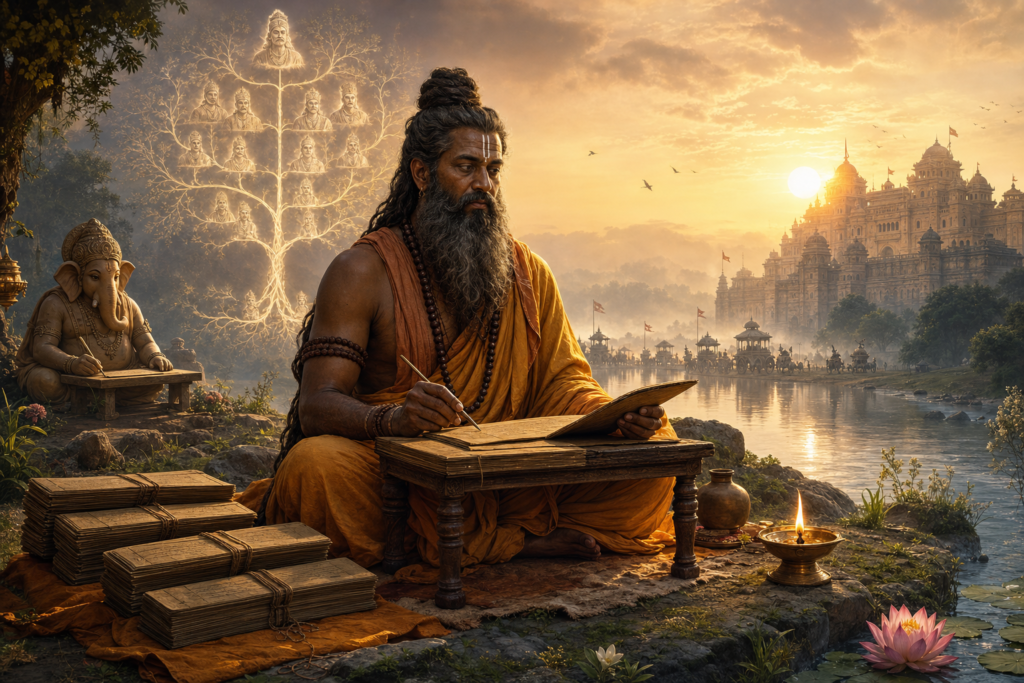
Vyasa in the Mahabharata occupies one of the most unusual positions in world literature: he is remembered as the composer of the epic, the seer who preserves its sacred memory, and a decisive participant in the events that make the story possible. In the traditional Hindu understanding, Vyasa is not merely a narrator standing outside the action. He enters the lineage of the Kurus, intervenes at moments of dynastic crisis, fathers key heirs through niyoga, warns elders about the moral collapse to come, and finally gives the epic its reflective, philosophical depth.
The Mahabharata is therefore not only a tale told by Vyasa; it is also a world shaped by Vyasa. This dual role gives the epic a remarkable self-awareness. The figure who organizes the story is also implicated in its sorrow. The sage who teaches dharma is also born into the very family whose decline becomes the central subject of the narrative. For readers of Hindu scriptures and Indian epics, this makes Vyasa a profoundly human and sacred presence at once.
Vyasa is traditionally known as Krishna Dvaipayana Vyasa. The name Krishna refers to his dark complexion, while Dvaipayana indicates that he was born on an island. The title Vyasa means arranger, compiler, or divider, and it points to his role in organizing sacred knowledge. In the broader Hindu tradition, he is also called Veda Vyasa because he is credited with dividing the Vedas into four collections: Rigveda, Yajurveda, Samaveda, and Atharvaveda. This association connects him not only with the Mahabharata but also with the preservation and transmission of Vedic knowledge.
The story of Vyasa begins with Satyavati, one of the most consequential women in the Mahabharata. She is remembered as the daughter of a fisher-chief in the social world of the Yamuna, though later traditions also preserve a more mythic account of her origin. According to that account, a cursed apsara, in the form of a fish, swallowed the semen of King Uparichara Vasu and gave birth to children. The female child was raised by a fisherman and came to be known as Matsyagandha because of the fish-like smell associated with her body.
This birth narrative may seem strange to modern sensibilities, but within epic literature it performs an important symbolic function. It places Satyavati at the meeting point of river, royalty, curse, desire, and destiny. The Mahabharata often presents great events as emerging from morally complex and socially unexpected places. Satyavati, who begins life outside royal privilege, becomes the mother of Vyasa and later the queen whose decisions determine the future of the Kuru dynasty.
While still young, Satyavati encountered the sage Parashara while ferrying him across the river. Their union led to the birth of Vyasa. In several traditional retellings, Parashara granted Satyavati important boons: her fragrance was transformed, her virginity was restored in a social sense, and the child born from their union would become a sage of extraordinary greatness. The child was born on an island and, in keeping with epic motifs, matured rapidly and departed for tapas, promising his mother that he would come whenever she needed him.
That promise becomes crucial later. Satyavati eventually married King Shantanu of Hastinapura after Bhishma, Shantanu’s son by Ganga, took his terrible vow of lifelong celibacy and renounced the throne. This vow was meant to secure the succession of Satyavati’s future sons, but it also planted one of the deepest causes of the Mahabharata’s tragedy. Bhishma’s sacrifice preserved his father’s desire, yet it also removed the strongest and most qualified heir from the normal line of succession.
Satyavati bore Shantanu two sons, Chitrangada and Vichitravirya. Chitrangada died without leaving an heir, and Vichitravirya also died childless after marrying Ambika and Ambalika, the princesses brought by Bhishma from Kashi. The Kuru dynasty then faced a grave crisis. In an ancient royal context, the absence of heirs was not only a family problem; it threatened political stability, ritual continuity, and the social order attached to the throne of Hastinapura.
At this moment Satyavati remembered the promise of her firstborn son. She summoned Vyasa and asked him to preserve the dynasty through the practice of niyoga, an ancient custom by which a designated man could be asked to father children on behalf of a deceased husband for the continuation of lineage. This episode is often difficult for contemporary readers, but it must be understood within the historical and textual world of the epic, where lineage, duty, and royal continuity carried immense weight.
Vyasa agreed to his mother’s request and entered the lives of Ambika and Ambalika. From Ambika was born Dhritarashtra, who was blind from birth. From Ambalika was born Pandu, described as pale or wan. When Satyavati sought another child, Ambika sent a maid in her place, and from that union was born Vidura, one of the wisest and most ethically grounded figures in the Mahabharata. In this way, Vyasa became the biological father of Dhritarashtra, Pandu, and Vidura, and therefore the grandfatherly source of both the Kaurava and Pandava lines.
This is where Vyasa’s role becomes historically and spiritually layered. Without him, there would be no Dhritarashtra, no Pandu, no Vidura, no Kauravas, and no Pandavas in the form known to the epic. The very conflict of Kurukshetra depends upon his intervention. Yet the text does not portray him as a schemer or power-seeker. He acts as a rishi responding to a call of duty, though the consequences of that duty unfold into one of the most devastating wars in sacred literature.
Vyasa’s presence in the Mahabharata is marked by clarity and restraint. He appears at decisive moments, offers counsel, reveals hidden truths, and then withdraws. He is not a king, general, or court politician. His authority is that of tapas, knowledge, and insight. When Satyavati later grieves over the direction of the dynasty, Vyasa warns her that the future will bring immense suffering. Following his advice, she retires to the forest with Ambika and Ambalika, stepping away from a palace whose destiny has turned dark.
One of the most significant aspects of Vyasa’s character is that he does not prevent the Mahabharata war, even though he understands its moral and cosmic implications. This restraint is central to the epic’s philosophy. Dharma cannot always be imposed from outside. Human beings must act, choose, fail, learn, and bear the consequences of their actions. Vyasa’s wisdom is not the wisdom of control; it is the wisdom of seeing clearly and preserving truth for future generations.
As the traditional composer of the Mahabharata, Vyasa transforms family history into civilizational instruction. The epic is not simply a record of war between cousins. It is a vast reflection on dharma, kingship, kinship, karma, suffering, renunciation, devotion, social obligation, and liberation. Through stories within stories, debates, vows, failures, pilgrimages, and philosophical teachings, the Mahabharata becomes a living archive of Hindu thought.
The famous statement that whatever is found in the Mahabharata may be found elsewhere, but what is not found there may not be found anywhere, reflects the scale traditionally attributed to the text. Vyasa’s genius lies in this expansiveness. He does not reduce life to a single doctrine. He allows multiple voices to speak: warriors, queens, sages, servants, gods, ascetics, householders, skeptics, devotees, and rulers. This openness is one reason the Mahabharata remains central to Sanatana Dharma and to the wider family of dharmic traditions.
Vyasa’s relationship with dharma is especially important. The Mahabharata does not present dharma as a simple rulebook. Again and again, characters face situations in which every available choice carries a cost. Bhishma’s vow is noble but leads to political imbalance. Yudhishthira values truth but becomes trapped in the dice game. Karna embodies generosity and loyalty but remains bound to adharma through his allegiance to Duryodhana. Draupadi’s humiliation exposes the collapse of courtly righteousness. In this moral landscape, Vyasa’s role is to preserve complexity rather than erase it.
This complexity gives the epic its enduring power. Many readers approach the Mahabharata seeking heroes and villains, but the text repeatedly resists simplistic judgment. Vyasa’s narrative method encourages reflection. It asks whether duty without wisdom is sufficient, whether loyalty can become destructive, whether silence in the face of injustice is itself a form of complicity, and whether power can remain legitimate when separated from ethical restraint.
Vyasa’s influence also reaches its spiritual summit through the Bhagavad Gita, which appears within the Mahabharata. Though the Gita is spoken by Sri Krishna to Arjuna, it is preserved within the epic attributed to Vyasa. This placement matters deeply. The teaching of the Gita does not arise in a monastery, forest hermitage, or detached philosophical school. It arises on a battlefield, at the moment when a warrior is overwhelmed by grief, moral confusion, and the unbearable weight of action.
By placing such a profound teaching inside the crisis of Kurukshetra, the Mahabharata shows that spiritual insight is not separate from life. Dharma must be understood in the midst of family, society, politics, grief, responsibility, and conflict. This is one of Vyasa’s greatest contributions to Indian philosophy: he allows metaphysics and everyday duty to meet. The highest knowledge is not presented as an escape from the world but as a way to act rightly within it.
In traditional accounts, Vyasa is also associated with the composition or compilation of the Puranas and with the transmission of sacred knowledge through disciples. Whether understood historically, theologically, or symbolically, this role presents him as a bridge between revelation and community. Sacred knowledge must not remain inaccessible. It must be arranged, narrated, remembered, and taught. Vyasa therefore represents not only authorship but also the responsibility of preserving wisdom across generations.
The narrative tradition that Ganesha served as the scribe of the Mahabharata while Vyasa dictated it adds another layer of meaning. In that account, Ganesha agrees to write only if Vyasa recites without pause, while Vyasa asks that Ganesha understand each verse before writing it down. Symbolically, this legend unites speed with comprehension, memory with intelligence, and divine writing with sage-like vision. It also conveys a subtle lesson: sacred literature is not merely written; it must be understood.
Vyasa’s connection with Satyavati also deserves careful attention. Satyavati is sometimes judged harshly because of her political ambition and her relentless concern for succession. Yet a more balanced reading recognizes the pressures around her. She moves through a world in which women often have limited formal power, yet she exercises agency through foresight, negotiation, and strategic decision-making. Her choices are not free from consequences, but they are central to the survival of the Kuru line.
Through Satyavati and Vyasa, the Mahabharata refuses to separate social margins from sacred destiny. A fisherwoman becomes queen. Her son becomes the great sage of the epic. A maid becomes the mother of Vidura, whose wisdom often surpasses that of kings. These narrative details carry a powerful civilizational message: dharma and wisdom are not confined to birth, rank, or royal display. They may arise wherever truth, discipline, and insight are present.
This point is particularly relevant for contemporary readings of Hinduism and dharmic traditions. The Mahabharata includes hierarchy, conflict, and social norms from its ancient setting, yet it also repeatedly disrupts rigid assumptions. Vidura, born from a maid, becomes a voice of ethical clarity. Krishna, though not the emperor of Hastinapura, becomes the central guide of dharma. Vyasa, born outside conventional palace structures, becomes the preserver of the epic itself. The text therefore invites humility before the many forms through which wisdom appears.
Vyasa’s role as both insider and observer makes him especially compelling. He belongs to the Kuru family by blood, but he also stands apart from its ambitions. He is emotionally connected to the dynasty, yet spiritually detached enough to see its decline. This combination gives the Mahabharata its tragic honesty. The epic does not glorify war for its own sake. It shows war as the result of accumulated failures: greed, humiliation, envy, weak governance, broken counsel, and the inability to restrain adharma when it first appears.
In that sense, Vyasa’s Mahabharata remains a guide for political and ethical reflection. The fall of the Kuru house is not caused by one event alone. It emerges from a chain of decisions across generations. Shantanu’s desire, Bhishma’s vow, Satyavati’s urgency, Dhritarashtra’s attachment, Duryodhana’s envy, Shakuni’s manipulation, and the silence of elders all contribute to the final catastrophe. Vyasa’s narrative method teaches that history is cumulative, and moral decline is rarely sudden.
The figure of Vyasa is also deeply connected to Guru Purnima, a festival that honors the guru principle. In many Hindu traditions, Guru Purnima is also called Vyasa Purnima because Vyasa represents the ideal guru who organizes knowledge for the welfare of humanity. This remembrance is not limited to one sect or school. It resonates across Vedanta, Yoga, bhakti traditions, and many streams of Hindu practice, while also speaking to the broader dharmic respect for teachers, lineage, discipline, and self-transformation.
For readers shaped by modern education, Vyasa can be understood as a theologian, philosopher, editor, historian of sacred memory, and narrative architect. For devotees, he is a rishi whose vision carries divine authority. For literary scholars, he is a symbol of the epic’s layered composition and oral tradition. These perspectives need not be mutually hostile. A dharmic approach can hold reverence and analysis together, recognizing that sacred texts operate at historical, ethical, symbolic, and spiritual levels at the same time.
This layered approach is essential when discussing the authorship of the Mahabharata. Academic study often views the epic as a text that developed over time through oral transmission, bardic recitation, theological expansion, and regional interpretation. Traditional belief, however, reveres Vyasa as the central compiler and seer behind the epic. A balanced account can acknowledge both: the Mahabharata has a complex textual history, and Vyasa remains the sacred name through which that vast tradition understands its origin and authority.
The emotional force of Vyasa’s story lies in the fact that knowledge does not spare him from sorrow. He sees more clearly than others, yet he lives among people who often fail to listen. This is a familiar pattern in the Mahabharata. Vidura counsels restraint, Krishna seeks peace before war, Bhishma understands dharma but is bound by his vow, and Vyasa warns of suffering before it unfolds. Wisdom is present, but human attachment resists it. That tension gives the epic its realism.
Vyasa’s appearances after the war further deepen his role as a sage of memory and consolation. The Mahabharata tradition presents him as one who can reveal hidden realities and help the grieving confront loss. The war destroys nearly the entire warrior generation, and the surviving elders are left with unbearable grief. Vyasa’s role is not to erase that grief but to place it within a larger framework of karma, time, duty, and spiritual continuity.
Time, or kala, is one of the great forces in the Mahabharata. Kings rise and fall. Vows produce unintended consequences. Human beings imagine themselves as controllers, yet they are carried by forces larger than personal desire. Vyasa’s wisdom is inseparable from this awareness of time. He records the rise and ruin of a dynasty so that later generations may recognize the patterns of adharma before they become irreversible.
The continued relevance of Vyasa lies in this warning. Families, communities, and nations decline when truth is subordinated to convenience, when elders remain silent before injustice, when personal loyalty overrides dharma, and when power is treated as an entitlement rather than a responsibility. The Mahabharata is ancient, but its moral questions remain immediate. Vyasa’s epic asks every generation to examine how it handles ambition, anger, counsel, inheritance, and ethical courage.
At the same time, the Mahabharata is not a text of despair. Through Vyasa, it preserves the possibility of learning. Even after catastrophe, there is instruction. Even after grief, there is spiritual inquiry. Even amid conflict, there is the Bhagavad Gita. The epic’s greatness lies in its refusal to deny suffering while still pointing toward wisdom. This is why Vyasa remains central not only to Hindu scriptures but also to the living moral imagination of India.
Vyasa in the Mahabharat is therefore best understood as a civilizational figure. He is the son of Satyavati and Parashara, the father of Dhritarashtra, Pandu, and Vidura, the traditional compiler of the Mahabharata, the arranger of Vedic knowledge, the guru remembered on Vyasa Purnima, and the sage who transforms a dynastic tragedy into a timeless meditation on dharma. His life shows that knowledge is not passive. It must be preserved, organized, spoken at the right time, and offered for the welfare of future generations.
In the end, Vyasa’s greatness does not rest only in authorship. It rests in vision. He sees the human condition without sentimentality and without cynicism. He recognizes the nobility and weakness of the same characters. He records the grandeur of kings and the wisdom of those outside power. He allows dharma to appear as inquiry, struggle, discipline, compassion, and truth. That is why the Mahabharata continues to speak across centuries, and why Vyasa remains one of the most powerful figures in Indian literature, Hindu philosophy, and dharmic civilization.
Inspired by this post on Hindu Pad.



Leave a Reply
You must be logged in to post a comment.