
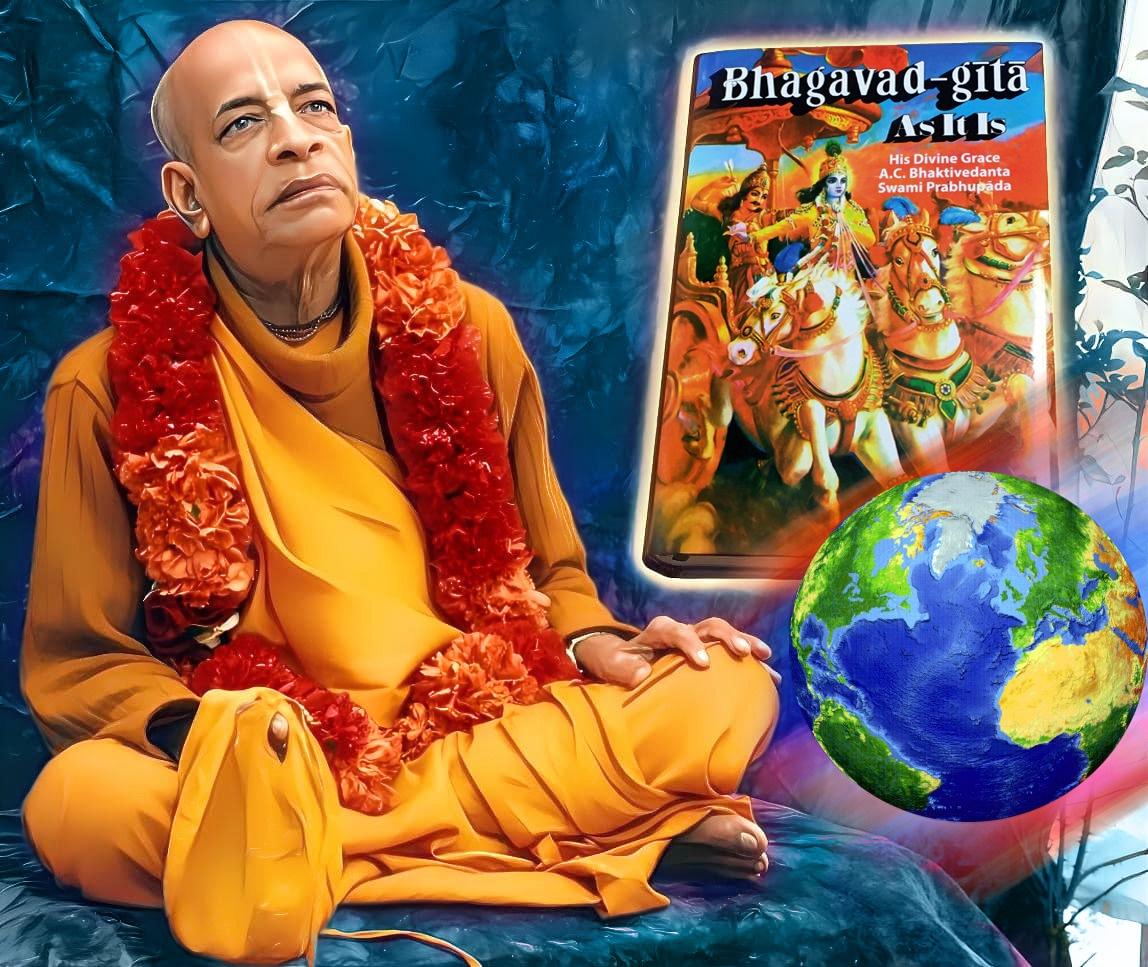
The May 2026 World Sankirtan Newsletter presents a striking portrait of organized devotional service within ISKCON, especially through the continuing global effort to distribute spiritual literature. At its center is a remarkable annual points competition among Bhrgupati Prabhu, Paramesvara Prabhu, and Mahotsaha Prabhu, three senior devotees whose sustained commitment reflects the living culture of sankirtan. The newsletter notes that Bhrgupati Prabhu currently holds the leading position in cumulative book points for the year, a detail made even more significant by the fact that he is 74 years old. In a tradition where service is understood not merely as activity but as disciplined offering, such perseverance becomes a meaningful example of bhakti expressed through action.
The phrase “nect to neck” competition, used in the original report, carries the affectionate devotional idiom often found in ISKCON circles. It points to a competitive mood that is not driven by ordinary rivalry, but by the desire to increase service, dedication, and outreach. In the context of sankirtan, competition functions as a form of collective encouragement. Devotees measure books, points, temple rankings, and monthly totals not simply as organizational data, but as indicators of how widely sacred teachings are being placed into public circulation.
Technically, the World Sankirtan Newsletter has long served as a reporting mechanism for ISKCON book distribution, a movement rooted in the mission of Srila Prabhupada and the broader Gaudiya Vaishnava emphasis on sharing Krishna consciousness through scripture, chanting, and public engagement. The distribution of Bhagavad-Gita, Srimad-Bhagavatam, introductory books, and other devotional literatures is understood as both education and seva. In this sense, book distribution connects personal spiritual discipline with public religious literacy, allowing individuals from diverse cultural and religious backgrounds to encounter Hindu philosophy, bhakti theology, and the devotional teachings of Lord Krishna.
The May 2026 results also show the international breadth of this work. Among large temples, Mayapur, Mumbai-Juhu, and Vrindavan emerged as the top three centers. These locations are not incidental. Mayapur is central to Gaudiya Vaishnava sacred geography as the birthplace of Sri Chaitanya Mahaprabhu; Vrindavan is intimately associated with Lord Krishna’s pastimes; and Mumbai-Juhu has long been one of ISKCON’s highly visible urban centers in India. Their strong performance demonstrates how pilgrimage centers and metropolitan temples can both become engines of religious education, devotional culture, and community engagement.
In the medium temple category, London-Soho, Bengaluru-South, and Bharuch led the rankings. This distribution is significant because it reflects the adaptability of ISKCON’s sankirtan model across different social environments. London-Soho functions in a dense Western urban setting shaped by pluralism and constant public interaction. Bengaluru-South reflects the devotional energy of a major Indian technology and education hub. Bharuch represents the continuing strength of regional devotional communities in Gujarat. Taken together, these centers show that spiritual outreach is not confined to one geography, language, or social class.
Among small temples, Surat, Ypsilanti, and Padayatra Proddatur were highlighted as the leading centers for the month. The inclusion of Padayatra Proddatur is especially meaningful because padayatra, or walking pilgrimage, carries an older Indic rhythm of public spirituality. It brings devotional presence into towns, villages, roads, and ordinary civic spaces. Such initiatives preserve the connection between movement, chanting, scripture, and community contact, reminding readers that dharmic traditions have historically been carried not only through institutions, but also through journeys, songs, teachers, and shared encounters.
In the maha-small temple category, Baltimore, Birmingham, and Kishinev were the top centers. Their presence in the rankings illustrates the importance of smaller communities in sustaining global Hindu and Vaishnava practice. Large temples often receive greater visibility, but smaller centers frequently depend on concentrated sacrifice, volunteer discipline, and close interpersonal bonds. A small group of steady practitioners can maintain worship, distribute books, organize kirtan, serve prasadam, and build a spiritual culture that reaches far beyond the size of the institution itself.
The report states that more than 490,000 literatures were distributed during the month, and that the cumulative total since 1965 has crossed 620 million literatures. This figure deserves careful attention. The year 1965 marks Srila Prabhupada’s journey from India to the West, a journey that eventually led to the founding of the International Society for Krishna Consciousness. From that historical point, book distribution became one of the most recognizable features of ISKCON’s global mission. A cumulative total above 620 million indicates not a temporary campaign, but a sustained transnational publishing and distribution culture spanning more than six decades.
From an academic perspective, these numbers invite analysis at several levels. First, they show the logistical capacity of a faith-based movement to print, translate, transport, and distribute texts across continents. Second, they reveal the role of lay and monastic volunteers in maintaining religious publishing networks. Third, they show how devotional communities use measurable goals to maintain momentum without reducing the spiritual purpose to mere statistics. The book point system, therefore, is best understood as an internal management tool placed in the service of a theological aim: the sharing of sacred knowledge.
The devotional importance of literature distribution also rests on the status of sacred texts within Hindu traditions. The Bhagavad-Gita, Srimad-Bhagavatam, and related Vaishnava works are not treated merely as books in the ordinary sense. They are viewed as carriers of spiritual knowledge, philosophical inquiry, ethical instruction, and transformative practice. When devotees distribute such texts, they participate in a long Indic tradition in which knowledge transmission is itself a sacred act. This connects ISKCON’s modern publishing efforts with older patterns of guru-shishya teaching, manuscript preservation, public recitation, and scriptural commentary.
The May 2026 newsletter is also valuable because it highlights senior service. Bhrgupati Prabhu’s leadership at the age of 74 challenges modern assumptions about age, productivity, and spiritual contribution. In many contemporary settings, aging is treated as withdrawal from public relevance. Within devotional culture, however, maturity can become a source of steadiness, example, and refined commitment. The continued service of senior devotees shows younger practitioners that bhakti is not a temporary enthusiasm, but a lifelong discipline that can deepen through decades of practice.
This point carries emotional resonance for many spiritual communities. Nearly every temple has elders whose quiet steadiness shapes the atmosphere more than formal announcements ever could. They may stand at book tables, cook prasadam, guide newcomers, chant steadily, teach children, or support festivals without seeking attention. The newsletter’s recognition of such service gives visibility to a deeper truth: dharmic life is sustained by people who return to their duties again and again, often with little public recognition, because they see service as a form of love.
The global rankings also encourage unity among dharmic traditions by emphasizing shared values rather than sectarian separation. Although the newsletter is specifically an ISKCON and Gaudiya Vaishnava document, its themes resonate across Hinduism, Buddhism, Jainism, and Sikhism: disciplined practice, scriptural learning, community service, humility, ethical conduct, and the transmission of wisdom. The act of sharing spiritual literature is not merely institutional outreach; it participates in a broader civilizational respect for knowledge as a path toward self-refinement and social harmony.
In Hindu and Vaishnava theology, sankirtan refers especially to the congregational glorification of the Divine, most prominently through the chanting of the holy names. ISKCON’s book distribution developed alongside this practice because sound, text, memory, and philosophy are deeply interconnected in the tradition. A public kirtan may attract attention through music and devotion, while a book allows a person to continue the encounter privately, thoughtfully, and at their own pace. This combination of public devotion and textual study has been one of ISKCON’s defining methods of spiritual outreach.
The newsletter’s temple categories also reveal a sophisticated reporting structure. By distinguishing large, medium, small, and maha-small temples, the system avoids measuring every center against the same institutional scale. This allows smaller communities to be recognized for excellence relative to their capacity. Such categorization is important for morale and fairness. It acknowledges that a temple with fewer residents, smaller facilities, and limited local resources may still demonstrate extraordinary dedication when its results are understood within an appropriate context.
The May 2026 data therefore tells a story larger than rankings. It shows how sacred geography, diaspora communities, urban temples, pilgrimage networks, and small local centers all contribute to a single global movement. Mayapur and Vrindavan carry theological and historical weight; London and Baltimore reflect diaspora engagement; Bengaluru and Mumbai-Juhu show urban Indian momentum; Padayatra Proddatur preserves embodied pilgrimage; Kishinev and Ypsilanti reveal the reach of devotional culture into less expected locations. Together, they form a map of contemporary bhakti in motion.
The reference to more than 620 million literatures distributed since 1965 also provides a long-term historical marker. Many religious movements struggle to sustain continuity across generations, especially when they move across languages and continents. ISKCON’s book distribution record suggests that publishing, translation, and volunteer-based outreach have remained central to its identity. This continuity matters because religious traditions survive not only through belief, but through repeatable practices that can be taught, measured, adapted, and renewed.
At the same time, a mature reading of the newsletter should not reduce sankirtan to numerical achievement alone. The number of books distributed matters, but so does the quality of interaction, the sincerity of the devotee, the dignity offered to the recipient, and the long-term spiritual effect that may unfold quietly. A single book received during a difficult period in life can become a turning point. A brief conversation at a book table can open philosophical curiosity. A text placed on a shelf may be read years later and still carry transformative force.
This is where the human dimension of the newsletter becomes especially compelling. Behind every monthly total are hours of walking, standing, speaking, listening, organizing, packing, traveling, accounting, and praying. There are early mornings, unpredictable weather, airport conversations, campus tables, street festivals, temple events, and moments of rejection as well as moments of gratitude. The public sees the exchange of a book; the devotee experiences the discipline of returning to service with patience and humility.
For the broader Hindu and dharmic public, the May 2026 World Sankirtan Newsletter offers an instructive example of how tradition can operate in the modern world without losing its spiritual center. It uses reporting, categories, metrics, and international coordination, yet its purpose remains devotional. It honors sacred literature while engaging contemporary public spaces. It recognizes individual excellence while strengthening collective identity. It shows that spiritual culture can be organized, measurable, and globally connected while still being rooted in bhakti, seva, and reverence.
The newsletter ultimately preserves a simple but powerful message: devotional service continues through people, places, books, and shared commitment. The leading temples and devotees of May 2026 represent more than monthly achievement. They represent a living network of practitioners who believe that sacred knowledge should remain accessible, portable, and available to anyone willing to receive it. In that sense, the World Sankirtan Newsletter is not only a record of distribution; it is a record of faith moving through the world in disciplined, organized, and compassionate form.
Inspired by this post on Dandavats.









Leave a Reply
You must be logged in to post a comment.