
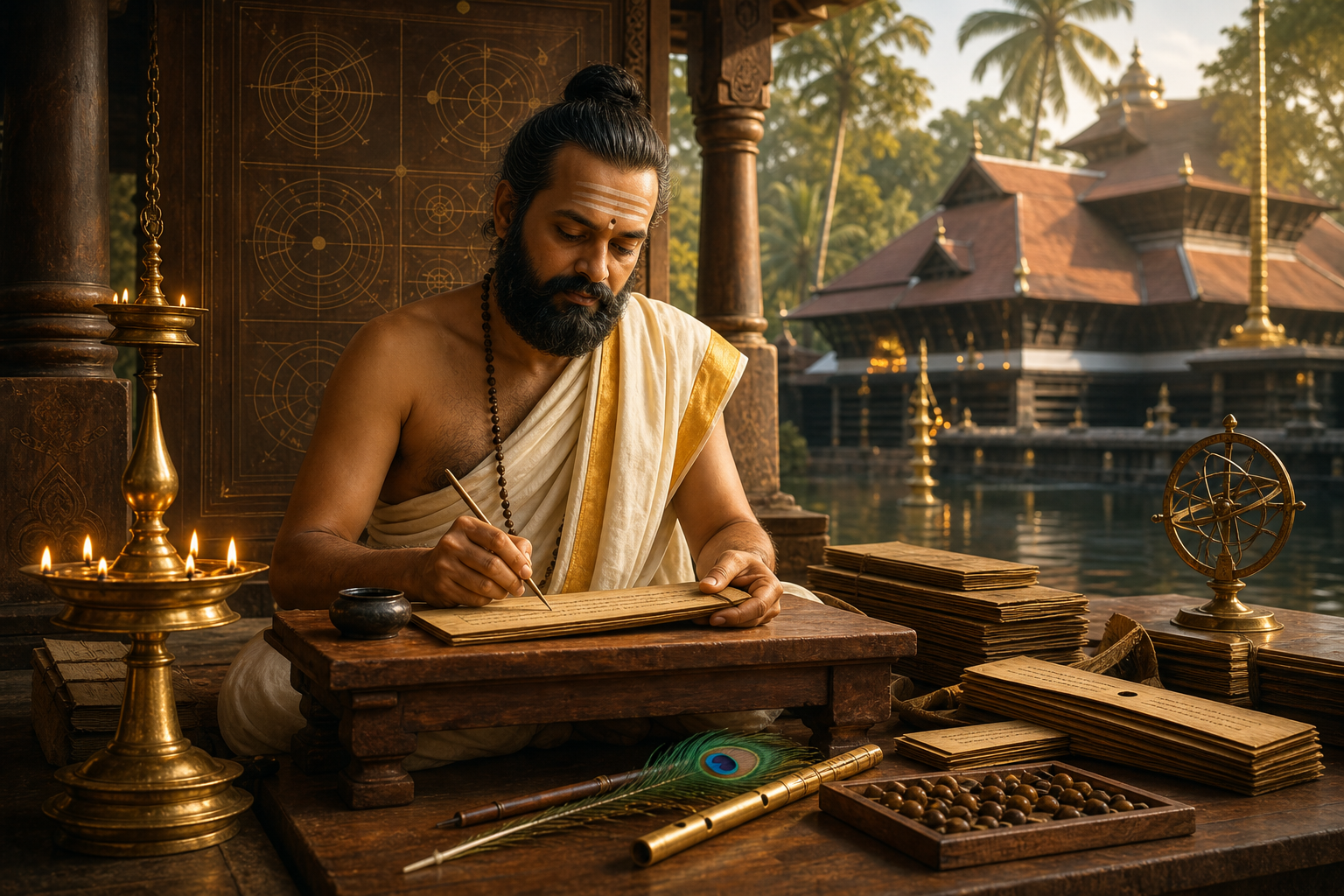
Narayana Bhattathiri, more fully remembered as Melpathur Narayana Bhattathiri, occupies a distinctive place in the intellectual and devotional history of Kerala. Traditionally dated to 1560-1646, with some accounts extending his life to 1666, he was a Sanskrit scholar, poet, grammarian, and mathematical thinker associated with the Kerala school of astronomy and mathematics. His name endures most widely through the Narayaneeyam, a compact yet luminous Sanskrit rendering of the devotional vision of the Bhagavata Purana, composed in praise of Guruvayoorappan, the Krishna of Guruvayur.
His life is important not merely because he wrote a celebrated devotional text, but because he represents a deeper Indian pattern: scholarship, spiritual discipline, poetic craft, mathematical reasoning, and guru-bhakti functioning together rather than as separate domains. In Bhattathiri’s world, grammar was not dry technicality, poetry was not ornament alone, mathematics was not detached calculation, and devotion was not anti-intellectual emotion. Each strengthened the other within a disciplined Sanskritic culture.
Bhattathiri was born in Melpathur, near the Tirur region of present-day Kerala, into a learned Brahmin family. His father, Mathrudattan Bhattathiri, was himself a scholar and became the first major influence in the young student’s education. This early household training reflected the older Indian model of learning in which intellectual formation began within family, ritual, language, and memory before expanding into formal study under specialized teachers.
From a young age, Bhattathiri showed remarkable aptitude. Traditional accounts describe him as becoming a pandit by the age of sixteen, a claim that should be understood in the context of the demanding educational standards of the period. Mastery meant not only reading texts, but memorizing, interpreting, debating, composing, and applying them. The intellectual culture of Kerala expected precision, discipline, and agility of mind.
His education included the Rig Veda, Sanskrit grammar, logic, and debate. He is said to have studied the Rig Veda from Madhava, tarka or the science of reasoning and debate from Damodara, and vyakarana or grammar from Achyuta Pisharati. These fields shaped his later work profoundly. The clarity of his Sanskrit poetry, the structural intelligence of his grammar, and the ordered architecture of the Narayaneeyam all reflect this rigorous training.
Achyuta Pisharati, Bhattathiri’s celebrated guru, was himself a major figure in Kerala’s scholarly world. Pisharati was known as a Sanskrit grammarian, astronomer, astrologer, and mathematician, and he belonged to the intellectual lineage associated with the Kerala school. Through him, Bhattathiri inherited a tradition that valued both scriptural learning and exact sciences. This is why Bhattathiri should be studied not only as a devotional poet, but also as part of India’s broader history of mathematics, astronomy, and linguistic analysis.
The Kerala school of astronomy and mathematics, associated with figures such as Madhava of Sangamagrama, Jyeshtadeva, Achyuta Pisharati, and others, cultivated sophisticated mathematical and astronomical inquiry. Bhattathiri’s direct technical contributions are not as famous as those of some predecessors, yet his presence in this milieu matters. He belonged to a learned ecosystem in which mathematical reasoning, calendrical science, grammar, ritual practice, and philosophical reflection were interdependent forms of knowledge.
Bhattathiri’s reputation as a mathematical linguist is closely tied to his work in Sanskrit grammar. His major grammatical work, Prakriya-sarvasvam, elaborated on the classical grammatical system of Panini. The technical importance of such a work lies in its attempt to organize linguistic generation with systematic rules. In this sense, Sanskrit grammar functioned almost like a formal science, demanding definitions, operations, exceptions, and internal consistency.
Modern readers often separate mathematics from language, but Bhattathiri’s intellectual world did not. Paninian grammar itself has long been admired for its rule-based elegance, economy, and analytical power. A scholar trained in that discipline learned to think structurally: how a sound changes, how a word forms, how a rule applies, how an exception is handled, and how a system remains coherent. Such training naturally overlaps with mathematical habits of mind.
The most beloved episode associated with Bhattathiri concerns his guru Achyuta Pisharati. According to traditional accounts, Pisharati suffered from a severe illness, often described as paralysis or rheumatism. Out of deep reverence for his teacher, Bhattathiri is believed to have prayed that the affliction be transferred to himself. The story, whether read as sacred memory, hagiography, or spiritual symbolism, expresses one of the strongest ideals of Indian learning: knowledge is not received as information alone, but through humility, gratitude, and service to the guru.
The emotional force of this tradition lies in its presentation of scholarship as a moral relationship. Bhattathiri’s reverence for Pisharati is not incidental to his intellectual greatness; it is part of it. The guru-shishya tradition gave learning an ethical frame. It asked the student to cultivate discipline, loyalty, self-restraint, and inner refinement along with technical mastery.
After taking on the suffering in the traditional narrative, Bhattathiri is said to have sought relief at Guruvayur, the sacred temple of Guruvayoorappan. The advice traditionally associated with Thunchaththu Ramanujan Ezhuthachan directed him toward composing a work on the divine manifestations of Vishnu, beginning with Matsya. The result was the Narayaneeyam, a devotional masterpiece that condensed the vast theological and narrative world of the Bhagavata Purana into one hundred dasakams, or groups of ten verses, totaling 1,036 verses.
The Narayaneeyam is not a casual summary. It is a carefully structured poetic and theological composition. It presents the cosmology, incarnations, divine play, and devotional vision of the Bhagavata Purana with remarkable compression. Its literary achievement lies in the balance between brevity and fullness: the work is shorter than the source scripture, yet it preserves the devotional intensity and narrative sweep that make the Bhagavata tradition central to Krishna bhakti.
Its final focus is Guruvayoorappan, the form of Lord Krishna worshipped at Guruvayur. This gives the text both a pan-Indian and deeply local character. It draws from the Sanskritic world of the Puranas, yet it is rooted in Kerala’s living temple culture. The result is a work that could be recited in homes, studied by scholars, sung by devotees, and honored in temple festivals.
For many devotees, the Narayaneeyam is also associated with healing. The traditional account says that Bhattathiri’s illness was relieved as he composed and recited the verses before Guruvayoorappan. This healing tradition should not be reduced to a narrow claim about disease. Its deeper meaning is spiritual and psychological: disciplined devotion, sacred sound, poetic concentration, and surrender can transform suffering into inner clarity.
The text remains especially loved in Kerala and Tamil Nadu, where recitation of the Narayaneeyam continues in devotional gatherings. The observance of Narayaneeyam Dinam at Guruvayur reflects the ongoing public memory of Bhattathiri’s offering. In this living tradition, the poet is not merely a historical figure. He is remembered through sound, ritual, study, and collective devotion.
Bhattathiri’s other works show the breadth of his scholarship. Texts attributed to him include Prakriya-sarvasvam, Kriyakrama or Asvalayanakriyakrama, Sripadasaptati, Dhatukavya, Svahasudhakara, Matsyavatara, Rajasuya, Ashtamicampu, Dutavakya, Subhadradharana, and Pancalisvayamvara. Some works are devotional, some grammatical, some ritual, and some literary. Together they reveal a mind comfortable across multiple domains of Sanskrit learning.
His association with royal patronage also deserves attention. Under the patronage of Cochin Vira Keralavarman, Bhattathiri is credited with works such as Gosrinagaravarnana and Virakeralaprasasti. This reflects another feature of early modern Indian intellectual life: scholars often moved between temple, court, household, and scholastic circles. Literature, polity, ritual, and cultural memory were closely connected.
From a literary standpoint, Bhattathiri’s importance lies in his command of Sanskrit as a vehicle of devotion and technical precision. The Narayaneeyam is admired not only for piety but also for literary merit. Its structure, diction, meter, and theological density reveal a poet who understood how to compress philosophical meaning into memorable verse. This is why the work has survived not as an archival curiosity, but as a recited and loved text.
From a philosophical standpoint, his life demonstrates the unity of jnana, bhakti, and karma. Knowledge appears in his grammar and scholarship. Devotion appears in his surrender to Guruvayoorappan. Action appears in his service to his guru and his disciplined composition. The three are not presented as competing spiritual paths, but as mutually reinforcing ways of refining the human being.
This is especially meaningful for a broader Dharmic understanding. Hinduism, Buddhism, Jainism, and Sikhism all preserve, in different ways, respect for disciplined practice, ethical self-cultivation, teachers, sacred language, contemplative insight, and liberation from ego-centered suffering. Bhattathiri’s life belongs specifically to the Hindu Vaishnava and Sanskritic world, yet the values illuminated through his story can be appreciated across Dharmic traditions without erasing their differences.
His legacy also helps correct a modern misconception that Indian spirituality was indifferent to intellectual rigor. Bhattathiri’s world shows the opposite. A scholar could be a devotee, a grammarian could be a poet, a temple-centered thinker could also belong to a mathematical culture, and a sacred text could be built with great formal sophistication. The Indian knowledge tradition often joined heart and intellect in ways that modern categories struggle to capture.
For students of Indian history, Bhattathiri is a bridge figure. He connects the Kerala school of mathematics and astronomy with Sanskrit grammar, Vaishnava devotion, temple culture, and literary production. He also shows how regional centers such as Kerala contributed powerfully to the larger civilizational fabric of India. The story of Indian knowledge is incomplete without such regional intellectual lineages.
For readers approaching him through devotion, Bhattathiri remains the poet who turned suffering into sacred song. For readers approaching him through scholarship, he remains a rigorous Sanskrit intellectual shaped by grammar, logic, and mathematical culture. For readers approaching him through cultural history, he represents Kerala’s extraordinary contribution to Indian learning. These perspectives do not cancel one another; they deepen one another.
The enduring power of Narayana Bhattathiri lies in this integration. His life invites reflection on what education can become when it is joined with humility, what devotion can become when it is disciplined by learning, and what literature can become when it carries both beauty and truth. In the memory of Guruvayur, in the recitation of the Narayaneeyam, and in the study of Sanskrit intellectual history, Bhattathiri remains a luminous personality of India’s spiritual and scholarly heritage.
Inspired by this post on Hindu Pad.



Leave a Reply
You must be logged in to post a comment.