
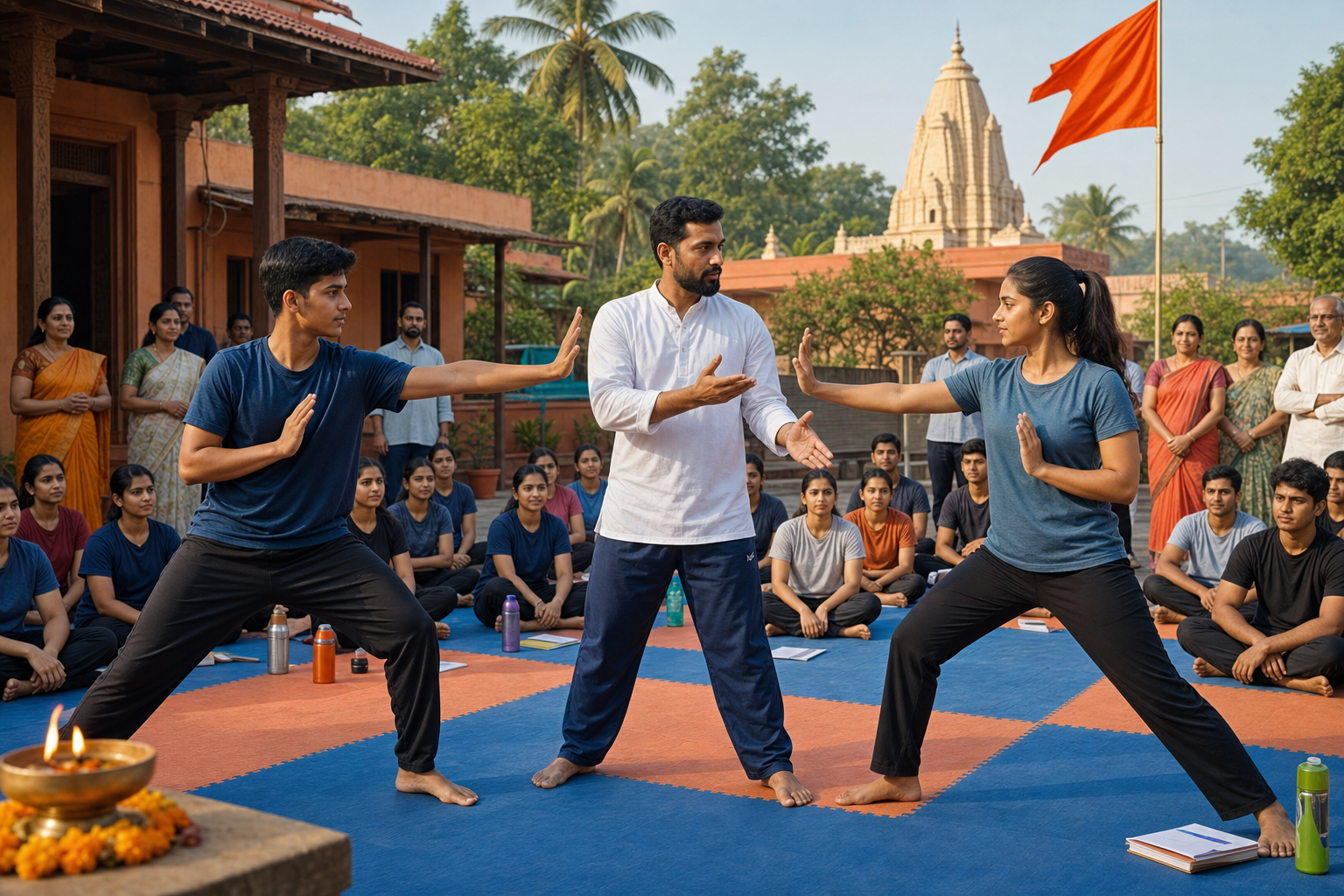
The Hindu Janajagruti Samiti’s ‘Har Ghar Yoddha’ self-defence training camp in Chiplun represents a significant example of youth-oriented community education, where physical preparedness, personal discipline, vigilance, and spiritual practice were presented as interconnected responsibilities. The camp was conducted under the broader ‘Har Ghar Yoddha’ campaign, a phrase that carries the idea that every home should nurture courage, alertness, and the capacity to respond wisely in moments of danger. In this context, the word “Yoddha” is not limited to physical combat. It also points toward a disciplined individual who understands duty, restraint, awareness, and service to society.
The central emphasis of the Chiplun camp was self-defence training for youth. Such training has practical importance in any society because young people often move through public spaces, educational institutions, workplaces, transport systems, and digital environments where safety depends not only on external protection but also on personal alertness. A self-defence camp therefore functions as more than a martial exercise. It becomes a structured lesson in situational awareness, confidence, bodily coordination, emotional control, and responsible action.
The available account indicates that the programme combined practical martial training with guidance on vigilance, spiritual practice, and personal safety. This combination is important because physical techniques, when separated from moral restraint and mental clarity, can become incomplete. In the Dharmic view of disciplined strength, the body is trained not for aggression but for protection, self-control, and the defence of dignity. A society that teaches youth only to be fearful weakens them; a society that teaches them only force without ethics endangers them. The camp’s broader framework appears to stand between these two extremes by connecting courage with responsibility.
Self-defence education has a technical dimension that is often misunderstood. It is not merely a list of strikes, blocks, holds, or escapes. Effective self-defence begins before any physical confrontation occurs. It includes learning how to read surroundings, identify unsafe situations early, maintain distance, use voice and posture, seek assistance, and disengage when possible. Practical martial training is most useful when it teaches the body to respond under stress while also training the mind to avoid unnecessary escalation.
For youth in places such as Chiplun, a camp of this nature can also have a strong civic meaning. Chiplun, like many towns in Maharashtra, has social networks shaped by families, schools, temples, local institutions, markets, and neighbourhood relationships. When youth participate in disciplined training, the benefit is not limited to individual confidence. Families gain reassurance, communities gain alert citizens, and younger participants encounter models of structured conduct. This is why youth empowerment is most meaningful when it includes both skill development and character formation.
The Hindu Janajagruti Samiti’s involvement gives the camp a cultural and spiritual framework. In many Hindu traditions, the cultivation of strength is not separate from the cultivation of sattva, self-restraint, and service. The Bhagavad Gita’s wider ethical vocabulary, the idea of dharma, and the long civilisational memory of protecting society all place courage within a moral order. Strength is not celebrated for domination; it is disciplined so that it may serve protection, justice, and social harmony.
This framework also aligns with the broader unity of Dharmic traditions. Hinduism, Buddhism, Jainism, and Sikhism each approach non-violence, discipline, courage, and protection through distinct philosophical languages, yet all recognise the need for inner mastery. Jainism places extraordinary emphasis on ahimsa and restraint. Buddhism teaches mindfulness, awareness, and freedom from reactive anger. Sikhism preserves a powerful model of saint-soldier discipline, where devotion and defence of the vulnerable are not contradictory. Hindu traditions speak of dharma, self-control, and the protection of society. A balanced self-defence camp can draw from this shared ethical landscape without reducing any tradition to mere physicality.
The emotional importance of such a camp should not be underestimated. Many young people carry unspoken anxieties about safety, public behaviour, peer pressure, and social conflict. Training spaces that are disciplined and culturally rooted can transform anxiety into preparedness. When a young participant learns how to stand firmly, breathe steadily, observe clearly, and act with restraint, the lesson reaches beyond the training ground. It affects how that person walks into a classroom, boards a bus, participates in community life, or supports a friend in distress.
Vigilance, as highlighted in the camp’s guidance, deserves careful interpretation. In an academic and civic sense, vigilance does not mean suspicion toward society or hostility toward others. It means awareness of one’s environment, sensitivity to risk, and the ability to respond lawfully and proportionately. A vigilant young citizen notices unsafe patterns, avoids preventable danger, helps others when appropriate, and understands when to contact responsible authorities. This form of vigilance strengthens community trust because it is rooted in responsibility rather than panic.
Personal safety training is especially relevant in the modern period because risk now appears in both physical and digital forms. Youth may face unsafe public situations, harassment, manipulation, bullying, misinformation, or social pressure amplified through phones and online platforms. A comprehensive understanding of self-defence therefore must include mental boundaries, digital caution, emotional resilience, and the confidence to seek help. Even when a camp primarily focuses on martial training, its larger educational value lies in encouraging young people to recognise that safety is a layered discipline.
The spiritual practice component is equally significant. Spiritual practice, when understood properly, is not an escape from social responsibility. It trains attention, steadies the mind, and reduces impulsiveness. Whether through prayer, japa, meditation, remembrance of dharma, or disciplined daily conduct, spiritual practice can help youth develop the inner composure required during stressful situations. In self-defence, panic often weakens judgment. A calm mind can distinguish between threat, insult, fear, and actual danger.
The idea of ‘Har Ghar Yoddha’ can therefore be read as a call for household-level resilience. A resilient household does not produce fear-driven individuals; it produces alert, ethical, compassionate, and disciplined people. Such a household teaches children and youth that courage begins with self-control, service begins with awareness, and cultural pride must be expressed through dignity. This is particularly important in Dharmic communities, where family, tradition, and social duty often remain central to moral education.
From a technical perspective, martial training for beginners should ideally emphasise foundations: balance, footwork, safe falling, basic escapes, protective guards, distance management, and verbal assertiveness. These foundations are more valuable than theatrical movements because real-life self-protection depends on simplicity, repeatability, and clarity under pressure. A well-structured camp also helps participants understand that the best outcome is often avoidance, de-escalation, and timely help, not physical confrontation.
For young women and girls, self-defence education can be especially empowering when taught with sensitivity and seriousness. It can help challenge the harmful assumption that personal safety is only a matter of restriction or dependence. Instead, it teaches agency, boundary-setting, and practical confidence. At the same time, the responsibility for a safe society cannot be placed only on potential victims. Community education must also cultivate respect, accountability, and lawful conduct among all youth.
For young men, such training is equally important because it can redirect strength toward restraint and service. In many societies, masculinity is sometimes distorted into aggression or recklessness. A disciplined self-defence camp can present a better model: strength guided by humility, courage guided by judgment, and confidence guided by respect. This is consistent with the Dharmic principle that power must be governed by dharma.
The Chiplun camp also demonstrates the role of civil society organisations in informal education. Schools and colleges may provide academic learning, but community groups often address practical life skills, cultural identity, local leadership, and social responsibility. When such programmes are conducted responsibly, they can complement formal education by preparing youth for real-world challenges. The practical nature of self-defence training makes it memorable because participants learn through movement, repetition, correction, and shared experience.
The language of empowerment must be handled carefully. Empowerment is not merely enthusiasm or slogan-making. It requires skills, discipline, institutional support, ethical clarity, and continued practice. A single camp can create awareness and motivation, but lasting empowerment depends on follow-up, regular training, parental support, community encouragement, and safe public systems. The value of the Chiplun camp lies in opening this pathway and reminding youth that preparedness is a habit rather than a one-day event.
There is also a cultural memory associated with self-defence and martial discipline in India. Traditional systems such as kalaripayattu, gatka, mardani khel, thang-ta, silambam, and other regional practices show that Indian civilisation has long understood the relationship between body training, courage, and community protection. These traditions differ in form and history, yet they share the recognition that physical discipline can be a vehicle for mental steadiness and ethical development.
In Maharashtra’s historical imagination, the ideal of courage is often associated with Chhatrapati Shivaji Maharaj, whose legacy is remembered not merely for warfare but for organisation, strategic clarity, protection of people, and civilisational confidence. A youth training camp in Maharashtra inevitably resonates with this wider memory of valour disciplined by purpose. However, responsible interpretation requires avoiding romantic excess. The practical lesson for youth is not to imitate conflict but to cultivate courage, preparedness, and respect for social order.
Personal safety also includes moral safety: the ability to resist destructive habits, manipulative influences, and impulsive behaviour. A young person trained only in physical response may still remain vulnerable to anger, addiction, digital exploitation, or peer pressure. The inclusion of spiritual practice and vigilance broadens the camp’s educational scope. It suggests that the true Yoddha protects not only the body but also the mind, values, family, and community trust.
The camp’s message becomes especially relevant in a time when many young people experience fragmentation between tradition and modernity. Some may view tradition as merely ceremonial, while others may view modern skills as detached from cultural identity. A programme that combines self-defence, vigilance, and spiritual practice offers an integrated model. It shows that Dharmic values can be lived through practical conduct: standing alert, caring for others, maintaining discipline, and acting with lawful restraint.
Such programmes also carry a responsibility to maintain inclusivity within the Dharmic fold. The blog’s larger objective of unity among Hinduism, Buddhism, Jainism, and Sikhism is served when youth empowerment is framed as a shared civilisational ethic rather than a narrow identity marker. Courage, compassion, non-violence, service, self-discipline, and protection of the vulnerable are values that can bring Dharmic communities closer together. The most constructive interpretation of ‘Har Ghar Yoddha’ is therefore not one of division, but of disciplined citizens who protect harmony.
Academic assessment of such a camp should also recognise the importance of embodied learning. In conventional education, knowledge is often transmitted through reading, listening, and examination. Self-defence education adds another dimension: the body learns timing, balance, reaction, and confidence. This embodied learning can reshape self-perception. A hesitant student who learns a basic escape or defensive stance may begin to understand capability not as an abstract idea but as a lived experience.
At the same time, accuracy demands that no claims be made beyond the available information. The known facts are that the Hindu Janajagruti Samiti conducted a self-defence training camp for youth in Chiplun under the ‘Har Ghar Yoddha’ campaign, and that the camp combined practical martial training with guidance on vigilance, spiritual practice, and personal safety. Its broader significance can be analysed through the lenses of youth empowerment, community resilience, Dharmic ethics, and civic preparedness, but the specific number of participants, dates, instructors, and curriculum details are not available in the provided material.
The disciplined tone of the initiative matters because public safety conversations can easily become reactive. A constructive approach focuses on prevention, preparedness, lawful conduct, and moral clarity. Youth should be encouraged to become calm responders rather than reckless actors. They should learn when to walk away, when to call for help, when to protect themselves, and when to support another person. These distinctions are central to mature self-defence education.
The spiritual dimension also prevents the training from becoming merely physical. In Dharmic traditions, the highest form of strength is often inner mastery. The one who controls anger, fear, speech, and impulse is stronger than one who merely knows techniques. A self-defence camp that reminds youth of spiritual practice can therefore deepen the meaning of martial training. It teaches that the hand, voice, and mind must act together under the guidance of dharma.
For parents and elders, the Chiplun initiative carries a relatable message. Many families want their children to be safe but may not know how to translate concern into practical preparation. A community camp provides a structured setting where youth can learn from trainers, practice with peers, and absorb values in a collective environment. This reduces isolation and helps families see safety as a shared responsibility rather than a private anxiety.
For the participants, the most lasting lesson may be the discovery that courage can be trained. Fear is not removed by denial; it is reduced by preparation. Confidence is not built through slogans; it is built through repeated practice, correction, and reflection. Spiritual steadiness is not achieved through occasional emotion; it grows through discipline. The Chiplun camp appears to bring these strands together in a manner that is both practical and culturally meaningful.
The ‘Har Ghar Yoddha’ campaign, as reflected in this camp, can be understood as a call to renew household and community-level responsibility. Every home benefits when youth are taught to be alert without being fearful, strong without being harsh, spiritual without being passive, and proud of tradition without being disrespectful toward others. This balance is essential for a healthy Dharmic public culture.
In conclusion, the Hindu Janajagruti Samiti’s self-defence training camp in Chiplun stands as a meaningful local initiative in youth empowerment, personal safety, and Dharmic civic education. Its significance lies not only in the martial skills taught, but in the wider message that preparedness, vigilance, spiritual practice, and ethical restraint belong together. When young people are trained to protect themselves while remaining grounded in dharma, compassion, and discipline, the result is not merely stronger individuals. It is a more confident, responsible, and harmonious community.
Inspired by this post on Hindu Jagruti Samiti.







Leave a Reply
You must be logged in to post a comment.