
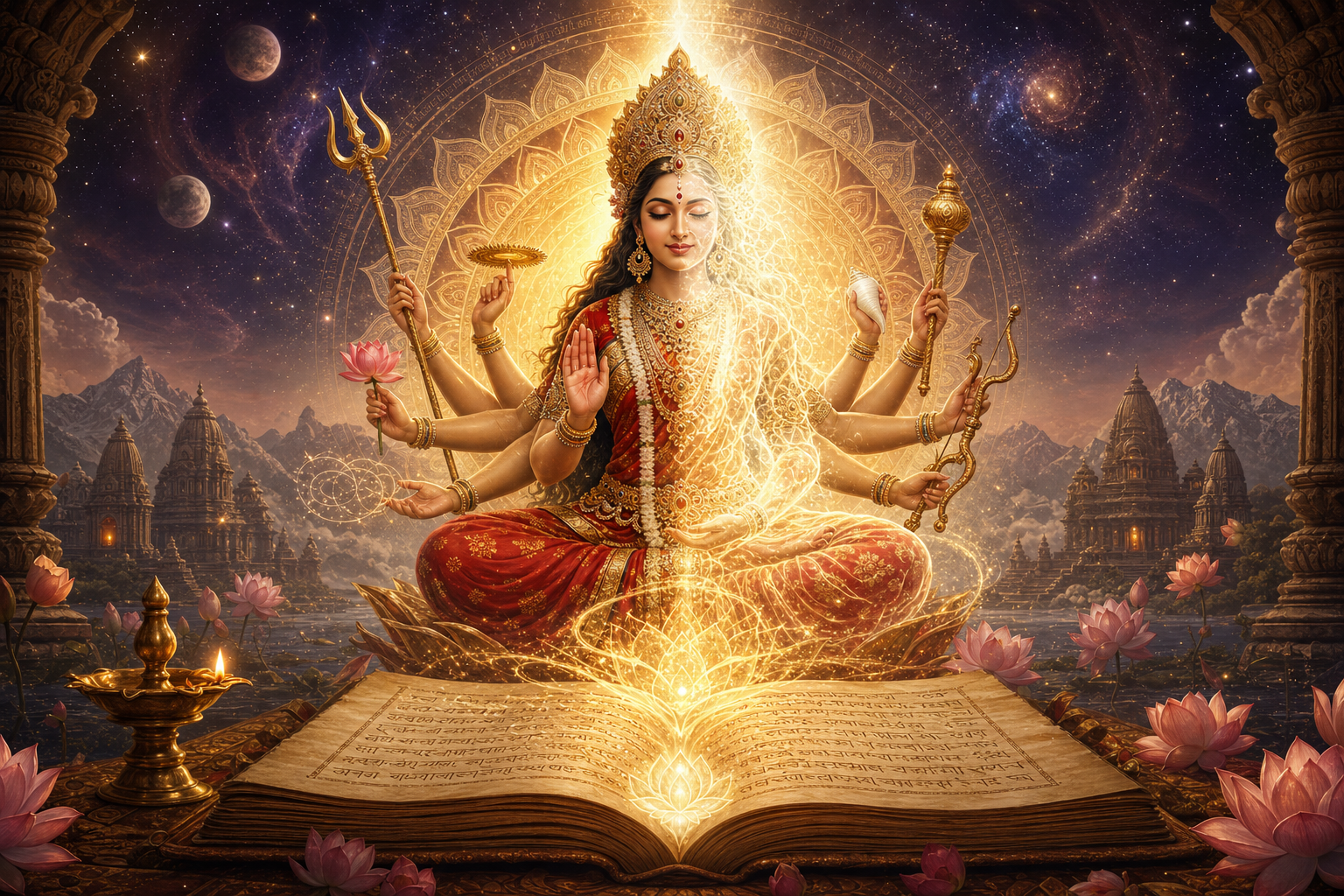
The Devi Upanishad occupies a decisive place in the Shakta vision of Hindu philosophy because it presents the Goddess not merely as a divine personality, cosmic mother, or protective power, but as Brahman itself. Its central declaration, Aham Brahma Swaroopini, is one of the most direct theological statements in the Sanskrit sacred tradition: the Devi is the very form of the Absolute. This is not a poetic exaggeration. It is a metaphysical assertion that places Durga, Shakti, and the Supreme Reality within a single philosophical frame.
In many devotional settings, Durga is approached through image, mantra, festival, temple worship, vrata, and sacred story. She is Mahishasuramardini, the destroyer of adharma; she is Jagadamba, the mother of the universe; she is the compassionate protector who answers the distress of devotees. The Devi Upanishad does not reject any of these forms. Instead, it deepens them. It teaches that the visible form is not a limitation of the Goddess, but a gateway into understanding her as the boundless ground of existence.
The phrase Aham Brahma Swaroopini can be understood as the Goddess declaring that her essential nature is Brahman. In Vedantic language, Brahman is the infinite, unconditioned, eternal reality from which all names, forms, powers, beings, worlds, and experiences arise. When the Devi is identified with Brahman, she is not being placed alongside the Absolute as another deity. She is being revealed as the Absolute itself, expressed through the language of Shakti, consciousness, power, and divine presence.
This declaration is especially significant because it bridges devotion and metaphysics. A devotee may bow before Durga with flowers, lamps, and mantras, while a philosopher may contemplate the nature of consciousness, causality, and ultimate reality. The Devi Upanishad allows both movements to meet. Worship becomes contemplation, and contemplation becomes worship. The Goddess is not reduced to an object of belief; she becomes the very reality through which belief, knowledge, devotion, and liberation become possible.
The text is commonly associated with the Shakta Upanishadic tradition and is often linked with the Atharvavedic stream of sacred literature. Its teaching reflects the mature theological insight that the Supreme can be approached not only through masculine, neutral, or abstract terms, but also through the feminine principle. This is not a secondary development in Hindu spirituality. It is a powerful expression of the broader Dharmic understanding that truth can be approached through many valid modes without weakening the unity of the highest reality.
In the Devi Upanishad, the Goddess is presented as the source of the universe, the inner power of the devas, the foundation of knowledge, and the principle behind both manifestation and transcendence. She is not confined to one cosmic function. She is creative, sustaining, dissolving, illuminating, veiling, and liberating. Such a portrayal goes beyond sectarian devotion. It offers a complete philosophical theology in which the universe itself is understood as the dynamic expression of Devi Shakti.
The power of this teaching becomes clearer when it is read beside the great Mahavakyas of the Upanishadic tradition. Statements such as Tat Tvam Asi and Aham Brahmasmi emphasize the identity of the inner self with the Absolute. Aham Brahma Swaroopini extends this insight through the voice of the Goddess. The Devi is not merely a helper on the path to Brahman; she is Brahman speaking as Shakti. The seeker is invited to recognize the sacred feminine not as symbolic ornamentation, but as supreme consciousness itself.
This understanding also corrects a common misunderstanding about Hindu deities. From a superficial view, the many forms of worship may appear as competing divine personalities. The Upanishadic view is far subtler. A form is not necessarily a boundary. A name is not necessarily a limitation. Durga, Lakshmi, Saraswati, Shiva, Vishnu, Rama, Krishna, Ganesha, and other revered forms can be understood as distinct approaches to the same inexhaustible reality. The Devi Upanishad gives this insight a Shakta articulation by affirming that all powers rest in Devi.
Durga in this context is not only the warrior Goddess of the Devi Mahatmya, though that dimension remains essential. She is the power that destroys inner ignorance, dissolves fear, protects dharma, and restores cosmic balance. Her battle with the asuras is not merely mythological drama. It is a spiritual map. Pride, delusion, violence, inertia, and fragmentation are the inner enemies that obscure recognition of Brahman. Durga’s victory becomes the victory of awakened consciousness over the forces that bind the mind.
The word Shakti is central to this theology. In ordinary language, Shakti means power or energy. In Shakta philosophy, it is far more profound. Shakti is the power of being, the power of knowing, the power of becoming, and the power of liberation. A static Absolute cannot explain the living dynamism of the universe unless its power of manifestation is acknowledged. The Devi Upanishad answers this by identifying that power with the Goddess herself. Brahman and Shakti are therefore not two competing principles, but two ways of speaking about the same ultimate reality.
This is why the Devi can be called both nirguna and saguna in a wider theological sense. As nirguna, she is beyond attributes, beyond mental categories, beyond form, color, gender, and conceptual grasp. As saguna, she appears with qualities, names, weapons, ornaments, compassion, radiance, and personality for the sake of devotion and meditation. The same reality that exceeds thought also becomes intimate enough to be loved. This is one of the most refined insights of Hindu spirituality.
The emotional depth of this teaching should not be underestimated. For many seekers, the idea of the Absolute as distant, impersonal, or unreachable can feel philosophically impressive but spiritually dry. The Devi Upanishad offers a different experience. The Absolute is also mother, refuge, wisdom, strength, and presence. The metaphysical becomes relational without losing its philosophical rigor. The devotee can stand before Durga with vulnerability and still be engaging with the highest non-dual truth.
There is also a profound psychological dimension here. To meditate on Durga as Brahman is to see strength and compassion as inseparable. It is to understand that liberation is not escapism, and spirituality is not weakness. Durga holds weapons because ignorance, injustice, and inner bondage require clarity and force. Yet she is also mother because liberation requires tenderness, patience, and grace. The Upanishadic Goddess integrates power and wisdom in a way that speaks directly to human struggle.
The declaration Aham Brahma Swaroopini also gives philosophical dignity to the sacred feminine. It challenges any narrow religious imagination that treats feminine divinity as decorative, secondary, or merely symbolic. In the Devi Upanishad, the feminine is not an accessory to ultimate truth. The feminine is ultimate truth. This has deep implications for how Hindu philosophy understands embodiment, nature, energy, speech, knowledge, and creation.
At the same time, this teaching should not be read as hostility toward other forms of Dharmic worship. The unity of Hindu, Buddhist, Jain, and Sikh civilizational wisdom rests partly in the recognition that spiritual life can take many disciplined forms while remaining oriented toward truth, liberation, compassion, and ethical transformation. The Devi Upanishad contributes to this wider Dharmic unity by affirming that the highest reality can be encountered through reverence, knowledge, discipline, and direct realization.
In Hindu practice, the Goddess is often approached through mantra. Mantra is not merely sound; it is a disciplined mode of consciousness. When a devotee recites names of Durga, the repetition gradually shifts attention from outer petition to inner recognition. The name first appears as a word addressed to the divine. With practice, it becomes a mirror in which the seeker recognizes that the divine presence being invoked is also the ground of awareness itself. This is where devotion and Vedanta begin to converge.
The Devi Upanishad’s teaching also clarifies the relationship between Prakriti and Purusha. In several streams of Indian philosophy, Prakriti refers to nature or primordial matter, while Purusha refers to consciousness or the witnessing principle. The Shakta vision does not treat the Goddess as mere material nature. She is the power behind both nature and consciousness, the source from which the apparent duality arises. This makes the Devi not simply the world, but the transcendent reality that appears as the world without being exhausted by it.
Such a view avoids two extremes. It does not reduce spirituality to world-denial, because the world is an expression of Shakti. It also does not collapse the Absolute into ordinary materiality, because Devi as Brahman remains beyond all finite expression. The universe is sacred, but it is not the full measure of the sacred. Form is meaningful, but the Goddess is beyond form. This balance is one reason the Devi Upanishad remains philosophically rich.
The term swaroopini is important because it points to essential nature rather than external appearance. To say that Devi is Brahma Swaroopini is to say that Brahman is not merely associated with her; it is her very being. This moves the discussion from mythology into ontology. The question is no longer only what the Goddess does, but what the Goddess is. The answer is radical: she is the ultimate reality from which all doing, knowing, and being arise.
For the practitioner, this changes the meaning of darshan. Seeing Durga in a temple is not simply seeing an image. It is an encounter with a consecrated form through which the formless becomes accessible. The murti does not imprison the divine; it focuses the mind so that the seeker can approach the infinite through a meaningful symbol. The Devi Upanishad gives the philosophical foundation for such worship by teaching that the Goddess in form and the Absolute beyond form are not ultimately separate.
This also helps explain why Navratri, Durga Puja, and other Goddess-centered traditions carry both emotional and philosophical intensity. These festivals are not merely cultural celebrations. They dramatize the return of order, the triumph of dharma, and the awakening of Shakti within individual and collective life. When communities gather around Durga, they are not only preserving heritage. They are reenacting a metaphysical truth: the divine power that sustains the cosmos also sustains moral courage.
In academic terms, the Devi Upanishad can be read as a text of theological non-dualism. It uses the language of Goddess devotion to articulate a vision in which ultimate reality, cosmic power, and spiritual liberation are unified. This is not identical in expression to every school of Advaita Vedanta, but it shares the concern for the identity of the highest truth. Its distinctiveness lies in refusing to separate the Absolute from the feminine power of manifestation.
The text also contributes to the broader Shakta claim that Devi is the source of the devas. In many Puranic and Tantric traditions, the gods derive their powers from the Goddess. The Devi Mahatmya famously shows the energies of the gods converging into the radiant form of the Goddess who defeats Mahishasura. The Devi Upanishad carries this insight to an even higher philosophical plane: the source of divine powers is not merely a superior deity, but Brahman as Devi.
This has implications for understanding religious plurality within Hinduism. If the same supreme reality can manifest as many forms, then diversity is not theological confusion. It is a disciplined recognition that finite minds approach the infinite through varied temperaments, lineages, languages, and practices. The Goddess as Brahman does not cancel other paths. Rather, it illuminates how one path can reveal the whole.
The philosophical strength of this view lies in its ability to hold transcendence and immanence together. Transcendence means the Devi is beyond the universe, beyond thought, and beyond all categories. Immanence means she is present as life, intelligence, speech, memory, courage, compassion, and the movement of every atom. A purely transcendent deity can feel distant. A purely immanent deity can become indistinguishable from the world. The Devi Upanishad preserves both dimensions with remarkable precision.
Speech itself becomes sacred in this tradition. The Goddess is often associated with Vak, the divine principle of speech, and with Saraswati as wisdom and expression. When truth is spoken, when mantra is recited, when scripture is studied, and when knowledge removes confusion, Devi is active. The declaration Aham Brahma Swaroopini is therefore not only a statement about the Goddess. It is also an example of sacred speech revealing the deepest structure of reality.
The seeker who studies this teaching carefully may discover that it asks for more than admiration. It asks for a transformation in perception. If Devi is Brahman, then the sacred cannot be confined to ritual moments alone. The world must be approached with reverence, the body with responsibility, speech with discipline, knowledge with humility, and power with dharma. The doctrine becomes ethical when it changes how life is lived.
This is where the Devi Upanishad remains contemporary. Modern life often divides intellect from devotion, power from compassion, nature from spirit, and philosophy from lived practice. The Upanishadic vision of Durga as Brahman heals these divisions. It allows a thoughtful person to engage reason deeply while still honoring the emotional and devotional needs of the heart. It allows spiritual strength to be both intellectually serious and personally meaningful.
The text also invites a refined understanding of liberation. Moksha is not merely escape from suffering. It is recognition of the truth that the individual self, the universe, and the supreme power are not ultimately alien to one another. In Shakta terms, liberation is awakening to Devi as the ground of consciousness. The worshipper begins with reverence for the Mother and gradually recognizes the Mother as the very reality in which worshipper, worship, and worshipped appear.
Such recognition does not make devotion unnecessary. On the contrary, it makes devotion deeper. A mature devotee does not abandon Durga after learning that she is Brahman. The devotee sees every mantra, image, festival, and act of worship as a doorway into that truth. The heart continues to bow, but now the bowing is filled with knowledge. The mind continues to inquire, but now inquiry is softened by reverence.
The Devi Upanishad therefore stands as one of the clearest scriptural foundations for understanding Durga beyond form and name. She is form, but not limited by form. She is name, but not confined by name. She is cosmic power, but also the silent Absolute. She is mother, warrior, wisdom, refuge, and Brahman. Aham Brahma Swaroopini is not only a declaration about the Goddess. It is a declaration about reality itself.
When this teaching is approached with seriousness, it reshapes both theology and practice. Durga is no longer only invoked in times of fear, difficulty, or festival celebration. She is recognized as the foundation of existence, the intelligence behind the cosmos, and the liberating presence within the heart. The Devi Upanishad’s supreme message is therefore both simple and inexhaustible: the Goddess is not a part of reality; she is the radiant fullness of reality.
Inspired by this post on Hindu Blog.



Leave a Reply
You must be logged in to post a comment.