
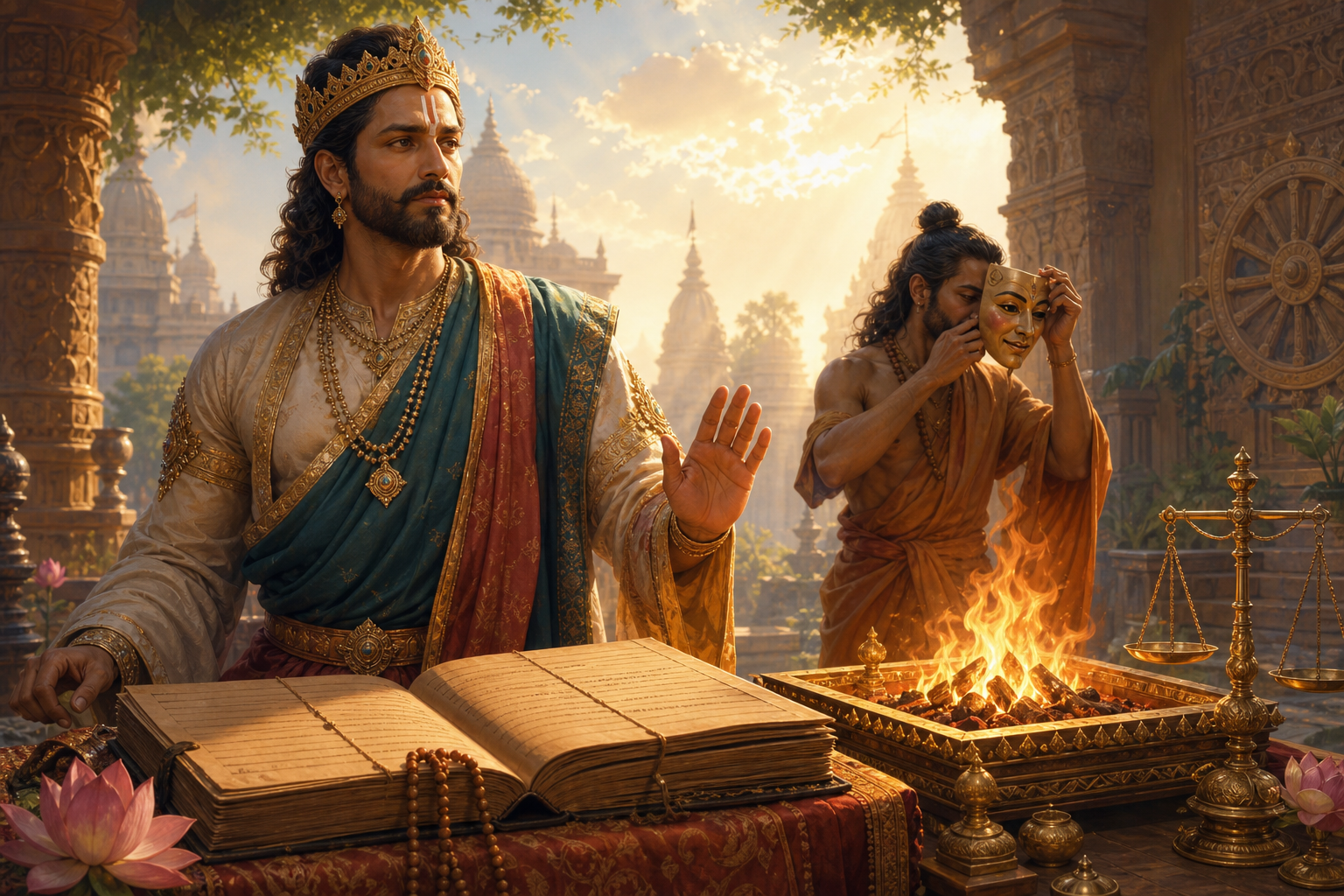
ŚB 4.19.23 stands in one of the most psychologically penetrating sections of the Śrīmad-Bhāgavatam. The episode is outwardly about King Pṛthu, Indra, and the interruption of a royal sacrifice, yet its deeper concern is the fragile boundary between authentic dharma and spiritual imitation. In academic terms, the verse studies how religious symbols can be separated from ethical substance, and how society becomes vulnerable when external signs are mistaken for realized character.
The narrative context is essential. King Pṛthu, remembered in the Bhāgavata Purāṇa as an exemplary ruler, undertakes a series of sacrifices that signify not merely ritual ambition but the proper ordering of society under dharma. Indra, seeing Pṛthu approach a level of ritual distinction associated with his own status, becomes disturbed by envy. This is not a simplistic story of one divine figure opposing another; it is a careful exploration of how insecurity can arise even in elevated positions when honor, recognition, and authority become objects of attachment.
ŚB 4.19.23 is especially important because it links Indra’s disguises with the emergence of pākhaṇḍa, a term used for religious hypocrisy, pseudo-spirituality, or externalized religiosity without inner surrender. The point is not that robes, vows, symbols, or renunciation are inherently suspect. The point is more precise: when sacred forms are used to conceal ambition, deceive the public, or disrupt righteous work, the form becomes detached from dharma and turns into an instrument of confusion.
This distinction is vital for preserving unity among dharmic traditions. Hinduism, Buddhism, Jainism, and Sikhism all contain disciplined paths of renunciation, devotion, meditation, service, study, and ethical restraint. Their diversity is not the problem. The danger identified in the Bhāgavatam is not plurality, but insincerity. A society rooted in dharma can honor many legitimate disciplines while still rejecting manipulation, vanity, and the misuse of sacred language for personal power.
The figure of King Pṛthu represents responsible authority. In the Purāṇic imagination, kingship is not merely political control; it is stewardship. A ruler is judged by the protection of citizens, the honoring of truth, the support of sacred learning, and the maintenance of social balance. Pṛthu’s sacrifice therefore functions as a public act of order, gratitude, and cosmic responsibility. When Indra disrupts it, the narrative asks how even legitimate institutions can be destabilized by envy and performative spirituality.
Indra’s role should be read with nuance. The Bhāgavatam does not reduce him to a permanent villain. Rather, it presents him as a powerful being temporarily overcome by fear of losing prestige. This makes the episode deeply relatable. Human communities repeatedly encounter the same pattern: individuals who have status may still feel threatened by another person’s excellence, and in that insecurity they may use moral language, religious imagery, or institutional authority to protect ego rather than truth.
The technical teaching of the verse rests on the difference between symbol and substance. Dharmic traditions use symbols because embodied human beings learn through gesture, sound, ritual, memory, and shared practice. A tilaka, a robe, a mala, a scripture, a mantra, a turban, a vow of ahiṁsā, a discipline of meditation, or an act of seva can carry profound meaning. Yet the Bhāgavatam insists that the symbol must be joined to self-control, humility, compassion, and accountability. Without these, the sign remains visible but the sacred purpose is lost.
The term pākhaṇḍa therefore has ethical, theological, and sociological force. Ethically, it refers to conduct that contradicts the values it publicly displays. Theologically, it refers to the distortion of sacred principles for egoic ends. Sociologically, it describes the social damage that follows when communities reward spectacle over character. ŚB 4.19.23 is not merely a warning about ancient ritual culture; it is a durable framework for evaluating religious authority in every age.
Modern readers can easily recognize the relevance. Spiritual branding, charismatic performance, selective quotation, and public moral posturing can create an appearance of depth without the slow discipline of transformation. This does not mean that public teaching is wrong or that visible religious identity is hollow. It means that visibility must be tested by conduct. The Bhāgavatam invites discernment, not cynicism; sober evaluation, not suspicion toward all religious life.
A practitioner approaching this verse may feel both caution and comfort. The caution is obvious: spiritual life can be misused when ego is not purified. The comfort is equally important: śāstra itself gives tools for recognizing misuse. The tradition does not demand blind acceptance of appearances. It encourages examination of motive, consistency, humility, scriptural grounding, and the effect of a teaching on the moral life of the listener.
In this sense, ŚB 4.19.23 supports a mature understanding of guru, śāstra, and sādhu. Authentic guidance does not merely impress; it disciplines, clarifies, and elevates. It does not isolate seekers from conscience or community. It does not use fear to replace inquiry. It does not turn renunciation into theater or devotion into status. Genuine spiritual leadership helps a person become more truthful, more restrained, more compassionate, and more firmly situated in dharma.
The episode also clarifies the relationship between dharma and adharma. Adharma does not always appear as open rebellion against the sacred. Sometimes it appears wearing sacred clothing, speaking sacred words, and invoking sacred authority. This is precisely why the Bhāgavatam is so psychologically sophisticated. It understands that the most dangerous distortions are often those that imitate the good closely enough to confuse sincere people.
At the same time, the verse should not be weaponized to attack different sampradāyas, sects, or dharmic communities. The Bhāgavata Purāṇa consistently honors devotion, humility, and surrender wherever they appear. A Vaiṣṇava reading of the verse can coexist with respect for Śaiva, Śākta, Smārta, Buddhist, Jain, and Sikh disciplines when those paths cultivate truthfulness, self-restraint, compassion, reverence, and liberation from selfishness. The unifying principle is not sameness of form, but sincerity of purpose.
This is where the verse becomes especially valuable for contemporary dharmic discourse. Unity does not require erasing difference. It requires recognizing the shared moral grammar that runs through dharmic civilization: satya, ahiṁsā, tapas, dāna, sevā, viveka, and reverence for the sacred. ŚB 4.19.23 strengthens that unity by warning against the one tendency that can corrupt any tradition from within: the use of spiritual appearance to mask unpurified desire.
The emotional force of the teaching should not be overlooked. Many people come to spiritual life during grief, confusion, loneliness, moral exhaustion, or a sincere search for meaning. When religious symbols are misused, the injury is not merely intellectual; trust itself is wounded. The Bhāgavatam therefore protects the seeker by teaching that devotion must be joined with discernment. Faith is not weakened by discrimination; faith becomes stronger when it learns to distinguish depth from display.
King Pṛthu’s response within the broader narrative also matters. He does not abandon dharma because hypocrisy appears near it. This is a crucial lesson. The presence of imitation does not invalidate the real. Counterfeit currency exists because real currency has value; similarly, pseudo-spirituality exists because genuine spiritual life has power. The proper response is not rejection of religion, but purification of practice and clearer commitment to authentic principles.
For students of Hindu scriptures, ŚB 4.19.23 is also a reminder that the Purāṇas are not merely mythic archives. They are analytical texts that encode political theory, moral psychology, ritual theology, and social criticism through narrative. The story of Indra’s disguise is a study in institutional anxiety, symbolic manipulation, and the need for ethical literacy. Its language may be ancient, but its diagnostic power remains contemporary.
A practical reading of the verse suggests several tests for spiritual authenticity. Does a teaching reduce selfishness or inflate ego? Does it deepen responsibility or provide excuses? Does it honor śāstra while encouraging humility, or does it use scripture as ornament? Does it create compassion and steadiness, or agitation and superiority? These questions are not hostile to faith; they are part of responsible faith.
The teaching attributed to ŚB 4.19.23 therefore has enduring benefit for householders, students, leaders, renunciants, and community organizers. It asks every role to remain inwardly accountable. A householder must not use family duty as an excuse for spiritual laziness. A renunciant must not use simplicity as a costume. A leader must not use dharma as a slogan. A teacher must not use knowledge as a tool of domination. In each case, the same principle applies: the outer form must serve inner truth.
In the broad arc of the Bhāgavata Purāṇa, the final standard is devotion to the Supreme, expressed through humility, service, remembrance, and purification of the heart. ŚB 4.19.23 contributes to that vision by exposing the danger of spiritual counterfeits. Its message is demanding but hopeful: dharma can be protected when communities learn to honor authentic practice, question hollow performance, and preserve unity across dharmic traditions through truth, compassion, and disciplined discernment.
Inspired by this post on Dandavats.
