
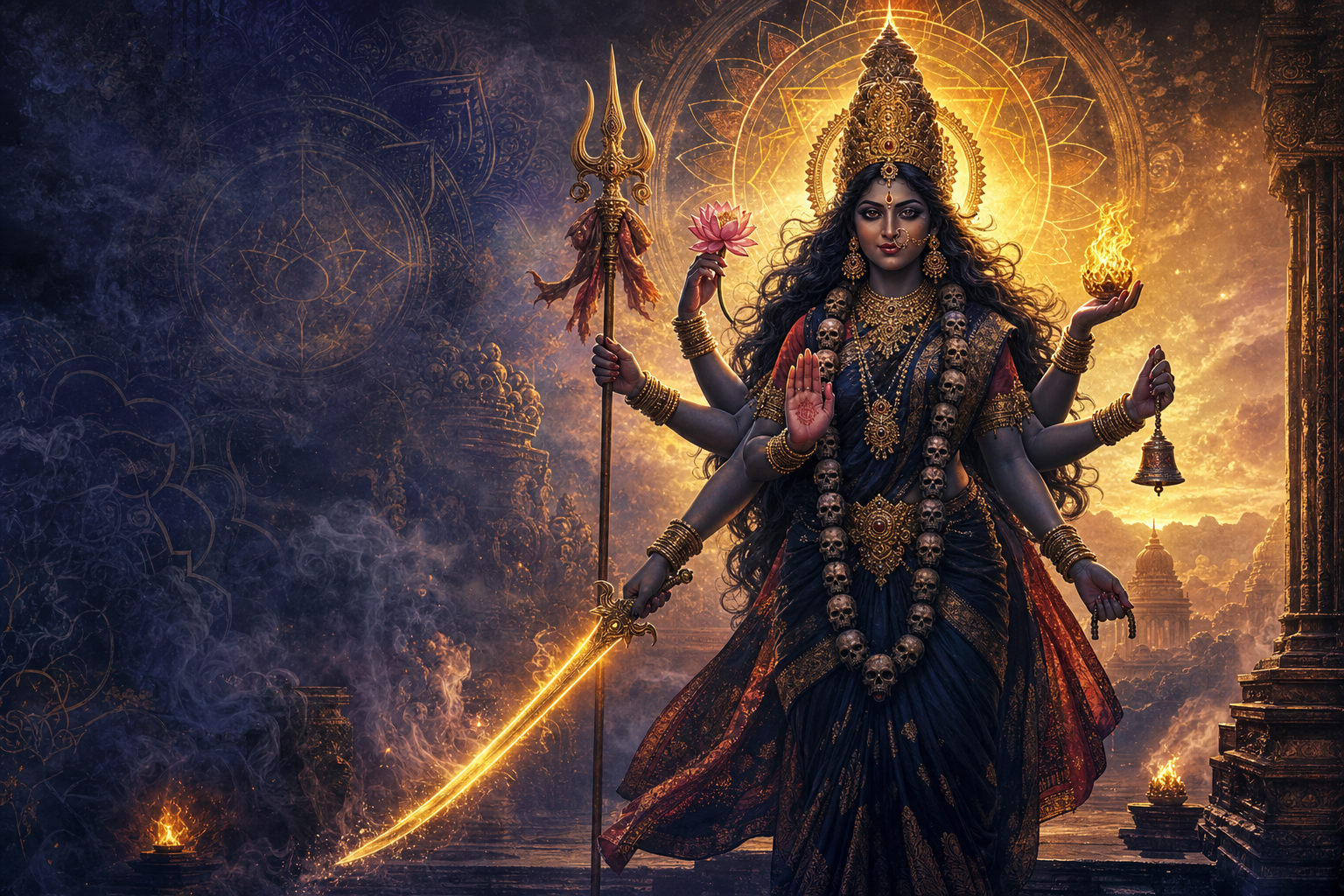
Hindu Tantric imagery is often misunderstood because it refuses to flatter the modern eye. Fierce goddesses such as Kali, Chamunda, Bhairavi, and certain forms of Durga do not always appear in soft colors, symmetrical calm, or domesticated sweetness. They may stand on corpses, wear garlands of severed heads, hold weapons, drink blood, laugh in cremation grounds, or display gestures that appear terrifying to an unprepared viewer. Yet these images are not designed as spectacles of cruelty. They are visual theology, ritual psychology, and metaphysical teaching compressed into sacred form.
The discomfort that many people feel before Hindu Tantric goddesses often reveals more about modern habits of perception than about Tantra itself. A culture trained to prefer sanitized spirituality can mistake fierce compassion for violence, symbolic death for nihilism, and the destruction of ego for savagery. The image becomes disturbing because it refuses denial. It brings mortality, desire, fear, rage, time, decay, and liberation into the same field of vision. Tantra does not hide the difficult dimensions of life; it places them before the practitioner so they may be transformed.
In this sense, Hindu Tantric iconography is not meant to horrify, but to reveal. It reveals the instability of the body, the limits of social vanity, the violence hidden inside attachment, and the sacred power that moves through both creation and dissolution. The fierce goddess is not an enemy of peace. She is the force that exposes false peace: the peace of avoidance, the peace of passivity, the peace that looks away from injustice while preserving a polite surface.
Tantrism belongs to a broad and complex stream within Hindu spirituality. It includes ritual practice, mantra, yantra, meditation, temple worship, subtle-body disciplines, philosophical inquiry, and methods for integrating energies that ordinary moralism often suppresses or fears. It cannot be reduced to exoticism, sexuality, occultism, or sensational imagery. Classical Tantric traditions developed sophisticated ritual systems around Shakti, the dynamic power of consciousness. In Shakta traditions especially, the Goddess is not merely a divine figure among others; she is the very power by which the universe appears, acts, dissolves, and renews itself.
This is why the Sacred Feminine in Hindu Tantra often appears in forms that exceed conventional beauty. A goddess who represents cosmic power cannot be confined to social expectations of femininity. She is mother, warrior, teacher, devourer of time, protector of devotees, destroyer of adharma, and liberating knowledge. When she appears fierce, the fierceness is not a moral defect. It is an iconographic language for uncompromising truth.
Kali is perhaps the most widely recognized example. Her dark form is frequently misread as sinister, yet her darkness is closer to the mystery of infinity than to evil. She represents time, death, transformation, and the ground into which all names and forms return. Her garland of heads is not a celebration of murder; it is commonly interpreted as a symbol of letters, speech, ego-identities, or the finite forms consumed by time. Her sword does not signify random aggression; it cuts ignorance. Her lolling tongue, cremation-ground setting, and wild hair communicate a state beyond social domestication. She is frightening only to that which clings to illusion.
Chamunda, another fierce goddess, is similarly misunderstood when viewed outside scriptural, ritual, and symbolic context. Her emaciated body, skull ornaments, and association with death are not meant to degrade the sacred feminine. They point toward impermanence and the radical stripping away of worldly pride. A viewer trained by consumer culture to equate divinity with polish may recoil from such imagery. But the image is doing precisely what it is meant to do: it disrupts superficial comfort and demands deeper perception.
Hindu iconography often works through paradox. The beautiful may conceal danger, and the terrifying may conceal grace. A mother may appear armed because protection sometimes requires force. A goddess may stand in a cremation ground because liberation requires facing death directly. A divine figure may wear skulls because every social identity eventually falls away. These symbols are not arbitrary decorative elements. They are visual arguments about reality.
The technical language of Tantric imagery is therefore essential. Weapons, mudras, ornaments, posture, color, direction, vehicle, companions, and setting all carry meaning. A severed head may represent ego, ignorance, false speech, or the limited mind. Blood may represent life-force, sacrifice, karmic consequence, or the raw continuity between life and death. A corpse may represent inert consciousness without Shakti, the dead weight of ignorance, or the body as temporary vehicle. The cremation ground may represent the field where all social distinctions collapse. Without this interpretive discipline, sacred symbolism becomes easy to caricature.
Modern viewers often bring moral categories shaped by Abrahamic, colonial, Victorian, or secular-liberal assumptions into the interpretation of Hindu sacred art. These categories may expect divinity to be visually pure, gentle, orderly, and morally didactic in a narrow sense. Hindu traditions, by contrast, have long recognized that reality includes multiple modes: sattva, rajas, and tamas; creation, preservation, and dissolution; compassion, discipline, and fierce correction. A complete sacred art must speak to all of these dimensions.
This does not mean every viewer must immediately feel comfortable before fierce goddess imagery. Discomfort can be honest and even useful. The problem begins when discomfort is mistaken for evidence of barbarism. A serious encounter with Hindu art and culture requires humility. It asks the viewer to learn the grammar of the tradition before judging its symbols by external standards.
Tantric goddesses also expose a contradiction in contemporary moral life. Many societies are disturbed by sacred images of symbolic violence while tolerating actual violence against women, children, the poor, animals, forests, rivers, and entire communities. A painted sword in the hand of Kali provokes anxiety, yet the daily destruction of nature is normalized. A skull garland is called horrifying, yet the psychological and physical exploitation of vulnerable people is often ignored. Tantra reverses the gaze. It asks why society fears the image that reveals violence more than the violence itself.
In this respect, fierce Hindu Goddess imagery carries ethical force. It is not escapist spirituality. It does not offer a decorative calm that leaves injustice untouched. The goddess who destroys demons represents the destruction of forces that degrade life: arrogance, cruelty, greed, delusion, predatory desire, and spiritual laziness. The battle is cosmic, psychological, and social at the same time. The demon is not only an external figure; it is also the inner pattern that resists truth.
This is one reason the imagery remains emotionally powerful. Many people know, from ordinary experience, that healing is not always gentle. Grief can feel like being dismantled. Trauma recovery may require confronting memories long avoided. Ethical courage may demand anger against abuse. Spiritual discipline may feel like the death of an older self. Fierce goddesses give sacred form to these realities. They affirm that transformation is not always soft, but it can still be compassionate.
Academic discussions of Tantrism often emphasize embodiment, ritual power, and the transformation of ordinary experience into a path of realization. Unlike approaches that divide the sacred from the material too sharply, many Tantric systems work with the body, senses, breath, sound, imagination, and emotion. This does not mean indulgence without discipline. On the contrary, authentic Tantric traditions are structured by initiation, lineage, mantra, purity rules, ritual precision, ethical preparation, and philosophical grounding. The aim is not shock. The aim is integration and liberation.
The goddess image functions as a mandala of that integration. She gathers what the ordinary mind separates: beauty and terror, birth and death, tenderness and power, form and formlessness. Her image may unsettle because it refuses fragmentation. It does not allow spirituality to become merely aesthetic. It insists that the sacred includes the whole of existence, including what the ego would prefer to hide.
There is also a profound feminist dimension in the interpretation of Shakti, though it must be understood within the language of Dharma rather than reduced to modern ideological slogans. The fierce goddess does not ask permission to be powerful. She is not defined by male approval, social gentility, or passive beauty. She acts. She protects. She destroys adharma. She teaches. She gives liberation. In a world where women are often expected to absorb harm quietly, the iconography of Kali and Durga can become a sacred protest against the domestication of feminine power.
At the same time, Hindu traditions do not present the feminine only as fierce. Lakshmi, Saraswati, Parvati, Sita, Radha, Andal, and countless local goddesses reveal other dimensions of grace, knowledge, prosperity, devotion, discipline, and compassion. The power of Hindu Goddess traditions lies in this plurality. The divine feminine is not locked into one mood or social role. She can be maternal, intellectual, erotic, ascetic, royal, village-centered, cosmic, terrifying, playful, and serene. This diversity is a strength of Hindu spirituality.
The same civilizational principle supports unity among Dharmic traditions. Hinduism, Buddhism, Jainism, and Sikhism differ in doctrine, practice, metaphysics, and historical development, yet they share a deep concern with liberation, ethical discipline, self-mastery, compassion, karma, and the transformation of consciousness. Fierce imagery appears in different forms across the Dharmic world, especially in certain Buddhist Vajrayana traditions, where wrathful deities are not evil beings but manifestations of awakened compassion. This wider context helps prevent shallow readings of fierce sacred art.
Jain and Sikh traditions may not use Tantric Goddess imagery in the same way, yet their disciplines also challenge superficial comfort. Jainism asks the practitioner to confront violence at the level of thought, consumption, and habit. Sikh tradition honors courage, justice, devotion, and the defense of righteousness. Together, Dharmic traditions remind society that spirituality is not mere softness. It can be rigorous, brave, disciplined, and morally demanding.
For this reason, Hindu Tantric imagery should not be isolated from the wider moral vocabulary of Dharma. Dharma is not sentimental peace. It is order, responsibility, truth, justice, duty, and the alignment of life with the deeper structure of reality. A peaceful society that refuses to confront exploitation is not truly dharmic. A religious imagination that cannot name destructive forces becomes vulnerable to them. The fierce goddess appears where evasion must end.
Colonial interpretations played a major role in distorting the public perception of Hindu Tantric traditions. European observers often approached Hindu practices through missionary suspicion, racial hierarchy, or exotic fascination. Images of Kali and other goddesses were sometimes used to portray Hindu civilization as irrational, cruel, or morally degraded. Such readings ignored Sanskrit texts, living ritual communities, philosophical frameworks, and indigenous modes of symbolic interpretation. The result was not scholarship alone, but cultural misrepresentation.
Post-colonial education has not fully escaped these distortions. Many Indians and members of the Hindu diaspora inherit embarrassment toward their own sacred symbols because those symbols were filtered through hostile or uninformed narratives. A child may learn to see a goddess image as frightening before learning its meaning. A young Hindu may feel pressure to explain away the tradition rather than understand it. Recovering iconographic literacy is therefore an act of cultural restoration.
Iconographic literacy does not require blind defensiveness. It requires careful study. Not every image circulating online is ritually accurate. Not every modern depiction respects traditional proportions, symbolism, or theological meaning. Commercial art, social media fragments, and sensational captions can flatten complex traditions into shock content. Serious engagement requires asking where the image comes from, which deity it represents, what textual or ritual tradition informs it, and how practitioners understand it.
The distinction between sacred image and spectacle is important. A murti or painted icon in a temple, shrine, manuscript, or ritual lineage participates in a world of worship, mantra, offering, and philosophical meaning. A cropped image circulated without context may lose that world. When the image is detached from practice, viewers may see only surface intensity. When restored to context, the same image becomes intelligible as theology.
Tantric art also challenges the modern separation between religion and psychology. Many fierce forms externalize inner states so they can be recognized and transformed. Fear becomes an object of meditation. Anger is disciplined into clarity. Attachment is cut by knowledge. Mortality is faced rather than repressed. The deity is not a projection in a reductive sense; rather, the image provides a sacred structure through which consciousness can encounter its own limitations and move beyond them.
This is why the cremation ground is such a powerful Tantric symbol. It is the place where status, wealth, youth, beauty, and social performance lose their authority. Kings and beggars, scholars and laborers, the admired and the forgotten all meet the same end. To meditate in or upon the cremation ground is to confront the truth that the ego spends a lifetime avoiding. The goddess who dwells there is not morbid. She is honest.
Modern society often hides death behind institutions, euphemisms, and sanitized rituals. This can create emotional fragility. When death becomes invisible, people may become less capable of wisdom. Hindu Tantric imagery places death back within sacred vision, not to produce despair, but to generate freedom. When impermanence is understood, attachment loosens. When attachment loosens, compassion can deepen. When compassion deepens, life becomes more truthful.
The same logic applies to time. Kali as time is not merely destructive. Time destroys, but it also ripens, reveals, and liberates. Everything false depends on time to expose it. Every body ages, every empire declines, every injustice carries consequence, every ego meets limitation. To worship Kali is, in part, to stop pretending that time can be conquered by vanity. It is to stand before reality without cosmetic protection.
The weapons of the goddess should also be read in relation to dharmic protection. Hindu traditions do not generally treat force as inherently sacred or inherently profane. The moral question concerns purpose, discipline, and alignment with Dharma. Durga’s weapons, given by the devas in many traditional narratives, signify the concentration of divine powers against forces that threaten cosmic and ethical order. Her battle is not aggression for domination; it is the restoration of balance.
This distinction matters in a world that often confuses passivity with virtue. Compassion without strength can become helplessness. Strength without compassion can become cruelty. The fierce goddess unites both. She is terrifying to oppression and protective toward the vulnerable. Her iconography teaches that genuine peace requires the capacity to resist what destroys life.
There is a further metaphysical dimension. In many Shakta and Tantric frameworks, reality is not divided between a pure spirit and a worthless world. Shakti is the power through which consciousness manifests as the universe. The body, speech, mind, senses, elements, and energies can become vehicles of realization when approached through disciplined practice. Fierce imagery therefore does not reject the world; it reveals the sacred power moving through the world, including through its most difficult thresholds.
This helps explain why Tantric practice has often seemed transgressive. It challenges rigid dualisms: pure and impure, sacred and profane, beautiful and ugly, acceptable and forbidden. However, transgression in Tantra is not mere rebellion. When authentic, it is governed by initiation, competence, purpose, and spiritual maturity. Its aim is to break bondage to ignorance, not to glorify disorder.
Public misunderstanding increases when Tantra is discussed without this discipline. Popular culture frequently reduces Tantra to erotic technique or dark mysticism. Anti-Hindu polemics may portray it as superstition. Some modern spiritual markets package it as personal empowerment without responsibility. All of these distortions miss the seriousness of Tantric traditions. They are not casual aesthetics. They are demanding paths with precise symbolic, ritual, and philosophical foundations.
A more accurate approach begins with respect for categories native to the tradition: Shakti, mantra, yantra, mudra, nyasa, chakra, kundalini, bhava, diksha, sadhana, and moksha. These terms cannot always be translated neatly into English without loss. Each belongs to a network of practice and meaning. The fierce goddess image is one node in that network. To isolate it from the whole is to misunderstand it.
It is also necessary to distinguish between fear and reverence. Sacred fear is not the same as horror. Reverence may tremble because it senses magnitude. A mountain, storm, ocean, or night sky can inspire awe because it exceeds human control. Fierce goddess imagery works similarly. It invites the viewer to encounter a reality larger than comfort. The trembling it produces can become the beginning of wisdom.
Many devotees do not experience Kali or Durga as frightening in the simplistic sense. They experience them as mother. This may seem paradoxical to an outsider, but it is central to the devotional imagination. A mother can be gentle when the child needs tenderness and fierce when the child is threatened. The maternal does not exclude power. In Hindu Goddess traditions, motherhood is not weakness; it is cosmic authority joined to intimate compassion.
This devotional experience complicates purely external interpretations. A museum visitor may see a violent image. A practitioner may see protection, grace, and liberation. A scholar may analyze symbols. A ritual specialist may see mantra embodied. A community may see ancestral continuity. All these layers matter, but the practitioner perspective prevents the image from being reduced to an object of detached curiosity.
The ethical challenge is to cultivate a gaze capable of learning. Before declaring a sacred image primitive, violent, or oppressive, the viewer must ask what the tradition is saying in its own language. What does the sword cut? What does the skull teach? What does the cremation ground reveal? What does the goddess protect? What form of ignorance is being destroyed? These questions open interpretation beyond reaction.
Such learning is especially important for younger generations encountering Hindu imagery through digital media. Social platforms reward speed, outrage, and visual shock. A complex Tantric image can be stripped of lineage and circulated as a meme, insult, or fear-based provocation. The remedy is not censorship of sacred complexity, but education. Families, temples, teachers, and cultural institutions can help restore context so that young Hindus and interested non-Hindus understand the depth of what they are seeing.
Hindu art and culture have always contained multiple visual registers. Temple sculpture, manuscript painting, folk shrines, classical bronzes, village goddesses, philosophical diagrams, and festival icons do not all speak in the same tone. Some soothe. Some instruct. Some protect. Some overwhelm. A mature civilization does not need every sacred image to be agreeable. It needs images that tell the truth.
The truth told by Hindu Tantric goddesses is that reality cannot be reduced to comfort. Life includes birth and death, nourishment and decay, beauty and terror, injustice and correction, bondage and liberation. A spirituality that excludes these realities becomes fragile. A spirituality that integrates them can become transformative. The fierce goddess stands at that threshold.
Therefore, the visceral force of Tantric Goddess imagery should be approached not as a scandal, but as a teaching. It asks society to stop confusing sacred honesty with brutality. It asks viewers to examine why symbolic severance disturbs them more than actual exploitation. It asks spiritual seekers to move beyond decorative peace toward courageous truth. It asks communities to honor Shakti not only as beauty, but as power, wisdom, protection, and liberation.
When seen in this fuller light, the fierce Hindu Goddess does not degrade the sacred. She rescues it from sentimentality. She restores the link between spirituality and reality. She reveals that compassion may carry a sword, that wisdom may stand in a cremation ground, and that liberation may first appear as the destruction of everything false. The image is not meant to horrify. It is meant to awaken.
Inspired by this post on Hindu Blog.





Leave a Reply
You must be logged in to post a comment.