
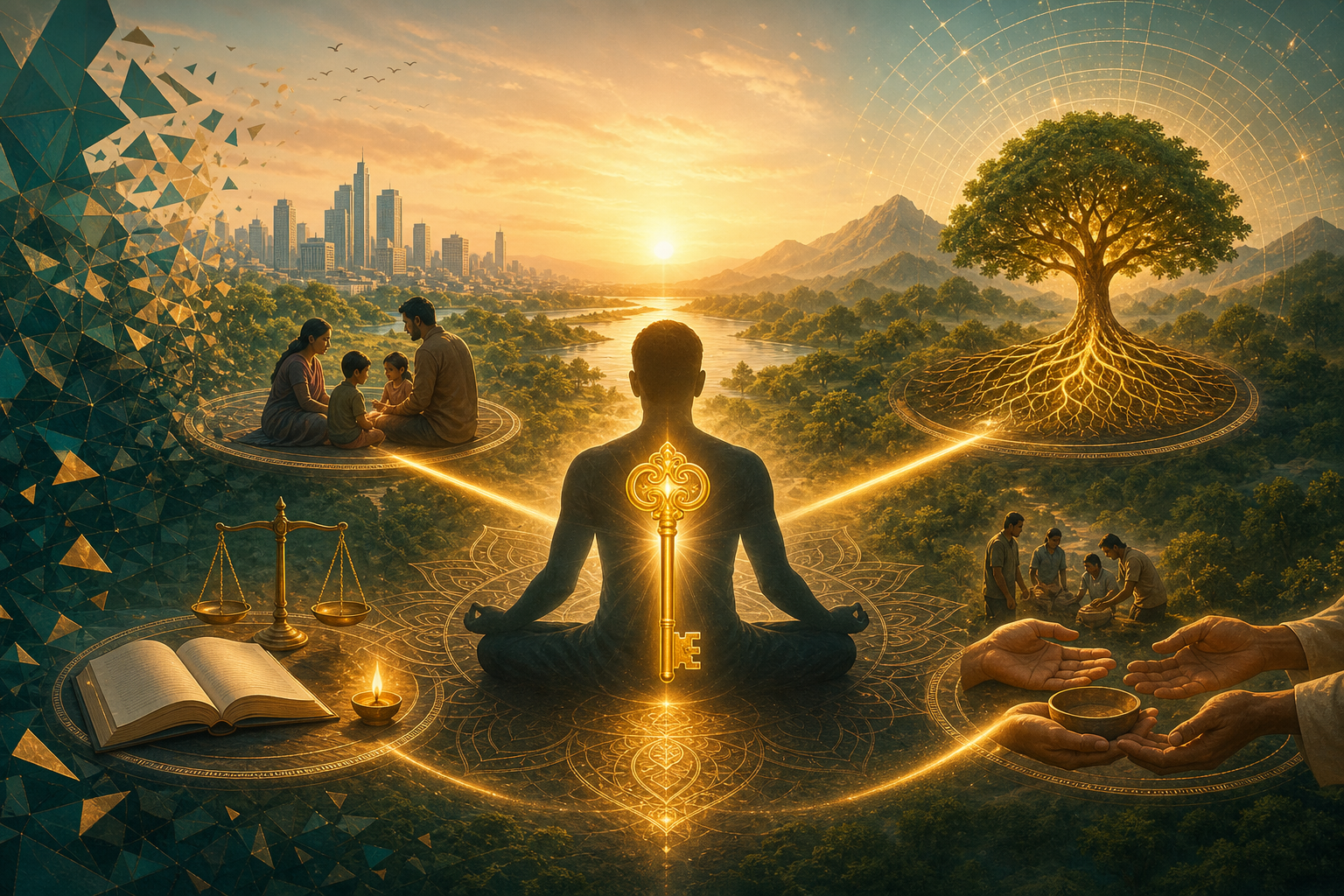
Human life, when viewed through the lens of Dharma, is not merely a repetitive cycle of biological needs, social obligations, and temporary ambitions. It is a disciplined movement from disorder toward excellence, from ignorance toward wisdom, from fragmentation toward integration, and from mortality-conscious living toward a deeper awareness of the immortal dimension of existence. This view does not reject the practical world; rather, it gives the practical world a moral, psychological, and spiritual architecture.
Dharma holds the key to an integrated life because it refuses to separate inner growth from outward conduct. A person may acquire knowledge, wealth, influence, skill, or social status, but without Dharma these gains remain unstable and often become instruments of anxiety, ego, or conflict. Dharma asks a more demanding question: whether power is guided by responsibility, whether knowledge produces humility, whether prosperity supports welfare, and whether personal freedom remains aligned with truth, restraint, and compassion.
The original insight that human progress is a movement from the transient to the permanent is central to Hindu philosophy and broadly resonant across Dharmic traditions. In ordinary life, the transient appears attractive because it is immediate: pleasure, praise, possession, victory, and recognition. Yet these experiences are unstable by nature. The permanent, by contrast, refers to enduring values such as truth, self-knowledge, ethical clarity, compassion, wisdom, and the realization that life is not exhausted by the visible body or the fluctuating mind.
In this sense, Dharma is not a narrow rulebook. It is a principle of alignment. It aligns the individual with conscience, family with responsibility, society with justice, nature with reverence, and spiritual life with disciplined practice. It is therefore both personal and civilizational. At the personal level, Dharma gives direction to choices. At the social level, it sustains trust. At the spiritual level, it turns life into a field of inner refinement.
The technical meaning of Dharma is difficult to compress into a single English equivalent. It can mean duty, law, virtue, order, nature, righteousness, sustaining principle, ethical obligation, and spiritual discipline, depending on context. The Sanskrit root often associated with Dharma is dhri, meaning to hold, support, or sustain. This etymological sense is significant: Dharma is that which sustains life from collapsing into chaos, impulse, exploitation, and meaninglessness.
An integrated life requires more than success in one compartment. A person may be professionally efficient but emotionally unsettled, intellectually sharp but morally confused, religiously active but socially insensitive, or materially comfortable but spiritually empty. Dharma challenges such fragmentation. It asks that thought, speech, action, livelihood, relationships, and aspiration form a coherent whole. This coherence is the practical meaning of integration.
The Bhagavad Gita gives one of the clearest frameworks for this integration. It does not recommend escape from action; it recommends purification of action. Karma Yoga teaches that action should be performed with discipline, competence, and dedication, while the egoistic craving for results is gradually reduced. This is psychologically profound. Much human suffering arises not from action itself, but from attachment, comparison, fear of failure, and the demand that every result must confirm the ego.
Dharma therefore converts daily work into a path of self-mastery. A teacher, parent, artisan, administrator, farmer, student, monk, professional, or community leader can all live dharmically when action is guided by integrity and service rather than vanity or exploitation. This insight is especially relevant in modern life, where productivity is often separated from purpose and success is frequently measured without reference to character.
Progress, in the Dharmic understanding, is also a dual process. It preserves the values already acquired and adds new capacities required by changing circumstances. This balance is crucial. A society that only conserves may become rigid; a society that only changes may become rootless. Dharma offers a middle principle: preserve what is life-giving, examine what is outdated, and adopt what is necessary without severing continuity with wisdom.
This is why Dharma is not opposed to modernity. It is opposed to thoughtless modernity. It does not reject science, technology, education, governance, commerce, or social reform. It asks that these be evaluated by their impact on human dignity, ecological balance, social harmony, and spiritual well-being. In a world shaped by artificial intelligence, consumerism, ecological stress, political polarization, and loneliness, Dharma becomes not less relevant but more urgent.
A life governed only by desire tends toward restlessness. Desire multiplies faster than satisfaction. Dharma does not deny desire; it disciplines it. Classical Hindu thought recognizes the purusharthas: Dharma, Artha, Kama, and Moksha. Artha, or material prosperity, and Kama, or legitimate enjoyment, are not condemned. They are placed within the regulating framework of Dharma and ultimately oriented toward Moksha, liberation. This structure prevents both self-denial and self-indulgence from becoming extremes.
The ethical depth of Dharma becomes clearer when compared with mere legality. A legal action may still be selfish, harsh, manipulative, or socially destructive. Dharma reaches deeper than external compliance. It asks whether action is truthful, proportionate, compassionate, and appropriate to circumstance. This sensitivity to context is one reason Dharmic ethics cannot be reduced to mechanical commands. It requires viveka, or discernment.
Discernment is essential because human life is rarely simple. Duties can conflict. A person may face tension between family responsibility and public duty, personal comfort and moral courage, loyalty and truth, tradition and reform, forgiveness and justice. Dharma does not remove the complexity of life; it trains the mind to respond with maturity. The Mahabharata is powerful precisely because it explores these conflicts with philosophical seriousness rather than simplistic moralism.
The movement from ignorance to wisdom is also a movement from impulsive reaction to reflective action. Ignorance is not merely lack of information. It is misidentification: mistaking the temporary for the ultimate, the ego for the self, possession for fulfillment, and social approval for truth. Wisdom begins when a person can observe desires, fears, anger, and pride without being completely ruled by them.
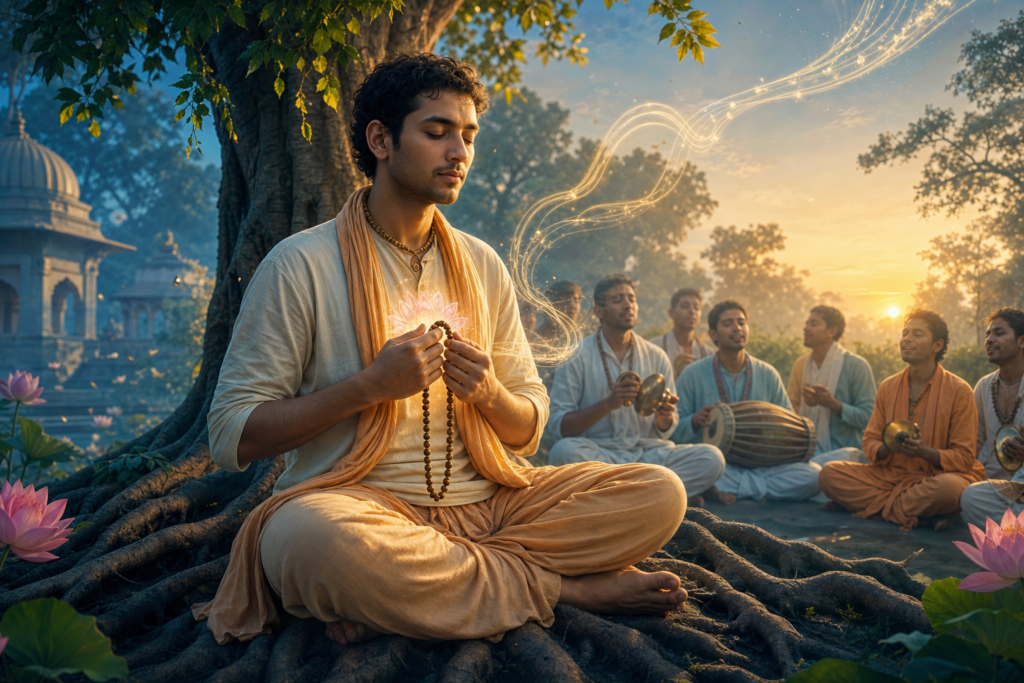
Yoga provides a practical technology for this transformation. The yamas and niyamas in the Yoga tradition include ethical restraints and observances such as non-violence, truthfulness, non-stealing, moderation, non-possessiveness, purity, contentment, discipline, study, and surrender to the Divine. These are not abstract ideals. They are methods for reorganizing the personality. Without ethical grounding, meditation can become escapism; with Dharma, meditation becomes a means of integration.
The same integrative spirit appears across Dharmic traditions. In Buddhism, Dhamma emphasizes the understanding of suffering, impermanence, ethical conduct, mindfulness, compassion, and liberation from craving. In Jainism, Dharma is inseparable from Ahimsa, Aparigraha, self-restraint, and Anekantavada, the disciplined recognition that reality may be approached from multiple perspectives. In Sikh tradition, Hukam, Naam, seva, truthful living, courage, and community welfare form a powerful vision of spiritually grounded social life.
These traditions differ in theology, metaphysics, practice, and historical development, yet they share a civilizational concern: human beings must rise above ego-centered existence. Hinduism, Buddhism, Jainism, and Sikhism all refuse to define human life as consumption alone. Each teaches, in its own language, that freedom without self-discipline becomes bondage, knowledge without humility becomes arrogance, and devotion without ethical conduct becomes incomplete.
This shared Dharmic vision is especially important for contemporary society. Communities often fracture when identity becomes competitive rather than cooperative. Dharma offers another model. It encourages unity without erasing difference. It allows multiple paths, disciplines, teachers, forms of worship, philosophical standpoints, and spiritual temperaments to coexist within a larger commitment to truth, compassion, restraint, and liberation.
Such unity is not sentimental. It is built through conduct. A society cannot claim Dharma while normalizing dishonesty, cruelty, corruption, exploitation, contempt, or indifference to suffering. Dharma must become visible in the way people speak to one another, manage disagreement, protect the vulnerable, care for elders, educate children, honor women, preserve nature, and use wealth responsibly.
The emotional relevance of Dharma becomes visible in ordinary life. Many people experience a quiet division between what they do and what they inwardly know to be right. This division produces anxiety, guilt, resentment, and spiritual fatigue. Dharma heals this division by calling the person back to alignment. Even a small act of truthfulness, restraint, generosity, or self-correction can restore a sense of inner dignity.
In family life, Dharma prevents relationships from becoming merely transactional. It teaches that affection must be supported by responsibility, that authority must be softened by care, and that freedom must be accompanied by gratitude. The traditional emphasis on duties and responsibilities is sometimes misunderstood as restrictive, but its deeper purpose is relational stability. Rights are necessary, yet relationships endure when duty, patience, forgiveness, and mutual respect are also cultivated.
In public life, Dharma requires justice and accountability. It cannot be used as a slogan for passivity. The concept of Dharma-Yuddha, or righteous struggle, shows that Dharmic thought recognizes the need to resist injustice when persuasion and patience fail. Yet such resistance must remain bound by ethical limits. Courage and restraint must coexist. This is one of the most demanding features of Dharmic ethics.
In economic life, Dharma rejects both greed and irresponsibility. Wealth is not treated as evil, but its acquisition and use are morally examined. Ethical business, fair exchange, charity, environmental responsibility, and social trust are all Dharmic concerns. A prosperous society without Dharma may become efficient but predatory. A Dharmic society seeks prosperity that supports human flourishing rather than reducing human beings to instruments of production and consumption.
In intellectual life, Dharma demands humility before truth. The Dharmic traditions developed debate, logic, grammar, metaphysics, ritual sciences, medicine, mathematics, aesthetics, and contemplative psychology, but they also warned against intellectual pride. Knowledge must refine the knower. If learning only strengthens ego, it has not yet become wisdom. True education integrates information, character, discernment, and service.
The movement from mortality to life immortal should not be read only as a belief about life after death. It also refers to the discovery of values that outlast bodily existence. A life lived in Dharma participates in something larger than private survival. Truthful action, compassion, knowledge, sacrifice, and spiritual realization leave impressions that extend beyond individual biography. In this sense, Dharma gives human life continuity with the eternal.
At the psychological level, Dharma helps integrate the body, mind, intellect, and deeper self. The body seeks comfort, the mind seeks stimulation, the intellect seeks coherence, and the soul seeks meaning. When these dimensions move in different directions, life feels scattered. Dharma orders them without suppressing them. It gives the body discipline, the mind clarity, the intellect discrimination, and the soul a path toward realization.
Modern life often rewards speed, visibility, and accumulation. Dharma asks for depth, sincerity, and right measure. It teaches that not every desire deserves fulfillment, not every opinion deserves expression, not every victory is noble, and not every loss is failure. Sometimes the most Dharmic act is restraint. Sometimes it is speech. Sometimes it is service. Sometimes it is courageous opposition. The maturity lies in knowing which response the moment requires.
This is why Dharma cannot be separated from self-awareness. Without self-awareness, duty can become mechanical, tradition can become pride, spirituality can become performance, and morality can become judgment of others. Dharma begins within. It asks a person to examine intention: Is this action driven by greed, fear, anger, jealousy, vanity, or genuine responsibility? The quality of intention shapes the moral quality of action.
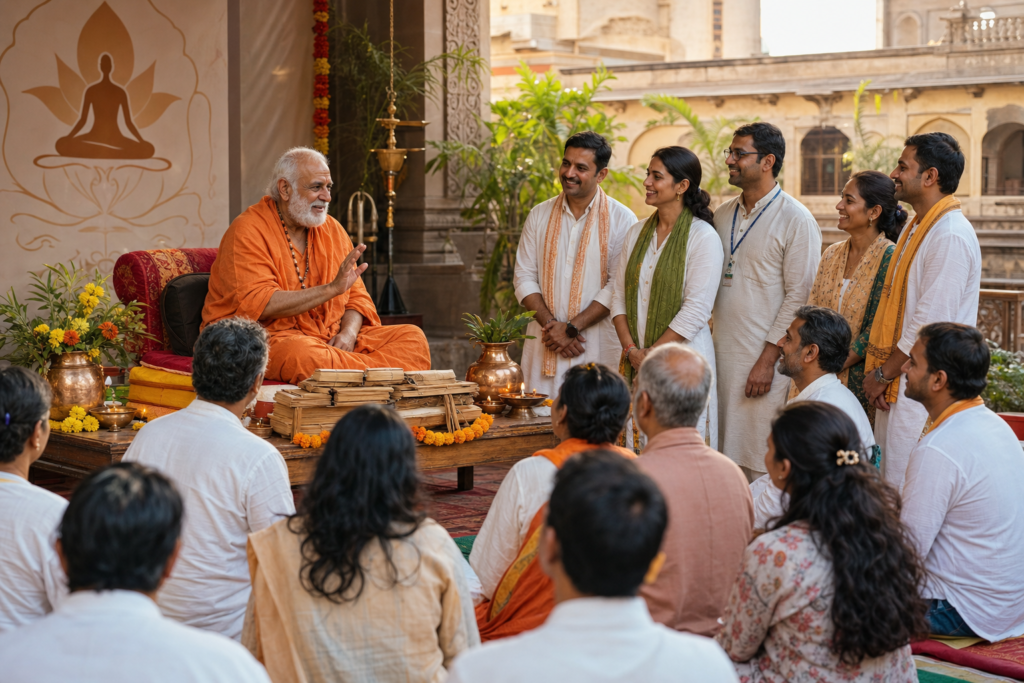
Dharma also protects diversity of spiritual practice. Hindu traditions alone include devotion, knowledge, meditation, ritual, service, mantra, temple worship, philosophical inquiry, renunciation, household life, and many forms of sacred art. The broader Dharmic family includes monastic discipline, lay ethics, community service, non-violence, contemplation, and remembrance of the Divine. This diversity is not weakness. It reflects a deep understanding that human beings differ in temperament, capacity, culture, and stage of growth.
An integrated life therefore does not require uniformity. It requires harmony. Just as a musical composition contains distinct notes ordered by rhythm and purpose, Dharmic life allows distinct roles, paths, and practices to participate in a wider moral order. The danger lies not in difference, but in egoistic separation. Dharma turns plurality into cooperation by grounding it in shared ethical and spiritual commitments.
The relevance of Dharma is not confined to temples, monasteries, scriptures, or rituals. It belongs in classrooms, courts, homes, workplaces, markets, public institutions, digital spaces, and ecological policy. If Dharma is understood only as ceremony, its transformative power is diminished. Ceremony has meaning when it trains remembrance, gratitude, humility, and self-offering. Without these, ritual becomes form without inner substance.
For individuals, the practical beginning is modest but serious. One may start by speaking truth with kindness, earning honestly, reducing unnecessary consumption, honoring commitments, practicing daily reflection, studying wisdom texts, serving without expectation, and correcting oneself without despair. These practices may appear simple, yet they slowly reorganize the character. Dharma is not achieved in a single dramatic gesture; it is cultivated through repeated alignment.
For society, the Dharmic task is to build institutions that sustain both justice and inner growth. Education should develop character along with competence. Governance should protect order without crushing dignity. Economics should reward enterprise without normalizing exploitation. Religious communities should preserve tradition while deepening mutual respect. Cultural life should transmit memory without hatred and reform without self-contempt.
The phrase that Dharma holds the key to an integrated life is therefore not a poetic exaggeration. It is a philosophical claim with ethical, psychological, social, and spiritual implications. Without Dharma, life becomes fragmented: desire fights conscience, knowledge serves pride, wealth feeds insecurity, and identity becomes conflict. With Dharma, the same forces can be redirected toward growth, service, wisdom, and liberation.
The enduring value of Dharma lies in its capacity to connect the finite with the infinite. It accepts that human beings live in time, body, society, and history, but it refuses to reduce them to these conditions. It teaches that one can work in the world while seeking the permanent, participate in society while cultivating inner freedom, and honor inherited wisdom while responding intelligently to new challenges.
Ultimately, Dharma is the art and science of rightful living. It is the discipline by which human life moves from malignity to excellence, from confusion to clarity, from selfishness to service, from restlessness to peace, and from mere survival to meaningful existence. An integrated life is not a life without struggle. It is a life in which struggle itself is guided by truth, strengthened by compassion, and oriented toward the highest realization.
Inspired by this post on Hindu Pad.



Leave a Reply
You must be logged in to post a comment.