
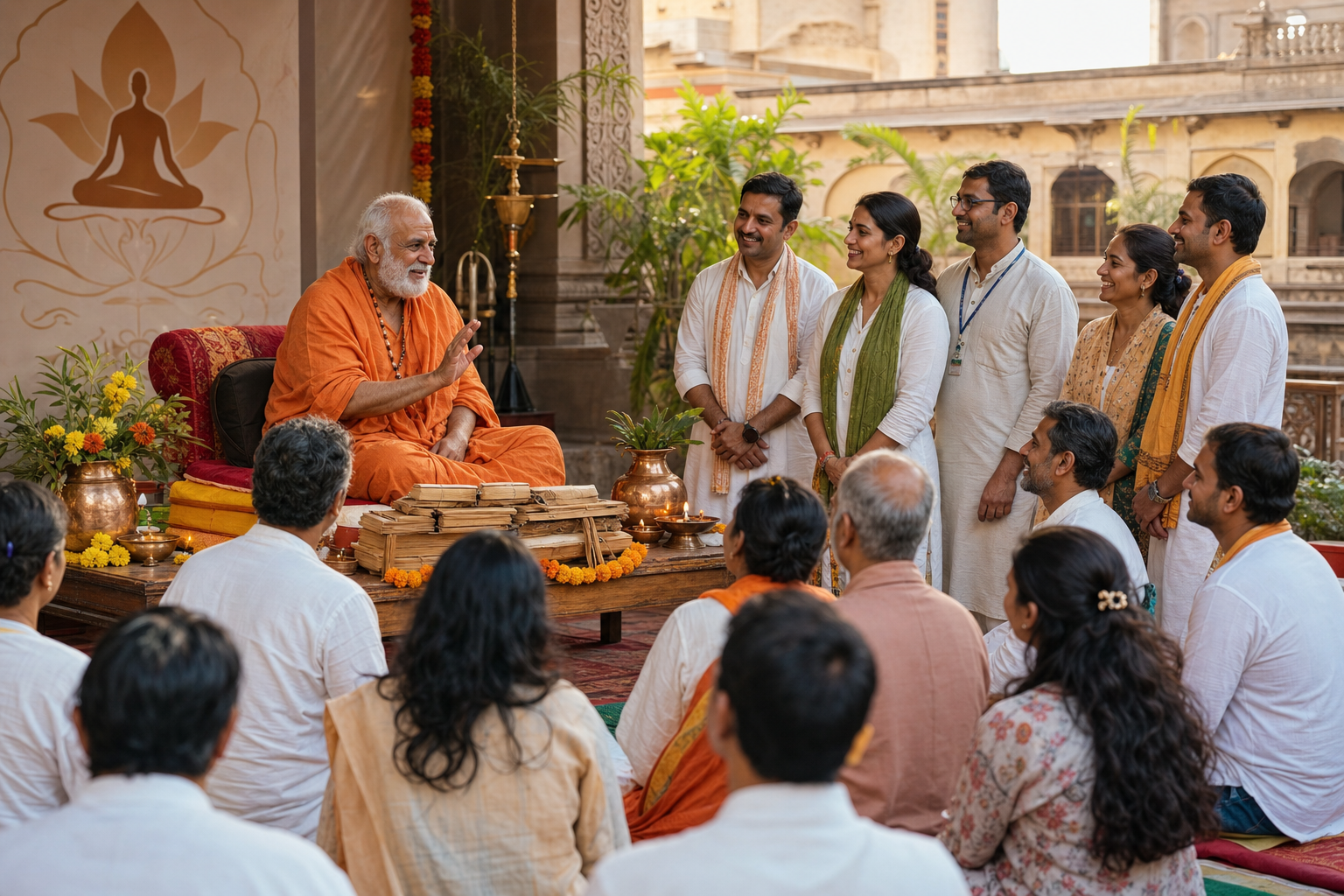
At the conclusion of the ‘Vedic Shashwat Chikitsa Shibir’ in Pune, Pujya Swami Bhakti Prakashji Maharaj publicly appreciated the work of the Hindu Janajagruti Samiti and affirmed support for its future activities connected with Sanatan Dharma. The statement is significant not merely as a ceremonial expression of goodwill, but as an indicator of how spiritual leaders, community organizations, and local participants continue to engage with questions of dharma, cultural continuity, and social responsibility in contemporary India.
The Pune gathering, centered around the idea of Vedic and traditional approaches to healing, offered a setting where spiritual practice, community education, and cultural awareness could converge. A shibir of this kind is not only a camp in the ordinary organizational sense; in the broader Indic context, it functions as a space of discipline, learning, reflection, and shared purpose. The term ‘Vedic Shashwat Chikitsa Shibir’ itself suggests a concern with enduring principles of well-being, where health is understood through a wider framework that includes the body, mind, conduct, environment, and spiritual orientation.
Pujya Swami Bhakti Prakashji Maharaj’s appreciation of the Hindu Janajagruti Samiti’s efforts reflects the continuing relevance of organized dharmic work in public life. Sanatan Dharma has historically been sustained not through one centralized institution, but through a living network of gurus, mathas, temples, families, local traditions, scriptures, festivals, pilgrimage circuits, and voluntary community initiatives. In that framework, organizations that focus on awareness, preservation, and social mobilization often operate as bridges between inherited wisdom and present-day civic challenges.
The phrase “protection of Sanatan Dharma” is best understood in a broad and constructive sense. It includes the preservation of Hindu heritage, the safeguarding of sacred traditions, the responsible transmission of scriptural knowledge, the encouragement of ethical conduct, and the strengthening of community confidence. It need not be read as a narrow or exclusionary project. For a society shaped by multiple dharmic traditions, including Hinduism, Buddhism, Jainism, and Sikhism, such protection is most meaningful when it upholds dignity, mutual respect, and the shared civilizational values of dharma, seva, self-discipline, compassion, and truthfulness.
In many Hindu communities, the role of a saint or spiritual guide is not limited to ritual instruction. Spiritual leadership often includes moral education, public counsel, encouragement of social service, and the ability to bring people together around a higher purpose. Pujya Swami Bhakti Prakashji Maharaj’s assurance of support for future activities can therefore be read as a gesture of continuity. It signals that the work of dharmic awareness is not an isolated event, but part of a longer process that requires cooperation, patience, and disciplined follow-through.
The location of the event, Pune, also carries cultural resonance. Maharashtra has long been associated with saint traditions, public religious discourse, social reform, kirtan movements, temple-centered community life, and intellectual engagement with dharma. From the bhakti movements of the region to the continuing presence of educational and spiritual institutions, Pune and its surrounding cultural landscape have often served as meeting grounds for scholarship, devotion, and organized public activity. In such a setting, appreciation for work related to Sanatan Dharma naturally connects with a larger regional memory of community awakening.
The Hindu Janajagruti Samiti, often identified by the abbreviation HJS, is known in public discourse for initiatives connected with Hindu awareness, cultural advocacy, and the defense of religious traditions. In evaluating such work academically, it is useful to distinguish between the emotional vocabulary of devotion and the sociological reality of organized community action. Religious communities survive across generations when they have institutions capable of education, communication, documentation, and mobilization. Praise from a spiritual leader therefore becomes more than a personal compliment; it recognizes the institutional labor required to keep tradition socially alive.
The theme of Vedic healing also invites deeper reflection. Traditional Indian approaches to health have rarely treated human life as a purely mechanical arrangement of symptoms and interventions. Ayurveda, yoga, mantra, ritual discipline, diet, daily routine, seasonal awareness, and ethical living have all been understood as parts of a larger vision of balance. While modern medical standards require careful evidence, clinical responsibility, and scientific scrutiny, the civilizational insight behind dharmic healing traditions remains important: human well-being is strengthened when physical care is integrated with mental clarity, emotional steadiness, social harmony, and spiritual meaning.
That broader understanding explains why a shibir dedicated to traditional healing can also become a platform for discussing Sanatan Dharma. Health, in dharmic thought, is connected with order. The Sanskritic idea of dharma does not simply mean religion in the narrow modern sense; it includes that which sustains, harmonizes, and gives coherence to life. A community that studies its healing systems, preserves its sacred knowledge, and respects its teachers is also participating in dharma at a collective level.
The emotional force of such gatherings often lies in their ability to make inherited traditions feel present and usable. Many participants in dharmic events do not experience them merely as lectures or formal programs. They encounter them as reminders of family practices, ancestral memory, temple experiences, devotional songs, sacred names, and the quiet disciplines learned from elders. This human dimension matters. Cultural preservation succeeds when people feel that tradition is not a museum object, but a living resource that speaks to daily anxieties, ethical dilemmas, health concerns, and the search for meaning.
At the same time, responsible dharmic work must remain intellectually clear and socially constructive. Sanatan Dharma has always contained plurality: multiple sampradayas, diverse deities, varied modes of worship, philosophical debate, renunciate and householder paths, temple traditions, yoga lineages, and devotional communities. Its strength lies not in uniformity, but in a disciplined capacity to hold diversity within a larger ethical and metaphysical framework. Any effort to protect Hindu Dharma is strongest when it preserves this inner plurality and remains respectful toward the wider family of dharmic traditions.
This is particularly important in the contemporary public sphere, where religious identity can easily become reduced to slogans, political reactions, or fragmented online debates. The Pune event points toward a more grounded model: learning in person, listening to spiritual guidance, connecting health with discipline, and building cooperation between saints and organizations. Such work may appear modest compared with large public campaigns, but community continuity often depends on exactly these recurring local efforts.
Pujya Swami Bhakti Prakashji Maharaj’s assurance of support also highlights a key principle of dharmic organizational life: authority and service must remain connected. Spiritual endorsement carries weight only when it encourages constructive action, humility, and accountability. Similarly, organizational activism becomes deeper when it remains guided by dharmic ethics rather than mere reaction. The relationship between spiritual leadership and community activity is therefore most valuable when both sides strengthen one another in the service of society.
For readers concerned with Hindu heritage, the episode offers a concise but meaningful lesson. Protecting Sanatan Dharma does not depend only on grand declarations. It also depends on camps, discussions, teaching forums, health initiatives, temple participation, youth education, family-level practice, and respectful cooperation among dharmic communities. The conclusion of the ‘Vedic Shashwat Chikitsa Shibir’ in Pune becomes significant because it represents this quieter architecture of cultural continuity.
In the final assessment, the praise offered by Pujya Swami Bhakti Prakashji Maharaj to the Hindu Janajagruti Samiti marks a moment of recognition for ongoing work connected with Sanatan Dharma. It affirms the value of organized cultural awareness, the relevance of Vedic and traditional frameworks of well-being, and the need for future collaboration. When approached with clarity, humility, and respect for the full diversity of dharmic life, such efforts can contribute to a more confident, educated, and united society.
Inspired by this post on Hindu Jagruti Samiti.
