

Fear becomes overwhelming when the mind begins to treat every possibility as a threat. Fear of failure, fear of the future, fear of death, fear of flying, fear of rejection, and fear of everyday uncertainty may appear as separate problems, yet they often arise from the same inner mechanism: the nervous system anticipates danger, the mind builds stories around that anticipation, and the body reacts as if those stories are already true.
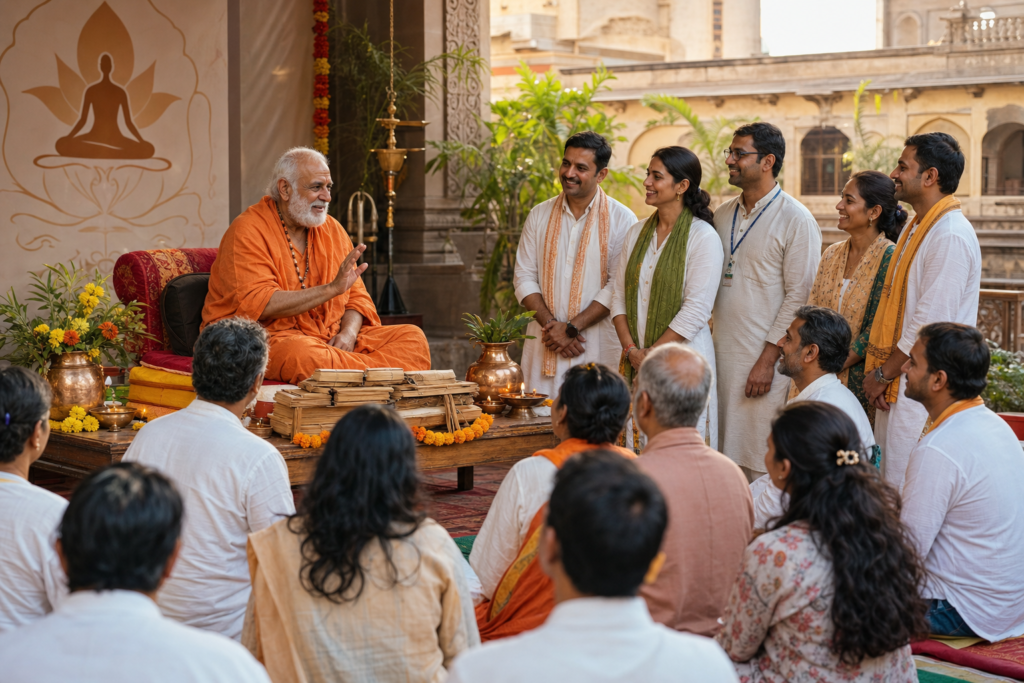
In a satsang associated with Sri Sri Ravishankar Guruji, the Founder of Art of Living, a devotee expressed this condition in direct and vulnerable language: everything felt scary. The question was not merely about one phobia or one passing worry. It was the deeper human question of how to live when fear seems to occupy the whole field of awareness.
A dharmic response to fear does not begin by shaming the frightened person. Hinduism, Buddhism, Jainism, and Sikhism all recognize that human beings struggle with attachment, uncertainty, loss, bodily vulnerability, and the restless movement of thought. Fear is not a moral defect. It is a signal, a samskara-shaped pattern, a bodily reaction, and often a doorway into deeper self-understanding.
Modern psychology describes fear as a protective response involving the brain, breath, muscles, hormones, memory, and attention. When the amygdala detects danger, the body may enter fight, flight, freeze, or appease responses. Heart rate rises, breathing becomes shallow, digestion slows, and attention narrows. This reaction is useful when danger is immediate, but it becomes painful when the same alarm is triggered by imagined failure, future uncertainty, social judgment, or thoughts about death.
Yogic traditions observed the same connection through a different vocabulary. The mind, breath, and prana are deeply linked. When fear is present, the breath becomes irregular; when the breath is steadied, the mind receives a different message. This is why breath awareness, pranayama, meditation techniques, and mindful living are central to many dharmic methods of stress management and inner peace.
Sri Sri Ravi Shankar has often emphasized the relation between emotion and breathing patterns. The practical insight is simple but powerful: every emotional state has a corresponding rhythm of breath, and conscious breathing can help shift the nervous system toward calmness. Slow, rhythmic breathing, especially with relaxed and slightly lengthened exhalation, can reduce physiological arousal and create space between stimulus and reaction.
This does not mean that one breath instantly solves every fear. It means the breath is an accessible first instrument. A person who is afraid of failure cannot always control the examination, interview, business outcome, or public response. A person who fears the future cannot control every event that may arrive. A person who fears death cannot abolish mortality by argument. But the person can begin by regulating the body, observing the mind, and acting from dharma rather than panic.
The fear of failure is often a fear of identity collapse. The mind says, “If this attempt fails, then the person has failed.” Dharmic philosophy challenges this confusion. Action and outcome are not identical. The Bhagavad Gita teaches disciplined action without obsessive attachment to the fruit of action. This does not produce passivity; it produces steadiness. The student studies, the worker prepares, the parent acts responsibly, the seeker practices sincerely, but the self is not reduced to a single result.
Fear of the future is usually the mind’s attempt to control time through worry. Worry gives an illusion of preparation while often draining the very energy required for wise preparation. A more mature approach separates practical planning from repetitive anxiety. Planning asks, “What can be done today?” Anxiety repeats, “What if everything goes wrong?” The first is intelligent; the second becomes suffering when it is left unexamined.
Fear of death is more existential. It cannot be answered only through positive thinking. The dharmic traditions treat death as a profound subject for contemplation, not as a taboo. Hindu thought speaks of atman, karma, and moksha. Buddhist thought emphasizes impermanence and the release of clinging. Jain philosophy teaches disciplined awareness of the soul’s journey and the consequences of action. Sikh teachings remind the devotee to remember the Divine, live truthfully, and serve without ego. These traditions differ in metaphysics, yet they converge in one practical instruction: life becomes clearer when mortality is faced with wisdom rather than denial.
Fear of flying, fear of illness, fear of public spaces, and fear of specific situations may also involve conditioned responses. The body remembers discomfort and anticipates repetition. In such cases, spiritual practice can support healing, but it should not be used to avoid appropriate professional care. Persistent panic attacks, severe phobias, trauma symptoms, or inability to function in daily life deserve qualified mental health support. Dharma and responsible healthcare are not enemies; both can serve well-being.
A practical path begins with naming the fear accurately. “I am afraid of everything” expresses real distress, but it is too broad for skillful action. The mind must be gently trained to become specific. Is the fear bodily, such as breathlessness or trembling? Is it social, such as embarrassment or rejection? Is it moral, such as guilt? Is it existential, such as death or meaninglessness? Is it practical, such as money, health, or family security? Specific naming reduces the fog around fear.
The next step is observing the body before arguing with the mind. Fear lives first in sensation: tight chest, shallow breath, clenched jaw, cold hands, restlessness, nausea, heaviness, or racing thoughts. A person can sit upright, relax the shoulders, soften the face, and breathe slowly through the nose. The aim is not dramatic spiritual performance. The aim is to teach the nervous system that awareness is present and immediate danger is not always present.
A simple breath practice may be used for daily regulation. Inhale gently for a comfortable count, pause briefly without strain, and exhale slightly longer than the inhalation. Repeat for a few minutes. If counting increases anxiety, the count can be dropped and attention can rest on the natural movement of the breath. The exhalation should never be forced. Breath awareness is effective when it is steady, kind, and sustainable.
In yogic language, such practice supports prana and steadies the mind. In physiological language, it may activate parasympathetic pathways and reduce arousal. In lived experience, it creates a small but decisive gap. That gap allows the person to say, “Fear is present, but fear is not the whole truth.” This distinction is one of the foundations of inner freedom.
Meditation deepens this gap. The purpose of meditation is not to forcibly empty the mind. It is to observe thoughts without immediately becoming their servant. A fearful thought may arise: “I will fail.” Another thought may arise: “Something terrible will happen.” Meditation permits the thought to be seen as a mental event, not as a commandment. This is close to the Buddhist emphasis on mindfulness and the yogic emphasis on witnessing consciousness.
Jain teachings on self-discipline and non-attachment add another useful dimension. Fear often grows when desire and aversion become extreme. The more the mind insists that life must unfold only in one acceptable way, the more fragile it becomes. Aparigraha, or non-possessiveness, is not indifference. It is the cultivation of inner space, so that possessions, status, praise, plans, and outcomes do not dominate consciousness.
Sikh tradition contributes the courage of remembrance and seva. Fear shrinks when life is lived only around self-protection. Service expands the field of identity. When a person helps another human being, participates in community, speaks truthfully, or performs honest work, the mind receives evidence that life is larger than private anxiety. Courage is strengthened by meaningful action.
For many people, fear intensifies because attention is consumed by imagined futures. A useful discipline is to bring the mind back to the next right action. If the fear is failure, the next action may be one hour of study, one honest conversation, one revision, or one application. If the fear is health, the next action may be a medical appointment, exercise, sleep, or a healthier meal. If the fear is death, the next action may be prayer, reflection, forgiveness, or time with loved ones. Fear becomes less absolute when translated into dharmic action.
It is also important to examine the role of imagination. The human mind can rehearse catastrophe with extraordinary detail. This ability is useful for risk assessment, but harmful when it becomes compulsive. A balanced method asks three questions: What is the evidence? What is within control? What value should guide the response? These questions shift attention from panic to discernment, from tamas to clarity, and from helplessness to responsible effort.
Dharmic courage is not the absence of fear. It is the capacity to act wisely while fear is present. Arjuna trembles before battle in the Bhagavad Gita. His crisis is emotional, ethical, relational, and spiritual. The teaching he receives does not mock his fear. It expands his understanding of self, duty, action, impermanence, and Divine presence. This remains one of the most profound models for transforming paralysis into clarity.
Fear must also be distinguished from caution. Caution protects life. Fear, when distorted, imprisons life. It is wise to prepare before flying, to learn safety procedures, to seek medical advice when symptoms appear, and to plan responsibly for the future. It is not wise to let the imagination punish the body every day for events that have not occurred. The goal is not recklessness, but proportion.
Community plays a significant role in reducing fear. Satsang, sangat, sangha, and disciplined fellowship are not merely social gatherings. They place the individual mind in a wider field of wisdom, remembrance, accountability, and shared practice. Isolation often makes fear louder. A healthy spiritual community can normalize struggle while encouraging responsibility, compassion, and steady practice.
At the same time, no community should encourage dependency or denial. True spiritual guidance strengthens self-awareness, ethical living, and inner steadiness. It does not require a person to pretend that fear has disappeared. It helps the person meet fear with breath, inquiry, prayer, service, wisdom, and disciplined action.
A daily anti-fear routine can be simple. Begin the morning with a few minutes of breath awareness. Read or recite a short passage from a trusted dharmic text. Identify the day’s most important duty. Reduce unnecessary stimulation from news, arguments, and digital comparison. Move the body. Serve someone in a small way. In the evening, reflect without harsh self-judgment: Where did fear lead the mind today, and where did awareness return?
Journaling can support this process. The page can hold fears that otherwise circulate endlessly in the mind. A useful format is direct: “The fear is…” “The body feels…” “The actual evidence is…” “The next dharmic action is…” “The deeper value is…” This converts vague anxiety into visible material for reflection. Once visible, fear becomes more workable.
Prayer and mantra can also be meaningful, especially when fear is linked to helplessness. Repetition of a sacred name, remembrance of Guru, contemplation of the Divine, or silent japa can stabilize attention. The psychological effect is concentration; the spiritual effect is surrender. Surrender, in this context, does not mean defeat. It means releasing the false belief that the individual ego must control the whole universe.
Fear of death deserves special compassion. Many people carry this fear silently because it feels too heavy to discuss. Dharmic wisdom encourages a more honest relationship with impermanence. Awareness of death can make life more ethical, more tender, and more purposeful. It can reduce arrogance, soften conflict, and awaken gratitude. The question changes from “How can death be avoided forever?” to “How should life be lived while this human birth is available?”
In the language of yoga, fear is weakened by abhyasa and vairagya: steady practice and non-attachment. In the language of Buddhism, fear is softened by mindfulness and insight into impermanence. In Jain thought, fear is refined through self-restraint, non-violence, and purification of karma. In Sikh tradition, fear is transformed through remembrance, truthful living, courage, and seva. These are not identical systems, yet together they form a wide dharmic landscape of inner strength.
The person who says “I have fear for everything” is not beyond help. That sentence may be the beginning of healing because it shows awareness and a willingness to seek guidance. The path forward is gradual: regulate the breath, name the fear, observe the body, question catastrophic thinking, act according to dharma, seek community, serve others, contemplate impermanence, and use professional support when fear becomes disabling.
Fear loses authority when it is met repeatedly with awareness. It may still arise, but it no longer defines the whole person. The future remains uncertain, failure remains possible, death remains real, and life remains unpredictable. Yet the human being can become steadier. Through breath, meditation, self-discipline, wisdom, and compassionate action, fear can become not a prison, but a teacher pointing toward inner freedom.
Inspired by this post on Hindu Pad.










Leave a Reply
You must be logged in to post a comment.