
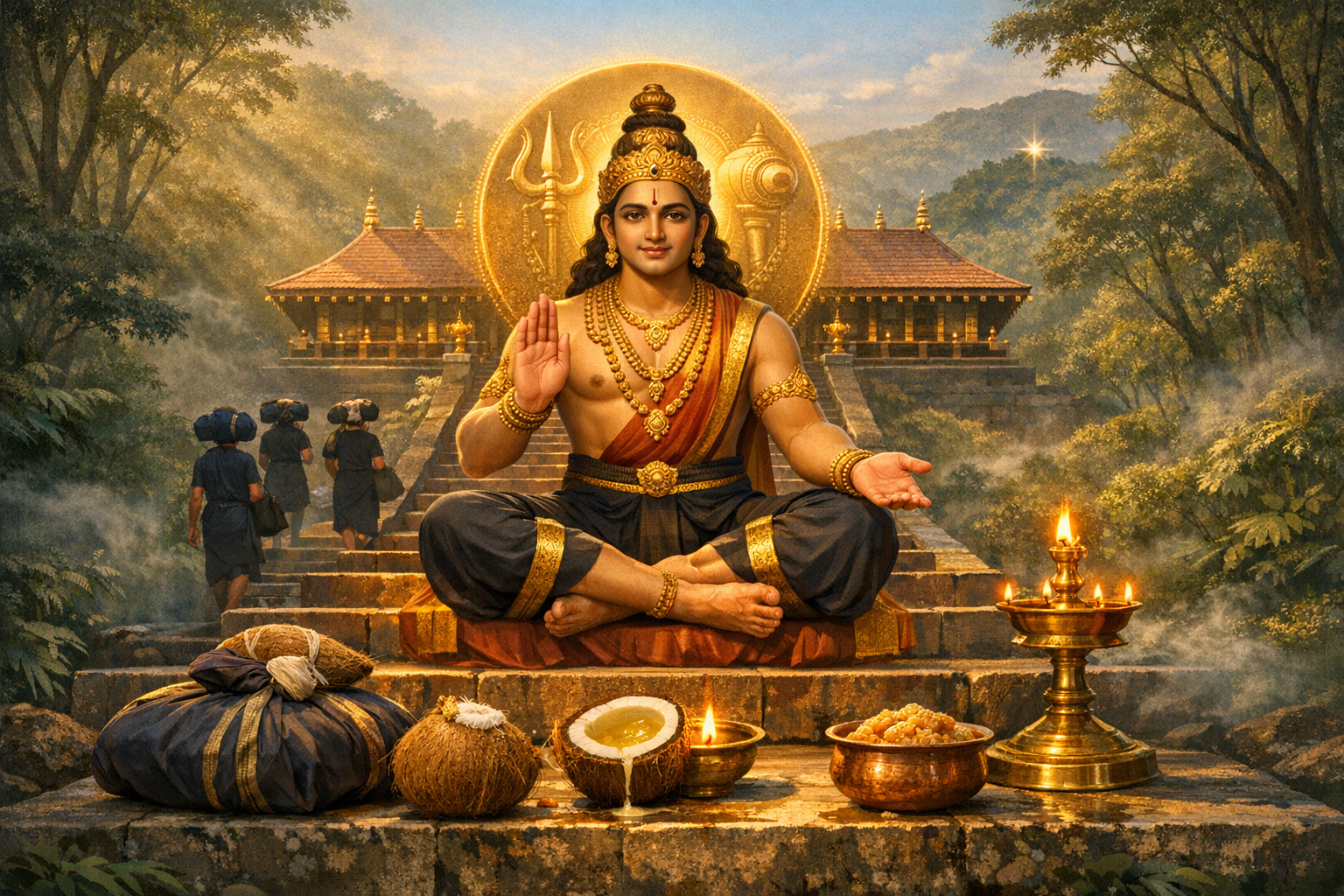
Indilayappan is a cherished regional epithet of Ayyappa that foregrounds compassion and relief from hardship. In Kerala’s sacred geography and across South India, Ayyappa—also revered as Sastha or Dharma Sastha—embodies a rare theological synthesis as Hariharaputra, born of Shiva and Vishnu (in the Mohini avatara). Under the name Indilayappan, this living tradition highlights Ayyappa’s role as the remover of distress (sankata-nivārana) and the bestower of courage (abhaya), a resonance that has made his worship central to Kerala’s ritual life and to the Sabarimala pilgrimage.
While the precise philology of “Indilayappan” is locally inflected, its devotional meaning in practice is clear: a compassionate guardian who dissolves the weight of anxiety and restores inner balance. This devotional semantics is anchored in the title Dharma Sastha, a name that situates Ayyappa within the broader dharmic vision—guiding seekers toward ethical clarity, steadfastness, and collective well-being.
The theological profile of Ayyappa unites Śaiva and Vaiṣṇava currents without erasing their distinctiveness. As Hariharaputra, Ayyappa holds a mediating place in South Indian temple culture, reaffirming that dharma is capacious enough to host multiple modes of realization. This inclusivity is reflected in household shrines, village temples, and the grand institution of Sabarimala, where the shared chant “Swamiye Saranam Ayyappa” aligns community devotion across social and linguistic boundaries.
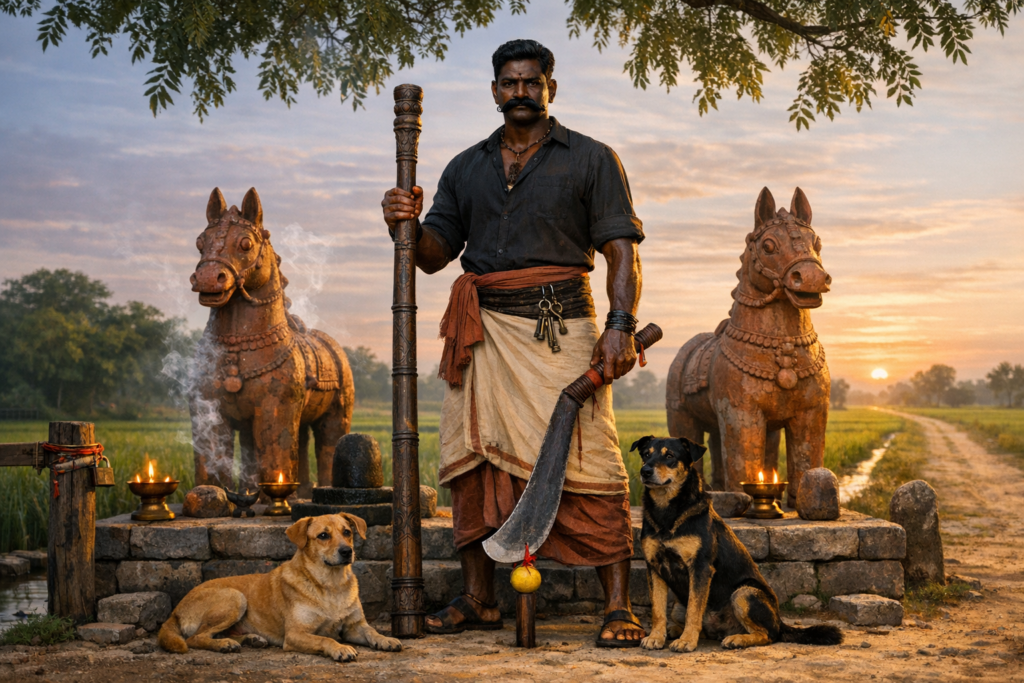
Historically, Sastha appears in Purāṇic literature and epigraphic references across the Tamil–Kerala region, with scholarly work often noting continuities with village-protective deities such as Ayyanar. Over centuries, these strands converged in Kerala’s ritual systems, shaping the distinctive figure of Ayyappa as both yogic ascetic and compassionate protector. The consolidation of this tradition at Sabarimala likely matured through the medieval period, integrating local cults, royal patronage, and evolving liturgical practices into a coherent, pan-regional pilgrimage.
In iconography, Ayyappa at Sabarimala is typically depicted in a yogic posture with the yogapaṭṭa (knee-band), communicating interior discipline (niyama) complemented by the outward mudrās of fearlessness (abhaya) and generosity (varada). The image encodes a profound synthesis: firmness without harshness, compassion without sentimentality. As Indilayappan, the emphasis falls on the deity’s readiness to receive the devotee’s burden and transform it into resilience.
The Sabarimala pilgrimage operationalizes this theology through a demanding yet egalitarian discipline. Observance of the 41-day vratham calls for simplicity in attire (often black or blue), brahmacharya, vegetarian diet, daily japa of “Swamiye Saranam Ayyappa,” and mindful conduct. By dissolving markers of rank—profession, caste, wealth—this code creates a field of relational equality in which each pilgrim stands as a seeker under dharma.
Ritual technologies deepen this shared field. The Irumudi Kettu—a twin-compartment bundle borne on the head—symbolizes both offerings and personal burdens entrusted to Indilayappan. The neyyabhishekam (abhisheka with ghee carried in a coconut) and the offering of Aravana Payasam intensify the devotee’s surrender and thanksgiving. Ascending the Pathinettam Padi (18 sacred steps) becomes a performative ascent from the constraints of ego to the space of dharma and refuge.
Communal rites such as Pettathullal at Erumely cultivate what anthropologists call communitas—an experiential solidarity that softens social boundaries. The nightly Harivarasanam hymn at Sannidhanam gathers these threads into a contemplative close, reinforcing the insight that relief from distress is not a momentary reprieve but a reordering of one’s inner life around courage, humility, and trust.
The epithet Indilayappan is especially meaningful in the psychology of devotion. The constant rhythm of “Swamiye Saranam Ayyappa” coordinates breath, attention, and reverence, which in turn steadies the mind. The pilgrimage architecture—extended vratham, embodied offerings, group discipline—functions as a sophisticated technology of transformation. By embedding ethical commitments into daily habit, it addresses distress at its roots: fractured attention, unexamined reactivity, and isolation.
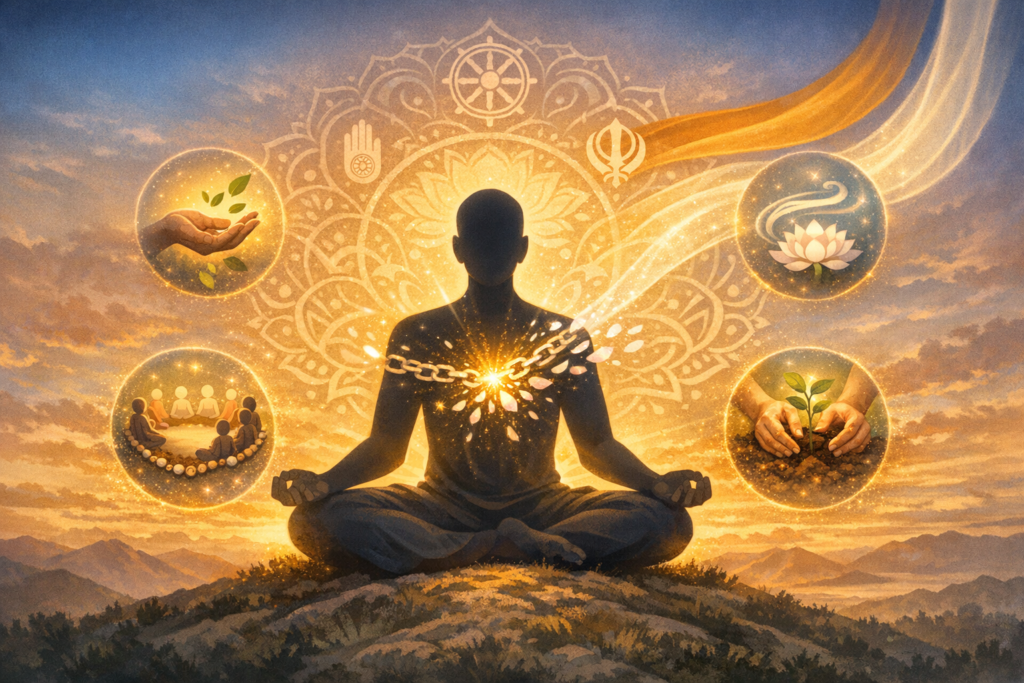
As Dharma Sastha, Ayyappa’s compassionate “governance” of the devotee’s life advances virtues shared across India’s dharmic family: dayā (compassion), ahiṁsā (non-violence), dāna (generosity), and seva (selfless service). The tradition’s emphasis on disciplined joy—rather than ascetic negation—parallels Buddhist karuṇā, Jain aparigraha (non-grasping), and Sikh seva infused with simran. Framed this way, Indilayappan becomes not only Kerala’s compassionate guardian but also a bridge concept that illuminates unity in spiritual diversity across Hinduism, Buddhism, Jainism, and Sikhism.
Seasonal culminations reinforce this integrative vision. On Makara Saṅkrānti, the sighting of the Makarajyoti and the ritual of Makaravilakku serve as luminous markers of renewal. For pilgrims, these events symbolize the passage from darkness to discernment; for communities, they reaffirm an ethics of mutual care, hospitality, and remembrance that extends far beyond the hill itself.
Household worship of Ayyappa as Indilayappan complements the yātra. Small sanctums maintain daily lamp-lighting, the recitation of names such as “Hariharaputra” and “Dharma Sastha,” and the simple offering of flowers or prasāda. Kerala’s cultural memory preserves this intimacy through lullabies, temple festivals, and storytelling, ensuring the living continuity of practice from grandparents to children—each generation learning how refuge in dharma reframes adversity as a path of growth.
Names and epithets communicate nuanced theological accents: “Sri Dharma Sastha” highlights ethical lordship; “Hariharaputra” affirms the reconciled energy of Śiva and Viṣṇu; “Manikanta” evokes beloved narrative motifs from the Pandalam lore; and “Indilayappan” consoles the heart directly, promising the lifting of burdens. Together, these names form a semantic ecology that instructs, consoles, and empowers.
Culturally, the Sabarimala pilgrimage is as much about social healing as it is about personal relief. Shared vows flatten hierarchies; the arduous climb generates mutual assistance; the concluding darśan strengthens the habit of gratitude. In an era of distraction and fragmentation, the Indilayappan dimension of Ayyappa worship offers a precise antidote: slow the pace, simplify conduct, bind the community through common discipline, and anchor aspiration in dharma.
Philosophically, this is consonant with the broader Indian articulation of Ishta—that each seeker may hold a chosen form or emphasis while honoring the legitimacy of other paths. Kerala’s Ayyappa tradition exemplifies this poise: the same pilgrimage can be experienced as yogic discipline, communal service, aesthetic devotion, or ethical renewal, without competition among these lenses. Such plurality nourishes unity, not division.
In sum, to understand Ayyappa as Indilayappan is to recognize a complete system of spiritual care. It integrates rigorous practice (vratham), embodied symbolism (Irumudi Kettu, neyyabhishekam), communal rites (Pettathullal, Harivarasanam), and luminous calendrical events (Makarajyoti, Makaravilakku). Above all, it affirms a dharmic economy of compassion: suffering is met not with despair but with shared strength, ethical clarity, and a steadfast return to refuge—“Swamiye Saranam Ayyappa.”
Inspired by this post on Hindu Blog.





Leave a Reply
You must be logged in to post a comment.